
Product listings give you a footprint, and the footprint is not the answer. The space an air fryer actually occupies is its base plus the clearance behind it, plus enough room in front for the door or basket to open, plus the vertical gap it needs under a cabinet.
That combined figure is what decides whether a machine fits, and it is not printed anywhere. Working it out takes five minutes and prevents the most common buying mistake in the category. Our note on choosing an air fryer covers the rest of the decision.
Quick Answer
Take the stated dimensions, add the manufacturer’s rear clearance, and allow for the door opening forward. Then measure your vertical gap from counter to cabinet, since that is what rules machines out most often.
Key Points
- Stated footprint excludes required clearance.
- Vertical gap under a cabinet is the constraint people forget.
- Basket units vent at the rear; oven styles often vent upward.
- Door swing on oven-style units needs room in front.
- Compact capacity does not always mean a compact footprint.
Typical Ranges
Small basket units
Roughly the footprint of a large kettle or a small coffee maker. These suit genuinely tight counters and hold correspondingly little, which is the trade rather than a flaw.
Mid-size basket units
The most common category, and consistently wider and deeper than people expect from product photos, as well as taller than a standard toaster.
Oven-style units
Similar footprint to a toaster oven and often deeper than one, with the added consideration of a door that opens forward into the room.
The pattern
Capacity and footprint correlate loosely rather than tightly. Some compact-capacity machines have a wide base, and some larger ones are surprisingly efficient in how they use the space they take.
The Vertical Gap Is the Real Constraint
Standard kitchens have a gap between counter and upper cabinets that many air fryers approach or exceed once clearance is added. That is where most buying mistakes happen, because people check the counter and not the height.
Measure from the counter surface to the underside of the cabinet, then subtract whatever clearance the manufacturer specifies for your intended model. What remains is the maximum machine height you can accommodate.
Oven-style units that vent upward need more of this gap than rear-venting basket units, so the same vertical space suits one and not the other. Our roundup of French door air fryer ovens covers the taller category.
Clearance Behind and In Front
Rear clearance is specified because most basket units exhaust backward, and a machine pushed flat to the wall restricts its own airflow. That figure adds directly to the depth you need.
Front space is about the door. Drawer-style baskets pull straight out, which needs less room than a hinged door swinging down, and French door designs open outward in two halves that each need somewhere to go.
Neither figure appears in the headline dimensions on a product page, which is why a machine that fits on paper can turn out to be impractical once it is actually on the counter.
What Mine Takes Up
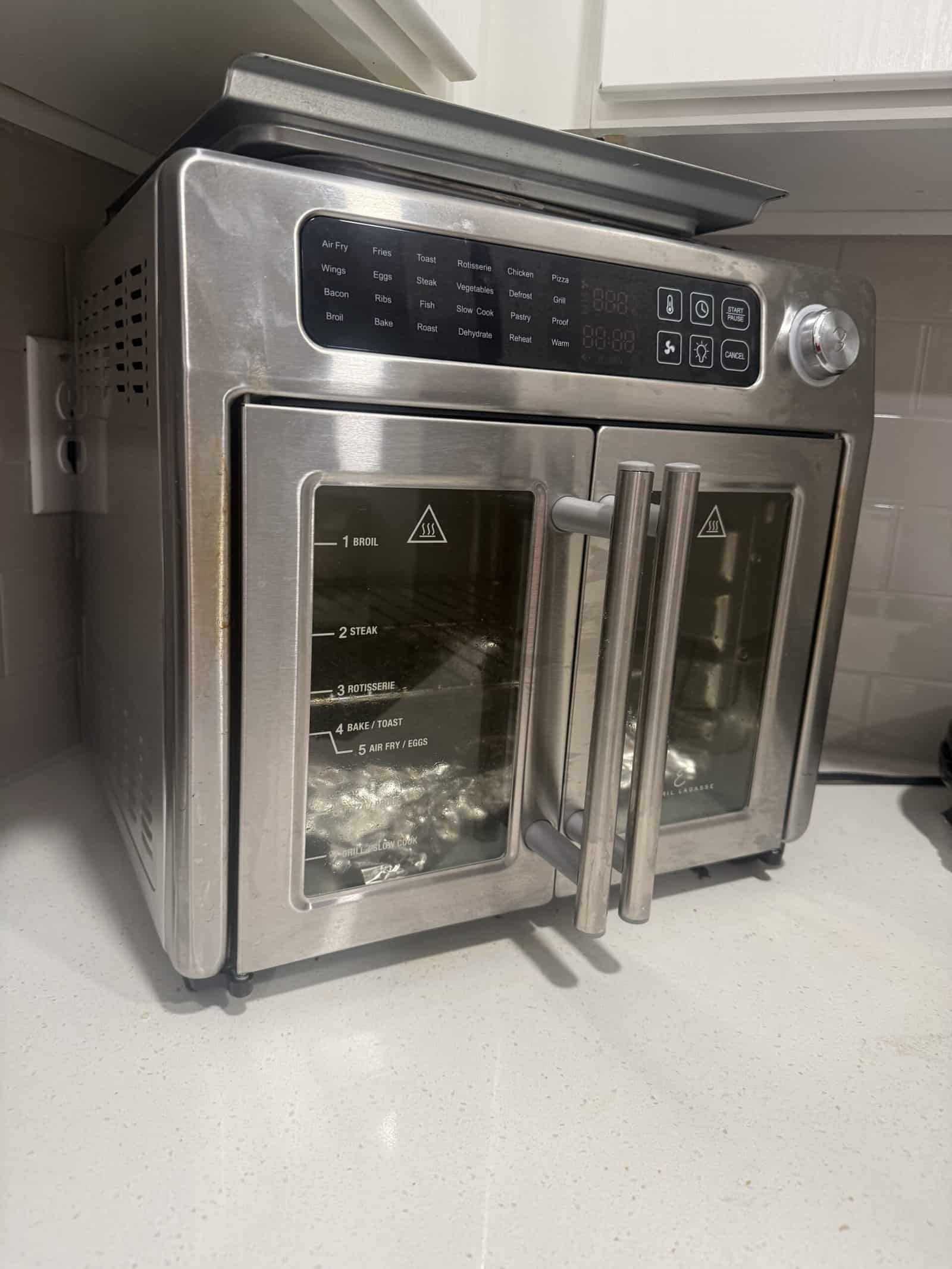
Mine is an Emeril Lagasse French Door oven, which is one of the larger machines in the category, and it sits permanently in a corner of the counter next to my indoor grill.
There is a cabinet directly above it and the venting has never been an issue. That is one machine in one kitchen rather than a general clearance rule, and it is the concern people raise most about putting an oven-style unit under a cabinet.
What I would say about the footprint is that it is substantial and I do not regret it. I cook on it nearly every day, and it replaces enough separate appliances that the space works harder than the number suggests. It is the one thing I would keep over anything else in the kitchen.
The corner placement is what makes it workable. That counter was awkward for prep anyway, so the machine took space I was not really using rather than the stretch between the sink and the stove.
Why Listings Understate It
Product dimensions describe the object, which is a reasonable thing for a listing to do and an incomplete answer to the question buyers are asking. Nobody wants to know how big the box is, they want to know whether it works in their kitchen.
Clearance figures live in the manual rather than on the product page, so they are invisible until the machine has arrived. That is the single biggest gap between what is advertised and what you need to know.
Photography compounds it. Product shots are taken on empty counters with nothing above, which is not a kitchen. A machine that looks modest against a white background can dominate a corner in a real room.
None of that is deceptive exactly, and it does mean the useful measurement is one you have to assemble yourself from two sources. Our roundup of air fryers covers the machines themselves.
Measuring Your Space Properly
Depth
Wall to counter edge, minus the rear clearance your model needs. This is your usable depth.
Height
Counter to cabinet underside, minus top clearance. This rules out more machines than any other measurement.
Width
The stretch you are genuinely willing to give up. In a corner, remember the adjacent run eats into usable width.
Front projection
How far the door or basket extends when open, and whether anything blocks it. Our note on organizing a small kitchen covers finding the space.
Does a Bigger Machine Cost You More Space?
Less than the capacity difference implies. Going from a small basket unit to a mid-size one adds a modest amount to the footprint while adding considerably more usable capacity, because the walls, insulation, and controls take a fixed amount regardless of size.
The step up to an oven-style unit is a bigger jump, and it is also the point where the machine starts replacing other appliances. A unit that handles baking and toasting alongside air frying can free up the space a separate toaster oven was using.
That is the calculation worth doing rather than minimizing footprint in isolation. Our roundup of countertop appliances worth the space covers the comparison.
Common Space Mistakes
Checking the footprint but not the height
Vertical gap under a cabinet is what actually rules machines out, and it is the measurement people skip.
Ignoring rear clearance
Pushing a rear-venting unit against the wall restricts its airflow, and the specified gap adds to the depth you need.
Forgetting the door swing
An oven-style door opening forward needs room, particularly opposite an island or in a galley kitchen.
Buying small when a bigger one would replace two appliances
A compact unit that sits alongside a toaster oven may use more total counter than one machine doing both. Our comparison of air fryers and toaster ovens covers that overlap.
Air Fryer Counter Space FAQ
How much counter space do I actually need?
The stated footprint plus the manufacturer’s rear clearance, with room in front for the door or basket to open. That combined figure is not printed anywhere and is what determines whether a machine works in place.
What is the most common sizing mistake?
Checking counter depth and forgetting the vertical gap. Many machines approach or exceed the standard space between counter and upper cabinets once required clearance is added.
Do compact air fryers have a small footprint?
Not always. Capacity and footprint correlate loosely, and some small-capacity machines have a wide base while some larger ones use their space efficiently. Compare stated dimensions rather than quarts.
How much clearance is needed behind?
Manufacturers specify it and it differs by model and venting design. Rear-venting basket units need meaningful space behind them, and that figure adds directly to the depth your counter must provide.
Do oven-style units need more space?
Generally yes, in footprint, height, and front projection for the door. They also tend to replace more separate appliances, so the total counter used across your kitchen can come out lower.
Can I put one in a corner?
Corners are usually the best use of limited counter, since they are awkward for prep and fine for something stationary. Remember the adjacent run reduces the usable width in a corner.
What if it barely fits under the cabinet?
Marginal clearance is not the same as meeting the specification, and heat and steam over time can affect cabinet finishes. Either choose a shorter machine or place it somewhere without a cabinet above.
Should I measure before or after buying?
Before, always. Five minutes with a tape measure against the stated dimensions and clearance figures prevents the most common and most annoying mistake in this category.
For the wider picture, see our guide to air fryer vs oven.
