
Disclosure: SmartLifeItems is reader-supported. As an Amazon Associate, we earn from qualifying purchases made through links on this page, at no extra cost to you.
The Tool That Changes Prep Time, If You Survive the Learning Curve
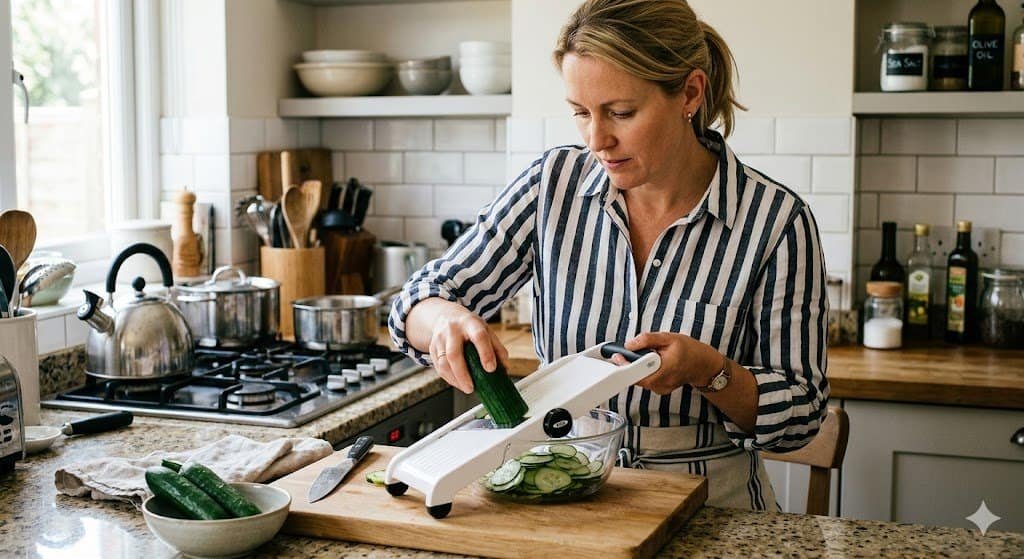
The mandoline slicer has a reputation that precedes it in two contradictory directions: professional chefs who cannot imagine prep work without one, and home cooks who bought one, sliced through a fingertip on the second use, and never opened the box again. Both reputations are accurate. A mandoline used correctly produces uniform slices at speeds that no knife technique can match, a full potato sliced paper-thin in under 30 seconds, an entire cucumber julienned in under a minute. A mandoline used without the cut-resistant glove or food holder produces injuries that require a visit to urgent care.
The safety equipment is not optional. This is the one kitchen tool where the accessory should be purchased simultaneously with the tool, not as an afterthought. A cut-resistant Kevlar glove, not the thin fabric gloves included with budget mandolines, costs $10 to $20 and is the difference between efficient prep and a laceration. Every mandoline recommendation on this list should be purchased with the understanding that the glove is part of the purchase, not an upgrade.
The reason to own a mandoline despite the learning curve is specific: uniform slice thickness at high volume produces results that knife work cannot replicate in a reasonable time. Potato gratin with layers of identical 2mm slices cooks evenly from edge to center. Cucumber salad with consistent paper-thin rounds absorbs dressing uniformly. Fennel shaved to translucence loses the fibrous quality that thicker cuts retain. These results are achievable without a mandoline, only with exceptional knife skills and significant time investment. Our guide to the best knife sets under $100 covers the blade foundation that pairs with a mandoline for complete prep capability.
What to Look For in Mandoline Slicers
Blade adjustment mechanism determines how precisely and securely you can set the slice thickness. Dial-adjustment systems offer continuous thickness selection but can drift during use, the dial loosens with vibration from repeated slicing, producing slices that thicken progressively through a session. Platform-based adjustment systems with discrete click positions are more secure, the thickness locks into position and stays consistent through the full slicing session. For precision cooking where 2mm versus 3mm matters, potato gratin, vegetable chips, ceviche, click-position adjustment is worth seeking.
Mandoline width determines what you can slice. A 4-inch wide slicing platform handles most fruits and vegetables up to medium-large size. A 5.5-inch platform handles larger items, including full-size beets, large sweet potatoes, and wide squash, without requiring them to be halved first. If you regularly work with large produce, the wider platform eliminates a prep step.
Food holder design is the safety specification. A food holder that grips the produce firmly, positions your hand safely above the blade, and maintains control through the final slices, when the produce is small and the distance from blade to hand is minimized, is the feature that actually determines whether the mandoline is used regularly or abandoned after one injury. Food holders that lose grip on the last inch of produce are where most mandoline injuries occur.
Stability during use prevents the single most dangerous scenario, a mandoline that shifts position during a fast slicing pass. Non-slip feet, suction cup bases, and foldable legs that stabilize the mandoline at an angle all address the stability requirement from different engineering approaches. Test stability before committing to speed, fast slicing on an unstable mandoline is the precise situation that produces serious injury.
Required purchase alongside any mandoline: cut-resistant gloves. Not the fabric gloves included with the mandoline. Dedicated cut-resistant Kevlar kitchen gloves rated ANSI A4 or higher provide the protection that mandoline use specifically requires. Budget $15 to $20 for these alongside the mandoline purchase.
Best Mandoline Slicers in 2026: Our Top 5 Picks
1. Benriner Japanese Mandoline Slicer, Best Overall
Best Overall | Price: ~$35
Benriner is the Japanese manufacturer that professional kitchen prep cooks have used for decades, a mandoline that costs less than a restaurant lunch while delivering the blade sharpness and adjustment precision that professional contexts require. The stainless steel blade is sharper than any plastic-body mandoline at twice the price, Japanese blade manufacturing applies tolerances to mandoline blades that Western manufacturers apply only to knife edges. The simple dial adjustment is not the most secure mechanism on this list, but the blade sharpness compensates, a sharper blade requires less force per slice, which means less vibration that would drift the dial setting.
Benriner, Japanese Blade Sharpness That Requires Less Force and Produces Cleaner Cuts
The 4.5-inch width handles most common produce effectively. The minimal design, no complex folding legs, no elaborate food holders, requires slightly more attention to stability than enclosed-frame alternatives but produces slices with fewer plastic contact surfaces that trap food particles. At approximately $35, the Benriner is the most cost-effective professional-quality mandoline available and the choice of experienced cooks who prioritize blade quality over plastic feature complexity.
Learning curve: The Benriner requires the most technique of any mandoline on this list, it rewards experienced cooks and punishes impatient beginners. The minimal food holder means the glove is non-negotiable on this model specifically. Week one: slow, deliberate passes with glove and food holder. Month one: comfortable speed with consistent results. The blade sharpness means cuts that go wrong go wrong quickly, respect the tool from day one.
Best for: Experienced home cooks and cooking enthusiasts who want professional blade quality at an accessible price, anyone who has used a mandoline before and wants better blade performance than their previous model provided.
PROS:
- Japanese blade sharpness exceeds any plastic-frame alternative at a comparable price
- Simple, easy-to-clean design with fewer food-trapping parts
- Compact storage footprint
- Professional kitchen standard for decades
- Approximately $35, exceptional value for blade quality
CONS:
- Minimal food holder requires technique and glove discipline, not beginner-friendly
- Dial adjustment can drift during high-volume slicing sessions
- No integrated stabilizing legs, requires placement against a stable surface or bowl rim
- 4.5-inch width limits very large produce without halving first
2. OXO Good Grips Mandoline Slicer, Best for Beginners
Best for Beginners | Price: ~$40
OXO’s mandoline prioritizes the safety features that make mandoline slicing accessible to home cooks who are learning the tool rather than experienced users who have already developed technique. The food holder grips produce firmly through the final slices, the critical safety moment when smaller produce brings the hand closer to the blade. The stainless steel blade is sharp and adjustable through three thickness settings with a secure click-position mechanism that does not drift. The non-slip base keeps the mandoline stable on the countertop during use without requiring placement against a separate surface.
OXO Good Grips, Food Holder and Non-Slip Base That Address the Two Causes of Most Mandoline Injuries
The three fixed thickness settings, thin, medium, thick, cover the applications that most home cooks actually need: paper-thin for cucumber salads and potato chips, medium for gratins and stir-fry prep, thick for vegetable planks and substantial cuts. The absence of a continuous adjustment dial is a genuine limitation for precision cooking, a recipe calling for exactly 2mm slices requires interpretation into thin or medium rather than an exact setting. For everyday home cooking where approximate thickness is adequate, the fixed settings are a safety feature rather than a limitation.
Best for: Home cooks who are new to mandoline slicers, anyone who wants the safety features and stability that make mandoline use forgiving while learning the technique.
PROS:
- Secure food holder grip through final slices, addresses the most common cause of mandoline injuries
- Non-slip base for countertop stability without placement against a surface
- Click-position thickness adjustment prevents drift during use
- OXO brand support and wide availability
- Accessible price at approximately $40
CONS:
- Three fixed settings limit precision for exact-thickness cooking applications
- Blade sharpness below Benriner standard, requires slightly more force per slice
- Bulkier than Benriner for storage
- Included food holder glove is fabric, upgrade to a Kevlar glove for real protection
3. Swissmar Börner V-Power Mandoline, Best Precision
Best Precision | Price: ~$75
The Swissmar Börner V-Power addresses the precision gap that OXO’s fixed settings create, a continuous dial adjustment in a V-blade geometry that produces more complete contact across wider produce than a flat blade creates. The V-blade design, two angled blades meeting at a central V, draws produce through the center and outward simultaneously, creating a self-centering effect that reduces the force required per slice and produces more consistent thickness across the full width of the slice. German engineering at a mid-range price that sits between OXO’s convenience and professional Japanese mandoline quality.
Best for: Cooks who need precise thickness control for specific applications, potato gratin at exactly 2mm, dauphinoise at 1.5mm, vegetable chips at paper-thin, where OXO’s fixed settings are inadequate, and Benriner’s minimal food holder is too unforgiving.
PROS:
- Continuous adjustment for exact thickness settings
- V-blade geometry for more complete contact across a wider produce
- German engineering quality at mid-range price
- Secure food holder with a firm grip through the final slices
- Stable folding legs for countertop use without placement support
CONS:
- Higher price at approximately $75
- V-blade design makes blade replacement and cleaning more complex
- Larger footprint than Benriner for storage
- Continuous dial can drift slightly under very high-volume use
4. Mueller Austria Premium Pro-Series Mandoline, Best Budget
Best Budget | Price: ~$25
Mueller delivers five thickness settings, a food holder, a cut-resistant glove, and a cleaning brush at approximately $25, the most complete bundle at the lowest price on this list. The blade sharpness is below Benriner and Börner standards but adequate for home cooking applications. The five thickness settings cover a wider range than OXO’s three positions. The included glove is a thin cut-resistant fabric rather than a Kevlar glove, adequate for learning the tool, not adequate for sustained high-speed professional-adjacent use.
Best for: First-time mandoline buyers who want a complete bundle at minimum cost, anyone who wants to determine whether mandoline slicing suits their cooking style before investing in a Benriner or Börner.
PROS:
- Lowest price on this list is approximately $25
- Complete bundle including food holder and cut-resistant glove
- Five thickness settings for a broader range than the OXO three-position
- Adequate performance for home cooking applications
- Good starting point for mandoline technique development
CONS:
- Blade sharpness requires more force than premium alternatives, increases fatigue at volume
- Included glove is fabric, not adequate for sustained high-volume use
- Plastic construction less durable than stainless alternatives under years of regular use
- Food holder grip is less secure than OXO on the final slices of small produce
5. Kyocera Advanced Ceramic Adjustable Mandoline, Best for Small Tasks
Best for Small Tasks | Price: ~$30
Kyocera’s ceramic mandoline is the narrow-use specialist on this list, a compact, lightweight slicer ideal for quick, small-batch slicing where the full mandoline setup is more equipment than the task requires. The ceramic blade does not rust, imparts no metallic taste to acidic produce, and stays sharp significantly longer than steel blades under light use. The compact footprint allows countertop placement and single-hand operation for quick tasks. What it cannot do is handle large produce, high-volume slicing sessions, or the range of thickness settings that cooking-serious mandoline use requires.
Best for: Cooks who want quick small-batch slicing capability, anyone whose mandoline use is primarily rapid slicing of cucumbers, radishes, or small vegetables for salads and garnishes rather than high-volume prep for gratins or bulk cooking.
PROS:
- Compact and lightweight for quick setup and small tasks
- Ceramic blade never rusts and imparts no metallic taste
- Blade stays sharp longer than steel under light use
- Simple single-hand operation for small produce
- Accessible price at approximately $30
CONS:
- Ceramic blade cannot be sharpened, requires replacement when dull
- Ceramic brittle, chips if dropped on a hard surface
- Limited thickness settings
- Not suitable for large produce or high-volume prep sessions
- No food holder, glove essential, and single-hand operation requires technique
Quick Comparison: Best Mandoline Slicers 2026
| Mandoline | Price | Adjustment | Best For | Score |
|---|---|---|---|---|
| Benriner Japanese | ~$35 | Dial | Best overall | 9.2 |
| Swissmar Börner V-Power | ~$75 | Continuous dial | Best precision | 9.1 |
| OXO Good Grips | ~$40 | 3 click positions | Best beginners | 9.0 |
| Kyocera Ceramic | ~$30 | Limited | Small tasks | 8.7 |
| Mueller Premium | ~$25 | 5 positions | Best budget | 8.8 |
Our Verdict on the Best Mandoline Slicers
Buy a Kevlar cut-resistant glove before anything else. That is the first decision, not the mandoline model.
Then: Benriner at $35 for cooks who have used a mandoline before and want professional blade quality at an accessible price. OXO at $40 for first-time mandoline buyers who want the safety features that make the learning curve forgiving. Swissmar Börner at $75 for cooks who need continuous thickness adjustment for precise cooking applications. Mueller at $25 if you want the complete bundle at minimum cost to determine whether mandoline cooking suits your kitchen. Kyocera at $30 specifically and only for quick, small-batch slicing, where the full mandoline is more than the task requires.
The honest answer for most home cooks is OXO, the safety features justify the marginal price premium over Mueller, and the Benriner’s minimal food holder rewards experience that most first-time buyers do not yet have.
Frequently Asked Questions: Best Mandoline Slicers
Are mandoline slicers dangerous?
Yes, mandoline blades are extremely sharp and produce serious lacerations when hands contact the blade without protection. The risk is specifically during the final passes of each piece of produce when the food holder brings the hand closest to the blade, and during blade adjustments or cleaning when distraction is highest. The solution is a Kevlar cut-resistant glove worn on the holding hand at all times during use, and dedicated blade guards during cleaning. With these precautions consistently applied, mandoline injuries drop to near zero.
What is the best way to clean a mandoline slicer?
Never clean a mandoline blade by running your finger along it. Use the included cleaning brush or a dedicated tool to remove food particles from the blade, then rinse under running water while keeping fingers away from the blade edge. For plastic body mandolines, most are dishwasher safe with the blade removed. Dry the blade immediately after washing to prevent rust on steel blades. Store with the blade guard in place.
What can I use a mandoline for?
The applications where mandoline superiority over knife work is most significant: potato gratin and dauphinoise (uniform 2mm slices that cook evenly), vegetable chips (paper-thin slices for even dehydration or frying), fennel salad (translucent shaving that removes fibrous texture), cucumber salads and ceviche (uniform thin rounds), coleslaw (consistent shredding), and zucchini ribbons for pasta alternatives. The applications where knife work is equally effective: any slicing task where uniform thickness is not critical to the cooking outcome.
What thickness do I need for different applications?
Paper-thin (1mm or below): cucumber salads, radish garnish, potato chips. Thin (1.5-2mm): potato gratin, dauphinoise, fennel salad, zucchini noodles. Medium (3mm): stir-fry vegetables, coleslaw, most salad applications. Thick (4-5mm): vegetable planks for grilling, substantial cuts for roasting. Most home cooking mandolines use falls in the thin to medium range, the paper-thin and thick settings are used occasionally rather than regularly.
Can I use a mandoline for cheese?
Semi-firm cheeses, Gruyère, cheddar, manchego, slice effectively on a mandoline for charcuterie presentations and layered preparations. Very hard cheeses like Parmigiano-Reggiano should not be sliced on a mandoline, the hardness causes the blade to catch and creates a safety risk. Soft cheeses crumble rather than slice cleanly on a mandoline. The best cheese application for mandoline use is thin-sliced semi-firm cheese for sandwiches and cheese boards, where uniform thickness produces a more refined presentation than hand-cut slices.
Related Reading
Explore more: colanders and strainers, and vegetable peelers.
More Kitchen Guides
Recommended Reading
See also our guides to egg slicers.
See also the comprehensive kitchen organization methodology.
