
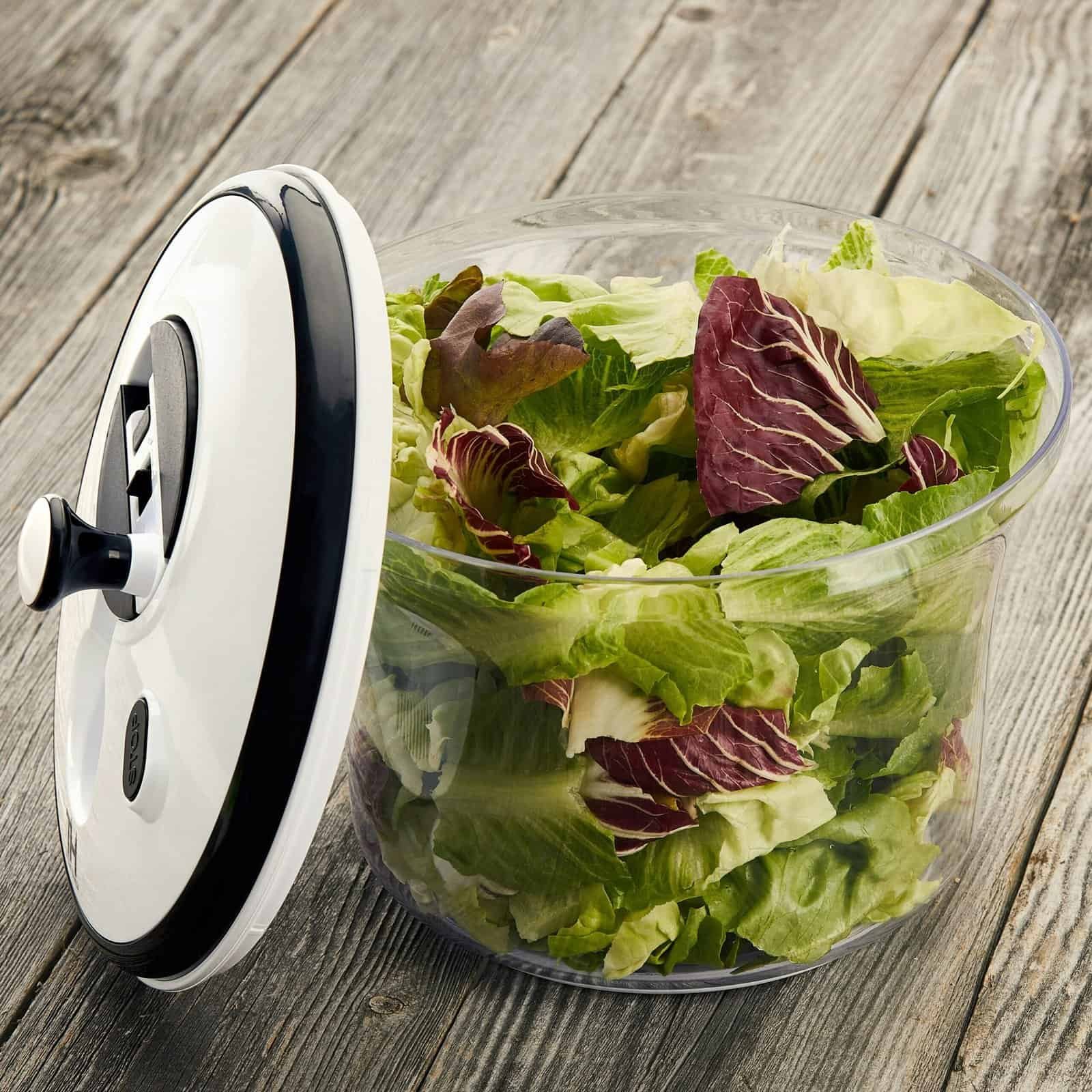
Wet salad greens are the most consistent obstacle to eating salad at home, not the preparation time, not the cost of produce, but the reality that greens purchased prewashed are still wet enough to dilute dressing immediately, making salads taste watered-down and turning crisp lettuce into limp, wet leaves within minutes of dressing application.
A salad spinner removes this moisture in under 60 seconds through centrifugal force, spinning the greens in a perforated basket inside a bowl until water is flung outward through the perforations and away from the greens. The resulting dry greens hold dressing rather than diluting it, stay crisp significantly longer after dressing, and store better in the refrigerator when the spinner bowl doubles as a storage container. The difference in salad quality between undried and properly dried greens is immediate and significant enough that cooks who try a salad spinner consistently report eating more salad at home afterward.
For the broader salad preparation setup, our guide to the best cutting boards for home cooks covers the prep surface that pairs with a salad spinner for complete salad station organization.
What to Look for in Salad Spinners
Bowl size determines practical salad capacity per spin. Most salad spinners are described by their total bowl volume, but the useful capacity is the perforated inner basket, which is typically 60 to 70 percent of the outer bowl volume. A 5-quart spinner accommodates enough greens for two to three servings per spin. A 7-quart spinner accommodates four to six servings. For households that make large salads or batch-dry greens for the week, a larger bowl capacity reduces the number of spinning cycles required.
Spin mechanism determines ease of use and durability. Pull-cord mechanisms are the simplest, a single pull generates spin force with no mechanical complexity. Push-button pump mechanisms require repeated pressing to build spin speed but allow one-handed operation. Twist-handle mechanisms are smooth but add mechanical components that can wear over time. Pull-cord mechanisms are the most durable and the most consistently effective for generating adequate spin speed.
Brake mechanism determines how quickly the spinning stops, relevant for counter stability during high-speed spinning and for stopping the basket to remove greens without waiting for natural deceleration. Push-button brakes stop the basket immediately. Natural deceleration takes 10 to 15 seconds after the mechanism stops.
Bowl stability during spinning determines whether the spinner needs to be held down or can operate hands-free. Spinners with a non-slip base or suction cup feet remain stationary on the counter during high-speed spinning. Spinners without stability features walk across the counter and require one hand to hold down, eliminating the hands-free spinning that makes salad preparation genuinely efficient.
Best Salad Spinners in 2026: Our Top 5 Picks
1. OXO Good Grips Large Salad Spinner, Best Overall
Best Overall | Price: ~$35
OXO’s salad spinner has held the top position in the category for over a decade through a pump mechanism that generates high spin speed through repeated one-handed pressing, a non-slip base that eliminates counter-walking during spinning, and a push-button brake that stops the basket immediately. The 6.22-quart bowl accommodates large salad preparations in a single batch. The clear lid allows visual assessment of remaining moisture without stopping the spin. The bowl and lid store neatly stacked without disassembly.
OXO Good Grips, One-Handed Pump and Non-Slip Base That Changes Daily Salad Prep
The one-handed pump mechanism is the OXO’s most practical advantage, it allows the cook to stabilize a cutting board or bowl with the free hand while spinning, rather than requiring both hands for either the spinning or the stabilizing. The non-slip base keeps the spinner stationary during high-speed operation without requiring any hand contact with the bowl. Together, these two features make OXO salad spinning genuinely hands-free and effective rather than requiring the awkward hold-and-spin approach that non-slip-base alternatives demand. At approximately $35, OXO delivers the category standard at an accessible price.
Best for: Most home cooks who make salads regularly, the one-handed pump and non-slip base make it the most practically efficient design for daily salad preparation.
PROS:
- One-handed pump mechanism for hands-free spinning operation
- Non-slip base eliminates counter-walking during high-speed spinning
- Push-button brake for immediate basket stop
- 6.22-quart bowl for a large salad batch capacity
- Clear lid for visual moisture assessment during spinning
CONS:
- Pump mechanism has more moving parts than pull-cord alternatives
- Price at approximately $35, higher than basic pull-cord alternatives
- Lid must be aligned correctly for the pump to engage, minor friction during rapid repeated use
2. Cuisinart Salad Spinner, Best Budget
Best Budget | Price: ~$20
Cuisinart delivers pull-cord salad spinning at approximately $20, the mechanism that generates the highest spin speed per pull of any design and requires the least moving part complexity. The 5-quart bowl handles most household salad quantities adequately. The pull-cord generates spin speed immediately from the first pull rather than requiring the repeated pressing that pump mechanisms need to build speed. For households that make salads daily and want durable simplicity over feature complexity, the Cuisinart pull-cord mechanism outlasts pump alternatives under sustained regular use.
Best for: Budget-conscious home cooks who want durable pull-cord simplicity at the lowest price, anyone for whom the OXO’s pump mechanism adds complexity they do not want.
PROS:
- Pull-cord mechanism for immediate high spin speed
- Most mechanically simple design, highest durability potential
- Lower price at approximately $20
- 5-quart capacity for standard household salads
- Dishwasher safe components
CONS:
- Two-handed operation, cord pull requires one hand, bowl stabilization requires the other
- No non-slip base, requires manual stabilization during spinning
- No brake, natural deceleration takes 10 to 15 seconds
3. Zyliss Swift Dry Salad Spinner, Best for Small Kitchens
Best for Small Kitchens | Price: ~$25
The Zyliss Swift Dry uses a lid-integrated pump mechanism that is shorter in overall height than the OXO, fitting under standard kitchen cabinets where the OXO’s taller pump handle creates clearance problems. For kitchens where overhead cabinet clearance above the counter limits which appliances can be operated without moving them first, the Zyliss solves a genuinely practical placement problem. The spinning performance matches the OXO’s effectiveness through an equivalent pump mechanism in a shorter profile.
Best for: Small kitchen and apartment cooks where overhead cabinet clearance limits which appliances can be used in place, and anyone who has experienced clearance problems with taller salad spinner designs.
PROS:
- Lower profile fits under standard cabinet clearance
- Effective pump mechanism matching OXO spinning performance
- Non-slip base for counter stability
- Brake mechanism for controlled stopping
- Mid-range price at approximately $25
CONS:
- Smaller bowl than OXO, 4.5-quart capacity for smaller batch sizes
- Pump mechanism less ergonomic than OXO’s top-mount design
- Less established brand support than OXO
4. Prepworks by Progressive Salad Spinner, Best Large Capacity
Best Large Capacity | Price: ~$30
Prepworks delivers an 8-quart salad spinner, the largest on this list, at approximately $30. For households that make large family salads, batch-dry greens for the week, or use the spinner for vegetables beyond salad greens, the 8-quart capacity handles larger volumes in a single cycle that smaller spinners require multiple batches to process. The pull-cord mechanism generates adequate spin speed, and the locking lid secures the basket during transport from sink to counter.
Best for: Families of four or more, meal preppers who batch-dry greens for the week, and cooks who use a salad spinner for vegetables beyond lettuce, anyone whose salad quantity consistently pushes the capacity of 5 to 6-quart alternatives.
PROS:
- 8-quart capacity, largest on this list
- Lower price than OXO at approximately $30
- Pull-cord mechanism for immediate spin speed
- Locking lid for transport from sink to counter
- Adequate for family-scale salad preparation
CONS:
- Pull-cord requires two-handed operation
- Larger footprint, requires more storage space
- Less refined mechanism than OXO for daily repeated use
5. RSVP International Endurance Salad Spinner, Best Stainless Steel
Best Stainless | Price: ~$40
The RSVP Endurance uses a stainless steel outer bowl, the only non-plastic outer bowl on this list, that suits design-conscious kitchens where plastic appliances clash with a stainless or natural material aesthetic. The stainless bowl is dishwasher safe, does not absorb odors the way plastic bowls can after extended use, and does not stain from berry washing or beet processing. The pull-cord mechanism is straightforward and durable. At approximately $40, the stainless premium adds cost over the OXO without performance improvement, justified for aesthetic integration rather than functional advantage.
Best for: Design-conscious home cooks whose kitchen aesthetic conflicts with plastic appliances, anyone who uses the salad spinner bowl for serving presentation alongside drying function.
PROS:
- Stainless steel outer bowl for premium aesthetic integration
- No odor absorption or staining over extended use
- Dishwasher safe throughout
- Durable pull-cord mechanism
- Suitable for serving presentation alongside the drying function
CONS:
- Higher price at approximately $40 for aesthetic premium without performance gain
- Heavier than plastic alternatives, more unwieldy for one-handed operation
- No brake mechanism
Quick Comparison: Best Salad Spinners 2026
| Salad Spinner | Price | Capacity | Mechanism | Best For | Score |
|---|---|---|---|---|---|
| OXO Good Grips Large | ~$35 | 6.22 qt | Pump + brake | Best overall | 9.3 |
| Zyliss Swift Dry | ~$25 | 4.5 qt | Pump + brake | Small kitchens | 8.9 |
| Cuisinart | ~$20 | 5 qt | Pull-cord | Best budget | 8.8 |
| Prepworks Progressive | ~$30 | 8 qt | Pull-cord | Large capacity | 8.8 |
| RSVP Stainless | ~$40 | 5 qt | Pull-cord | Stainless aesthetic | 8.7 |
Our Verdict on the Best Salad Spinners
OXO Good Grips at $35 is the default recommendation for most home cooks, the one-handed pump, non-slip base, and push-button brake produce the most practically efficient daily salad preparation experience on this list. Small kitchen cooks with cabinet clearance issues should look at Zyliss Swift Dry at $25, the lower profile solves a specific problem that OXO’s taller pump handle creates in constrained spaces.
Budget-conscious buyers get solid pull-cord performance from Cuisinart at $20. Family cooks who batch-dry greens weekly need the Prepworks 8-quart at $30. And design-focused kitchens where plastic conflicts with the aesthetic get the stainless steel option from RSVP at $40, a premium paid for look rather than function, but a legitimate preference.
Frequently Asked Questions: Best Salad Spinners
Do salad spinners actually make a difference?
Yes, measurably. Properly dried greens hold dressing rather than diluting it with residual water, stay crisp longer after dressing application, and store better in the refrigerator because excess moisture is the primary cause of premature wilting. The difference is most noticeable with delicate greens like arugula and butter lettuce that wilt immediately when dressed wet. For robust romaine and iceberg, the difference is less dramatic but still improves dressing adherence and storage life.
Can I use a salad spinner for things other than lettuce?
Yes, salad spinners excel at drying fresh herbs like parsley, cilantro, and basil after washing. They dry strawberries, blueberries, and other berries before storage, removing surface moisture that accelerates mold growth. They drain pasta, blanch vegetables, and can beans effectively. The larger-capacity models specifically suit these applications where volume beyond standard salad quantities is relevant.
How do I store a salad spinner?
The OXO and most pump-mechanism spinners store with the inner basket nested inside the outer bowl with the top lid, a single footprint that requires less cabinet space than the component volume suggests. The bowl doubles as a storage container for dried greens in the refrigerator, store the washed, dried greens directly in the spinner bowl with the lid on for two to five days of refrigerator freshness that loose greens in a bag cannot match.
How do I clean a salad spinner?
Most salad spinners are dishwasher safe, check the specific model’s instructions. Hand washing is faster for the inner basket, which has perforations that can trap food particles requiring thorough rinsing. The lid mechanism, particularly pump mechanisms, benefits from occasional disassembly for cleaning of the internal mechanism that can accumulate moisture over time. The outer bowl and inner basket clean easily under running water with standard dish soap.
Does spinning dry greens better than patting with a towel?
Yes, centrifugal force removes water from the crevices and surfaces of leafy greens more completely than towel patting, which primarily removes surface water and leaves moisture in the interior leaf structures. Towel patting also bruises delicate greens through physical contact pressure that centrifugal spinning avoids. The combination of spinning followed by a brief spread on a towel to absorb any remaining surface moisture produces the driest greens achievable through home methods.
Related Reading
Keep going with a good colander or strainer. Also explore: mandoline slicers.
More Kitchen Guides
See also the comprehensive kitchen organization methodology.
