
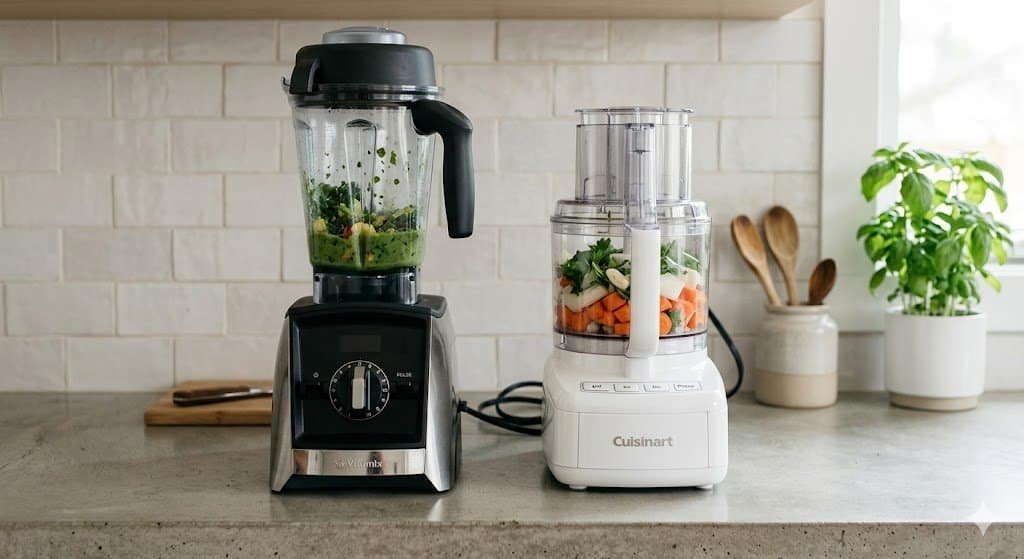
The blender versus food processor question looks simple until you’re standing in a kitchen store or scrolling Amazon at 11 pm, trying to justify $200 on an appliance you might not need. Both machines chop, puree, and transform ingredients. They also take up counter space and promise to replace the tedium of hand-preparing ingredients. Yet they produce fundamentally different outcomes from the same inputs, and choosing the wrong one means you end up with a kitchen gadget that sits in a cabinet while you still chop onions by hand or struggle to puree soup smoothly. If you’re shopping, start with our guide to the best food storage containers.
The problem with most comparison guides is that they describe features without explaining which cooking behaviors each machine actually enables. A blender handles liquids exceptionally well, smoothies, soups, sauces, frozen drinks. A food processor handles solids exceptionally well, chopping, slicing, shredding, grinding. The overlap zone where both machines technically work (think hummus, pesto, certain dips) is where most buyer confusion lives, because both tools can produce the result but one produces it dramatically better than the other.
This comparison walks through when a blender is the right tool, when a food processor is the right tool, when the overlap zone creates real trade-offs, and which specific tasks justify owning both. By the end, you’ll have a clear framework for which appliance to buy first, whether a second appliance is worth the additional investment, and how to stretch the capabilities of whichever one you own. For specific product picks, our guides on the best blenders for smoothies and best food processors under 100 cover the current top options in each category. If you’re still undecided between blender types, our guide on how to choose the right blender covers the decision framework within that category.
What a blender actually does (and doesn’t)
A blender uses a tall, narrow container with angled blades at the bottom that spin at high speeds. The design creates a vortex effect, liquid pulls downward into the blades, gets broken apart, and rises back up along the container walls. This circulation pattern means blenders work brilliantly with liquid-heavy mixtures because the vortex keeps the ingredients moving toward the blades continuously.
What blenders do well
- Smoothies and shakes. The vortex action breaks down fruits, vegetables, and ice into a drinkable consistency. This is the blender’s primary use case in most home kitchens.
- Pureed soups. Hot or cold soups pureed to restaurant-quality smoothness. The blender’s continuous circulation eliminates the lumps that food processors leave behind.
- Frozen drinks. Margaritas, daiquiris, frappuccinos. The vortex + high-speed blades break ice into fine crystals rather than chunks.
- Salad dressings and vinaigrettes. Emulsifies oil and acid into stable suspensions. Can handle garlic, herbs, and small amounts of solid flavoring ingredients.
- Batter for crepes, pancakes, and quick breads. Combines wet and dry ingredients thoroughly without overworking gluten.
- Nut milks. Breaks down almonds, cashews, or oats into a milk-like consistency when combined with water.
- Sauces (blended). Pesto, romesco, hot sauces. Blenders handle these better than food processors because the small amount of liquid carries the solids through the blade zone.
What blenders do poorly
- Chopping solid ingredients without liquid. Try to chop raw onions in a blender, and you get puree at the bottom and whole chunks on top. The vortex requires liquid to work.
- Shredding or slicing. Blenders have no attachments for these tasks. Cannot shred cheese, slice cucumbers, or cut vegetables into uniform pieces.
- Making dough. Pizza dough, cookie dough, pie crust, none of these fit in a blender (they’d jam the blades and break the motor).
- Grinding meat. Standard blenders cannot grind raw meat effectively. The texture ends up mushy rather than the distinct fibrous structure of properly ground meat.
- Processing large batches. Most blenders max out at 64 ounces (8 cups). Not suitable for batch prep of sauces or salsas for multiple meals.
The practical summary: Blenders are liquid-processing tools. If your ingredients will become a drink, soup, sauce, or emulsion, a blender handles it. If they’ll remain in distinct solid pieces, a blender is the wrong tool.
What a food processor actually does (and doesn’t)
A food processor uses a wide, shallow bowl with multiple attachment options, typically a chopping blade (S-blade), slicing disc, shredding disc, and sometimes a dough blade. The ingredients sit horizontally rather than vertically, and the wide base allows blades to cut through solid materials without needing liquid to create motion.
What food processors do well
- Chopping vegetables. Onions, carrots, celery, garlic, the S-blade pulses solids into uniform diced pieces within 10-20 seconds.
- Slicing vegetables or cheese. The slicing disc produces uniform thickness across dozens of cucumber slices or hundreds of potato chips in under a minute.
- Shredding cheese or vegetables. The shredding disc handles pounds of cheese or cabbage for coleslaw in seconds. The output is uniform and immediate.
- Making pastry dough. Pie crusts, scones, galette dough. The food processor cuts cold butter into flour faster and more precisely than the hand technique or any other tool.
- Making hummus, pesto, and thick dips. Because the bowl is wide, these dense mixtures spread out and process evenly without requiring significant liquid.
- Grinding nuts. Nut butters, ground almonds for baking, crushed pistachios for garnish. Food processors handle nuts well without turning them into oily pastes too quickly.
- Pureeing cooked vegetables for baby food. Smaller batches of cooked squash, sweet potato, or peas, smooth enough without the liquid required for a blender.
- Grinding meat. Most food processors handle raw meat grinding adequately for home use (sausage, burger patties, meatloaf mixtures). The texture is better than a blender can produce.
- Kneading bread or pasta dough. Dough blade attachments handle light kneading for pizza dough, focaccia, or small bread batches.
What food processors do poorly
- Producing truly smooth purees. Even the best food processor leaves a detectable texture in pureed soups. For restaurant-quality smoothness, a blender or immersion blender finishes the job better.
- Crushing ice for drinks. Technically possible but mediocre. Ice tends to collect in corners of the wide bowl rather than staying in the blade zone.
- Emulsifying dressings without adding significant liquid. The wide bowl makes emulsification less efficient than a blender for small batches.
- Making smoothies. The design is wrong for liquid-heavy mixtures. You’ll get separated layers, ingredient clumps, and an overall worse smoothie than a $40 blender would produce.
- Heating food (unlike some blenders). Food processors are room-temperature tools. High-powered blenders like Vitamix can heat ingredients through blade friction for hot soups; food processors cannot.
- Grinding coffee. Can technically do it, but produces uneven particle sizes. Dedicated coffee grinders are substantially better.
The practical summary: Food processors are solid-ingredient-processing tools. If your ingredients will remain in distinct pieces (diced, sliced, shredded) or become a thick paste (hummus, pesto, dough), a food processor handles it. If they’ll become a drink or a very smooth puree, a food processor is the wrong tool.
The overlap zone: when both tools technically work
Some recipes fall in the middle ground where both a blender and a food processor can produce a usable result. These tasks are where most buyer confusion happens, because both machines “work”, just with different quality outcomes.
How each machine handles overlap tasks
Hummus: Both machines make hummus. Food processors produce smoother hummus because the wide bowl redistributes ingredients continuously against the blade. Blenders produce acceptable hummus but require stopping repeatedly to scrape down sides, and the thick mixture often requires extra tahini or water to blend properly. Food processor wins.
Pesto: Both machines make pesto. Food processors produce classic Italian pesto with detectable basil texture and small cheese and pine nut pieces. Blenders produce ultra-smooth pesto that looks less traditional but coats pasta more uniformly. Preference-dependent; traditionalists prefer food processors, modernists sometimes prefer blenders.
Salsa: Both machines make salsa. Food processors produce pico-de-gallo-style salsa with distinct pepper, onion, and tomato pieces. Blenders produce restaurant-style salsa with a smoother, more uniform texture. Depends on the salsa style you prefer.
Guacamole: Both machines make guacamole. Food processors produce chunky-style guacamole with an identifiable avocado texture. Blenders produce creamy guacamole that spreads easily but lacks the characteristic bite. Food processors preferred for most purists; blenders acceptable for smooth-guacamole preferences.
Other overlap tasks worth noting
Bean dip or refried beans: Both machines work. Food processors produce a slightly chunky texture; blenders produce smoother results. Preference-dependent.
Nut butter: Both machines work. Food processors handle the long processing time (10-15 minutes) more gracefully than blenders, which can overheat during extended operation. Food processor wins for this specific task.
Frozen fruit desserts (like banana “nice cream”): Food processors excel here because the wide bowl accommodates frozen fruit pieces that would jam a blender’s narrow container. The output has an ice-cream-like texture that blenders cannot match. Food processor wins.
The summary of the overlap zone: Food processors win most overlap-zone tasks because the wider bowl accommodates thicker mixtures better. Blenders win overlap tasks only when ultra-smooth texture is the goal and some liquid is already present in the recipe.
The cost comparison over 10 years
Both categories span from budget ($40-80) to premium ($350+), and the long-term value calculation varies by what you actually use.
Budget blender ($40-80): NutriBullet, Hamilton Beach, Oster. Adequate for daily smoothies and occasional soup. Lifespan 3-5 years under regular use. Total 10-year cost: approximately $150 (two replacements).
Mid-tier blender ($100-200): Ninja Foodi, Breville Fresh & Furious, Cuisinart. Handles smoothies, soups, frozen drinks, and batters well. Lifespan 8-12 years. Total 10-year cost: $150 (one unit, no replacement).
Premium blender ($350+): Vitamix, Blendtec. Can heat soups through blade friction, crush ice with ease, run continuously for 15+ minutes, and process restaurant-quality smoothies. Lifespan 20+ years with manufacturer warranty (Vitamix standard is 7-year warranty, many units last far longer). Total 10-year cost: $350 (no replacement).
Budget food processor ($40-80): Hamilton Beach, Black+Decker. Adequate for weekly chopping and occasional slicing. Lifespan 3-5 years under regular use. Total 10-year cost: approximately $150.
Mid-tier food processor ($100-200): Cuisinart 9-14 cup, KitchenAid 11-cup. Handles chopping, slicing, shredding, and dough tasks well. Lifespan 10-15 years. Total 10-year cost: $150.
Premium food processor ($300-500): Cuisinart Elite Collection 14-cup, Robot-Coupe home models, Magimix. Commercial-grade motors, comprehensive disc selections, and 10+ year lifespans under heavy use. Total 10-year cost: $400-500.
The practical math: If you use the machine 3+ times per week, mid-tier beats budget over 10 years. If you use the machine daily or for serious cooking, premium pays off within 5-7 years and continues paying off for another 10-15. If you use the machine monthly, budget options are fine, you won’t wear out a $60 machine at monthly usage.
When you need both machines (honestly)
Most households need only one of these tools, but there are specific cooking patterns where owning both becomes genuinely worth it rather than redundant.
Scenarios where owning both pays off
Scenario 1: You eat smoothies daily AND cook from scratch regularly. Daily smoothie makers need a blender that can run on daily use without wearing out. Scratch cooking requires chopping, slicing, and shredding at volume. Trying to use one machine for both means either the blender is wrong for the scratch cooking or the food processor is wrong for the daily smoothies. Owning both creates two optimized tools instead of one compromised tool.
Scenario 2: You make hot pureed soups AND serious baking. Hot soups benefit from a high-powered blender that can produce a restaurant-smooth texture. Serious baking (pie crusts, pastry dough, bread doughs) benefits from a food processor’s specific design for cutting cold fat into flour and handling stiff doughs. One machine cannot excel at both.
Scenario 3: You entertain frequently at scale. A 14-cup food processor handles meal prep for 8+ people efficiently (chopping for mirepoix, shredding for cheese platters, slicing for vegetable trays). A premium blender handles drink service for the same group (frozen cocktails, blended desserts, pureed soups served in shot glasses). Both are working simultaneously during entertainment prep.
More specialized scenarios
Scenario 4: You follow very specific dietary patterns. Paleo and Whole30 cooks rely heavily on food processors for ingredient prep (cauliflower rice, riced vegetables, nut-based crusts). Keto cooks rely on food processors for almond flour, coconut cream, and various low-carb bases. Meanwhile, smoothies remain important for nutrient density across all these diets. The combination of food processor + blender covers the full dietary pattern.
Scenario 5: You cook for very different diners in one household. Kid-friendly smoothies and adult gourmet cooking have different tool requirements. Trying to compromise with one machine usually means one of the diners gets worse food.
The honest summary: Most households don’t need both. If you’re unsure, you probably don’t need both yet. Buy the tool matching your most frequent cooking pattern, use it for six months, and only add the second tool if you consistently encounter tasks the first tool handles poorly. Impulse buying both at the same time wastes money for most home cooks.
Which to buy first (if you can only have one)
For buyers choosing between a blender and a food processor, here’s the decision framework based on your actual cooking patterns.
Buy a blender first if:
- You make smoothies at least 2-3 times per week
- You want to make pureed soups regularly
- Your cooking involves frequent sauces, dressings, or emulsions
- You enjoy frozen cocktails or blended drinks
- You prioritize health-food preparation (nut milks, green drinks, nutrient-dense smoothies)
- You have limited counter space and can only fit one appliance
Buy a food processor first if:
- You cook from scratch multiple times per week
- You make pie crusts, pastry dough, or bread doughs regularly
- You prep vegetables for meal planning frequently
- You make hummus, pesto, or thick dips often
- You shred your own cheese regularly (which saves money and tastes better than pre-shredded)
- Your cooking style involves classic French, Italian, or Middle Eastern techniques that depend on solid ingredient preparation
The default recommendation: For buyers who do both types of cooking but must pick one, a food processor provides broader functional coverage than a blender. A food processor can make passable smoothies (with some liquid), passable blended soups, and passable sauces, while also doing all the chopping, slicing, and shredding tasks that a blender cannot touch. A blender cannot replace a food processor’s solid-ingredient handling.
The exception: if smoothies are a non-negotiable daily habit, buy a blender first. No food processor replaces a blender for smoothie quality, and if smoothies drive your daily morning routine, that’s the decisive factor.
The power specifications that actually matter
Both categories feature marketing around motor wattage. Here’s what translates to real performance and what’s noise.
For blenders
500-800 watts: Entry tier. Handles frozen banana smoothies and soft fruit drinks. Struggles with hard ice, frozen vegetables, or dense nut blends.
1000-1200 watts: Mid-tier sweet spot. Handles most smoothie and soup tasks well. Ice crushes adequately. Vegetables puree smoothly.
1500+ watts: Premium. Can heat soups through blade friction, power through dense frozen berry blends without liquid, and run continuously for extended periods.
Peak power claims: Ignore “peak watts” specifications, these measure burst power, not sustained operation. Running wattage matters; peak wattage is marketing.
For food processors
400-600 watts: Entry tier. Handles basic chopping and slicing for 6-8 cup bowls. Struggles with dense doughs or large batches.
650-850 watts: Mid-tier sweet spot. Handles most home cooking tasks including dough work. Appropriate for 9-14 cup bowls.
1000+ watts: Premium. Commercial-grade or near-commercial. Appropriate for 14+ cup bowls or professional home use. Runs continuously for extended periods.
What matters more than watts: Blade sharpness (replace blades every 5-7 years in heavily-used food processors), bowl seal integrity (leaks are the most common failure point), and attachment disc quality for food processors. For blenders, container material (glass vs plastic affects durability and staining) and vortex design matters more than raw wattage.
Practical kitchen workflow examples
Here’s how the right tool choice affects actual cooking sessions.
Sunday meal prep (2-hour session, feeds family of 4 for the week):
With a food processor: Dice onions and carrots for 5 meals in 2 minutes. Shred 2 pounds of cheese in 30 seconds. Slice 3 pounds of potatoes for gratin in 1 minute. Make pie dough for 2 quiches in 90 seconds. Grind chicken breast for meal prep sausages in 45 seconds. Total tool time: about 6 minutes across the session.
Without a food processor: Same prep requires approximately 45 minutes of knife work and manual shredding.
Weekday dinner (30-minute window from start to plate):
With a blender: Blend butternut squash soup (roasted earlier, puree with stock in 60 seconds). Make salad vinaigrette in 20 seconds. Blend 2 smoothies for dessert in 30 seconds. Total tool time: 2 minutes.
Without a blender: Squash soup requires pressing through a fine-mesh strainer (15 minutes and suboptimal results). Vinaigrette works fine with a jar and vigorous shaking.
Saturday baking session (1-hour window):
With a food processor: Pie crust in 90 seconds. Shred carrots for carrot cake in 20 seconds. Grind almonds for frangipane in 45 seconds. Cut scones in 2 minutes. Total tool time: 5 minutes.
Without a food processor: Pie crust requires 15+ minutes of hand technique. Everything else requires manual grating and cutting.
Daily breakfast routine (5-minute window):
With a blender: Smoothie in 45 seconds.
Without a blender: No realistic smoothie alternative at this time scale. Forces a different breakfast pattern entirely.
The pattern: Food processors save the most time on batch cooking and recipe prep. Blenders save the most time on specific liquid-based tasks. Your actual cooking pattern determines which time savings matter more.
Storage and counter-space reality
Both machines are larger than most buyers expect when they arrive.
Blender footprint: Typical 64-ounce blender base is approximately 8″ wide by 9″ deep by 17″ tall. Fits under standard 18″ upper cabinets with about 1″ clearance. Container stores on base when not in use.
Food processor footprint: The typical 11-cup food processor base is approximately 9″ wide by 11″ deep by 16″ tall. Similar fit under standard upper cabinets. Work bowl stores on base when not in use.
The additional footprint of attachments: Food processors come with 3-5 discs and 1-2 blades that need storage. Cuisinart’s 14-cup model ships with 7+ accessory pieces. Plan for a drawer or dedicated cabinet shelf to store these items. Many buyers forget to account for this and end up with attachments scattered across their kitchen.
Counter-stored vs cabinet-stored: Counter-stored blenders get used 4x more often than cabinet-stored ones. Counter-stored food processors get used 3x more often. Both appliances are too heavy (8-15 pounds) for comfortable frequent relocation, so if you don’t have counter space for either, consider buying only the one you’ll actually leave on the counter and skip the other entirely.
Our verdict
For the majority of home cooks who can only have one, the answer depends on the cooking pattern:
Recommendations by household type
Smoothie-driven households buy a blender. If your morning routine involves smoothies 3+ times per week, no food processor substitutes. Start with a $100-150 Ninja or Breville blender, upgrade to Vitamix if you commit to blender-based cooking long-term.
Scratch-cooking households buy a food processor. If you chop, slice, shred, and make pastry regularly, a food processor saves the most kitchen time. Start with an 11-cup Cuisinart in the $150-180 range. Upgrade to 14-cup premium models if cooking volume grows.
For households that do both types of cooking but must pick one, the food processor provides broader coverage. It can approximate blender function (with some liquid in mixtures); a blender cannot approximate food processor function. If undecided, food processor first, blender later if smoothies become a daily habit.
For households that need both, buy the blender first if smoothies are non-negotiable; buy the food processor first if scratch cooking is central. Add the second tool after six months of using the first, once you have real data on which gaps the first tool doesn’t cover.
The broader point: these aren’t interchangeable tools despite doing some overlapping tasks. A blender that produces restaurant-quality smoothies will produce mediocre hummus. A food processor that makes pie crust effortlessly will produce mediocre smoothies. Trying to save money by buying one for both purposes means compromising on one of them. Better to buy the right tool for your dominant cooking pattern and accept that the other machine’s specialty tasks might be done less frequently or differently than optimal. For specific product picks within each category, see our guides on the best blenders for smoothies, best food processors under 100, and how to choose the right blender for more targeted recommendations.
Frequently asked questions
Can a blender replace a food processor for chopping?
No, not for most chopping tasks. Blenders require liquid to create the vortex action that keeps ingredients moving toward the blades. Without liquid, solid ingredients either stick to the container walls (chopping stops) or puree at the bottom while the top remains untouched. For chopping raw onions, carrots, celery, or other hard vegetables without adding water or broth, a food processor is meaningfully better. Blenders can “chop” ingredients that are already in a liquid medium, like vegetables in soup, being further pureed. Neither handles raw meat well, and a dedicated grinder is the tool for burgers and sausage.
Can a food processor replace a blender for smoothies?
Technically, yes, but the result is inferior. Food processors produce smoothies with separated layers, chunks of unblended fruit, and ice that doesn’t crush uniformly. The wide bowl design works against liquid-heavy mixtures. If smoothies are an occasional treat, a food processor is passable. If smoothies are a daily habit, a dedicated blender produces dramatically better results with less frustration.
What’s the difference between a food processor and a high-powered blender like Vitamix?
Vitamix and similar high-powered blenders ($350+) handle tasks that budget blenders cannot, crushing ice into smooth consistency, heating soups through blade friction, processing dense mixtures without added liquid. They still don’t chop, slice, or shred solid ingredients the way a food processor does. A Vitamix is a premium blender with expanded capabilities, not a food processor substitute. Many serious home cooks own both a Vitamix and a food processor.
Is a blender or food processor easier to clean?
Blenders are generally easier to clean for liquid mixtures. Add warm water and a drop of dish soap, run for 20 seconds, rinse. Food processors have more components to clean, bowl, lid, blade, feed tube, and any discs used, and these typically need individual washing. For dishwasher-safe components, both work well. For hand-washing, blenders win on daily convenience.
Can a food processor make bread dough?
Some food processors have dough blade attachments that handle light bread doughs (pizza dough, focaccia, small bread batches). The capacity is limited, typically 2-3 cups of flour maximum. For serious bread baking, a stand mixer with a dough hook is substantially better. Food processor dough capability is a convenient bonus rather than a reliable bread-making solution.
Can a blender crush ice?
Budget blenders crush ice poorly, the ice bounces around the container without breaking down uniformly. Mid-tier blenders handle ice adequately with the proper technique (add a small amount of liquid, use pulse function). Premium blenders like Vitamix and Blendtec crush ice effortlessly. If frozen drinks or smoothies with ice are important to you, spend at least $150 on a blender rather than buying a budget unit.
Why do some recipes specify one tool over the other?
Recipe authors specify a blender or a food processor because the texture they’re targeting requires a specific tool. A recipe calling for a blender usually wants a restaurant-smooth texture or heavy emulsification. A recipe calling for a food processor wants identifiable texture, chopped pieces, or dough formation. Substituting the wrong tool often produces a dish the recipe author wouldn’t recognize. Trust the recipe’s tool specification when the outcome matters.
What about immersion blenders, do they replace regular blenders?
Immersion blenders (hand-held stick blenders) handle many blender tasks directly in the cooking pot, which is convenient for soups and sauces. They don’t crush ice well, don’t make thick smoothies efficiently, and have limited capacity for batch work. An immersion blender complements a countertop blender rather than replacing it. For buyers with very limited budget, an immersion blender is a useful entry point, but most serious cooks eventually add a countertop blender for tasks an immersion blender handles poorly.
Recommended Reading
See also our guides to food dehydrators.
Related Reading
Explore more: immersion vs countertop blender, food dehydrators, why food sticks to nonstick pans, blender under 100, and why food browns when cooked. Also explore: ninja vs instant pot.
