
Disclosure: SmartLifeItems is reader-supported. As an Amazon Associate, we earn from qualifying purchases made through links on this page, at no extra cost to you. Not sure what size you need? You can our cookware size calculator can suggest a capacity to get a quick starting point.
The Pot That Serious Home Cooks Buy Once and Never Replace
There is a specific moment that converts a skeptic into a Dutch oven devotee, usually the first time they pull a loaf of bread from one at 450°F and find a crust that no sheet pan or loaf pan has ever produced, or the first time a braise comes out with the kind of deep, concentrated flavor that requires three hours of low heat held so precisely that only cast iron can manage it without scorching the bottom.
A Dutch oven is a heavy, thick-walled pot, almost always cast iron, with or without enamel coating, whose mass creates a heat environment that thin stainless or aluminum cookware cannot replicate. The walls retain heat so effectively that temperature stays consistent even when cold ingredients are added, and the heavy lid traps moisture so completely that braising liquid reduces by concentration rather than evaporation. The result is cooking that simply does not happen the same way in any other pot.
The problem most buyers face is that the Dutch oven category spans from $40 to $400, and the marketing at every price point makes identical claims. The actual differences, enamel thickness, wall uniformity, lid fit precision, and heat distribution consistency, are real and measurable in cooking outcomes but invisible in product photography. This guide identifies exactly what those differences are and which price point produces which outcome. For high-heat searing before braising, our guide to the best electric skillets covers the alternative searing surface for cooks who want to keep the sear step off the stovetop.
What Actually Matters in a Dutch Oven
Wall thickness and uniformity determine heat distribution. A Dutch oven with uneven walls, thinner at the sides than at the base, creates hot spots that scorch braising liquid and produce uneven browning. Quality Dutch ovens maintain consistent wall thickness throughout, which produces the even heat distribution that makes braising, stewing, and slow cooking genuinely foolproof rather than requiring constant monitoring. Thinner metal behaves differently, and our note on warping in the oven explains why heavier pans hold their shape.
Enamel quality is the specification that most separates premium from budget Dutch ovens. Enamel is applied in layers, premium brands apply three or more coats to a specific minimum thickness that prevents chipping under thermal cycling. Budget enamel is applied thinner and begins chipping within two to three years of regular use at high temperatures. Chipped enamel is not merely cosmetic, exposed bare cast iron in a cooking surface requires re-seasoning and cannot be used with acidic foods without reactive leaching.
Lid fit determines moisture management. A lid that fits with a close, consistent seal traps steam that bastes the food continuously, the mechanism that produces the tender, self-basting result that makes Dutch oven braises distinctive. A lid that rocks or has gaps allows steam to escape, reducing braising liquid faster and requiring more active management.
Size selection is the most practical decision that most buyers get wrong. A 5.5-quart Dutch oven is the standard recommendation for households of two to four, large enough for a whole chicken or a 3-pound pot roast with vegetables, small enough to heat efficiently for smaller preparations. A 7.25-quart suits households that regularly cook for six or more, or batch-cook large quantities. Going too large means the pot never heats as efficiently for everyday use because the thermal mass requires more energy to bring to temperature.
Required accessories most buyers miss: A Dutch oven at 500°F is not something to handle with standard kitchen mitts. Heavy-duty oven mitts rated to 500°F or above are the accessory that matters most, standard oven mitts fail at Dutch oven temperatures, especially during bread baking. Budget approximately $20 to $30 for quality oven mitts alongside the pot purchase.
Best Dutch Ovens in 2026: Our Top 5 Picks
1. Le Creuset Signature Round Dutch Oven, Best Overall
Best Overall | Price: ~$380
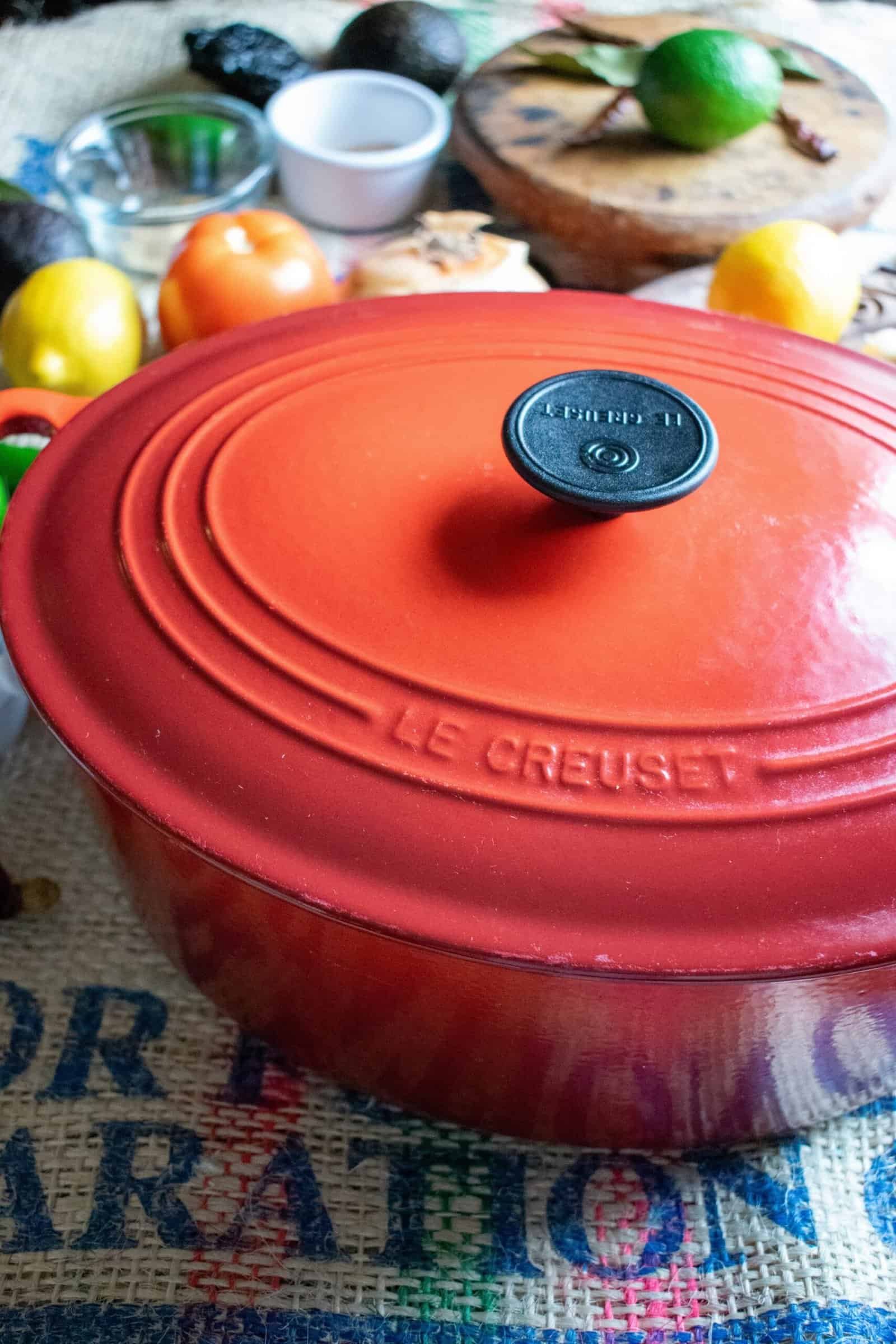
Le Creuset has manufactured enameled cast iron in France since 1925 and holds the position of undisputed quality leader in the category, not through marketing but through the specific engineering details that produce cooking outcomes no competitor has matched at scale. The enamel is applied in three coats to a thickness that Le Creuset guarantees against chipping for the lifetime of the pot. The sand-colored interior enamel is not purely aesthetic, it allows visual monitoring of fond development during searing that dark-interior alternatives make impossible. The lid fits with precision that produces a near-hermetic seal under steam pressure. For coated options specifically, see the best enameled cast iron cookware.
Le Creuset, Three Coats of Enamel and a Lifetime Guarantee That Explains the Price
The honest cost reality: $380 for a 5.5-quart is the most expensive option on this list by a significant margin. The justification is longevity and cooking performance. A Le Creuset purchased today will outlast multiple generations of $60 to $100 alternatives, the total cost of ownership over 20 years of regular use makes Le Creuset competitive with any alternative when amortized over its actual lifespan. The lifetime guarantee against manufacturing defects provides the confidence that makes the upfront investment rational for serious cooks who will use the pot multiple times per week.
Learning curve: None for the pot itself, Dutch ovens are inherently forgiving. The learning curve is in bread baking, specifically. The first Dutch oven loaf benefits from understanding that the lid comes off for the final 15 minutes of baking to develop crust color, a step that first-time users sometimes skip, producing excellent crumb but pale crust.
Best for: Serious home cooks who want the category benchmark with a lifetime guarantee, anyone who cooks braised dishes, stews, soups, or bread multiple times per week and wants the pot they will never replace.
PROS:
- Three-coat enamel with a lifetime manufacturing defect guarantee
- Sand-colored interior for fond monitoring during searing
- Precision lid fit for maximum steam retention
- Even heat distribution from uniform wall thickness
- Iconic design available in an extensive color range
CONS:
- Premium price at approximately $380
- Heavy at 12.3 pounds for a 5.5-quart, challenging for some users to maneuver
- Color selection adds cost, neutral colors cost less than signature colors
- Dishwasher safe, but hand washing recommended for enamel longevity
2. Lodge Enameled Cast Iron Dutch Oven, Best Value
Best Value | Price: ~$80
Lodge is the only major Dutch oven manufacturer producing enameled cast iron in the United States, and the brand’s value proposition is straightforward, the same fundamental cooking mechanism as Le Creuset at approximately 20% of the price. The enamel is applied in fewer coats than Le Creuset, which matters over a decade of heavy use but is functionally invisible in the first three to five years. The dark interior, standard black enamel rather than Le Creuset’s sand tone, makes fond monitoring harder during searing but does not affect braising, soup, or bread outcomes.
Lodge, American-Made Cast Iron Performance at the Price Point That Makes Dutch Oven Cooking Accessible
The 6-quart capacity is slightly larger than Le Creuset’s standard 5.5-quart, useful for larger batches and households of four to six. The weight is comparable to premium alternatives at 13.5 pounds, and the pot handles high oven temperatures up to 500°F without issue. For cooks who want to experience Dutch oven cooking before committing to a $380 investment, Lodge provides the complete experience at a price that removes the financial barrier entirely.
Total cost of ownership reality: If the Lodge enamel chips at year six, which is the realistic outcome with regular high-heat use, the $80 replacement cost represents $13.33 per year of use. Le Creuset at $380 over 20 years represents $19 per year. The Lodge wins the annual cost calculation, even accounting for likely replacement, while Le Creuset wins for cooks who prefer to buy once.
Best for: Home cooks who want genuine Dutch oven performance without the premium price, anyone testing whether Dutch oven cooking suits their habits before committing to a Le Creuset investment.
PROS:
- American-made enameled cast iron at approximately $80
- 6-quart capacity for larger family cooking
- Full Dutch oven cooking capability at a fraction of the premium price
- Oven safe to 500°F
- Wide color selection at an accessible price
CONS:
- Fewer enamel coats than premium alternatives, shorter longevity under heavy use
- Dark interior makes fond monitoring harder during searing
- Lid fit less precise than Le Creuset under comparative testing
- Enamel may begin showing wear by year five to seven of heavy use
3. Staub Cocotte Round Dutch Oven, Best for Braising
Best for Braising | Price: ~$350
Staub is Le Creuset’s closest competitor in quality, a French manufacturer whose engineering approach differs from Le Creuset in one meaningful way that makes it better for braising specifically. The Staub lid interior features small spikes, called self-basting spikes, that collect condensation from the steam and channel it back down onto the food in a continuous drip pattern. Le Creuset relies on a smooth lid that channels condensation to the rim rather than returning it to the center. The practical outcome is that Staub braised dishes are slightly more self-basting, requiring less manual basting during long cooks, while Le Creuset provides marginally better fond visibility through the lighter interior.
Staub, Self-Basting Lid Spikes That Le Creuset’s Smooth Lid Cannot Match
The dark matte enamel interior that Staub uses is not a compromise, it actually develops a mild non-stick quality over time as the matte surface retains microscopic amounts of cooking fat that smooth enamel does not. Long-term Staub users report improved release characteristics after the first six to twelve months of regular use, which Le Creuset’s smooth interior does not develop in the same way.
You can see which dishes hold and which collapse before deciding.
Best for: Cooks whose primary Dutch oven use is braising, pot roasts, and slow-cooked dishes, anyone who prioritizes self-basting performance and is comfortable with the dark interior that makes fond monitoring harder than Le Creuset.
PROS:
- Self-basting lid spikes for continuous moisture return during braising
- Matte dark interior develops mild non-stick quality over time
- Quality and longevity comparable to Le Creuset
- Slightly lower price than Le Creuset at approximately $350
- Made in France to the same quality standard as Le Creuset
CONS:
- Dark interior makes fond monitoring harder during searing
- Marginal price advantage over Le Creuset does not represent significant savings
- Heavier than Le Creuset at comparable sizes
- Self-basting advantage only meaningful for long braises, not applicable to bread or soup
4. Cuisinart Chef’s Classic Enameled Cast Iron, Best Mid-Range
Best Mid-Range | Price: ~$70
Cuisinart’s enameled cast iron Dutch oven occupies the price band between Lodge and the premium French alternatives, approximately $70 for a 5-quart that delivers reliable Dutch oven performance for cooks who use the pot occasionally rather than multiple times per week. The enamel is comparable to Lodge in application quality, the heat distribution is even for standard braising and soup applications, and the lighter interior color improves on Lodge’s dark interior for fond monitoring. For households where the Dutch oven is used once or twice per week rather than daily, Cuisinart provides adequate performance at a price that doesn’t require justification.
Best for: Occasional Dutch oven cooks, households that want the capability for roasts, soups, and occasional bread without the frequency of use that justifies Lodge’s value or Le Creuset’s premium.
PROS:
- Mid-range price at approximately $70
- Lighter interior than Lodge for better fond monitoring
- Reliable even heat for braising and soup
- Oven safe to 500°F
- Wide availability for warranty and support
CONS:
- Enamel quality similar to Lodge, not significantly better for the price difference
- 5-quart capacity is slightly smaller than the Lodge 6-quart at a comparable price
- Cuisinart brand is less established for cookware than for appliances
- Not meaningfully better than Lodge at a similar price point
5. Amazon Basics Enameled Cast Iron Dutch Oven, Best Budget
Best Budget | Price: ~$45
The Amazon Basics Dutch oven is the honest entry point for cooks who want to experience Dutch oven cooking before committing to any meaningful investment. At approximately $45, it delivers the fundamental cast iron thermal mass that produces braising and bread results meaningfully better than stainless or aluminum alternatives, the core mechanism that makes Dutch ovens valuable works at this price point. The enamel is the thinnest on this list and the most likely to chip within three to five years of regular high-heat use, but for cooks who use the pot monthly rather than weekly, the timeline extends to the point where the $45 entry cost is fully justified.
Best for: First-time Dutch oven buyers who want to confirm the cooking style suits them before spending more, anyone who has read about Dutch oven bread or braising, and wants to experience the results without financial commitment.
PROS:
- Lowest price on this list is approximately $45
- Genuine cast iron thermal mass for authentic Dutch oven cooking performance
- Adequate for occasional braising, soup, and bread baking
- Risk-free entry into Dutch oven cooking
- Oven safe to 400°F
CONS:
- Thinnest enamel on this list, shortest longevity under regular high-heat use
- Lower oven temperature limit at 400°F versus 500°F for premium alternatives
- Lid fit is less precise, some steam escapes during long braises
- Color selection very limited
- Not suitable for daily high-heat use
Quick Comparison: Best Dutch Ovens 2026
| Dutch Oven | Price | Capacity | Enamel Quality | Best For | Score |
|---|---|---|---|---|---|
| Le Creuset Signature | ~$380 | 5.5 qt | Premium (3 coats) | Best overall | 9.5 |
| Staub Cocotte | ~$350 | 5.5 qt | Premium | Best braising | 9.3 |
| Lodge Enameled | ~$80 | 6 qt | Good | Best value | 9.0 |
| Cuisinart Chef’s Classic | ~$70 | 5 qt | Good | Mid-range | 8.8 |
| Amazon Basics | ~$45 | 6 qt | Basic | Budget entry | 8.5 |
Our Verdict on the Best Dutch Ovens
The decision comes down to three buyer types with three clear answers.
If you cook multiple times per week and want a pot you will genuinely never replace, Le Creuset at $380 is the rational choice when the cost is amortized over 20-plus years of daily use. The enamel quality, lid precision, and lifetime guarantee separate it from every alternative in ways that show up in cooking outcomes over time. Staub at $350 is the alternative recommendation for cooks who braise specifically, the self-basting lid spikes produce marginally better moisture management during long cooks in a pot that matches Le Creuset’s quality standard.
Lodge at $80 is the recommendation for everyone else, cooks who want to learn Dutch oven cooking, households with once-or-twice-weekly use, and buyers who want to experience the technique before committing to a premium investment. The cooking results from Lodge are genuinely excellent. The enamel longevity is the trade-off, not the cooking performance.
Amazon Basics at $45 is specifically for cooks who have never used a Dutch oven and want to confirm the cooking style suits their kitchen habits before spending more. Spend one winter making braises and bread in it, if the pot changes how you cook, upgrade to Lodge or Le Creuset with full confidence.
Frequently Asked Questions: Best Dutch Ovens
What size Dutch oven should I buy?
A 5 to 5.5-quart is the right size for most households of two to four people, large enough for a whole chicken, a 3-pound pot roast with vegetables, or a standard bread loaf, small enough to heat efficiently for everyday soups and stews. A 7.25-quart is right for households of five or more or for cooks who regularly batch-cook large quantities. The most common Dutch oven sizing mistake is buying too large, a 7-quart pot for a two-person household never heats as efficiently as a properly sized 5-quart.
Can I use a Dutch oven on any stovetop?
Enameled cast-iron Dutch ovens work on gas, electric, ceramic, and induction stovetops. The flat bottom required for induction compatibility is standard on all Dutch ovens listed here. The weight, 12 to 14 pounds for a 5 to 6-quart pot, can scratch glass and ceramic stovetop surfaces if slid rather than lifted. Always lift a full Dutch oven rather than sliding it on any smooth stovetop surface.
What can I cook in a Dutch oven?
The complete list is extensive: braised meats (pot roast, short ribs, lamb shanks), soups and stews (French onion soup, beef stew, minestrone), no-knead bread (the most transformative Dutch oven application for most home cooks), chili, pulled pork, chicken cacciatore, cassoulet, risotto, deep frying, and pasta dishes that finish in the pot. The Dutch oven’s thermal mass and tight lid make it the most versatile single pot in the kitchen, the replacement for a braiser, a large saucepan, a stockpot, and a bread cloche simultaneously. For shallower cooking with more surface area, the braiser version of the same job covers where the wider pan wins.
How do I clean an enameled Dutch oven?
Allow the pot to cool completely before washing, thermal shock from cold water on a hot Dutch oven accelerates enamel chipping over time. Hand wash with warm soapy water and a soft cloth or sponge. For stuck-on food, fill with warm water and bring to a gentle simmer on the stovetop to loosen residue before washing. Avoid metal scouring pads, abrasive cleaners, and bleach, all damage enamel. Most enameled Dutch ovens are technically dishwasher safe, but the dishwasher detergent gradually dulls the enamel finish. Hand washing extends enamel life significantly.
Is a Dutch oven worth it?
For cooks who make braises, soups, stews, or bread even occasionally, yes, unambiguously. A Dutch oven produces results in these categories that no other pot at any price achieves comparably. The thermal mass and lid seal create a cooking environment that replaces a braiser, a large saucepan, a stockpot, and a bread cloche. For cooks whose repertoire does not include any of these applications, primarily stovetop cooking of quick dishes, a Dutch oven adds less specific value. The honest use-case question is whether your cooking includes anything that benefits from low, even, moist heat over an extended time. If yes, a Dutch oven is worth every dollar of the Lodge price at a minimum.
Recommended Reading
Related: our roasting pans guide. See also our guides to dutch ovens, and dutch oven vs stockpot. On the same capability, what else finishes in the oven.
Related Reading
Explore more: dutch oven vs stockpot, dutch ovens under 50, difference between convection and conventional ovens, pizza stones for home ovens, dutch oven vs cast iron skillet, and microwave ovens. Also explore: how yeast actually works.
- how to choose the right cookware
- carbon steel pans
- cast iron skillets
- a braiser, for shallow braises and family meals.
