
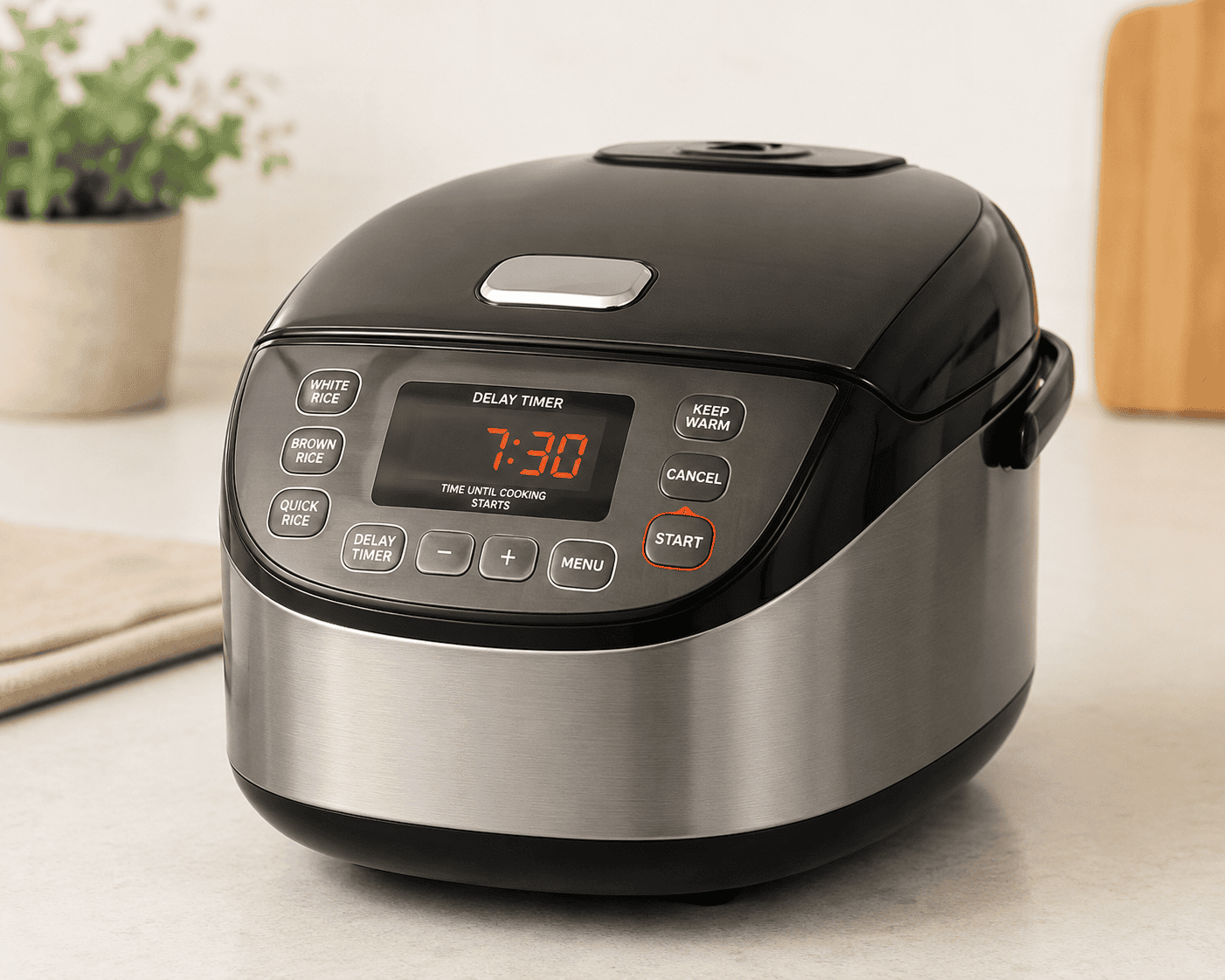
A delay timer lets you load rice and water in the morning and set the cooker to finish at six in the evening, so dinner’s starch is done before you walk through the door. The best rice cookers with delay timers pair that scheduling with fuzzy logic control, because a long soak changes how the rice absorbs water and a cooker that adjusts through the cycle handles it better. There is one real constraint worth knowing before you buy: rice sitting in room-temperature water for many hours is a food safety consideration, not just a texture one. For the fundamentals, see our guide to choosing a rice cooker.
Quick Verdict
A fuzzy logic cooker with a delay timer is the right pick for most people, since it handles the soak that a delay inevitably creates. Choose a large-capacity model for family dinners, a compact one for a single serving on a schedule, and a budget model if you only want the feature occasionally. Keep delays within a few hours in warm kitchens.
Key Takeaways
- Delay timers schedule the finish time, not the start time, on most cookers.
- Rice soaks in the water for the whole delay period, which affects texture.
- Fuzzy logic models handle pre-soaked rice better than basic on-off cookers.
- Long delays with rice sitting at room temperature carry food safety limits.
- The keep-warm function matters as much as the timer for real-world use.
How We Picked These Rice Cookers
We started with the timer implementation itself, because delay functions differ more than people expect. Most cookers ask you to set the time you want the rice ready and work backwards, while a few set a delay duration instead. Longer maximum delays give more flexibility for a full workday.
We then prioritized fuzzy logic control. A delay means the rice sits in water absorbing moisture before cooking even begins, and a cooker that senses and adjusts through the cycle copes with that far better than one that simply boils until dry.
Keep-warm quality was the third criterion, since scheduled rice often waits a while after finishing. Good keep-warm holds temperature without drying the rice into a crust. We covered a range of capacities so the timer feature is available whether you cook for one or for a household.
Zojirushi Fuzzy Logic Cooker With Timer
Why It Stands Out
Zojirushi fuzzy logic models pair a well-implemented delay timer with the temperature control that scheduled cooking really needs. Because the rice will have soaked during the delay, a cooker that adjusts heat and timing to the actual condition of the grain produces a better result than a fixed cycle.
The extended keep-warm on these models is also strong, which matters when rice finishes before everyone is home.
Worth Knowing
These sit at the higher end of the price range. The control panel carries many settings beyond the timer, which is more than some buyers want. Our guide to fuzzy logic rice cookers covers the technology.
Best for people who use the timer regularly and want the best texture from it. Skip it if you want a simple machine at a low price.
Tiger Rice Cooker With Programmable Timer
Why It Stands Out
Tiger’s programmable models offer flexible delay settings alongside grain-specific cycles, so you can schedule brown rice or mixed grain as easily as white. That flexibility is useful because different grains want different soak behavior.
Build quality across the range is solid, and the inner pots hold up well to daily use.
Worth Knowing
Settings vary between models, so confirm the specific unit has the delay range you want. Some imported model menus are less clear in English. Our guide to rice cookers for brown rice covers grain-specific cycles.
Best for households cooking several grain types on a schedule. Skip it if you only cook white rice and want simplicity.
Large-Capacity Rice Cooker With Delay Start
Why It Stands Out
Scheduling matters most when you are feeding a household, and a large-capacity cooker with a delay timer means dinner rice is ready without anyone standing over it. The combination suits working families directly.
Larger pots also hold heat better on keep-warm, which is useful when people eat at different times.
Worth Knowing
Large cookers take real counter space and are heavier to move and wash. Cooking small amounts in a big pot gives less even results. Our guide to large rice cookers covers sizing.
Best for families scheduling dinner rice. Skip it if you cook for one or two.
Compact Rice Cooker With Timer
Why It Stands Out
A small cooker with a delay function suits one or two people who want rice ready at a set time without a large appliance on the counter. The scheduling benefit is identical, just at a smaller scale.
Compact models also reach temperature faster, so the cooking portion of the cycle is shorter.
Worth Knowing
Not every compact cooker includes a delay timer, so check the feature list rather than assuming. Small pots dry out faster on extended keep-warm. Our guide to mini rice cookers covers small options.
Best for singles and couples on a schedule. Skip it if you cook for a group.
Budget Rice Cooker With Delay Function
Why It Stands Out
Delay timers are no longer exclusive to premium machines, and budget models increasingly include them. If scheduling is the one feature you want and you are not chasing perfect texture, this tier delivers the function at low cost.
For plain white rice on a timer, the results are generally acceptable.
Worth Knowing
Budget cookers usually lack fuzzy logic, so a long soak during the delay can leave rice softer than intended. Keep-warm performance is often weaker. Our guide to rice cookers under $50 covers this tier.
Best for occasional scheduled cooking on a budget. Skip it if you want consistent texture from long delays.
Multi-Function Cooker With Timer and Steamer
Why It Stands Out
Models combining a delay timer with a steamer basket let you schedule rice and steam vegetables or fish over it, producing more of a meal from one appliance and one schedule. That suits people trying to reduce appliance count.
The timer applies to the whole cycle, so both components finish together.
Worth Knowing
Steaming delicate items on a long delay is less practical than rice, since the food sits at room temperature too. Use the steamer for same-time cooking rather than scheduled. Our guide to rice cookers with steamers covers these models.
Best for cooks wanting rice and steaming from one scheduled appliance. Skip it if you only cook rice.
Delay Timer Rice Cookers at a Glance
| Model type | Control | Keep-warm | Capacity | Best for |
|---|---|---|---|---|
| Zojirushi fuzzy logic | Fuzzy logic | Extended | Mid | Best scheduled texture |
| Tiger programmable | Fuzzy logic | Good | Mid | Multiple grain types |
| Large-capacity | Varies | Good | Large | Family dinners |
| Compact timer | Varies | Moderate | Small | One or two people |
| Budget timer | On-off | Basic | Mid | Occasional scheduling |
| Timer with steamer | Varies | Good | Mid | Rice plus vegetables |
What to Look For in a Delay Timer Cooker
How the Timer Actually Works
Most cookers ask for the time you want rice ready and calculate backwards, which means the rice sits in water until cooking begins. A few set a delay before starting instead. Either way, the soak is real, so understand which model you are buying and plan around it.
Fuzzy Logic for Soaked Rice
Because a delay guarantees a soak, temperature control matters more here than in a cooker used immediately. Fuzzy logic senses conditions and adjusts, which compensates for the extra absorbed water. A basic on-off cooker will often produce softer rice from a long delay.
Keep-Warm Quality
Scheduled rice frequently waits after finishing, so keep-warm performance is part of the feature. Good implementations hold temperature without drying the surface into a crust. Our guide to using a rice cooker covers getting the most from these cycles.
Maximum Delay Range
Check the longest delay the cooker supports against your actual schedule, since a cooker capped well below a full workday will not do what you bought it for. Our guide to why rice turns out mushy covers the texture side of long soaks.
Delay Timer vs Keep-Warm
What Each Solves
A delay timer schedules when cooking happens, so the rice finishes close to when you want to eat. Keep-warm holds already-cooked rice at temperature after the cycle ends. They address different halves of the same convenience problem.
Which You Actually Need
If you leave the house and want rice fresh on arrival, the timer is the feature that matters. If you cook when you are home but eat at staggered times, strong keep-warm matters more. Most people scheduling around a workday benefit from both, which is why they usually appear together.
Common Delay Timer Mistakes
Setting Very Long Delays in a Warm Kitchen
Rice sitting in room-temperature water for many hours is a food safety consideration. Keep delays modest in warm conditions, and avoid overnight soaks with perishable additions.
Adding Perishable Ingredients Before a Delay
Meat, dairy, and stock should never sit unrefrigerated through a delay period. Add those at cooking time, not at loading time.
Using the Same Water Ratio as Immediate Cooking
Rice absorbs water during the soak, so a long delay can leave it softer. Slightly less water often gives a better result on a timer.
Assuming Every Cooker Has One
Delay timers are common but not universal, particularly at the budget end. Confirm the feature before buying rather than after.
Recommended Reading
- How to choose a rice cooker
- Getting the most from a rice cooker
- What else a rice cooker can make
- Cleaning a rice cooker
- Rice cooker versus Instant Pot
- Rice cookers with steamer baskets
Frequently Asked Questions
How does a rice cooker delay timer work?
On most cookers you set the time you want the rice ready and the machine calculates when to start, meaning the rice and water sit together until cooking begins. A few models let you set a delay duration before starting instead. Either way the rice soaks for the whole waiting period, which affects the final texture.
Is it safe to leave rice in a rice cooker with a delay timer?
For moderate delays in a cool kitchen it is common practice, but rice sitting in room-temperature water for many hours is a food safety consideration rather than only a texture one. Keep delays shorter in warm conditions, and never include perishable ingredients such as meat, stock, or dairy during the wait.
Does soaking during the delay ruin the rice?
It changes the texture rather than ruining it, typically making the rice softer because it has absorbed water before heating. Fuzzy logic cookers compensate for this well. With a basic on-off cooker, using slightly less water than usual generally produces a better result on a timer.
Can you set a rice cooker overnight?
Many cookers allow delays long enough to span a night, but leaving rice soaking at room temperature that long is not ideal, particularly in a warm kitchen. If you want rice ready in the morning, a shorter delay set later is safer. Never leave perishable ingredients in the pot overnight.
Do all rice cookers have a delay timer?
No. Delay timers are common on fuzzy logic and mid-range models but are not universal, and plenty of basic on-off cookers omit the feature entirely. If scheduling is why you are buying, confirm the specific model includes it rather than assuming it comes standard.
Should I use less water when using the delay timer?
Often yes, especially with a basic cooker, because the rice absorbs water throughout the soak before cooking starts. Reducing the water slightly compensates. Fuzzy logic models handle this automatically, so the standard ratio usually works on those.
What is the difference between delay start and keep-warm?
Delay start schedules when cooking begins so the rice finishes at a chosen time, while keep-warm holds rice at serving temperature after the cycle has already completed. They solve different problems, and most cookers offering a timer include both since scheduled rice often waits before it is eaten.
Timers matter more when an appliance lives on the counter permanently. Weighing which appliances to keep out covers that tradeoff.
