
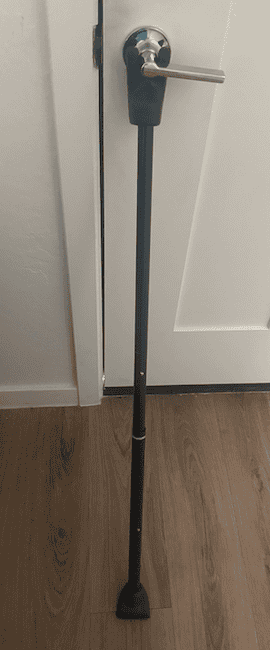
A door security bar is a steel or aluminum brace that wedges under your door handle and presses into the floor, holding the door shut even if the lock gives way. The best door security bars resist hundreds of pounds of force, set up in seconds, and add a physical layer that a kicked-in deadbolt cannot. They suit renters, ground-floor apartments, and anyone who wants a second line behind the lock.
I keep one braced under my own front-door lever every night. Mine is the simple telescoping type you see below: a padded cradle hooks under the handle, the pole angles down, and a rubber foot bites the floor. It will not stop a determined crew forever, but it turns a quiet kick into a loud, slow struggle. That noise and delay is the whole point. A bar like this pairs naturally with a good smart lock and a doorbell camera, covering the gap between “locked” and “actually hard to open.”
Quick Verdict
The Buddybar Door Jammer is the strongest pick, built from heavy steel with a grippy floor pad for serious resistance. For most homes the Master Lock 265D does the job at a fraction of the weight and price, and it doubles as a sliding-door bar. Travelers and renters should grab the pocket-sized DoorJammer instead.
Why Trust This Guide
Selections draw on product research, manufacturer specs, hands-on use of a telescoping under-handle bar on my own front door, and the federal crime data cited in Sources. First-person notes appear only where the gear was genuinely used.
Key Takeaways
- A door security bar braces a closed door from the inside so force from outside meets the floor, not just the latch.
- Heavy steel bars resist the most force; aluminum and plastic models trade strength for weight and price.
- Match the bar to your floor: rubber feet grip hard surfaces best and can slip on thick carpet.
- Treat a bar as one layer, alongside a deadbolt, lighting, and a camera, not a complete system.
- Pick a model with a fast release so you can still get out quickly in a fire.
Disclosure: SmartLifeItems is reader-supported. As an Amazon Associate, we earn from qualifying purchases made through links on this page, at no extra cost to you.
How We Picked the Best Door Security Bars
Doors are where most break-ins happen. The FBI’s Uniform Crime Reporting program found that 55.7% of burglaries involved forcible entry rather than walking through an unlocked door. An analysis of federal crime data puts the front door as the single most common entry point at 34%, ahead of first-floor windows and back doors. A bar targets exactly that weak point. Pairing one with timed smart lighting that makes a home look occupied adds deterrence before anyone reaches the door.
We weighed four things for each pick: raw strength, fit range, floor grip, and how fast you can remove it in an emergency. Strength came first, since a bar that bends under a shoulder charge is decoration. We favored models with a wide adjustment range so they fit standard interior and entry doors, and a padded or rubberized foot that grips without scratching. We also flagged the trade-offs honestly, because the strongest bar is also the heaviest and the hardest on your hardware.
1. Buddybar Door Jammer: Best Overall
The Buddybar is the tank of this category. It is built from powder-coated steel with no plastic parts, so there is nothing cheap to snap under load. The maker states it withstands up to 2,560 lbs of force, and reviewers who tested it could not budge a braced door. A lever lock, similar to a tension baby gate, ratchets it snug instead of a fiddly push pin.
Why It Stands Out
Mass and rigidity are what stop a kick. At over 8 lbs of solid steel, the Buddybar resists shifting when force hits the door. Its large rubber floor pad grips wood, tile, vinyl, concrete, and even carpet. The bar extends from 36 to 51 inches, so it reaches the handle on most entry doors without straining.
Worth Knowing
That strength comes with weight. The Buddybar is heavy to lift and set, and the high tension can press hard on a doorknob over time. It also costs far more than a basic bar. If you have grip strength concerns or want something for a suitcase, look further down this list.
Get the Buddybar if you want the most resistance money can buy for a home door and you will leave it in one place. Skip it if budget, weight, or travel matter more than maximum strength.
2. Master Lock 265D Door Security Bar: Best for Most People
The Master Lock 265D is the bar most homes should start with. It is the same telescoping, under-handle design I use on my own front door, and it covers the basics without the Buddybar’s heft or price. Built from 20-gauge steel and weighing around 2 lbs, it adjusts from 27.5 to 42 inches and carries a pivoting ball joint so the foot sits flat on uneven floors.
Why It Stands Out
This model is genuinely dual-purpose. Remove the top cradle and the bar works against a sliding patio door, laid in the track to block it. The padded foot grips without scratching, and the limited lifetime warranty is reassuring for a part you trust with your front door. For the everyday job of bracing a closed door, this is enough bar for most people.
Worth Knowing
Some owners report the push-pin adjustment can be finicky, and constant tension can mark a doorknob. It is also lighter than the heavy steel options, so a sustained battering will test it harder than a Buddybar. In daily peace-of-mind terms, though, I have never had mine slip or feel flimsy under the handle.
Choose the 265D if you want a proven, affordable bar that also handles a sliding door. Skip it if you specifically need the maximum force rating for a high-risk entry.
3. SABRE Adjustable Door Security Bar: Best With an Alarm
SABRE’s adjustable bar adds a feature most others skip: noise. The standard model is a heavy-steel telescoping bar with release-button length adjustment, a pivoting ball joint, and a padded foot. The upgraded version pairs the bar with a vibration-detecting alarm that sounds at 115 dB when someone shoves the door, turning a silent attempt into an instant scene.
Why It Stands Out
An alarm changes the math for an intruder. A bar alone resists the push; a bar plus a shriek wakes the house and the neighbors. The bar collapses for storage, fits most hinged and sliding doors, and the rubberized foot keeps a firm grip on hard floors. It is a strong choice for a primary bedroom door or a rental entry where you want a warning, not just a wall.
Worth Knowing
The alarm runs on a battery, so test it on a schedule and keep a spare cell on hand. As with any bar, it depends on your door and frame holding up. Treat the noise as a deterrent and an early warning, not a guarantee.
Pick the SABRE bar if you want both a physical brace and an audible alert in one device. Skip it if a silent setup suits your home better.
4. Nightlock Original Door Barricade: Best Floor-Mounted
The Nightlock takes a different approach. Instead of leaning under the handle, it bolts a low base plate to the floor near the door; a solid aluminum rail then drops into that plate to block the door from swinging open. Testers installed one in under five minutes and could not push the braced door at all.
Why It Stands Out
Floor anchoring removes the weak link of a leaning bar, which is grip. Because the rail seats into a fixed plate, it cannot slip. It also shines on French or double doors, where it can hold both panels at once, and it stows out of sight when not in use. For a regular entry door you secure every night, sliding the rail in is quick once the plate is set.
Worth Knowing
This one needs installation. The base plate screws into the floor, so it is not for renters who cannot drill, and the plate sits in the walkway as a minor trip risk. It also wants a hard, flat surface and does not suit thick carpet.
Choose the Nightlock if you own your home, want a slip-proof brace, or need to secure double doors. Skip it if you rent or want a no-install option.
5. SecurityMan 2-in-1 Door Security Bar: Best for Multiple Entries
The SecurityMan 2-in-1 is the value play for covering more than one opening. It works on hinged doors, sits in the track of a sliding patio door, and many sets include a window stopper, often sold as a two-pack. Some versions add an alarm. For a renter trying to cover a front door and a balcony slider on a budget, that flexibility matters.
Why It Stands Out
Buying one product that secures several entry types keeps things simple and cheap. The adjustable bar fits standard doors, the sliding-door function blocks the most common ground-floor vulnerability, and a two-pack lets you arm two openings at once. It is a practical kit rather than a single specialized tool.
Worth Knowing
Jack-of-all-trades hardware rarely matches a dedicated heavy bar on raw strength. Build quality varies more across this style, so check that the foot grips your floor and the cradle fits your handle. Treat it as solid everyday deterrence rather than a fortress.
Get the SecurityMan set if you need to secure several doors or windows without buying separate tools. Skip it if you want one maximum-strength bar for a single high-risk door.
6. DoorJammer Portable: Best for Travel and Renters
The DoorJammer throws out the long pole entirely. It is a compact brace, a few inches tall, that slides into the gap under the door and screws down to grip the floor and block the swing. It fits in a laptop bag and needs only about a quarter inch of clearance, which makes it the go-to for hotel rooms, dorms, and short-term rentals.
Why It Stands Out
Portability is the whole pitch, and it delivers. With no knob cradle, it works on doors where a tall bar will not reach, and an extension foot adapts it to larger floor gaps. A quick-release lets you remove it fast in an emergency. For travelers who want a real brace without packing a steel pole, nothing here is more convenient.
Worth Knowing
A small brace cannot match a full-length steel bar against a sustained battering. It relies on a snug fit in the door gap, so very tight or very loose thresholds need the included spacers. Think of it as strong travel security, not a permanent front-door solution.
Pack the DoorJammer if you travel, rent, or want a brace that hides in a bag. Skip it if you want maximum strength for a fixed home entry.
Door Security Bars at a Glance
| Pick | Type | Material | Best for |
|---|---|---|---|
| Buddybar Door Jammer | Under-handle bar | Heavy steel | Maximum strength, fixed home door |
| Master Lock 265D | Under-handle + sliding | 20-gauge steel | Most people, dual hinged/sliding use |
| SABRE Adjustable Bar | Under-handle + alarm | Steel | Bar plus an audible alert |
| Nightlock Original | Floor-mounted barricade | Aluminum | Homeowners, French/double doors |
| SecurityMan 2-in-1 | Bar + sliding/window | Steel | Covering several entries cheaply |
| DoorJammer Portable | Under-door brace | Steel/composite | Travel, hotels, renters |
How to Choose a Door Security Bar
Material and Strength
Steel resists more force than aluminum, and both beat plastic, which can crack under a hard kick. A heavier bar shifts less when struck, so weight often signals real resistance. Match the strength to the risk: a primary entry deserves more bar than a closet.
Fit and Adjustment Range
Measure from your door handle to the floor before buying. A bar that barely reaches sits at a poor angle and grips weakly. A wide adjustment range, like 27 to 51 inches across these picks, gives you room to set a firm, confident angle.
Floor Surface and Grip
The foot is where a leaning bar wins or fails. Rubber pads bite hard floors well and most low-pile carpet, but thick carpet and uneven thresholds can let a bar slide. If you have plush carpet, a floor-mounted barricade like the Nightlock removes the grip problem entirely.
Alarm and Emergency Exit
Decide whether you want noise. An alarm bar deters and warns, but adds a battery to maintain. Whatever you choose, confirm you can release it in seconds, because the same brace that keeps an intruder out must let your family out in a fire. Away from home, timed lamps on smart plugs keep the place looking lived-in.
Door Security Bar vs Floor-Mounted Barricade
When a Leaning Bar Wins
A telescoping bar needs no tools and no holes, so it suits renters and travelers. You set it in seconds and remove it just as fast. The cost is grip: it relies on floor friction, so surface and angle decide how well it holds. Either way, fold the bar into a wider plan; our guide on how to set up a smart home covers the sensors and cameras around it.
When a Floor Barricade Wins
A floor-mounted barricade like the Nightlock anchors to a fixed plate, so it cannot slip and resists a heavier shove. It also handles French and double doors. The trade-off is installation and a base plate in your walkway, which rules it out for most rentals.
Common Door Security Bar Mistakes to Avoid
Over-Tightening the Bar
Cranking a bar to maximum tension does not add much security, but it does stress the doorknob and can damage it over time. Set it snug and firm, then stop. Let the angle and the floor grip do the work.
Ignoring Your Floor Surface
A bar that grips tile beautifully can creep on thick carpet. Test the foot on your actual floor and watch for any slide when you push the door. On plush carpet, switch to a floor-anchored brace.
Relying on the Bar Alone
A bar is one layer, not a security system. Keep a working deadbolt, add motion lighting, and consider security cameras and a smart doorbell so you see trouble coming. Layers buy time, and time is what makes burglars quit.
Forgetting the Exit Plan
Any brace strong enough to stop an intruder can slow your own escape. Practice removing it quickly, and make sure everyone in the home knows how. A smart garage door opener and a clear second exit round out a safer plan.
Recommended Reading
- smart home hubs
- smart smoke detectors
- smart water leak detectors
- smart light switches
- smart blinds and shades
Frequently Asked Questions
Do door security bars actually work?
Yes, as a delay-and-deterrence layer. A braced door turns a quick kick into a loud, repeated effort, and the noise plus the time often makes an intruder give up and move on. A bar will not defeat a determined attacker forever, but it raises the cost of getting in.
Will a door security bar damage my door or floor?
It can if you over-tighten it. High tension on the knob can mark hardware over time, so set the bar snug rather than maxed out. A padded or rubberized foot protects the floor and grips without scratching.
Can renters use a door security bar?
That is one of their best uses. A telescoping bar or a portable under-door brace needs no drilling and leaves no marks, so it adds security without touching the structure. Avoid floor-mounted barricades, which require screwing a plate into the floor.
Do door security bars work on outward-opening doors?
Leaning bars and under-door braces are designed for inward-opening doors, which most interior and many entry doors are. For an outward-opening door, a wedge or floor barricade will not block the swing, so a reinforced strike plate and a strong deadbolt matter more.
Is a bar better than a deadbolt?
They solve different problems, so use both. A deadbolt resists picking and prying at the lock; a bar resists the door being forced as a whole. Layered together, they protect both the latch and the door panel.
Will a bar hold on carpet?
On low-pile carpet, a good rubber foot usually grips fine. Thick or plush carpet is the weak point, since the foot can compress and slide. If your entry has deep carpet, choose a floor-anchored barricade instead.
Can I use a security bar on a sliding glass door?
Yes, with the right model. Bars like the Master Lock 265D and the SecurityMan set lay in the slider track to block it from opening. A bar in the track stops the door even if the factory latch is weak.
