
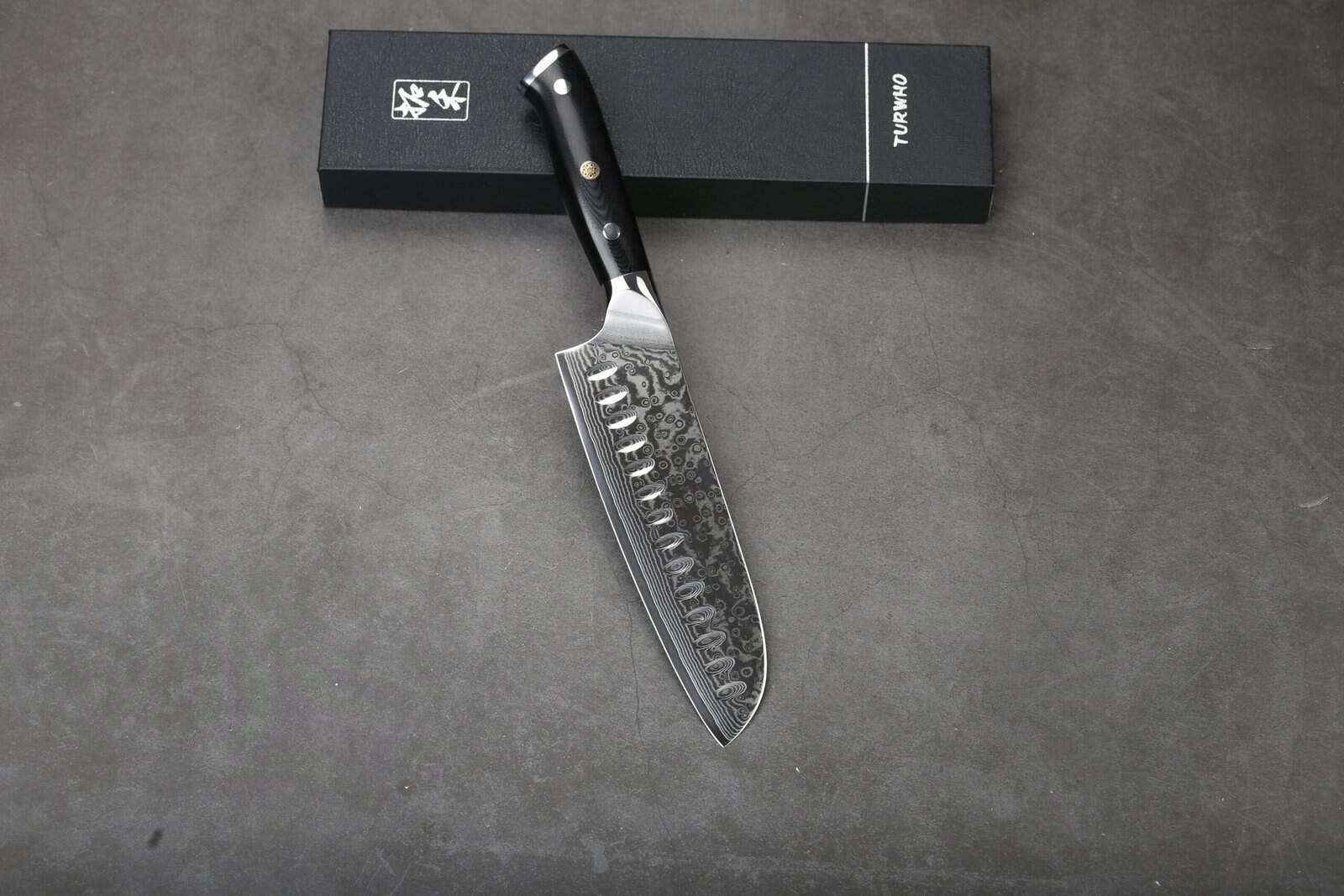
The santoku is Japan’s take on the all-purpose kitchen knife: shorter, lighter, and flatter than a Western chef’s knife, with a blade built for quick, precise up-and-down chopping. Its name roughly means “three virtues,” a nod to how well it slices, dices, and minces the everyday vegetables, meat, and fish that fill a home kitchen. For cooks who find a big chef’s knife unwieldy, a santoku’s control and agility can be a revelation. This guide sorts santokus by type so you can match one to your hands and habits, and if you are torn between the two styles, our chef knife vs santoku comparison lays out the differences.
Quick Verdict
For most cooks, a Granton hollow-edge santoku is the sweet spot, releasing food cleanly as you chop. Choose a full-tang knife for durability, a lightweight one for control and less fatigue, a compact blade for small hands, and a Damascus-style knife if you want premium steel and looks. Balance and a comfortable handle matter more than any single spec.
Key Takeaways
- A santoku is shorter and flatter than a chef’s knife, favoring chopping over rocking.
- Granton hollow-edge dimples help food release instead of sticking to the blade.
- Lighter santokus reduce hand fatigue and give nimble control for detailed work.
- Full-tang construction, where the steel runs through the handle, adds durability and balance.
- A santoku complements rather than fully replaces a chef’s knife for many cooks.
How We Compared Santoku Knives
A santoku is judged on the balance between blade and handle, the quality and edge retention of its steel, a flat profile suited to its chop-and-lift motion, and a grip that stays comfortable through a big prep session. Those are the factors weighed here, grouped by type so you can match a knife to your kitchen rather than chase a single ranking. Whatever you choose, a stable cutting board protects the edge and makes every cut safer.
1. Granton Hollow-Edge Santoku (Best Overall)
Why It Stands Out
A Granton santoku has shallow oval dimples ground along the blade that create air pockets, so slices of potato, cucumber, or meat fall away instead of clinging to the steel. That clean release keeps your rhythm going and your board tidy, which is exactly what you want when chopping a pile of vegetables. For most home cooks, it is the most satisfying santoku to use day to day.
Worth Knowing
The dimples help release but do not replace a sharp edge, so keep the blade keen. Hollow-edge knives can cost slightly more than plain-bladed ones.
Who it is for: most cooks who chop a lot of produce. Who should skip it: those on the tightest budget who do not mind a stickier blade.
2. Full-Tang Santoku (Best for Durability)
Why It Stands Out
A full-tang santoku has its steel running the entire length of the handle, which adds strength, better balance, and a reassuring heft in the hand. That construction resists loosening over years of use and shifts the balance point toward your grip for control. For a knife you want to keep for the long haul, full-tang is the durable choice.
Worth Knowing
Full-tang knives are usually heavier than partial-tang ones, which some cooks love and others find tiring. The added steel can also raise the price.
Who it is for: cooks who want a durable, well-balanced knife for life. Who should skip it: those who prefer the lightest possible blade.
3. Lightweight Santoku (Best for Control)
Why It Stands Out
A lightweight santoku is easy to maneuver and gentle on your hand and wrist, which is much of the santoku’s original appeal over a heavier chef’s knife. The reduced mass gives nimble control for fine dicing and mincing, and it stays comfortable through long prep. For anyone with smaller hands or fatigue concerns, lighter is better.
Worth Knowing
A lighter blade relies more on your technique and a sharp edge than on its own weight to cut. It is less suited to heavy-duty tasks that a hefty knife powers through.
Who it is for: cooks who value agility and comfort over heft. Who should skip it: those who like a knife with substantial weight.
4. Compact Santoku (Best for Small Hands)
Why It Stands Out
A compact santoku, often around five to six inches, brings the knife’s versatility to smaller hands and tighter kitchens with easier control. The shorter blade is less intimidating and more maneuverable for detailed work, while still handling the everyday chopping a santoku is made for. For newer cooks and smaller grips, the compact size is confidence-inspiring.
Worth Knowing
A shorter blade covers less food per stroke, so very large prep jobs take a bit longer. Make sure the size still fits the biggest items you cut regularly.
Who it is for: smaller hands, tight kitchens, and beginners. Who should skip it: cooks who prep large volumes and want blade length.
5. Damascus-Style Santoku (Best Premium)
Why It Stands Out
A Damascus-style santoku layers steel into a rippling, watery pattern that is as much about performance as looks, often pairing a hard cutting core with softer, tougher outer layers. The result can be a keen, long-lasting edge wrapped in a striking blade. For cooks who want a knife that performs and looks the part, this is the showpiece.
Worth Knowing
Not all Damascus is equal, since the pattern is sometimes cosmetic, so buy for the core steel and edge, not just the swirls. These knives sit at the premium end of the price range.
Who it is for: enthusiasts who want premium steel and a beautiful blade. Who should skip it: practical buyers focused only on value.
6. Budget Santoku (Best Value)
Why It Stands Out
A budget santoku shows that the knife’s flat, nimble design delivers most of its benefit at a low price, giving you a capable everyday chopper for very little. It is the easiest way to try the santoku style before committing, and a decent one holds a working edge with regular sharpening. For a first santoku or a second knife, it is smart value.
Worth Knowing
Cheaper steel may dull faster and need sharpening more often. Check that the handle is comfortable and secure, since that affects control as much as the blade.
Who it is for: first-time buyers and value seekers. Who should skip it: those who want premium edge retention and materials.
Santoku Knives at a Glance
| Type | Best for | Standout | Watch-out |
|---|---|---|---|
| Granton hollow-edge | Most cooks | Food releases cleanly | Costs a bit more |
| Full-tang | Durability | Strong, well-balanced | Heavier |
| Lightweight | Control | Nimble, low fatigue | Less heft to cut |
| Compact | Small hands | Easy to maneuver | Less per stroke |
| Damascus-style | Premium | Keen edge, striking look | Pattern can be cosmetic |
| Budget | Value | Core design, low price | Sharpen more often |
How to Choose a Santoku Knife
Weigh balance and heft
A santoku should feel balanced where blade meets handle, not tip-heavy or tail-heavy. Decide whether you want a substantial full-tang feel or a light, nimble blade, since that preference shapes your whole experience more than the brand.
Consider the edge and steel
Look for hard, well-tempered steel that takes and holds a keen edge, and a hollow edge if food sticking bothers you. Harder steels stay sharp longer but need more careful sharpening.
Fit it to your hand
Blade length from five to seven inches and handle shape both affect control, so match them to your hand size and the food you prep. Smaller hands often do better with a compact blade.
Care and sharpening
Hand wash a santoku and hone it regularly, sharpening when honing no longer restores the bite. Pair it with the right tools from our knife sharpeners guide to keep the edge keen.
Santoku vs Chef’s Knife
When a santoku wins
A santoku shines for straight up-and-down chopping, precise slicing, and dicing vegetables, with a flat edge and light body that many cooks find more controllable than a chef’s knife. Its clean release and nimble feel make everyday prep quick and comfortable.
When a chef’s knife wins
For rocking cuts, mincing herbs with a pivoting motion, and powering through larger items, a curved chef’s knife has the edge. Many cooks keep both and reach for whichever suits the task, which our comparison guide explores in detail.
Common Santoku Mistakes to Avoid
Trying to rock-chop with it
A santoku’s flatter edge is built for up-and-down chopping, not the rocking motion of a chef’s knife. Lift and chop rather than pivot, and the knife feels natural.
Letting the edge go dull
Harder santoku steel cuts beautifully sharp but feels clumsy when dull. Hone often and sharpen when needed to keep the fine edge working.
Putting it in the dishwasher
Heat, detergent, and jostling damage the edge and handle. Hand wash and dry a santoku to protect both the steel and its balance.
Buying only for the pattern
A pretty Damascus finish means little if the core steel is soft. Choose for the cutting core and edge first, and treat the looks as a bonus.
Recommended Reading
- Steak knives, to complete your table cutlery.
- Knife sets under $100, to build a full kit affordably.
- How to store knives safely, to protect your edges.
- how German and Japanese knives differ
- choosing a kitchen knife
Santoku Knife FAQ
What is a santoku knife used for?
A santoku is an all-purpose knife for slicing, dicing, and mincing vegetables, meat, and fish. Its flat edge and light body suit quick up-and-down chopping, making it a go-to for everyday prep. The name refers to its three virtues across these core cutting tasks.
What is the difference between a santoku and a chef’s knife?
A santoku is shorter, lighter, and flatter with a rounded tip, favoring chopping, while a chef’s knife is longer with a curved edge built for rocking cuts. Santokus feel nimble and controllable; chef’s knives excel at rocking and powering through larger items. Many cooks own both.
Is a santoku knife good for beginners?
Yes. Its lighter weight, shorter blade, and flat chopping motion are approachable and forgiving, giving new cooks good control. A compact santoku in particular is easy to handle, though any santoku rewards learning its up-and-down cutting style.
Why do some santoku knives have dimples?
Those hollow-ground dimples form a Granton edge that creates small air pockets along the blade, so food releases instead of sticking. It is especially helpful when slicing starchy or moist foods like potatoes, cucumbers, and raw meat, keeping cuts clean.
What size santoku knife should I buy?
Santokus typically run five to seven inches. A five to six inch blade suits smaller hands and detailed work, while seven inches covers larger items in fewer strokes. Choose based on your hand size and the volume you usually prep.
How do you sharpen a santoku knife?
Hone it regularly with a rod, and sharpen with a whetstone or a sharpener suited to its edge angle when honing stops restoring the bite. Japanese santokus often have a finer edge angle than Western knives, so match your sharpening tool to the blade.
Can a santoku replace a chef’s knife?
For many everyday tasks, yes, since it slices, dices, and minces capably. But it is less suited to rocking cuts and very large items, so cooks who do those often keep a chef’s knife too. For a single do-most knife, a santoku is a strong choice.
Can you cut meat with a santoku knife?
Yes, a santoku slices boneless meat and fish cleanly, and a hollow edge helps it release. It is not meant for cutting through bone, though, so use a cleaver or boning knife for those jobs and keep the santoku for slicing and dicing.
This guide is part of the full guide to choosing the right cookware for your kitchen.
