
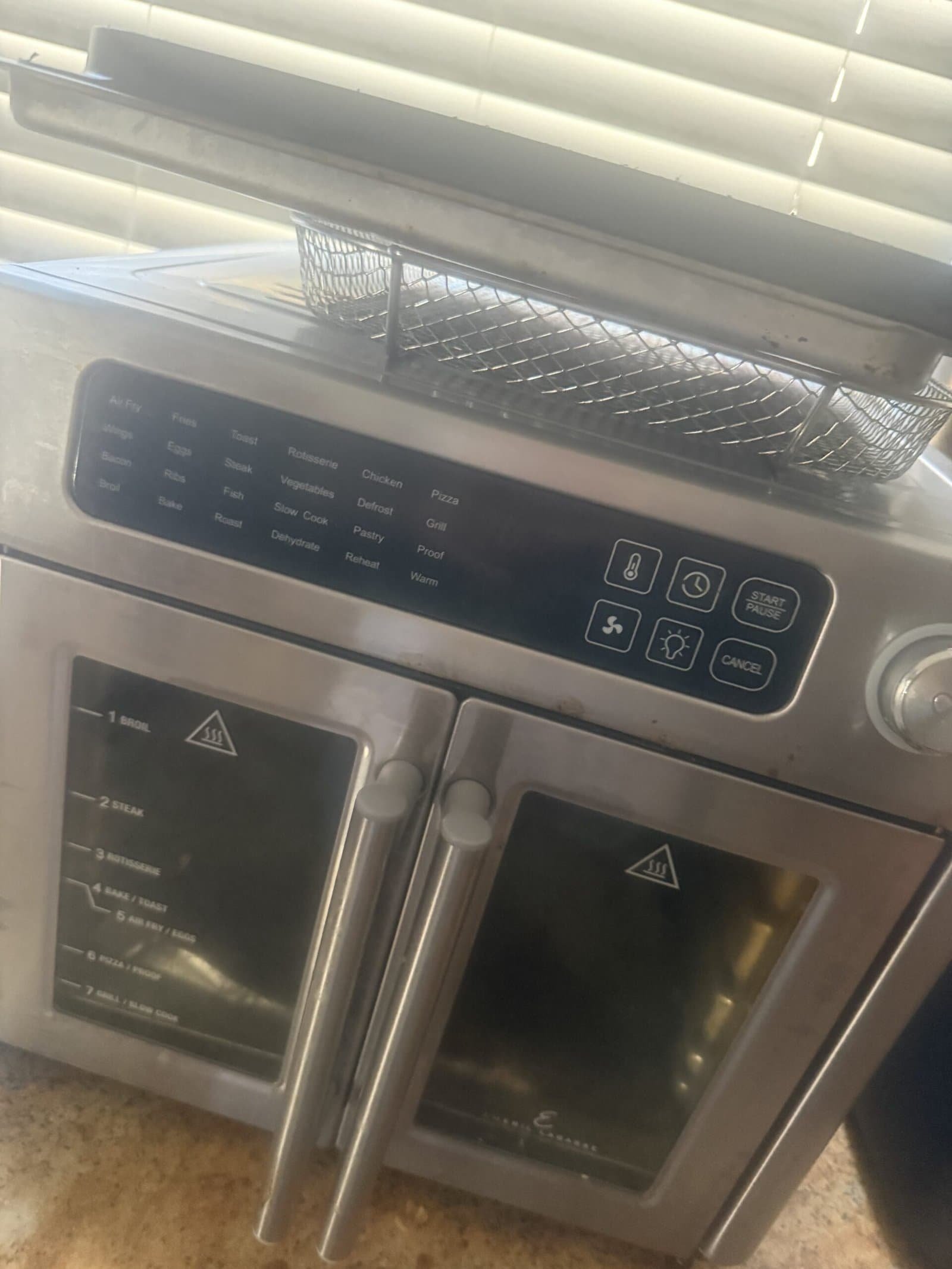
You can, and it works better in a combo cooker with a proper bake setting than in a small basket unit. The circulating fan that makes an air fryer good at crisping is the same thing that makes plain air frying awkward for bread.
I baked a loaf in mine using the bake feature. It is a combo cooker I have had a couple of years, and using the bake setting rather than the air fry setting is what made it work.
Quick Answer
Use the bake function if your machine has one, not air fry. Expect a smaller loaf, a darker crust, and faster cooking than a conventional oven. Cover the top with foil once it colors, since the top element is close and bread browns before it finishes inside.
What Changes Against an Oven
| Factor | Air fryer | Conventional oven |
|---|---|---|
| Loaf size | Limited by basket | Full size |
| Cooking time | Shorter | Standard |
| Temperature | Reduce by about 25F | As written |
| Crust | Darker, faster | Even |
| Rise | Can be uneven | Even |
| Preheat | Fast or none | Ten to fifteen minutes |
The fan is the main difference. Moving air transfers heat faster than still air, which is why convection recipes call for lower temperatures and shorter times.
In a small cavity that effect is amplified further, since the food sits close to the element and the moving air has very little distance to travel.
Bake Setting, Not Air Fry
The air fry setting runs the fan at full speed, and on an unbaked loaf that can distort the surface before the structure sets.
Bake settings on combo cookers typically reduce fan speed and adjust which elements run, which is much closer to what dough wants.
Basket-style air fryers without a bake mode still work for smaller items and quick breads, and yeasted loaves are harder in those.
That is why a combo cooker is the better tool here, and general capability sits in how to use an air fryer combo cooker.
How Mine Went
I used the bake feature rather than air fry, and that was the decision that mattered. A whole loaf came out properly baked.
The machine handles a lot of what I cook, including baked potatoes and chicken, so bread was more curiosity than necessity on my part. It worked well enough that I would happily do it again.
What I would flag is that this is a combo cooker with a real bake mode. I would not assume a basket-style air fryer does the same thing, since I have not tried one.
It also does not replace a bread machine for anything routine, since a bread machine handles the mixing and the rise as well as the bake, covered in bread machine dough then oven bake.
For an occasional loaf without heating up a full oven, it is a reasonable option to have.
What Bakes Well
Quick breads and banana bread
No yeast, no rise to protect, and they suit the smaller pan sizes an air fryer accepts. These are the easiest starting point.
Small yeasted loaves
A single loaf in a pan that fits the basket works. Doubling a standard recipe does not, since the cavity limits size more than anything else.
Rolls and buns
Individually sized items suit the format well, and they cook fast enough that the crust does not outrun the interior.
Flatbreads and naan
Thin breads cook very quickly under circulating heat and take color nicely, which is where the fan is genuinely an advantage.
The Problems to Expect
The top browns before the inside is done. The element is close, and covering the loaf loosely with foil once it has color is the standard fix.
Uneven rise happens when the fan pushes air across one side of a loaf harder than the other. Rotating the pan partway through addresses it in machines that let you open them mid-cycle.
Pan size is the hard limit here. A standard loaf pan does not fit most air fryers, so a smaller pan and a smaller loaf is simply the reality of it.
And crust texture differs. It tends to be thicker and drier than oven crust, which some people prefer and others find too much, covered in common air fryer mistakes.
Finding a Pan That Fits
Pan choice decides more about this than technique does, and it is where most people run into trouble first.
Measure the basket or cavity before buying anything, and take the height into account as well as the footprint. A pan that fits the floor but leaves no clearance above stops the air circulating over the top.
Round pans suit basket-style machines better than rectangular ones, since baskets are usually squared with rounded corners and a round pan wastes less of the space.
Mini loaf pans are the common answer for yeasted bread, and two small loaves often bake better than one attempt at a standard size.
Silicone pans are flexible enough to fit awkward spaces and they insulate, which slows browning on the sides while the top continues browning fast. That widens the gap you are already fighting.
Metal conducts better and gives a more even result, and dark metal browns faster still, which in a machine that already browns aggressively is usually the wrong direction.
Leave clearance on all sides. A pan pressed against the cavity wall creates a hot spot on that side and blocks the circulation the machine depends on.
Practical Adjustments
Drop the temperature by around 25 degrees Fahrenheit from the recipe, which is the standard convection adjustment.
Start checking at two thirds of the stated time, since faster heat transfer means a loaf can be done considerably earlier than expected.
Use an instant-read thermometer rather than color. Most yeasted breads are done between 190 and 210 degrees Fahrenheit internally, and color is misleading in a machine that browns fast.
Let it cool properly before cutting. Bread continues setting as it cools, and cutting hot bread gives a gummy interior regardless of how it was baked, covered in what to cook in an air fryer.
When to Use the Oven Instead
Anything full sized, since the cavity is the constraint you cannot work around.
Multiple loaves or batch baking, where an oven handles the volume and an air fryer forces sequential batches.
Breads that need steam for oven spring, such as sourdough with an open crumb, which is hard to reproduce in a fan-driven cavity.
And anything where crust quality is the point, since a still-air oven produces a more even crust than a convection cavity does, covered in air fryer against oven.
Related Reading
- using a combo cooker
- air fryer against oven
- what to cook in an air fryer
- bread machine dough, oven bake
- air fryer accessories
- common air fryer mistakes
Frequently Asked Questions
Can you bake bread in an air fryer?
Yes, and it works best in a combo cooker with a bake setting rather than a basket unit on air fry. Expect a smaller loaf and faster cooking.
Should I use bake or air fry?
Bake, if the machine has it. Air fry runs the fan at full speed, which can distort the surface of a loaf before the structure sets.
What temperature should I use?
Around 25 degrees Fahrenheit below the recipe, which is the standard convection adjustment, and start checking at roughly two thirds of the stated time.
Why does the top burn before the inside cooks?
The element sits close to the food in a small cavity. Covering the loaf loosely with foil once it has taken color solves it.
What size loaf fits?
Smaller than a standard loaf pan in most machines. The cavity is the binding constraint, so a smaller pan and a smaller loaf is the practical answer.
How do I know when it is done?
Internal temperature rather than color, since these machines brown fast. Most yeasted breads finish between 190 and 210 degrees Fahrenheit.
What pan should I use?
Measure the cavity height as well as the floor, and leave clearance on all sides. Mini loaf pans and round metal pans suit most machines better than a standard rectangular one.
Is it better than a bread machine?
Different. A bread machine handles mixing and rising as well as baking, and an air fryer only bakes, which suits an occasional loaf rather than a routine.
Recommended Reading
See our note on choosing the right air fryer.
