
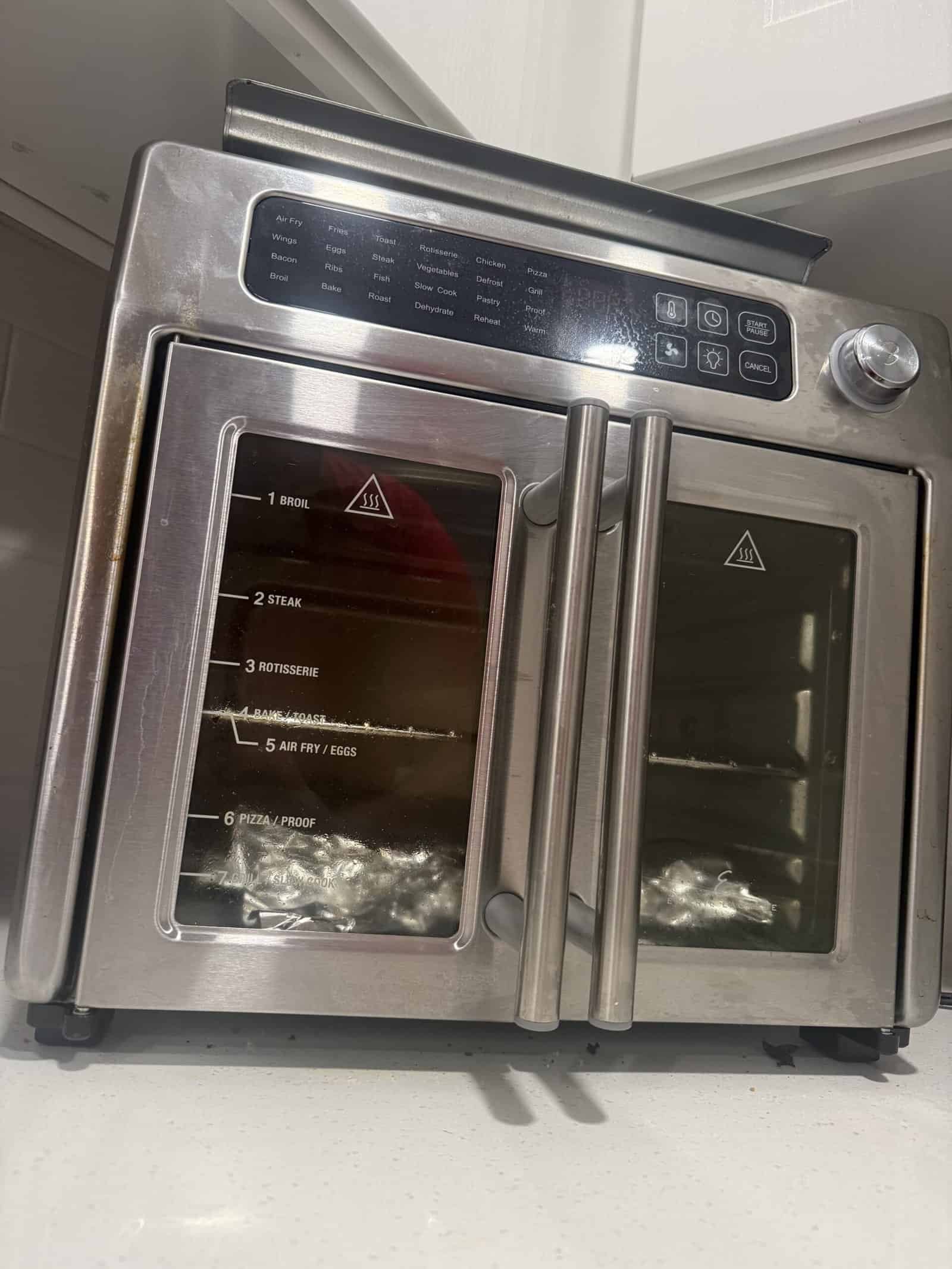
Most people buy the air fryer and then work out where it goes, which is backwards in a kitchen without spare counter. The spot determines what will fit, and deciding it first turns a vague worry about size into a measurement you can shop against.
The other thing worth settling early is whether it lives out permanently or gets put away. That single decision changes which machine makes sense more than any feature does. Our note on storing small kitchen appliances covers the put-away route.
Quick Answer
A corner is usually the best use of limited counter, since corners are awkward for prep anyway. Check cabinet clearance above and airflow behind, then measure before buying rather than after.
Key Points
- Corners waste less usable prep space than a mid-counter position.
- Clearance above matters for venting on oven-style units.
- Rear and side clearance is specified by the manufacturer.
- A machine put away between uses gets used less.
- Outlet position constrains placement more than people expect.
Corners Are Usually the Answer
Corner counter is the least useful part of a small kitchen for prep, because you cannot stand square to it and reaching the back is awkward with anything in your hands. That makes it the natural home for something that sits still and gets approached rather than worked at.
Putting an appliance mid-counter costs you the most valuable stretch of working surface, which is the run between the sink and the stove where most actual cooking happens. Losing that to a machine that sits still is the worst trade available in a small kitchen.
A corner also means only one side is exposed, so the machine intrudes less visually in a small room. Our note on organizing a small kitchen covers the wider layout question.
Clearance Above
Air fryers vent hot air, and where it goes depends on the design. Basket units generally vent at the rear, while oven-style machines often vent upward or from the top rear.
Manufacturers specify a minimum clearance, and it varies enough between models that checking yours matters rather than assuming a general figure applies. Under-cabinet placement is extremely common and it needs that number confirmed rather than estimated.
The practical concern with cabinets above is steam and heat over time affecting the finish, particularly on painted or veneered doors. Whether that becomes a problem depends on the unit, the clearance, and how often it runs.
Clearance Behind and Beside
Rear clearance matters most on basket units that exhaust backward, since pushing one flat against a wall restricts the airflow the machine depends on to work properly and to shed its own heat.
Side clearance is usually less critical than rear clearance and is still specified by most manufacturers. It also affects whether you can open the door or pull the basket out without shifting the machine along the counter first.
Door swing is the part people forget on oven-style units. A French door design opens outward in two halves, and it needs room in front rather than above, which matters in a galley kitchen or opposite an island where the opposing counter is close.
Where Mine Lives
Mine sits in a corner on the counter, permanently, right next to the indoor grill. It is an Emeril Lagasse French Door oven, which is a large machine, and I cook on it nearly every day.
There is a cabinet directly above it and the venting has never bothered me. That is one machine in one kitchen rather than a general rule, and it is the specific worry people raise most about oven-style units under cabinets.
The corner placement is the part I would recommend to anyone. It is counter I was not using productively, the machine has one exposed side, and the working stretch between the sink and the stove stayed clear.
What I would say about the size question is that I chose a large machine in a kitchen where space is not generous, and I would do it again without hesitating. It is the one appliance I would keep over anything else, because it does enough jobs that it earns the footprint several times over.
Out Permanently or Put Away?
Leave it out if
You use it more than a couple of times a week. Anything you have to lift out of a cupboard gets used less, and air fryers are bought precisely because they are quick.
Put it away if
It is genuinely occasional, or the counter is needed for something else daily. A machine used monthly does not deserve permanent space.
The honest test
Think about the last appliance you stored away in a cupboard and how often you genuinely went and retrieved it. That number is the realistic frequency rather than the one you intended when you bought it.
Weight decides feasibility
Oven-style units are heavy enough that putting them away is not realistically practical, which makes the placement decision permanent from the day it arrives. Our roundup of countertop appliances worth the space covers that trade.
Practical Constraints People Miss
Outlet position limits placement more than the counter does. Air fryers draw substantial current and should go into a wall outlet directly rather than through an extension lead, which rules out any spot without one.
Cord length is short on most units, often deliberately for safety reasons, so the machine has to sit near an outlet rather than wherever the counter happens to be free.
Under-cabinet lighting and anything mounted low can also interfere with an oven-style unit’s height. Measuring the actual vertical gap rather than the counter depth catches this.
Our roundup of surge protectors and power strips covers the power side.
Measuring Before You Buy
Counter depth available
Measure from the wall forward, and subtract any rear clearance the manufacturer specifies.
Vertical gap
Counter to the underside of the cabinet, then subtract the clearance figure. This is what actually rules machines out.
Width in the corner
Corners lose usable width to the adjacent run, so measure the space the machine can physically occupy rather than the wall length.
Door swing
How far the door opens forward, and whether anything is in the way when it does. Our note on choosing an air fryer covers matching a machine to a space.
Air Fryer Placement FAQ
Can an air fryer go under a cabinet?
Commonly yes, provided the manufacturer’s clearance figure is met. That figure varies by model and by whether the unit vents upward or at the rear, so checking yours rather than assuming a general number is what matters.
How much clearance does an air fryer need?
Manufacturers specify it and the requirements differ between basket and oven-style designs. Rear-venting units need space behind, and top-venting units need space above. Your manual has the figure for your machine.
Where is the best place in a small kitchen?
A corner, generally, since corner counter is awkward for prep and useful for something stationary. It also keeps the run between sink and stove clear, which is where most actual work happens.
Should I put it away between uses?
Only if you use it occasionally. Anything requiring retrieval from a cupboard gets used less, and speed is why people buy air fryers. Oven-style units are heavy enough that putting them away is impractical anyway.
Can I use an extension cord?
Air fryers draw substantial current and manufacturers generally advise a direct wall outlet. That constraint frequently decides placement more than counter space does, since a spot without an outlet is not a spot.
Will it damage the cabinet above?
It depends on the model, the clearance, and how often it runs. Heat and steam over time can affect painted or veneered doors. Meeting the specified clearance is the guidance, and a heat shield is an option where the gap is marginal.
Does an oven-style unit need more room than a basket?
Generally yes, in footprint and often in door swing, since French door designs open forward. They also tend to be heavier. What they give back is versatility, which for some kitchens justifies the space.
What if there is genuinely no counter space?
A small basket unit stored in a cupboard is the realistic option, accepting that it will be used less. The alternative is displacing something else, which is worth considering if the air fryer would replace two appliances.
For the wider picture, see our guide to how to organize your kitchen.
