
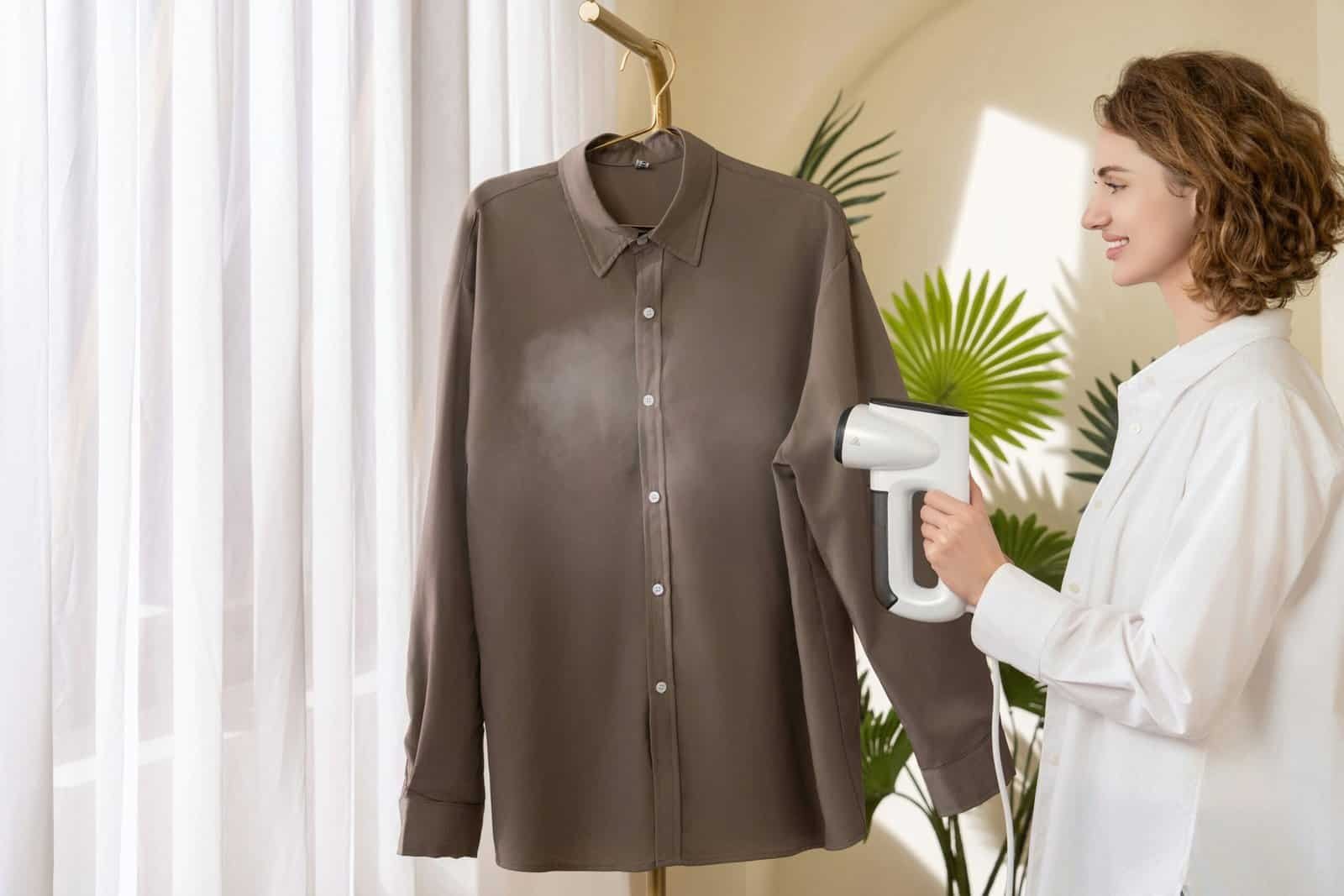
Households that mainly refresh knits and soft suiting should buy a steamer, while anyone needing a sharp collar or trouser crease should buy an iron. The clothing steamer vs iron debate sounds like a contest, yet the tools solve different problems. A steamer relaxes wrinkles, and an iron presses fabric flat.
That difference drives the whole debate. Steam loosens the bonds holding a wrinkle, so hanging cloth falls smooth beside a good rack for a small laundry room. Pressing sets a shape that lasts all day.
Quick Verdict
Pick a steamer for quick refreshes, delicate fibers, travel, and clothes that live on hangers. Pick an iron for crisp shirts, structured cotton, linen, and a weekly stack pressed in one sitting. Many households keep both, which is sensible rather than indecisive.
Key Takeaways
- A steamer relaxes wrinkles. An iron presses fabric flat and sets a shape.
- Crisp creases need pressure against a hard surface, which vapor cannot supply.
- Only vapor touches the cloth, which suits silk, knits, and soft suiting.
- Steamers pass water through constantly, so scale builds faster.
How We Compared
This comparison ranks both tools on the jobs households actually ask of them. Speed, finish quality, fabric safety, and volume throughput carry the most weight. Storage, portability, and upkeep round it out.
No claim here rests on a wattage number or a heat-up time, since those vary by model.
Clothing Steamer vs Iron at a Glance
| Criterion | Clothing steamer | Steam iron |
|---|---|---|
| Two garments, fast | Faster, no board | Slower setup |
| Crisp creases | No sharp line | Sets a sharp line |
| Delicate fibers | Safer, vapor only | Plate may scorch |
| Full basket | Slow and tiring | Efficient at volume |
| Storage and travel | Compact, packable | Board stays home |
| Upkeep | Scale builds fast | Occasional descaling |
Clothing Steamer, Pros and Cons
PROS:
- Works on the hanger, so no board is needed.
- Only vapor touches the fabric, protecting delicate weaves.
- Handles pleats, ruffles, and gathered sleeves easily.
- Handheld models fit a drawer or a suitcase.
CONS:
- Cannot create a sharp crease or stiff collar point.
- Needs the garment held taut, or vapor drifts past.
- Small tanks run dry during longer sessions.
- Scale builds faster because water passes through constantly.
Best for: knits, silk, and soft suiting. Skip it if the wardrobe runs to crisp button-downs. Start with these best clothing steamers.
Steam Iron, Pros and Cons
PROS:
- Produces genuinely crisp collars, plackets, and trouser creases.
- Flattens heavy cotton and linen that vapor barely moves.
- Moves fast through a stack once set up.
- Upkeep stays simple, usually a descale and wipe.
CONS:
- Requires a board and cleared space every time.
- Plate contact can scorch or shine fine fibers.
- Struggles with ruffles, gathers, and structured shoulders.
- Too bulky to travel with in practice.
Best for: office shirts, uniforms, and a weekly pile pressed at once. Skip it if most garments are fine. Sorted laundry helps, so use good hampers and baskets.
Which Is Faster for a Couple of Garments?
The steamer wins here, and the gap is wide. There is no board to unfold, no cover to smooth, and no long wait before the first pass. Fill the tank, wait briefly, then work the garment while it hangs.
An iron adds several setup steps before any fabric gets touched. The board comes out, the space gets cleared, and each panel gets positioned by hand. That overhead often costs more time than pressing the two shirts themselves.
Winner: the steamer, for small jobs handled on the hanger without clearing a surface.
Which Produces a Genuinely Crisp Finish?
The iron wins, and no amount of steam changes that. A crease is a fold set into the fibers, and setting one takes three things. Heat softens fibers, moisture makes them pliable, and pressure against a firm surface locks the shape.
A steamer supplies heat and moisture but no pressure, and it works on loose hanging cloth. Wrinkles relax, so a garment looks tidy rather than sharp. Structured cotton and linen show that difference most clearly.
Winner: the iron, for anyone who wants a knife edge on a trouser leg.
Which Is Safer on Delicate Fabrics?
The steamer wins on fabric safety, and by a clear margin. Only vapor reaches the cloth, so no hot plate presses color and texture flat. Silk, fine knits, velvet, and soft suiting come through without the shine that direct plate contact can leave behind.
Technique still matters more than people expect. The garment must hang, and one hand should pull the hem to create tension. Slack fabric simply moves with the vapor instead of releasing its wrinkles.
Winner: the steamer, especially with slow downward passes held slightly off the surface.
Which Handles a Full Basket of Laundry Better?
The iron wins on volume, and the margin grows with the pile. Once the board is up, that setup cost is already paid, and each extra shirt moves quickly. Panels lie flat, both hands stay free, and no tool has to be held at shoulder height.
Steaming a full basket feels different. Every garment gets hung, tensioned, and worked top to bottom while the tank drains. Arms tire, refills break the rhythm, and heavy cotton resists vapor anyway.
Winner: the iron, which pairs well with a compact laundry sorter on big wash days.
Which Is Easier to Store and Travel With?
The steamer wins on both counts, and it is not a close call. A handheld unit fits in a drawer, a carry-on, or a shelf beside the closet. Even standing models collapse into a slim footprint against a wall.
An iron is only half the equipment. The board is the bulky part, and it wants wall space, a closet slot, or a gap behind a door. Travel rules it out, since packing a board is not realistic.
Winner: the steamer, which suits homes already stretched for closet organizers and storage.
Which Needs Less Maintenance?
The iron generally wins on upkeep. Both appliances turn tap water into steam, and both leave mineral deposits behind. The difference is volume, since a steamer pushes water through continuously while an iron releases bursts.
That constant flow concentrates scale faster, which shows as weak output, spitting, or white flecks on dark cloth. Distilled water comes up so often for this reason, since it carries almost no dissolved minerals. Hard water areas notice first.
Winner: the iron, much as fixing a root cause beats masking it when towels smell after washing.
Which Fits Your Situation
| If this is you | Better choice |
|---|---|
| Wardrobe of crisp button-down shirts | Steam iron |
| Closet of knits, silk, and soft suiting | Clothing steamer |
| Two garments to refresh before leaving | Clothing steamer |
| A full basket pressed every Sunday | Steam iron |
| Frequent traveler living from a suitcase | Handheld steamer |
How to Choose Between Them
Start with the fabrics that actually hang in the closet. Structured cotton and linen want an iron, since those fibers hold a wrinkle hard. Knits, silk, suiting, and anything that shines under heat want a steamer.
Then count the garments in a typical session. A handful on hangers suits a steamer, and a weekly stack suits an iron.
Many households land on both, which is legitimate rather than indecisive. That choice often firms up when people organize a laundry room.
The Verdict
The steamer wins speed, fabric safety, and portability. The iron wins crispness, volume throughput, and lower upkeep.
Buy the steamer if the wardrobe leans soft and quick refreshes matter most. Buy the iron if sharp collars and creases are non-negotiable. Buy both if the closet holds everything.
Recommended Reading
Fabric care rarely stops at wrinkles, so keep good stain removers handy. Storage decides how often either tool gets used, so solid shoe racks and storage help. Closet access matters too, so learn to put a sliding door back on track.
Common Misconceptions
A Steamer Fully Replaces an Iron
It cannot, and the reason is physical rather than a quality issue. Setting a crease takes pressure, and a steamer applies none. Expect relaxed fabric, not pressed fabric.
Any Water Works in a Steamer
Tap water carries minerals that stay behind when water turns to vapor. Those deposits collect in the tank and vents, and output weakens. Distilled water sidesteps most of that.
Owning Both Means a Wasted Purchase
Two tools that do different jobs are not redundant. Mixed wardrobes use whichever suits the garment in hand. That is efficient, not wasteful.
Clothing Steamer vs Iron FAQ
Is the clothing steamer vs iron choice really an either-or decision?
Not for most households. A steamer relaxes wrinkles on hanging garments, while an iron presses fabric flat with pressure. Wardrobes built on knits and soft suiting run fine on a steamer alone, and mixed closets are best served by keeping both.
Can a steamer put a crease in dress pants?
No, and that is a limit of physics, not power. A crease needs heat, moisture, and firm pressure working together against a hard surface. A steamer supplies the first two against loose cloth, so the result is smoother fabric with no sharp line.
Which fabrics should never meet a hot iron plate?
Fine silk, many synthetics, velvet, and delicate knits react badly to direct plate contact. Heat can scorch the surface or leave permanent shine on dark colors. A steamer avoids the problem, and a pressing cloth helps when only an iron is available.
Why does a steamer work poorly on heavy cotton?
Heavy cotton and linen hold wrinkles through tightly packed fibers. Vapor softens the surface but delivers no force to flatten the weave, so the wrinkle relaxes and then returns. Pressing those fabrics against a firm board gives a result that lasts far longer.
Does distilled water actually matter?
It matters most in hard water areas, especially for steamers. Minerals in tap water stay behind as scale when water becomes vapor, which weakens output and can spit white flecks onto clothing. Distilled water carries almost none, so the problem builds much more slowly.
How should a garment hang while being steamed?
Hang it on a sturdy hanger at roughly chest height. Hold the hem or a side seam and pull gently to create tension, then move the head down the taut panel in slow passes. Loose fabric absorbs the motion instead of the vapor.
Is a handheld steamer good enough, or is a standing model better?
Handheld units suit frequent travel, small wardrobes, and quick touch-ups between wears. Standing models hold more water and give steadier output for longer sessions at home. Neither adds pressure, so the choice comes down to session length and available storage space.
