
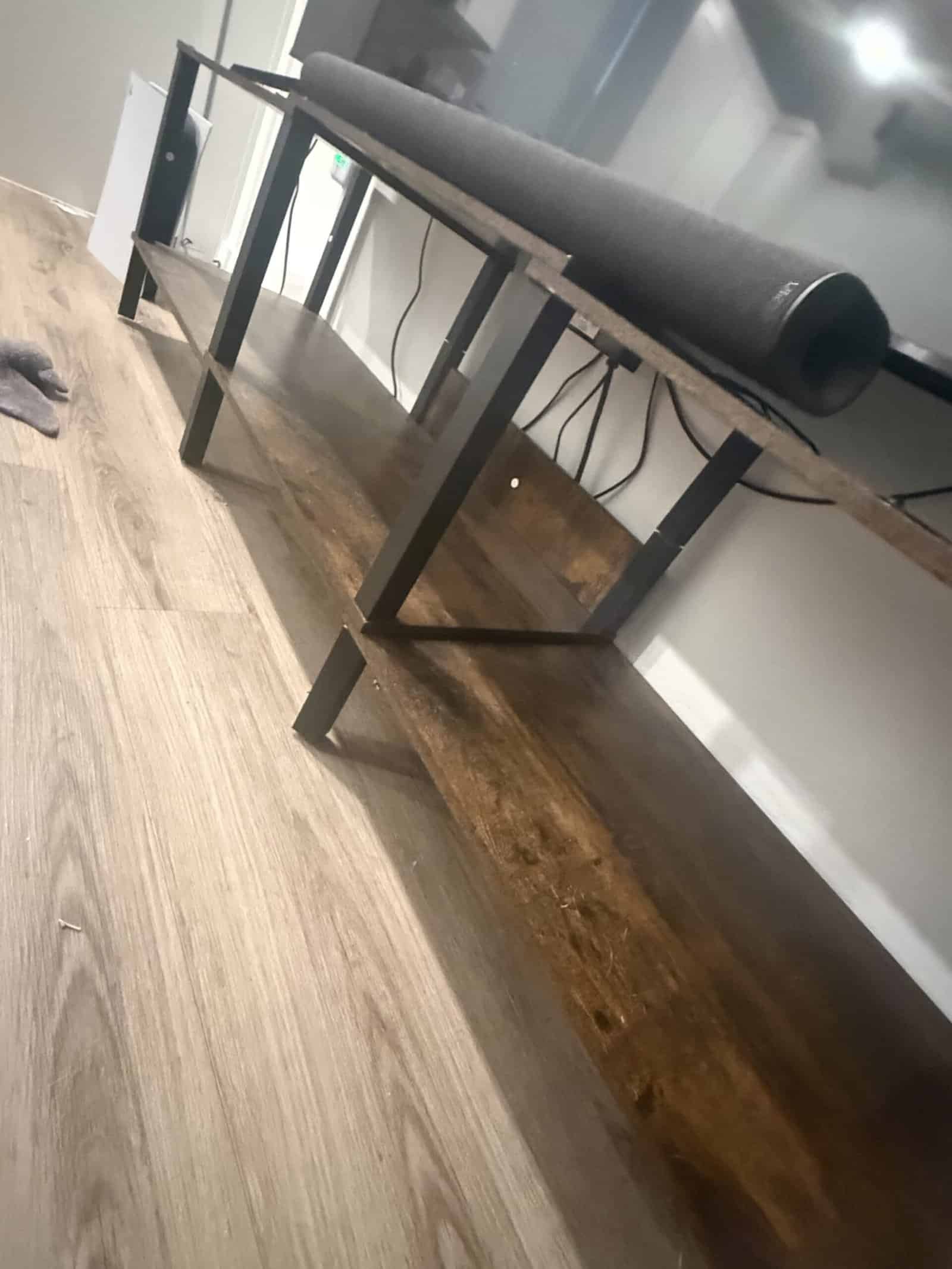
Yes, an enclosed cabinet measurably changes what a soundbar sounds like, mostly by muffling high frequencies and boosting a narrow band of bass until speech gets harder to follow. Whether a soundbar sounds worse inside a cabinet depends on how enclosed it is, since a shelf with an open front behaves very differently from a cabinet with a solid door. The high frequencies that carry consonants are the first thing you lose.
That matters more than the bass change, because dialogue intelligibility lives in the treble. Our guide to why music drowns out dialogue covers the broader version of that problem.
Quick Answer
A soundbar in a cabinet with a closed door loses treble detail and gains boomy mid-bass, which together make speech harder to understand. An open-front shelf costs you far less, mainly some high-frequency dispersion if the opening is shallow. If the bar must live in a cabinet, take the door off or leave it open during use, and pull the bar to the front edge of the shelf.
Key Takeaways
- Treble is directional and blocks easily; bass passes through almost anything.
- Closed doors cost dialogue clarity more than they cost volume.
- An enclosed space adds a resonant bass hump rather than useful low end.
- Moving the bar to the front edge of a shelf recovers most of the loss.
- Glass doors are worse than fabric or mesh ones.
- Enclosure also traps heat, which matters for an amplified bar.
What Enclosure Does, Frequency by Frequency
| Placement | Treble | Bass | Dialogue Clarity |
|---|---|---|---|
| Open surface, nothing around it | Full | Neutral | Best available |
| Open shelf, bar at front edge | Near full | Slight lift | Very good |
| Open shelf, bar pushed back | Reduced | Noticeable lift | Softer |
| Cabinet, door open | Reduced | Resonant lift | Softer |
| Cabinet, mesh or fabric door | Dulled | Resonant lift | Poor |
| Cabinet, solid or glass door | Heavily muffled | Boomy | Worst |
Why Treble Suffers and Bass Does Not
High frequencies travel in a relatively narrow beam and reflect off almost any hard surface. Put a panel between the drivers and your ears and those frequencies bounce around inside the cabinet instead of reaching you.
Low frequencies behave the opposite way. Their wavelengths are long enough to pass through thin panels and diffract around edges, so the bass arrives largely intact no matter where the bar sits.
The result is not a quieter soundbar but a differently balanced one. You get the bass and lose the detail, which is exactly the balance that makes speech hard to follow. People describe it as the bar sounding muddy, and what they are hearing is the treble missing rather than the bass added.
Enclosure adds one more thing. A box of trapped air has its own resonant frequency, and the bar excites it, producing a one-note thump around that pitch. That is why cabinet bass often sounds boomy rather than deep.
What My Own Setup Tells Me
My soundbar is an all-in-one VIZIO and I have had it about two years. It sits on an open-shelf wood stand with two levels, out in the open with nothing in front of it, and it connects over Bluetooth.
So I do not have the enclosed-cabinet version of this problem to report on, and everything above about closed doors is research rather than my experience.
Here is the part worth knowing anyway. Even on a fully open shelf, with no door and nothing blocking the drivers, music still comes through louder than dialogue on mine. That tells you enclosure is not the only cause of poor dialogue clarity, and taking a cabinet door off will not fix a balance problem that was already there.
I also run it without a separate subwoofer, which our guide to whether you need a subwoofer covers. An all-in-one bar has less bass to begin with, so the cabinet resonance effect would hit it differently than it would a bar with a sub.
Fixes That Work Without Moving the Furniture
Take the door off
The single biggest improvement available, and on most cabinets it is two hinge screws. Store the door and put it back if you ever sell the unit. Nothing else recovers as much treble for as little effort.
Pull the bar to the front edge
Bringing the bar forward so its front face sits flush with or slightly past the shelf edge lets the drivers fire into the room instead of into the opening. This is free and it recovers a surprising amount.
Angle it upward slightly
A thin shim under the back edge tilts the drivers toward ear height. Combined with a forward position it changes the character noticeably. Keep the tilt small so the bar stays stable.
Damp the cabinet interior
Lining the inside back and sides with felt or acoustic foam reduces the internal reflections that muddy the sound. It does nothing for a closed door blocking the output, so do this after the door question is settled.
Move the bar out entirely
A riser above the cabinet or a wall mount below the screen removes the problem rather than mitigating it, and our guide to soundbar wall mount brackets covers the hardware.
The Heat Problem Nobody Mentions
Soundbars contain amplifiers, and amplifiers make heat. A bar in a closed cabinet with a streaming box and a console alongside it sits in a warm pocket with no airflow.
Sustained heat shortens the life of the power supply and can push the bar into thermal protection during loud passages. Leave clearance above and behind, keep vent slots unobstructed, and give a closed cabinet some ventilation if it holds more than one powered device.
This applies to the shelf case too, just less severely. Check what the vents on your bar look like and keep that face clear.
Better Placements, Ranked
If you have any freedom in where the bar goes, the order is straightforward. In front of the TV on an open surface at roughly ear height is best, a wall mount below the screen is close behind, an open shelf with the bar at the front edge is very good, and a closed cabinet is last.
Shelf placement below the TV is a common compromise and it works well when the opening is generous, which our guide to putting a soundbar on a shelf below the TV covers in detail.
Room size interacts with all of this, since a small room already loads the bass. Our guides to soundbars for small rooms and choosing a soundbar cover that, and whether a soundbar blocks the remote sensor covers the other consequence of moving it forward.
Frequently Asked Questions
Does a soundbar sound worse inside a cabinet?
Yes, and the loss is concentrated in the high frequencies that carry speech detail. A solid or glass door muffles treble badly while bass passes through and gains a resonant boom. An open-front shelf costs far less than a closed cabinet does.
Is it the door or the cabinet that causes the problem?
Mostly the door. An open cabinet with the bar near the front edge sounds close to an open shelf, while the same cabinet with a closed door is the worst placement on the list. Removing the door is the highest-value fix.
Are glass doors worse than fabric ones?
Yes. Glass reflects high frequencies almost completely, while fabric and mesh let some of them through and absorb rather than reflect. Neither is as good as no door.
Will moving the soundbar forward on the shelf help?
Noticeably. Bringing the front face flush with or past the shelf edge lets the drivers fire into the room rather than into the shelf opening. It costs nothing and it is the first thing to try.
Does a cabinet give a soundbar more bass?
It gives it more of one particular bass note rather than more useful low end. The trapped air has a resonant frequency and the bar excites it, which reads as boomy instead of deep. Damping the interior helps some of that.
Can a cabinet cause dialogue problems on its own?
It can make them considerably worse, and it is not always the cause. Plenty of soundbars on fully open shelves still play music louder than speech, which points at the bar’s own balance or the source mix. Rule out placement first because it is free, then look at the bar.
Should you worry about heat in a closed cabinet?
Yes, especially with other powered devices in the same space. Amplifiers make heat and a closed box has no airflow, which shortens component life and can trigger thermal protection. Leave clearance and keep vents clear.
What is the best placement for a soundbar?
On an open surface in front of the TV at roughly ear height, or wall mounted just below the screen. An open shelf with the bar at the front edge is a good third. A closed cabinet is the placement to avoid if you have any alternative.
