
Reheat leftovers at a moderate temperature for a short run, check them early, and give the food room rather than stacking it. Learning to reheat leftovers in an air fryer is mostly about accepting that the machine dries the surface while it warms the middle, which is exactly why fried and roasted food comes back from it properly. A microwave does the opposite and steams the crust soft.
That difference is the whole argument for the method, and it also explains where it fails. Anything saucy or soupy has nothing to crisp, so it just dries out. Our comparison of air fryers that replace a microwave covers how far you can take this.
The Short Version
Set a moderate temperature rather than a high one, spread the food in a single layer, and start checking well before you think it is done. Most portions need only a few minutes. Breaded and roasted food comes out better than it went in, while sauces, soups and anything with a wet coating belong in a pan.
Key Points
- Moderate heat warms the middle before the outside overcooks.
- A single layer is the difference between crisp and steamed.
- Check early, because reheating goes from cold to dry quickly.
- Skip it for sauces, soups and delicate fish.
- Cold food from the fridge reheats more evenly than frozen.
Reheating Leftovers, Step by Step
- Take the food out of the fridge while the machine comes up to temperature. Less of a cold center to fight.
- Set a moderate temperature. High heat browns the outside before the middle has warmed up at all.
- Spread the food in one layer with gaps between pieces. Overlapping pieces trap moisture and steam each other.
- Start with a short run and check it. Reheating is a different job from cooking, and the window is narrower.
- Shake the basket or turn the pieces halfway if the machine is a basket style. Oven-style units need less of this.
- Add short runs until it is hot through, rather than one long run. You cannot undo dry.
- Let it sit a minute before eating. The surface firms up as it cools slightly.
Why Hot Air Beats a Microwave on Texture
A microwave heats the water inside food, so moisture moves outward and collects at the surface. That is why a slice of pizza comes out hot and limp, with a base that has gone soft.
Moving hot air does the reverse. It carries moisture away from the surface while warming the food through, so the crust dries and firms instead of softening.
That is also the limit of the method. Food with no crust to recover gets nothing from the trade and loses moisture it needed, which is why the food list below matters as much as the technique.
What Reheats Well and What Does Not
| Food | How it does | What to watch |
|---|---|---|
| Fries and wedges | Excellent, often better than fresh | Single layer, no crowding |
| Fried chicken and wings | Excellent | Skin crisps fast, middle lags |
| Pizza slices | Very good | Base crisps, cheese can split |
| Roast vegetables | Very good | Small pieces dry out quickly |
| Breaded fish or cutlets | Good | Thin pieces go from warm to dry fast |
| Steak and chops | Workable | Lower heat, short runs, expect more doneness |
| Rice and pasta, plain | Poor | Dries out, needs a splash of liquid and a lid |
| Saucy dishes, curries, soups | Avoid | Nothing to crisp, sauce separates |
| Delicate fish fillets | Avoid | Dries before it warms through |
| Anything in a wet batter | Avoid | Batter never re-sets |
If most of your leftovers sit in the bottom half of that table, the machine is not the right tool and a pan on the stove will serve you better. Our list of what to cook in an air fryer follows the same logic from the cooking side.
How I Actually Do It
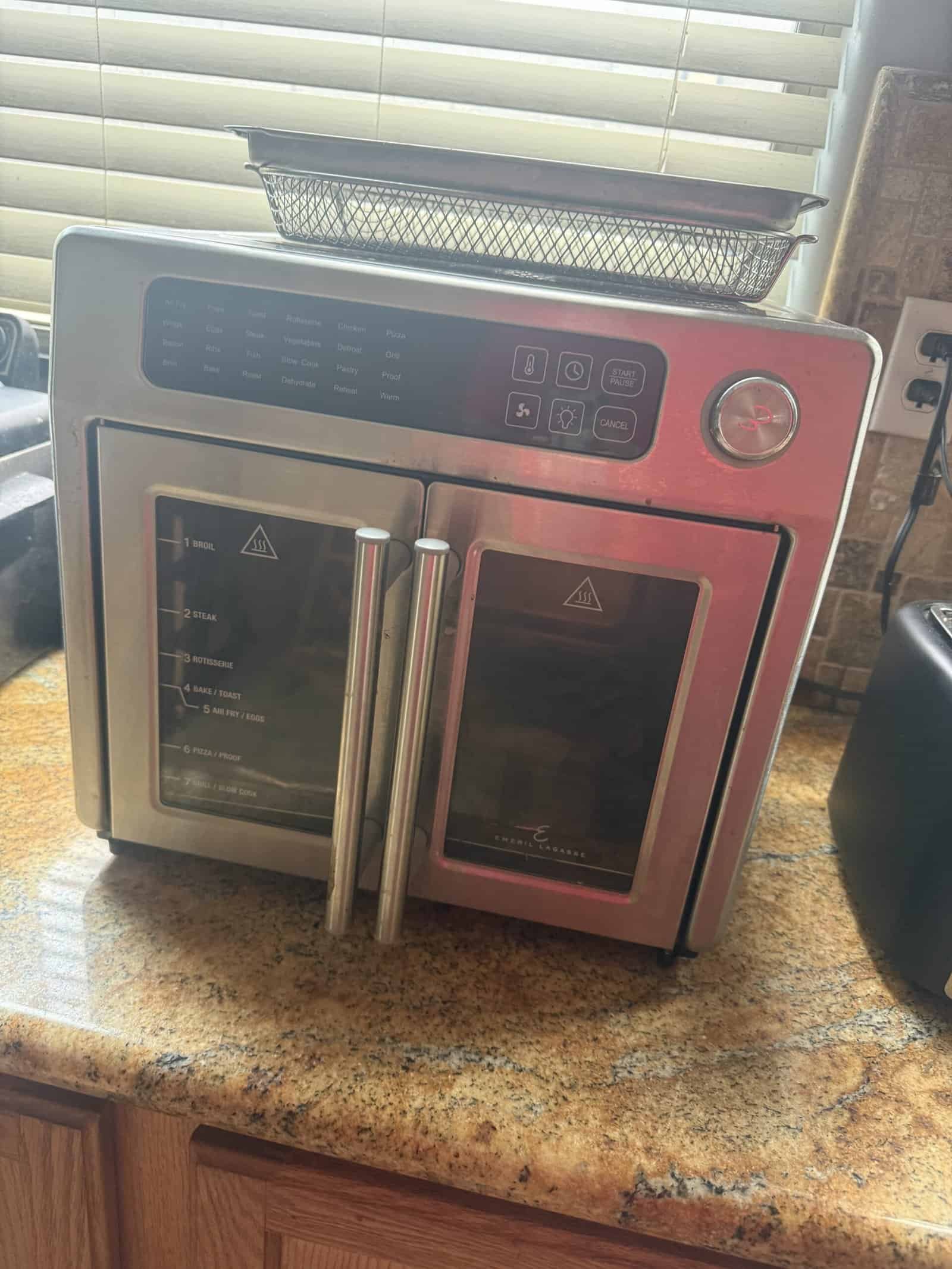
I run an Emeril Lagasse French Door air fryer, the oven-style combo with the double doors. I have cooked on it for years and still reach for it almost daily.
Leftovers go in it instead of the microwave. I use mine for reheating and prefer it, which surprised me, because leftovers come out with texture rather than steamed soft.
My honest method is not a recipe. It depends on the food and I eyeball it, which is to say I put it in, watch it, and pull it when it looks right rather than following a temperature and a timer.
It lines up with how I cook generally. Chicken and fries are what I air fry most, and I do not preheat for air frying at all, only for baking and pizza.
There is a reason the machine stays on the counter rather than in a cupboard. It sits in a corner next to my indoor grill, and it air fries, bakes and makes pizza, so most of a meal can come out of the same machine. Through an Arizona summer it also leaves the kitchen cooler than the oven leaves it.
I still own a conventional oven and still use it for big batches and baking. The split is simple: quick and crispy goes in the combo oven, volume goes in the oven. Our air fryer against oven comparison goes through that split properly.
The boundary on all of this is that my experience is one oven-style combo unit with my habits. A basket machine behaves differently, holds less, and needs shaking partway in a way mine does not.
Keeping It Clean When You Reheat Constantly
Reheating is messier than cooking in one specific way: you are putting already-cooked food with sauce and fat on it straight onto hot surfaces. Drips land on the floor of the chamber rather than in a pan.
My own routine is more relaxed than the ideal. I put the accessories through the dishwasher and use wipes for the inside, and I do not clean it on any set schedule. It gets pretty dirty and I clean it when I notice it needs it.
The honest observation after years of using it is that an oven-style unit dirties up faster than I would like. The interior has spots that are genuinely hard to reach, and that is my main frustration with cleaning it.
Two things reduce the problem. A liner or a piece of foil under the food catches drips without blocking airflow, as long as it does not cover the whole surface. And reheating on a rack over a tray keeps grease off the chamber floor entirely. Our guide to cleaning an air fryer covers the thorough version.
What Trips People Up
Reheating at cooking temperature
Food that was cooked at a high setting does not want that setting again. The outside is already done, so high heat just burns it while the middle is still cold.
Filling the basket
Crowding is the single most common reason reheated food comes out soft. Air has to reach every surface, and a piled basket is just a small steamy oven.
Walking away
The gap between warmed through and dried out is short on a reheat. Checking once halfway costs nothing and saves the portion.
Covering everything in foil
Foil over the top traps moisture, which defeats the whole reason for using the machine. Foil belongs underneath, catching drips, not across the food.
Related Reading
- Air fryers, including the oven-style combo I use
- Whether you need to preheat, which matters less on a reheat than on a bake
- Food storage containers, since how food is stored decides how well it reheats
- How long food lasts in the refrigerator
Air Fryer Reheating FAQ
What is the best way to reheat leftovers in an air fryer
Moderate temperature, single layer, short runs with a check partway. Add time in small increments rather than setting one long run, because the step from hot to dry happens fast on food that is already cooked.
Do I need to preheat before reheating
For most reheating, no. A cold start works fine and gives the middle a little longer to catch up with the surface. Preheating helps most when you want an immediate crust, such as on pizza.
Can I reheat pizza in an air fryer
Yes, and it is one of the strongest cases for the method. The base crisps rather than going leathery the way it does in a microwave. Watch the cheese, which can split if the heat is set too high.
Can I reheat rice or pasta
Poorly, on its own. Plain rice and pasta have nothing to crisp and dry out instead. If you must, add a splash of water, cover loosely, and accept a worse result than a pan or a microwave gives.
Can I put a plate or container in there
Only oven-safe dishes, and they slow things down because air cannot reach the underside. Reheating directly on the rack or in the basket works better. Plastic storage containers do not belong in one at all.
Does reheating twice make food unsafe
Repeated cycles of warming and cooling are the thing to avoid, since each one gives food longer in the temperature range where bacteria grow. Reheat only the portion you are about to eat rather than the whole container.
Should I add oil when reheating
Rarely. Fried food already carries enough and extra oil makes it greasy. A very light spray helps roast vegetables and dry breaded items that have been in the fridge a few days.
Is a basket or an oven-style unit better for reheating
Oven-style units hold more in a single layer, which is the main constraint when reheating. Basket machines heat faster and suit small portions, though they need shaking partway and fill up with one plate of food.
