
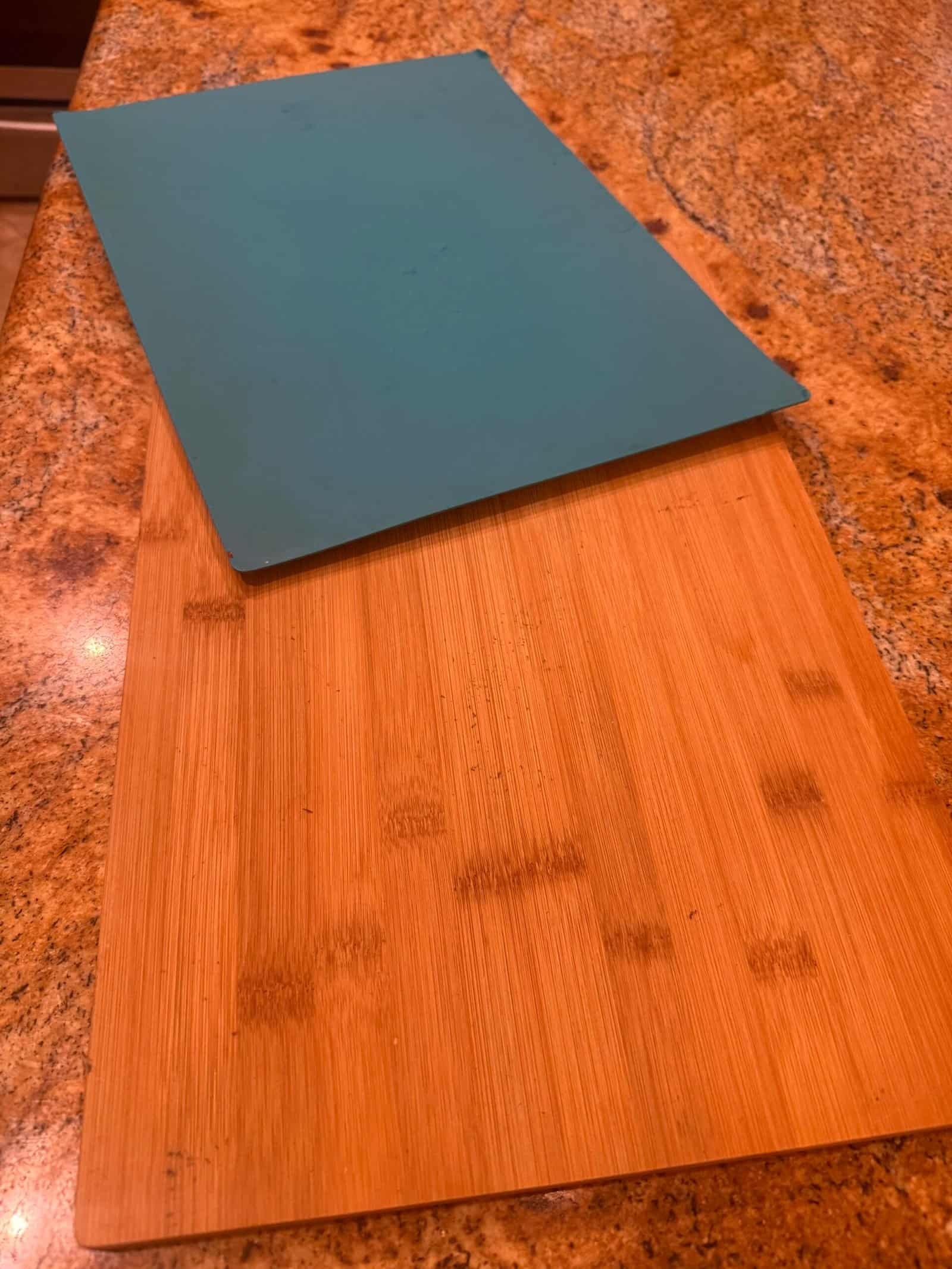
Put a damp paper towel or a thin cloth under the board. That single fix stops nearly every sliding board, costs nothing, and takes two seconds to set up. The damp layer grips both the counter and the underside of the board, and it works on wood, plastic, and glass alike.
If that is not enough, the problem is usually the board rather than the surface. Thin lightweight boards slide because there is not enough mass holding them down, and no amount of counter preparation fully solves that.
Quick Answer
A damp paper towel or thin cloth under the board stops most sliding immediately. A silicone mat or rubber shelf liner works as a permanent version. If the board still moves, it is too light for the work you are doing, and a heavier board is the real fix.
Key Points
- A damp towel underneath fixes most sliding boards instantly
- Weight matters more than any grip solution
- Thin plastic boards slide because they lack mass, not grip
- Wet counters make sliding worse rather than better
- Rubber feet and silicone corners work and wear out
- A sliding board under a sharp knife is a genuine safety problem
Fixes Ranked by Effort
| Fix | Cost | How well it works |
|---|---|---|
| Damp paper towel underneath | Nothing | Stops most sliding, needs redoing each session |
| Damp dish cloth | Nothing | Same grip, more cushion, more to wash |
| Rubber shelf liner cut to size | Low | Permanent, washable, works on any board |
| Silicone mat | Low to moderate | Excellent grip, easy to clean, takes storage space |
| Stick-on rubber feet | Low | Good until the adhesive fails, then it fails completely |
| Heavier board | Moderate to high | Solves the cause rather than the symptom |
Why Boards Slide
Three things cause it and only one of them is the counter.
Weight is the main factor. A heavy board has enough friction from its own mass to stay put through normal chopping, and a light one does not. That is why thin plastic boards move and thick wooden ones generally do not.
Moisture between the board and counter creates a film that reduces friction rather than increasing it. A wet counter under a dry board is worse than a dry counter, which is the opposite of what the damp towel trick suggests until you look at why it works.
Surface finish matters at the margins. Polished granite and sealed quartz offer less grip than a laminate counter, and a board that behaves on one surface can slide on another.
Why a Damp Towel Works
The towel is not adding water between two hard surfaces, it is adding a soft layer that deforms slightly under pressure and grips both sides.
Paper towel fibers compress into the microscopic texture of both the counter and the board. That contact area is far larger than board-on-counter, and the damp state keeps the fibers pliable rather than slick.
Too much water defeats it. A dripping towel creates the same film problem as a wet counter, so damp rather than wet is the whole trick.
What I Use and Where It Actually Matters
My main board is a big wooden one and it does not slide. It is heavy enough to stay where I put it, including when I use the edge to scrape chopped food off, which puts real sideways force into it. I have never needed to do anything to keep it in place.
The cheaper thin plastic boards I own are a different story. Those slide a lot, and they do it under ordinary chopping rather than anything forceful. The difference between them and the wooden board is mass, and nothing about the counter changed between the two.
That is the thing worth taking from it. If your board slides and you are looking for a grip solution, check the board’s weight first. A damp towel will get a light board through a session, and it is compensating for something a heavier board would not need.
My experience covers a wooden board and several thin plastic ones on an apartment counter. It does not cover glass boards, which are their own problem, or bamboo, which sits between wood and plastic on weight.
Permanent Options
Rubber shelf liner
Cut a piece slightly smaller than the board and keep it in the drawer with it. Washable, cheap, and it lasts years. The most practical permanent fix for most kitchens.
Silicone mats
Better grip than shelf liner and easier to clean, at the cost of taking up more storage room. Worth it if the board lives out on the counter anyway.
Stick-on feet
Small rubber discs applied to the board’s corners. They work well until the adhesive gives up, usually after repeated washing, and then they fail all at once. Better on boards that never go in the sink.
Boards with built-in grip
Some boards come with rubber edges or feet molded in. That is the cleanest solution when buying new, and options sit in cutting boards for home cooks.
Why This Is a Safety Issue
A board that shifts under a knife moves the thing you are cutting while the blade is traveling. That is how people cut themselves, and it happens fastest with a sharp knife rather than a dull one.
The instinct when a board slides is to press harder with the guiding hand, which puts fingers closer to the blade and adds force to whatever happens next.
Fixing the sliding removes that entirely, and it is worth doing before the first time it matters. Checking your edge is a related habit, covered in telling if a knife is sharp.
Things That Make It Worse
Wiping the counter and putting the board straight down leaves a water film that reduces grip. Dry the counter first.
Warped boards rock rather than slide, and no grip solution fixes a board that is not flat. Wooden boards warp when washed on one side only or left to dry unevenly, and drying both faces evenly prevents most of it.
Oil and grease on the counter or the board’s underside kill friction completely. This is easy to miss because the top of the board looks clean.
When to Replace Instead
A board that slides despite a damp towel underneath is too light for what you are asking of it. That is a buying problem rather than a technique problem.
Warped, deeply scored, or cracked boards should be replaced regardless of sliding, since grooves hold moisture and bacteria in ways a flat surface does not.
Weight is the specification to check when replacing. A board you can lift with one finger will slide, whatever else it has going for it, and heavier wooden boards hold position where thin plastic ones will not.
Related Reading
- boards worth the counter space
- keeping the edge that meets the board
- storing boards and small tools
- boards meant for serving instead
- the other half of safe cutting
- matching the knife to the board
- where boards should live
Frequently Asked Questions
What is the easiest way to stop a cutting board sliding?
Put a damp paper towel or thin cloth underneath. The fibers compress into the texture of both surfaces and grip far better than board-on-counter contact. Damp rather than wet, since too much water creates a slippery film.
Why does my cutting board slide so much?
Usually weight. A light board lacks the mass to stay put under chopping force, which is why thin plastic boards move and thick wooden ones do not. Wet counters and polished stone surfaces make it worse.
Does a wet counter help or hurt?
It hurts. Water between two hard smooth surfaces reduces friction rather than adding grip. Dry the counter before putting the board down, and use a damp towel between them if you want grip.
Do rubber feet work on cutting boards?
They work well until the adhesive fails, which usually happens after repeated washing. Better suited to boards that get wiped rather than submerged, and worth checking periodically.
Is a sliding cutting board dangerous?
Yes. A board that shifts moves the food while the blade is traveling, and the instinct to press harder puts your guiding hand closer to the edge. It is worth fixing before it matters.
Will a heavier board solve it?
Usually. Mass is the underlying variable, and a thick wooden board generally stays put without any help. If you are replacing a board anyway, weight is the specification to check.
Can I use a towel with a wooden board?
Yes, though most heavy wooden boards do not need one. If yours does slide, a damp towel works the same way it does under plastic, and it will not harm the wood over a single session.
