
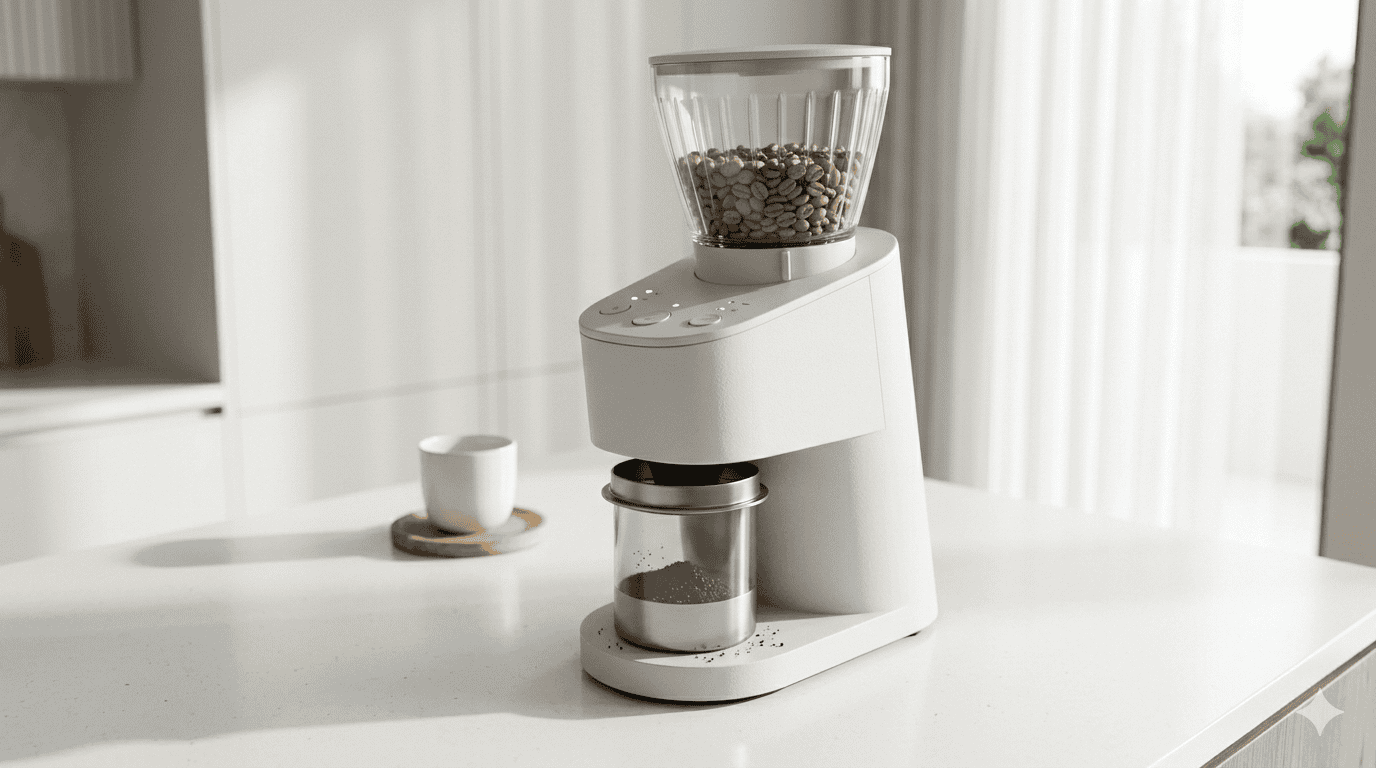
The best coffee grinders under $50 make a bigger difference to your morning coffee than any other single upgrade, including a better coffee maker.
Pre-ground coffee starts losing flavor the moment the bag is opened. Ground coffee has approximately 40 times more surface area exposed to oxygen than whole beans, which means the volatile aromatic compounds that make coffee smell and taste the way it does at its best dissipate within minutes of grinding. Most grocery store pre-ground coffee was ground weeks before you bought it. The coffee you brew from it is a pale representation of what those beans could produce.
Grinding fresh immediately before brewing changes the cup in a way that is immediately obvious from the first sip, more aroma, more complexity, and a flavor that actually reflects the origin characteristics of the bean rather than a flat generic coffee taste. And you do not need a $200 grinder to get there. Under $50, several options produce genuinely good grind consistency for drip coffee, French press, and pour-over.
If you are building out your complete coffee setup, our guides to the best coffee makers under $75 and the best electric kettles cover the rest of the equipment that pairs with a fresh grinder.
Disclosure: SmartLifeItems is reader-supported. As an Amazon Associate, we earn from qualifying purchases made through links on this page, at no extra cost to you.
What to Look for in a Coffee Grinder Under
Burr versus blade grinders is the most important distinction.
Blade grinders use a spinning metal blade, similar to a blender, that chops beans into uneven fragments. Some pieces are very fine, some very coarse, and the distribution varies randomly with each grind. Uneven grind size produces uneven extraction, the fine pieces over-extract into bitterness while the coarse pieces under-extract into sourness simultaneously. The result is a cup that is both bitter and sour, not because the beans are bad but because the grinder produced an uneven particle distribution that no brewing method can compensate for.
Burr grinders use two abrasive surfaces, one stationary, one spinning, that crush beans to a consistent size determined by the gap between the burrs. Every particle exists at the same size. Even extraction produces a cup where sweetness, acidity, and body are in balance. Under $50, you can find entry-level burr grinders that produce dramatically more consistent results than any blade grinder at any price.
Grind settings determine brewing method versatility.
Different brewing methods require different grind sizes, espresso needs very fine, drip coffee needs medium, French press needs coarse, and pour-over needs medium-fine. A grinder with only one or two grind settings limits the brewing methods you can use effectively. Look for grinders with at least 5 distinct grind settings, 10 to 17 settings provide enough range to fine-tune for different beans and brewing methods as your preferences develop.
Grind consistency determines extraction evenness.
Even within burr grinders at the under-$50 price point, consistency varies. Conical burr grinders, where a cone-shaped burr rotates inside a ring burr, produce more consistent particle sizes than flat burr grinders at equivalent price points because the conical geometry reduces the variation in how beans contact the grinding surfaces. At sub-$50 price points, conical burr grinders deliver better consistency than flat burr alternatives.
Grind retention affects freshness.
Grind retention refers to how much ground coffee remains trapped in the grinder after each use. High retention means ground coffee from your previous session enters your current brew, slightly stale grounds mixed with fresh ones. Low retention grinders deliver almost all the ground coffee into your cup with each session. For everyday home use at sub-$50 price points, this is a minor consideration, but it becomes relevant if you switch between different beans regularly.
The 5 Best Coffee Grinders Under in 2026 (with one clear reccomendation)
The Exception: Baratza Encore Conical Burr Grinder
Best Overall Coffee Grinder Under $50 | Price: ~$170
I want to be completely honest with you upfront, the Baratza Encore costs $170, which is above the $50 threshold in this article’s title. Overall, I think that it is important to include it because it is the grinder that every coffee professional recommends as the first serious grinder purchase, and understanding what it offers helps you evaluate the genuine trade-offs of the sub-$50 options below. If your budget extends to $170, stop reading here and buy the Encore.
The Encore’s 40-millimeter conical steel burrs produce a consistent particle distribution that entry-level sub-$50 grinders cannot match. The 40 grind settings cover everything from espresso to cold brew. The build quality lasts 10 years or more of daily use. Baratza’s customer service replaces individual components rather than requiring full unit replacement when parts wear. This is the benchmark that every other grinder on this list is evaluated against.
#1 Under Oxo BREW Conical Burr Coffee Grinder
Best Value Burr Grinder Under $50 | Price: ~$50
The OXO BREW sits right at the $50 ceiling and delivers the most consistent grind quality available in the under-$50 burr grinder category, a meaningful step above blade grinders and the entry-level burr alternatives below it.
The Best True Burr Grinder at This Price
The 38-millimeter conical stainless steel burrs produce a particle distribution that noticeably improves drip coffee and French press quality over blade grinders from the first use. Fifteen grind settings cover drip, French press, pour-over, and AeroPress, a sufficient range for most home brewing methods. The one-touch timer doses your chosen amount automatically, no standing over the grinder counting seconds.
The low-speed motor reduces static buildup that causes ground coffee to cling to the sides of the catch container, a practical detail that keeps your grinding area cleaner than high-speed alternatives. The removable upper burr and catch container both rinse clean under water for monthly maintenance. At $50, it is the most the under-$50 category offers in terms of genuine burr grinder performance.
PROS:
- 38mm conical stainless steel burrs produce a consistent particle distribution
- 15 grind settings cover drip through French press brewing methods
- One-touch timed dosing, automatic shutoff at chosen amount
- Low-speed motor reduces static and grounds clinging to the container
- Removable burr and container both rinse clean for easy maintenance
- OXO build quality is above average for the price
CONS:
- Sits at the very top of the $50 budget, no price flexibility
- 38mm burrs are smaller than the Baratza Encore’s 40mm, slightly less consistency at extreme grind settings
- Hopper capacity is small, requires refilling for more than 2 to 3 servings
Best for: Home brewers who want genuine burr grinder consistency for drip coffee, French press, and pour-over at the maximum available performance level under $50.
#2, Cuisinart DBM-8 Supreme Grind Automatic Burr Mill
Best Automatic Burr Grinder Under $50 | Price: ~$35
The Cuisinart DBM-8 is the burr grinder that most people buy when they decide to upgrade from a blade grinder and want to spend as little as possible doing it, and it delivers the fundamental improvement that matters most from that upgrade at $35.
The Affordable Upgrade From Blade Grinding
The flat burr design grinds more consistently than any blade grinder while remaining accessible to buyers who are not yet ready to spend $50 on a grinder. Eighteen grind settings provide more range than the OXO, from fine espresso to coarse French press, though the consistency at extreme settings is lower than the OXO’s conical burrs. The large bean hopper holds up to half a pound of whole beans, reducing how frequently you need to refill for daily brewing.
The automatic shutoff when the ground coffee container is full prevents overflow, a minor but practical feature that eliminates one common source of mess in the grinding process. The grind selector and cup selector dials make operation intuitive from the first use without consulting the manual. At $35 it is the most affordable genuine burr grinder on this list.
PROS:
- Genuine flat burr grinding at $35, most affordable burr grinder on this list
- 18 grind settings cover espresso through French press range
- Large bean hopper holds up to half a pound, less frequent refilling
- Automatic shut-off when the container is full
- Intuitive dial controls for grind size and cup amount
- Cuisinart brand reliability backed by decades of kitchen appliance manufacturing
CONS:
- Flat burr design produces less consistent particle distribution than conical burrs at equivalent price
- Plastic burrs in some components, less durable than all-steel alternatives
- Grounds container is small relative to hopper capacity
Best for: Home brewers upgrading from a blade grinder who want genuine burr grinding at the lowest possible price, particularly those who primarily brew drip coffee and French press where extreme grind precision matters less than for pour-over.
#3, Hario Skerton Pro Manual Coffee Grinder
Best Manual Coffee Grinder Under $50 | Price: ~$45
The Hario Skerton Pro is the manual grinder that serious coffee drinkers recommend to anyone who wants high-quality grind consistency at a sub-$50 price, and it delivers grind quality that outperforms electric grinders at twice the price because manual grinding mechanisms can use larger, more precisely machined burrs than the motor constraints of budget electric grinders allow.
Better Consistency Than Any Electric Grinder at This Price
The ceramic conical burrs produce a particle distribution that competes directly with the Baratza Encore at a fraction of the price, because ceramic burr machining costs are lower than steel burr machining, and the grinding mechanism is simpler without a motor driving it. The grind is noticeably more consistent than the OXO BREW or Cuisinart DBM-8 in the medium-fine to coarse range that drip coffee, pour-over, and French press require.
The trade-off is obvious, you turn the handle manually for 30 to 60 seconds per 20 grams of beans. For one cup of coffee, that is acceptable. For a full 12-cup carafe, it is tedious. The Skerton Pro is the right grinder for single-serve brewing, pour-over, AeroPress, French press for one, where the manual effort is proportional to the serving size and the grind quality improvement over electric alternatives is immediately worth it.
PROS:
- Ceramic conical burrs produce a grind consistency that outperforms electric grinders at this price
- Glass jar collection eliminates static grounds clinging to plastic containers
- Compact and portable, fits in a bag for travel or camping
- No power required, grinds anywhere
- Easy disassembly for full cleaning every few weeks
- Produces genuinely excellent results for single-serve pour-over and AeroPress
CONS:
- Manual operation, 30 to 60 seconds of grinding per serving
- Not practical for brewing more than 2 to 3 cups per session
- Grind consistency degrades at very coarse settings, better suited for medium to fine range
Best for: Single-serve coffee drinkers who make pour-over, AeroPress, or one to two cups of French press daily and want the best possible grind consistency under $50 without the tedium of manual grinding for larger amounts.
#4, JavaPresse Manual Coffee Grinder
Best Compact Manual Grinder Under $50 | Price: ~$25
The JavaPresse is the manual grinder for people who primarily want a compact, portable option for travel, camping, or office use, where the grind quality improvement over pre-ground coffee matters more than the precision difference between this and the Hario Skerton Pro.
At $25, the conical ceramic burrs produce significantly more consistent results than any blade grinder at any price, the fundamental upgrade that matters most when moving away from pre-ground coffee. The 18-grind-setting selector covers drip-through espresso ranges. The compact cylindrical design fits in a side pocket of most bags and daypacks, genuinely portable in a way that no electric grinder at any price can match.
The honest limitation is grind consistency compared to the Hario Skerton Pro, the JavaPresse’s smaller burrs and lighter construction produce adequate but not exceptional particle distribution. When you are using it for travel and camping use, where you are comparing it against pre-ground coffee or no grinder at all, the JavaPresse is a clear improvement. Using at home daily use where you are comparing it against the OXO or Hario, the additional $20 to $25 investment in those alternatives produces noticeably better results.
PROS:
- Most affordable burr grinder on this list at approximately $25
- Compact cylindrical design fits in any bag for travel and camping
- 18 grind settings cover the drip through espresso range
- Ceramic conical burrs, significantly more consistent than blade grinders
- No batteries or power required
- Easy to clean, fully disassembles in under a minute
CONS:
- Smaller burrs produce less consistent particle distribution than the Hario Skerton Pro
- Manual operation requires 45 to 90 seconds per serving at coarse settings
- Plastic components feel less durable than the Hario’s glass jar and metal body
Best for: Travelers, campers, and office workers who want fresh-ground coffee away from home, and anyone who wants the most affordable entry point into burr grinding before committing to a more expensive option.
#5, Krups GX5000 Professional Electric Burr Grinder
Best Large-Batch Burr Grinder Under $50 | Price: ~$40
The Krups GX5000 is the electric burr grinder for households that brew larger quantities, 4 to 12 cups per session, where the manual Hario and JavaPresse options are impractical, and the convenience of automatic operation justifies the slightly lower grind consistency compared to manual burr grinding.
The 17-grind-setting selector covers the French press through the espresso range. The cup selector automatically doses the correct amount for 2 to 12 cups, eliminating the guesswork of manually timing or measuring each grind session. The flat burr design at $40 produces consistent results for drip coffee and French press, the two most common brewing methods for households making multiple cups per session.
The grind consistency at medium-fine settings for pour-over is less precise than the OXO BREW or Hario Skerton Pro, if pour-over is your primary brewing method, the OXO at $10 more is the better investment. For households primarily brewing drip coffee in 4 to 12 cup quantities, the Krups GX5000 delivers the convenience of automatic operation at a fair price.
PROS:
- Electric operation with cup selector, most convenient option on this list for large batches
- 17 grind settings cover French press through espresso
- Cup selector doses 2 to 12 cups automatically
- Large bean hopper and grounds container for multi-cup brewing
- Affordable at approximately $40
- Krups brand reliability for kitchen appliances
CONS:
- Flat burr design produces less consistent particle distribution than conical burr alternatives
- Less precise at medium-fine settings, not ideal for pour-over
- Plastic components throughout, less durable than metal alternatives
Best for: Households that brew 4 to 12 cups of drip coffee or French press per session who want the convenience of automatic electric burr grinding at a budget price.
Quick Comparison: Best Coffee Grinders Under in 2026
| Grinder | Price | Type | Settings | Best For | Score |
|---|---|---|---|---|---|
| OXO BREW Conical Burr | ~$50 | Electric conical burr | 15 | Overall under $50 | 9.0 |
| Hario Skerton Pro | ~$45 | Manual conical burr | Stepless | Single-serve consistency | 9.1 |
| Krups GX5000 | ~$40 | Electric flat burr | 17 | Large batch drip coffee | 8.8 |
| Cuisinart DBM-8 | ~$35 | Electric flat burr | 18 | Affordable burr upgrade | 8.8 |
| JavaPresse Manual | ~$25 | Manual conical burr | 18 | Travel and camping | 8.7 |
Our Verdict
For most home coffee drinkers, the OXO BREW at $50 is the right choice, conical burr consistency, 15 grind settings, and automatic dosing in a compact unit at the top of the under-$50 range. If you make one to two cups of pour-over or AeroPress daily and care about grind quality above everything else, the Hario Skerton Pro at $45 produces better consistency than any electric grinder at this price through its manual ceramic burrs.
For households brewing 4 to 12 cups of drip coffee per session, the Krups GX5000 at $40 provides the most convenient automatic operation for large batches. The Cuisinart DBM-8 at $35 is the most affordable genuine burr grinder for everyday drip coffee. And the JavaPresse at $25 is the travel and camping companion that brings fresh grinding anywhere without power.
Frequently Asked Questions: Best Coffee Grinders Under
What is the best coffee grinder under $50 in 2026?
The OXO BREW Conical Burr Grinder is the best electric burr grinder under $50, 15 grind settings, conical steel burrs, and automatic dosing at the top of the budget range. For single-serve brewing where grind consistency matters most, the Hario Skerton Pro manual grinder at $45 produces better particle distribution than any electric grinder at this price through its ceramic conical burr mechanism.
Does a coffee grinder really make a difference?
Yes, a burr grinder makes a more immediate and noticeable difference to coffee quality than upgrading your coffee maker. Pre-ground coffee loses volatile aromatic compounds within minutes of grinding. Fresh-ground coffee brewed immediately retains those compounds and produces a cup with significantly more aroma, complexity, and flavor clarity. The difference is obvious from the first cup brewed with freshly ground beans versus pre-ground coffee from the same bag.
More Questions About Coffee Grinders
What grind size should I use for different brewing methods?
Espresso needs an extra-fine grind, similar to powdered sugar. AeroPress works best at medium-fine, slightly coarser than espresso. Pour-over needs medium-fine to medium, similar to table salt. Drip coffee makers work best at medium, similar to coarse sand. French press needs coarse, similar to sea salt flakes. Cold brew needs extra-coarse, the coarsest setting on most grinders. Starting at these reference points and adjusting based on taste, finer for more body and strength, coarser for lighter and cleaner, is the most efficient way to dial in your preferred grind for each brewing method.
How often should I clean my coffee grinder?
Brush out the grinding chamber and burrs after every 5 to 7 uses to remove accumulated coffee oils and fine grounds that contribute to stale flavors. Deep clean by running a small amount of uncooked white rice through the grinder, the rice absorbs coffee oils from the burrs as it grinds, then brushing out the resulting powder. Full disassembly and rinse of the burrs and collection container monthly is recommended for daily users. Never wash electric grinder components in water, moisture causes rust on steel burrs and damages the motor. Manual grinder ceramic burrs and glass jars rinse safely under cold water.
Recommended Reading
See also our guides to salt and pepper grinders. See also our guides to why do onions make you cry, paper towel holders, salad spinners, why meat needs to rest, why does brown sugar harden, olive oil grades explained, and french press vs pour over.
Related Reading
Explore more: espresso coffee grinders, manual coffee grinders, and burr coffee grinders. Also explore: egg cookers.
