
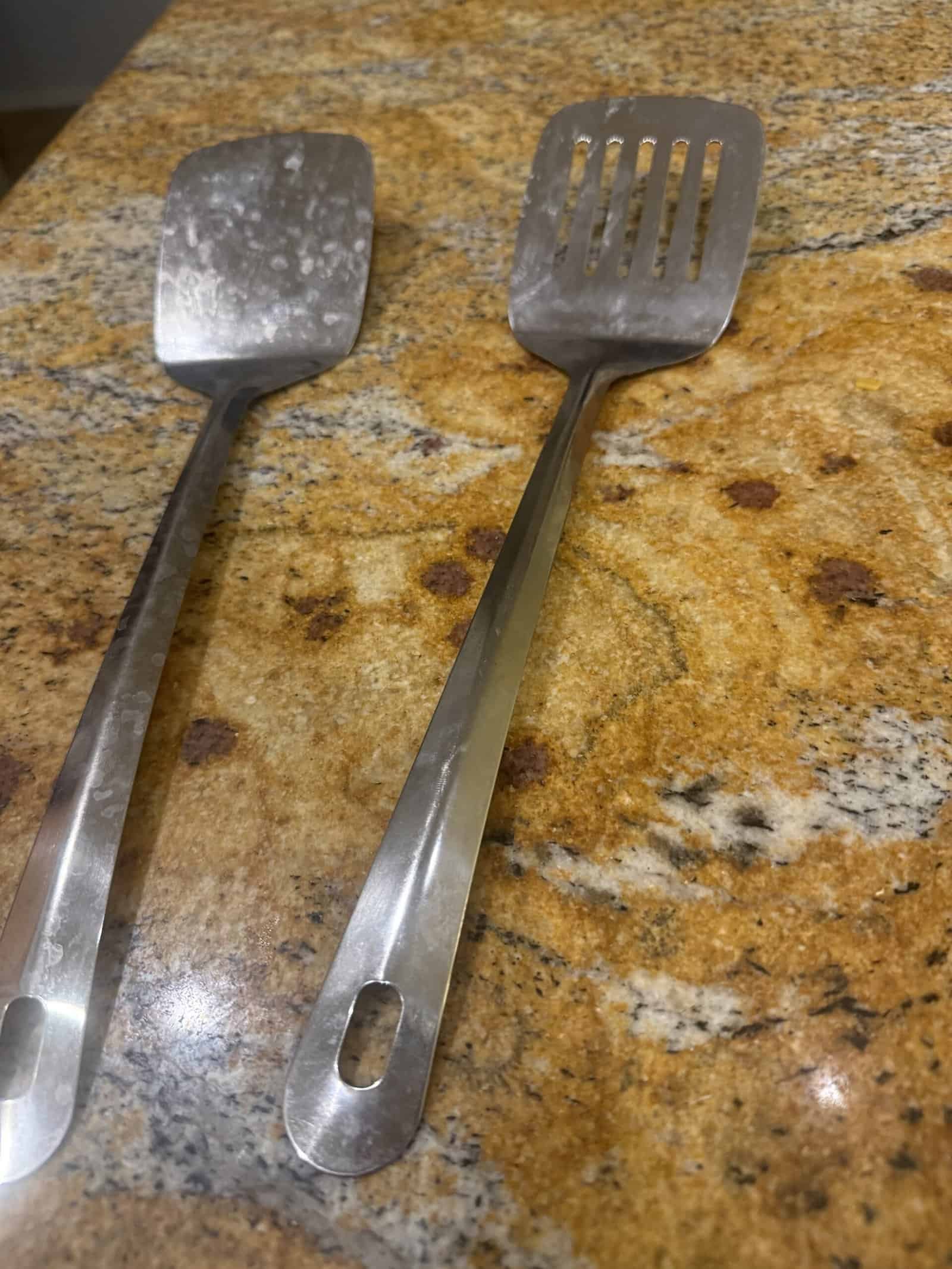
The part of a turner that matters is the front edge, and most listings do not mention it. A thin bevelled edge slides under a fried egg or a delicate fillet; a thick blunt one pushes the food across the pan instead of getting beneath it.
Everything else is comfort. Our roundup of measuring cups and spoons covers the flexible side of the category.
Types at a Glance
| Type | Best for | Watch out for |
|---|---|---|
| Slotted turner | Eggs, fish, general use | Edge thickness |
| Solid turner | Burgers, anything saucy | Suction on wet food |
| Fish spatula | Delicate items | Too flexible for heavy work |
| Offset turner | Griddles, sheet pans | Awkward in deep pans |
| Perforated | Draining as you lift | Small holes clog |
| Bench scraper | Dough, chopping transfer | Not for hot pans |
The short version: a slotted turner with a genuinely thin edge handles most of what a home cook does.
How We Picked
Selections are grouped by the task each shape actually suits, since a turner that excels at burgers is frequently poor with fish and the reverse. Edge thickness and flex carry the most weight, because those decide whether a tool works rather than how pleasant it is.
Descriptions come from documented construction and materials. First-hand experience here is one metal turner used over a number of years, which informs the durability points rather than the comparisons between shapes.
Mine Has Never Given Me a Reason to Think About It
That sounds like faint praise and it is the honest verdict on a metal turner used for years.
It comes out for grilling, and it comes out when I want something rigid rather than flexible. Those are the two jobs, and it does both without any of the failures that make people replace kitchen tools.
No bent blade, no loose handle, no discoloration that matters. Metal turners are simple enough that there is very little to go wrong, and that is worth knowing before spending on one.
What it means practically is that the money in this category buys edge geometry and handle comfort rather than durability. A cheap metal turner and an expensive one will both still be here in ten years.
Which reframes the decision. You are choosing a shape for the cooking you do, not buying longevity.
1. A Slotted Metal Turner, Best Overall
Why It Stands Out
The default for a reason. A thin front edge slides under food cleanly, and the slots let fat drain rather than carrying it onto the plate.
Enough rigidity to lift a burger and enough give to flex under an egg is the balance most cooks want from one tool.
Worth Knowing
Not for nonstick pans. Metal edges scratch coatings, and one careless scrape ruins a pan.
Edge thickness varies enormously between models at similar prices, and it is rarely stated. Our roundup of nonstick cookware covers what to avoid using it on.
This suits stainless and cast iron. Skip it entirely if all your pans are nonstick.
2. A Fish Spatula, Best for Delicate Food
Why It Stands Out
Very thin, flexible, and angled, which is exactly what getting under a fillet without breaking it requires.
The flexibility also makes it good at eggs and pancakes, so it earns space beyond the fish it is named for.
Worth Knowing
Too flexible for heavy work. Lifting a thick burger with one flexes the blade and drops it.
The thin edge that makes it work also makes it the worst offender on nonstick. Our roundup of fish spatulas covers the category in detail.
This suits anyone cooking fish or eggs often. Skip it if you mostly cook heavy items.
3. A Solid Turner, Best for Saucy Food
Why It Stands Out
No slots means nothing falls through, which matters with anything soft, saucy, or in pieces.
Also better for pressing, whether that is a smashed burger or getting a good crust on something.
Worth Knowing
Suction is the trade. A solid blade under wet food sticks to the pan surface in a way a slotted one does not.
Fat and liquid come along with whatever you lift. Our roundup of burger smashers covers the pressing job specifically.
This suits saucy cooking. Skip it as your only turner.
4. An Offset Turner, Best for Flat Surfaces
Why It Stands Out
The bend between handle and blade keeps your knuckles clear of a griddle or sheet pan, which is both more comfortable and safer.
It also lets the blade sit flat against a flat surface, where a straight turner approaches at an angle and lifts food unevenly.
Worth Knowing
Awkward in a deep pan, since the offset that helps on flat surfaces fights you against curved sides.
Griddle turners are often wider than needed for a skillet. Our roundup of cast iron griddles covers the surface these suit.
This suits griddle and sheet pan cooking. Skip it if you cook mostly in skillets.
5. A Stainless Bench Scraper, Best Non-Pan Tool
Why It Stands Out
Not a turner at all, and it does several jobs a turner is bad at: scraping a board clean, transferring chopped vegetables, and dividing dough.
Cheap, indestructible, and it takes almost no drawer space, which matters if space is your constraint.
Worth Knowing
Not for hot pans. The handle is not designed for heat and the blade is not shaped for lifting.
A sharp edge on a wooden board can gouge if you press hard. Our note on scraping a cutting board with a knife covers why this exists.
This suits anyone who preps a lot. Skip it if you rarely chop.
6. A Perforated Turner, Best for Draining
Why It Stands Out
Many small holes rather than a few slots means faster draining and better support for small or crumbling items.
Useful for anything fried where you want the oil left behind rather than carried to the plate.
Worth Knowing
Small holes clog with batter and coating, and cleaning them takes more effort than a slotted blade.
The perforations weaken the blade slightly compared with a solid one. Our roundup of kitchen tongs covers the other lifting tool.
This suits frying. Skip it if you rarely deep fry.
Why the Edge Matters More Than the Metal
Almost all of these are stainless steel, and the grade makes very little practical difference at home. What differs is how the front edge is finished.
A bevelled or tapered edge is thin enough to get under food that is stuck slightly, which is most of the difficulty in turning anything.
A blunt stamped edge pushes rather than slides. It works fine on a burger sitting loose in a pan and fails on an egg with a set bottom.
You can feel the difference with a fingertip, which is worth doing in a shop where the specification will not tell you.
Blade Width and Pan Size
A turner too wide for the pan cannot sit flat against the surface, which is the same problem as a blunt edge arriving from a different direction.
In a ten inch skillet a wide griddle turner hits the curved sides before the blade is flat, so you end up approaching food at an angle and lifting unevenly.
Too narrow is the opposite failure. A blade narrower than what you are lifting means the food folds over the edges, which matters with fish and large pancakes.
Matching the widest turner to your most-used pan rather than to your largest is the practical rule, since the largest pan comes out occasionally and the everyday skillet does not.
Slot orientation matters slightly too. Slots running along the blade drain better than slots running across it, because the fat has a path to the edge. Our roundup of cast iron skillets covers the pans these work in.
Why Cheap Turners Fail
The failure is almost never the blade. Stamped stainless is stamped stainless and it lasts indefinitely.
Handles are what go. Plastic handles attached with two rivets work loose over years of dishwasher cycles, and once a handle wobbles the tool is unpleasant to use even though nothing has broken.
Wooden handles crack if put through a dishwasher repeatedly, which most people do despite the guidance not to.
Silicone handle grips separate from the metal underneath and trap water in the gap, which is both unhygienic and impossible to fix.
One-piece stainless avoids all of it and costs very little more. Our roundup of dishwasher-safe cookware covers the same question elsewhere.
Handles and Heat
Riveted versus welded
Riveted handles are traditional and create crevices that trap food. Welded or one-piece designs clean more easily.
Handle material
All-metal handles are dishwasher safe and get hot if left resting on a pan. Plastic and silicone stay cool and have temperature limits.
Handle length
Longer keeps your hand away from heat, which matters more with cast iron and griddles than with a shallow skillet.
Balance
A blade-heavy turner is tiring to use for long. Weight distribution is hard to judge online and obvious in the hand.
What to Look For
A thin front edge
The single most useful feature and the least advertised. Check it by feel where you can.
Appropriate flex
Flexible for delicate food, rigid for heavy. One tool cannot do both well.
Cleanability
Fewer crevices means less trapped food. Riveted handles are the main culprit.
Pan compatibility
Metal on nonstick is a mistake. Confirm what your pans need before buying.
Common Mistakes to Avoid
Using metal on nonstick
One scrape damages the coating permanently, and the damage spreads with use.
Buying one turner for everything
Flex requirements genuinely conflict. A fish spatula and a solid turner do different jobs.
Ignoring edge thickness
It is the difference between a tool that works and one that pushes food around. Check it before buying.
Buying a set
Sets fill drawers with tools you will not use. Two good turners beat a block of eight. Our note on how many pots and pans you actually need covers the same principle.
Recommended Reading
See our roundup of vegetable peelers, our guide to kitchen utensil sets, our roundup of whisks, and a guide to kitchen drawer organizers.
Metal Turner FAQ
What is the difference between a spatula and a turner?
In common use they are interchangeable. Strictly, a turner has a broad flat blade for lifting and flipping, while a spatula is often the flexible scraping tool used for batter and bowls.
Can I use metal turners on nonstick pans?
No. Metal edges scratch the coating, and once damaged it degrades further with use. Silicone or nylon is the answer for nonstick.
Why does my turner not get under the food?
Almost always a thick front edge. A thin bevelled edge slides underneath where a blunt stamped one pushes the food across the pan instead.
Slotted or solid?
Slotted for general use, since fat drains and there is less suction. Solid for saucy or crumbling food where things would fall through the slots.
Do I need a fish spatula if I do not cook fish?
Many people use one as their main turner because the thin flexible blade suits eggs and pancakes. It is too flexible for heavy items like thick burgers.
Are riveted handles worse?
They trap food in the crevices around the rivets, which makes cleaning harder. Welded or one-piece construction avoids that entirely.
What is an offset turner for?
Flat cooking surfaces. The bend keeps your knuckles off a griddle and lets the blade sit flat, which a straight turner cannot do on a flat surface.
Should I buy a utensil set?
Generally not. Sets include tools you will not use and fill drawer space, and two well-chosen turners outperform a block of eight mixed-quality pieces.
