
Three pans cover most home cooking: a large skillet, a medium saucepan, and a stockpot or Dutch oven. Add a second smaller skillet and a second saucepan and you have covered nearly everything a home kitchen produces, which puts the working number at five.
Most people own considerably more than that. The gap between what sits in the cabinet and what comes out in a given month is where the storage problem starts, and it is worth measuring before buying anything else.
Quick Answer
Five pieces handle almost all home cooking: a 10 or 12 inch skillet, a small skillet, a 2 quart saucepan, a 4 quart saucepan, and a stockpot or Dutch oven. Add a sheet pan and a lid that fits more than one pot. Anything beyond that is specialisation rather than coverage.
Key Points
- Five pieces cover the large majority of home cooking
- Cabinet space, not cooking need, is what limits most kitchens
- Sets include pieces you will rarely reach for
- Two skillets matter more than two saucepans for most people
- Lids that fit several pots reduce the pile substantially
- A pan you have not used in six months is storage rather than equipment
The Five That Cover Almost Everything
| Piece | Size | What it handles |
|---|---|---|
| Large skillet | 10 to 12 inch | Searing, frying, one-pan meals, most weeknight cooking |
| Small skillet | 8 inch | Eggs, toasting spices, single portions |
| Small saucepan | 2 quart | Sauces, grains, reheating, boiling small amounts |
| Large saucepan | 4 quart | Pasta for two, soups, blanching |
| Stockpot or Dutch oven | 6 to 8 quart | Stock, braises, batch cooking, pasta for a crowd |
That list assumes you cook for one to four people. Cooking for six regularly shifts the large saucepan up a size and makes the stockpot mandatory rather than optional.
Why Sets Overshoot
Cookware sets are sold on piece count because piece count is easy to compare. A twelve-piece set sounds better than an eight-piece one, and the count usually includes lids as separate pieces.
The pieces that pad out a set tend to be the ones nobody reaches for. Very small saucepans, a second stockpot, and specialised shapes fill the box and then fill the cabinet.
Buying three good pieces individually costs about what a mediocre ten-piece set costs, and you end up using all three. Set-buying is covered in choosing cookware, and if a set is the plan anyway, sets under a hundred covers what to look for.
Storage Is the Real Constraint
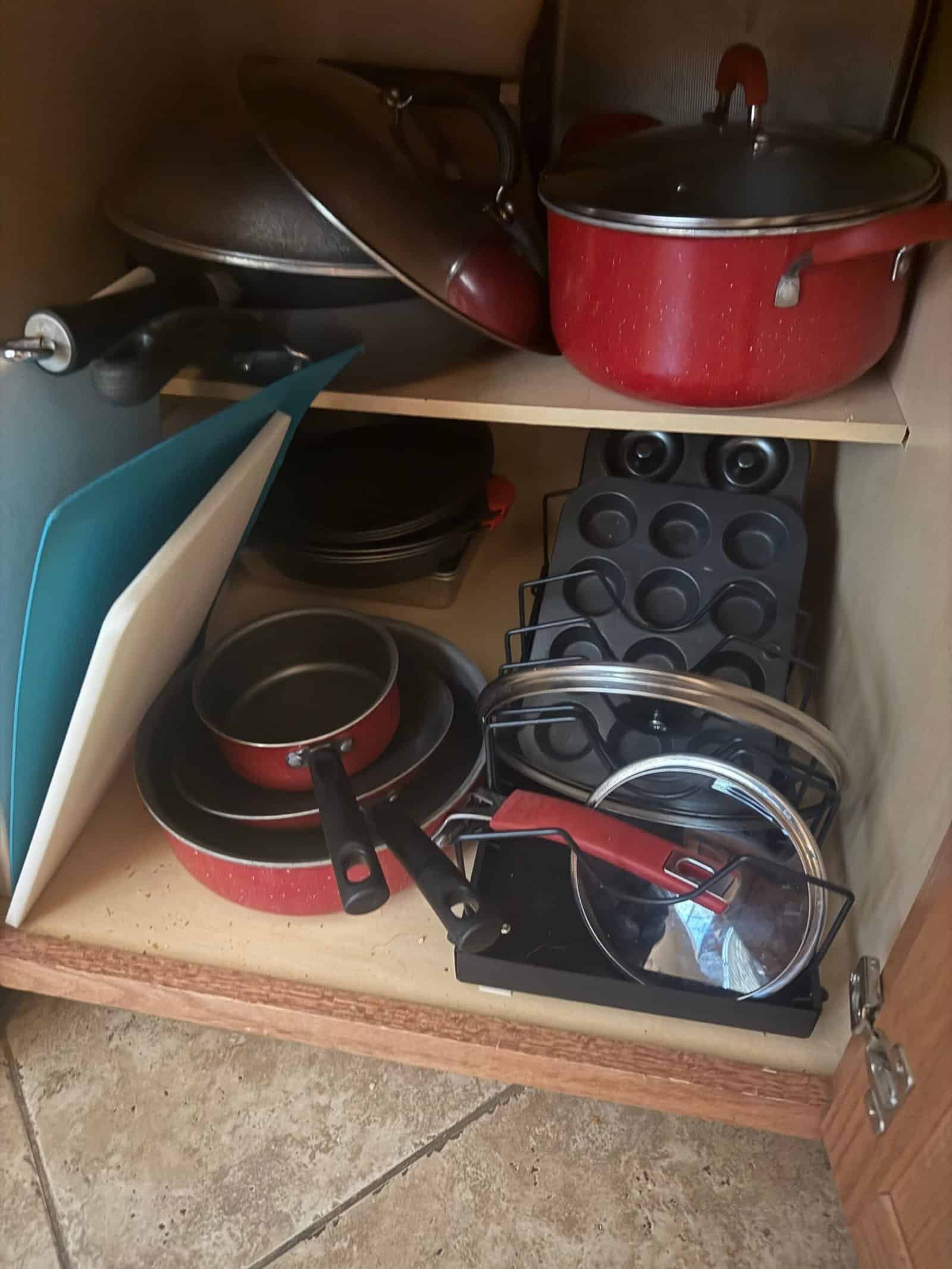
Most kitchens run out of cabinet before they run out of cooking need. Pots are bulky, awkwardly shaped, and do not stack well unless they were designed to.
That constraint should shape the buying rather than being discovered afterwards. A kitchen with two deep cabinets can hold a dozen pieces. A kitchen with one shallow one cannot, and buying as though it can produces a cabinet you dread opening.
Nesting sets and stackable designs address this directly, and they come with their own compromise, covered in stackable cookware for small kitchens.
How This Works in My Kitchen
I own around twelve pots and pans, which is roughly double what I use. There are definitely ones I never reach for, and they have been sitting there long enough that I no longer pretend otherwise.
Cabinet space is what stopped me buying more. Not a decision about minimalism, just running out of room. I also do not need any more, and those two things arrived at about the same time.
My apartment kitchen has generous counter and pantry space, so it took me a while to work out that cabinet capacity was the thing actually limiting me. It is worth checking which of your spaces is the tight one before assuming the kitchen is small overall. Mine is not small, it is unevenly distributed.
My experience covers cooking for one or two in an apartment. It does not cover cooking for a family every night, or anyone doing serious baking, where sheet pans and specialised shapes earn their space in a way they do not for me.
What to Add After the Five
A sheet pan or two
Roasting vegetables, sheet pan dinners, and anything that goes in the oven flat. The highest-value addition after the core five for most people.
A second large skillet
Useful when one is occupied and you need another surface. More valuable than a second saucepan, since skillets tend to be the bottleneck.
A cast iron skillet
Different job from a nonstick or stainless one, and it holds heat in a way the others do not. Where it fits is covered in cast iron against nonstick.
A saute pan with straight sides
Holds more liquid than a skillet, which matters for braising and pan sauces. Genuinely useful, and not before the core five.
Two Sizes That Get Bought Twice
Skillets and saucepans are where duplicates accumulate, and for different reasons.
Skillets get bought again because materials do different jobs. A nonstick for eggs and a stainless or cast iron for searing is a reasonable pair rather than a duplicate, since neither does the other’s work well.
Saucepans get bought again because sizes creep. A 2 quart and a 3 quart overlap almost completely, and most kitchens would be better served by a 2 quart and a 4 quart with a real gap between them.
What to Skip
Very small saucepans under a quart get used for melting butter and little else, and a small skillet does that job.
Single-purpose pans deserve suspicion. Egg pans, pancake pans, and similar shapes duplicate what a small skillet already does, and they take up the same cabinet space as something more useful.
Duplicate sizes accumulate without anyone deciding to buy them. Two 10 inch skillets in different materials is defensible; three is a cabinet problem.
Working Out Your Own Number
Pull everything out and look at what has a film of dust on it. Anything untouched in six months is storage rather than equipment, and it is occupying space something else could use.
Then count how many pans you have going at once during your most involved meal. That number, plus one, is roughly what you need in active rotation.
Material matters less than quantity here. A well-chosen five in mixed materials beats twelve of anything, and the material question is separate, covered in nonstick against stainless.
Enough Versus Too Many
Enough looks like every piece coming out at least monthly, room to put things away without stacking awkwardly, and being able to reach what you want without moving three other things first.
Too many looks like pans you have to shift to get at other pans, pieces you cannot remember using, and a cabinet you brace yourself before opening. That is a storage problem wearing the costume of a cooking problem, and buying an organizer rarely fixes it.
Related Reading
- choosing pieces individually
- cookware built to nest
- making the space you have work
- what a budget set includes
- which large pot to own
- checking what can go in the oven
Frequently Asked Questions
What is the minimum cookware for a kitchen?
A 10 or 12 inch skillet, a 2 quart saucepan, and a stockpot or Dutch oven handle most cooking between them. Add a small skillet and a larger saucepan and you have covered nearly everything a home kitchen produces.
Should I buy a cookware set or individual pieces?
Individual pieces if you can. Sets are priced on piece count, and the pieces padding out the count tend to be ones you rarely reach for. Three good pans cost roughly what a mediocre ten-piece set does.
How many skillets do I need?
Two covers most situations, a large one for the bulk of cooking and a small one for eggs and single portions. A second large skillet helps if you often need two surfaces at once.
Do I need both a stockpot and a Dutch oven?
Rarely. They overlap heavily, and most home kitchens are served by one or the other. A Dutch oven is more versatile since it goes from stove to oven, and a stockpot holds more for the space it takes.
How do I know if I have too many pans?
Pull everything out and note what is dusty. Anything untouched for six months is storage rather than equipment, and it is taking cabinet space from something you would actually use.
Is it worth buying pans that stack?
In a small kitchen, yes. Nesting designs and removable handles cut the space needed considerably. The tradeoff is retrieval, since getting the bottom pan out means lifting the ones above it.
What should I buy first if I am starting over?
A good 12 inch skillet. It handles more of your cooking than any other single piece, and it is the one worth spending on before anything else in the kitchen.
