
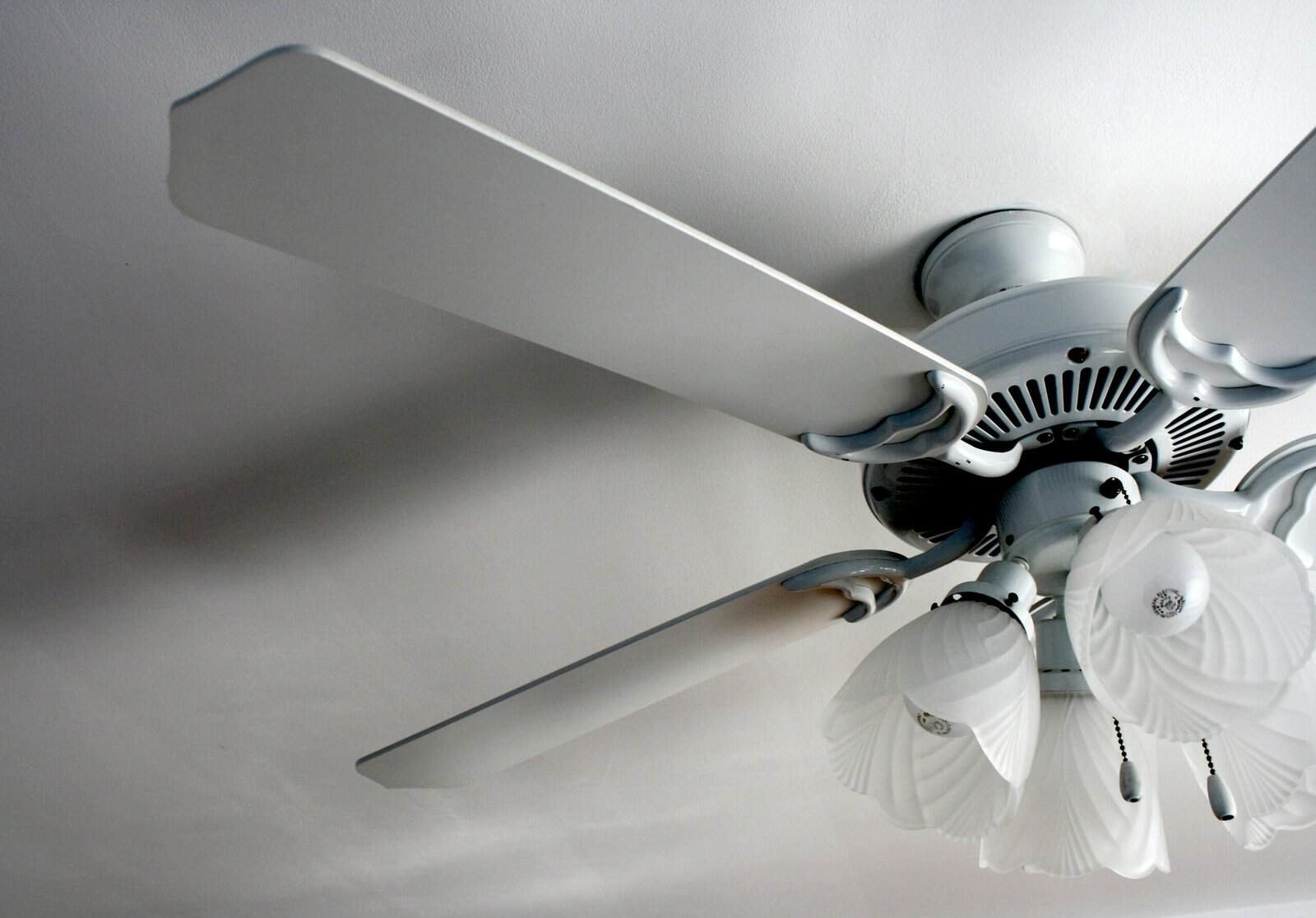
A smart ceiling fan should hold a schedule, respond to voice, and run quietly enough that you forget it is on. Smart ceiling fans separate into two groups that barely compete with each other: full replacement fixtures with DC motors and app control built in, and control modules that add scheduling to the fan already on your ceiling. If your existing fan works and you like it, the module wins on cost every time. If the fan is loud, wobbles, or predates the remote era, replacing the whole fixture solves problems a module cannot touch.
| Type | Install effort | Motor | Best for |
|---|---|---|---|
| DC motor smart fan | Full fixture swap | DC, 6 speeds typical | Bedrooms, quiet rooms |
| AC motor smart fan | Full fixture swap | AC, 3 speeds typical | Budget replacement |
| Smart fan control module | In-canopy wiring | Keeps existing | Fans worth keeping |
| Smart fan wall switch | Switch box swap | Keeps existing | No attic or canopy access |
| Outdoor rated smart fan | Full fixture swap | DC or AC | Covered porches |
| Low profile smart fan | Full fixture swap | DC typical | Ceilings under 8 feet |
Key Takeaways
- DC motors run quieter, use less power, and offer more speed steps than AC motors
- A control module costs a fraction of a new fan and keeps the fixture you already have
- Reversing direction seasonally is the feature most owners never set up
- Downrod length and ceiling height decide the fan size before any smart feature does
- Fans on a dimmer circuit will hum, and no app setting fixes that
How We Picked
Noise came first, because a fan you can hear from bed is a fan you stop using. That pushed DC motors ahead of AC across the board. Schedule reliability came second: a fan that forgets its routine after a power blip is worse than a pull chain, since you now have to open an app to fix something a string used to handle.
Install reality shaped the rest. Many homes have a single switched wire to the ceiling box, which rules out certain control modules entirely. Others have no attic access above the fixture. Picks reflect what people can realistically install without rewiring a room, and the same constraint that governs choosing a smart switch applies here.
Blade span and airflow were treated as sizing questions rather than ranking questions. A 52 inch fan is not better than a 44 inch fan; it is correct for a larger room and wrong for a small one.
1. The DC Motor Smart Fan
Why It Stands Out
DC motors are the reason smart ceiling fans became worth buying. They draw substantially less power than AC equivalents, run noticeably quieter at matched airflow, and support six or more speed steps instead of three. That granularity is what makes overnight scheduling usable, because you can run a genuinely low speed rather than choosing between too much and nothing.
Worth Knowing
DC fans need their receiver module, which lives in the canopy. If the fan fails, that receiver is often the culprit and it is manufacturer specific. Replacement availability varies, so favor brands likely to be around in five years.
Right for bedrooms, nurseries, and offices where noise matters. Skip it if the room already has a quiet fan and you only want scheduling.
2. The Smart Fan Control Module
Why It Stands Out
This is the highest value purchase on the page for most people. The module tucks into the fan canopy, wires between the existing supply and the fan motor, and adds app control and scheduling to a fixture that already works. Cost runs well under a replacement fan, and install takes under an hour with the breaker off.
Worth Knowing
Canopy space is the limiting factor. Low profile and hugger fans often have no room for a module, and forcing one in creates a heat problem. Measure before ordering. You also need neutral wire at the fixture, which most ceiling boxes have but some older homes do not.
Right for a fan you like on a ceiling you can reach. Skip it on flush mount fans with no canopy volume.
3. The Smart Fan Wall Switch
Why It Stands Out
When the canopy is inaccessible, the wall box is the fallback. A fan rated smart switch replaces the existing switch and controls speed from there, adding schedules and voice without touching the fixture. Install happens at chest height instead of overhead, which is a real quality of life difference.
Worth Knowing
Fan rated is not optional. A standard smart dimmer wired to a fan motor will buzz, overheat, and eventually fail, because dimmers chop the waveform in a way motors handle badly. Confirm the switch explicitly lists fan control.
Right for high ceilings and rooms where the fixture is hard to reach. Skip it if the fan and light share one switched wire and you want independent control.
4. The Low Profile Smart Fan
Why It Stands Out
Ceilings under eight feet make a standard downrod fan a hazard and a headache. Flush mount smart fans sit tight to the ceiling while keeping app control and, in better models, a DC motor. For apartments and finished basements, this is often the only category that fits.
Worth Knowing
Airflow suffers when blades sit close to the ceiling, because the fan cannot draw air from above as efficiently. Expect to run a low profile fan a step higher than a downrod fan for the same felt effect, which partly cancels the power savings.
Right for low ceilings and small rooms. Skip it wherever you have the clearance for a downrod.
5. The Outdoor Rated Smart Fan
Why It Stands Out
Covered porches and screened rooms need sealed motors and blades that will not warp. Damp rated and wet rated smart fans handle humidity that would destroy an indoor fixture within a season, and scheduling matters more outdoors, since nobody walks out to a porch to turn a fan on before sitting down.
Worth Knowing
Damp rated and wet rated are different. Damp handles humidity and condensation under cover. Wet handles direct rain. Buying damp rated for an exposed pergola is a short term purchase.
Right for covered outdoor seating. Skip it indoors, where you pay for sealing you will never use.
6. The Smart Fan and Light Combination
Why It Stands Out
Most ceiling fans carry a light, and controlling both independently from one app removes the pull chain problem entirely. Better combinations offer dimmable and tunable white light, so the same fixture runs bright in the afternoon and warm at night.
Worth Knowing
Integrated LED arrays are usually not user replaceable. When the light fails, you may be replacing the whole fixture. Models with a standard bulb socket trade some design polish for a repair path, and they pair more easily with bulbs you choose yourself.
Right for rooms where the fan is the only ceiling light. Skip it where separate lighting already exists.
What to Look For in a Smart Ceiling Fan
What size does the room actually need?
Blade span should match floor area, not preference. Small bedrooms and offices suit 42 to 44 inches. Standard bedrooms and dining rooms suit 48 to 52. Great rooms need 56 or more, or two smaller fans placed apart. An oversized fan in a small room moves air unpleasantly at any speed.
How high is the ceiling?
Blades should sit roughly eight to nine feet off the floor for good circulation. Standard eight foot ceilings need a flush or short downrod mount. Ten foot ceilings need a downrod of about a foot, and vaulted ceilings need both a longer rod and an angled mount that many kits sell separately.
Does it reverse, and can the app do it?
Reversing to clockwise in winter pushes warm air down off the ceiling instead of creating a draft. Many fans reverse only via a physical switch on the housing, which means climbing up twice a year. App controlled reversal is worth paying for if you plan to actually use it, and it works well alongside thermostat scheduling.
Which ecosystem does it join natively?
Check whether the fan works directly with your assistant or needs a bridge. A fan that requires its own app for schedules and only exposes on and off to your assistant is a partial integration, and you will notice the gap daily.
DC Motor vs AC Motor Fans
Where DC clearly wins
Noise, power draw, and speed granularity all favor DC. In a bedroom those three add up to a meaningfully different experience, particularly at low speeds where AC motors tend to hum.
Where AC still makes sense
AC fans cost less and their parts are generic, so a failed capacitor is a cheap fix rather than a proprietary module hunt. In a garage, laundry room, or workshop where noise does not matter, AC is the sensible spend.
Common Misconceptions
That a fan cools a room
Fans cool people, not rooms, by moving air across skin. Running one in an empty room adds heat from the motor and nothing else. Schedules should follow occupancy, which is exactly what smart control makes easy.
That higher speed is always better
A fan running hard creates noise and disturbs paper, and most people sleep better on a low steady setting. The extra speed steps on a DC motor exist so you can find the setting you forget about.
That any smart dimmer will control a fan
It will not, and trying is a fire safety question rather than a performance one. Fan control requires a fan rated device.
That installation is a two hour job
Removing an old fixture, checking the box rating, and mounting a heavier fan usually runs longer than expected. Ceiling boxes must be rated for fan support, and a standard lighting box is not.
Worth reading next: if the fan is part of a broader build, start with the setup order that avoids wasted purchases, then look at plugs for the devices that cannot be replaced and air purifiers that pair well with circulation. For rooms where light matters as much as airflow, light strips and automated shades cover the rest of the environment.
Frequently Asked Questions
Can I add smart control to any ceiling fan?
Most fans accept either a canopy module or a fan rated wall switch, so the answer is usually yes. The exceptions are flush mount fans with no canopy room and fans wired without a neutral at the box.
Do smart ceiling fans work without internet?
The wall control and pull chains keep working regardless. Schedules stored on the device continue to run in many models, while cloud dependent ones pause until the connection returns. Local control is worth confirming before buying.
Why does my fan hum on low?
Humming almost always means the fan is on a dimmer or an incompatible speed control. Replacing that control with a fan rated device resolves it. AC motors also hum more than DC motors at low speed by nature.
What size downrod do I need?
Subtract the fan height and your target blade height from the ceiling height. For a ten foot ceiling aiming for nine foot blades, a twelve inch rod is typical. Vaulted ceilings need both a longer rod and an angled mount.
Should the fan and light be on separate switches?
Separate control is more flexible, but a single switched wire is workable with a module that splits the two loads internally. Check that the module supports independent light and fan channels before buying.
How much power does a ceiling fan use?
Far less than air conditioning, which is the point. DC motors draw meaningfully less than AC at the same airflow, and the savings compound in rooms where the fan runs most of the day.
Will a heavier smart fan fit my existing ceiling box?
Only if that box is rated for fan support. Standard lighting boxes are not, and they are held by nails into a joist rather than braced across it. Replacing one with a fan rated brace box is inexpensive but does require attic access or cutting the ceiling, so confirm before ordering a fixture.
Does blade count affect performance?
Less than people expect. Three blade fans move air efficiently and suit DC motors well, while four and five blade designs run marginally quieter and look more traditional. Motor quality and blade pitch matter considerably more than the number of blades.
