
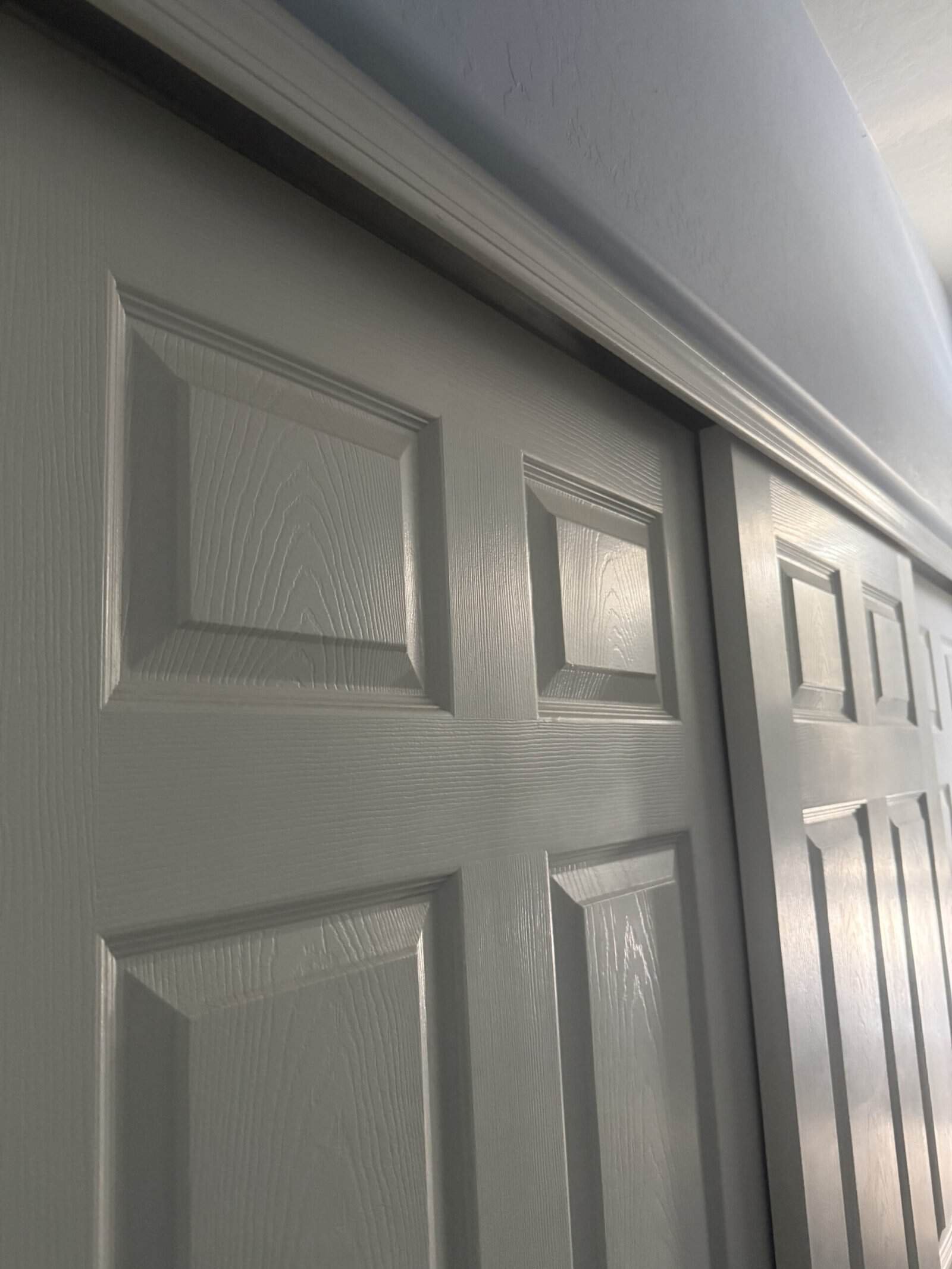
The real difference between them is not appearance at all. Bifold doors open the full width of the closet and need floor clearance underneath to swing properly. Sliding doors never block the room at all, and they only ever expose half of the opening at any one time.
I have lived with both. The bifolds were installed over carpet at a place I lived before, and they stuck so often that I ended up simply leaving them open all the time. I have sliding doors now. Our note on fixing a sliding door off its track covers the current setup.
Quick Answer
Bifolds for full access when you have swing room and hard flooring. Sliding for tight spaces and carpet, accepting that half the closet is always covered. Door style aside, how much closet space a wardrobe really needs is the number that decides the layout.
Side by Side
| Factor | Bifold | Sliding |
|---|---|---|
| Access | Full opening | Half at a time |
| Room clearance needed | Yes, doors fold outward | None |
| Floor clearance | Critical, pivots at the bottom | Minimal on top-hung |
| Carpet tolerance | Poor | Good |
| Common failure | Sticking, pins jumping the track | Rollers off the rail |
| Adjustment | Fiddly, several points | Height screws on brackets |
Access Is the Real Trade
A bifold door folds back on itself and clears almost the entire opening, which means you can see and reach everything inside the closet at once.
Sliding doors bypass each other, so one panel is always sitting in front of part of the closet. Reaching the covered section means sliding a door across first.
For a closet with shelving or a system where you need to see the whole thing, that difference matters daily rather than occasionally.
For a closet holding hanging clothes you move through anyway, it matters considerably less.
What you store decides which annoyance you will notice. Our roundup of closet organizers covers the interior.
Why Bifolds Stick on Carpet
A bifold pivots on a pin at the bottom and rides a track at the top, and the bottom pivot needs clearance to swing freely.
Carpet eats into that clearance directly. The pile drags against the bottom edge of the panel, which adds resistance the mechanism was never designed to overcome.
Thick carpet or a pad underneath makes it worse, and the doors bind rather than folding cleanly.
Mine stuck constantly on that carpet, and the practical result was that I stopped bothering to close them at all. That is a common outcome rather than an unusual one.
Hard flooring removes the problem entirely, which is why bifolds work well in some rooms and poorly in others with identical hardware. Our roundup of shelf organizers covers what goes inside.
Sliding Doors Have Their Own Failure
Rollers jump the rail
The equivalent problem, and it happens randomly rather than constantly.
Bottom guides go missing
Which is what lets the door swing enough to derail.
Half the closet is always covered
Permanent by design rather than a fault.
Removal is straightforward
Lift and tilt. Our note on removing sliding doors covers that.
Room Clearance Decides It Sometimes
Bifold doors fold outward into the room, and that swing needs space that some rooms simply do not have.
A bed, dresser, or door swing path in front of a closet rules bifolds out regardless of any other consideration.
Sliding doors move entirely within their own opening, which is why they suit tight rooms and small apartments.
That constraint is worth measuring rather than estimating, since a bifold needs roughly half the closet width in clearance.
Where the room allows either, the decision comes back to flooring and to what you store. Our roundup of bathroom organizers for small spaces covers small rooms.
Maintenance and Repair
Bifolds have more adjustment points, including the top pivot, the bottom pivot bracket, and the alignment between panels.
Getting all of them right at once is fiddly, and a bifold that has been forced while sticking frequently has a bent top pin or a pivot that has worked loose.
Sliding doors adjust at the roller brackets, usually a screw per side that sets height and squareness.
Both systems have inexpensive replacement parts, and both fail at the guide or pivot rather than at the door itself.
Neither is genuinely difficult, and the sliding adjustment is the simpler of the two to get right.
Appearance and the Room
Both styles change how a wall reads, and that is a real consideration in a small room even though it rarely decides anything.
Sliding doors present one flat plane, which reads as quieter and takes up less visual space than panels breaking outward.
Bifolds have vertical seams and louvers on many models, which adds texture and can look dated depending on the panel style.
Mirrored versions exist for both, and a mirrored sliding door doubles as a full length mirror while covering half the closet permanently.
Neither is objectively better looking, and the practical differences around clearance and flooring are the ones you will actually notice every day. Our roundup of coat racks and hooks for entryways covers what sits behind either.
Which to Choose
Carpet points at sliding, because the bifold pivot problem does not go away and gets worse as carpet compresses unevenly over time.
A closet you need to see all of at once points at bifold, provided you have the swing room.
Tight rooms point at sliding, since bifolds need clearance that furniture usually occupies.
Wide closets favor sliding as well, since a very wide bifold means large panels that sag and bind more readily.
If you already have one and it works, replacing it with the other is a bigger job than it looks, since the track systems mount differently.
Cost and Installation
Both sit in a similar price range for basic panels, and the installation differs more than the hardware cost does.
Sliding doors need a rail mounted securely to the header above the opening, which has to carry the full weight of the panels.
Bifolds need a top track plus a bottom pivot bracket anchored to the floor or the jamb, and getting both aligned is what makes the difference between smooth operation and constant binding.
Neither requires much beyond a drill and a level, and both punish an out-of-square opening in their own way.
An opening that is not square will show up as a sliding door that drifts on its own or a bifold that binds at one end, and neither adjustment fully compensates for a frame that is out of true.
Common Mistakes to Avoid
Fitting bifolds over thick carpet
The bottom pivot needs clearance, and pile drag is what makes them stick.
Forcing a sticking bifold
That bends the top pin and makes the binding permanent.
Ignoring swing clearance
Bifolds need roughly half the closet width free in front of them.
Expecting sliding doors to expose the whole closet
Half is always covered. That is the design rather than a defect.
Recommended Reading
See our note on organizing an entryway, our roundup of entryway storage, our roundup of key and mail organizers, and a roundup of console tables.
Bifold vs Sliding FAQ
Which is better, bifold or sliding?
Bifold for full access when you have swing room and hard flooring. Sliding for tight rooms and carpet, accepting that half the closet stays covered.
Which do you have?
Sliding now. I had bifolds at a place I lived before, on carpet, and they stuck so often that I just left them open.
Why do bifolds stick on carpet?
The bottom pivot needs clearance to swing, and carpet pile drags on the bottom edge. Thick carpet or a pad underneath makes it worse.
How much room does a bifold need?
Roughly half the closet width in front of it, since the panels fold outward into the room.
Which fails more often?
Bifolds stick repeatedly where clearance is marginal. Sliding doors derail occasionally and randomly, usually from a missing bottom guide.
Which is easier to fix?
Sliding, generally. Adjustment is a screw per roller bracket. Bifolds have several adjustment points that all need to be right at once.
Can I swap one for the other?
Yes, and it is a bigger job than it looks. The track systems mount differently, so it is more than changing the doors.
What about wide closets?
Sliding usually suits better. Very wide bifold panels sag and bind more readily than narrow ones.
