
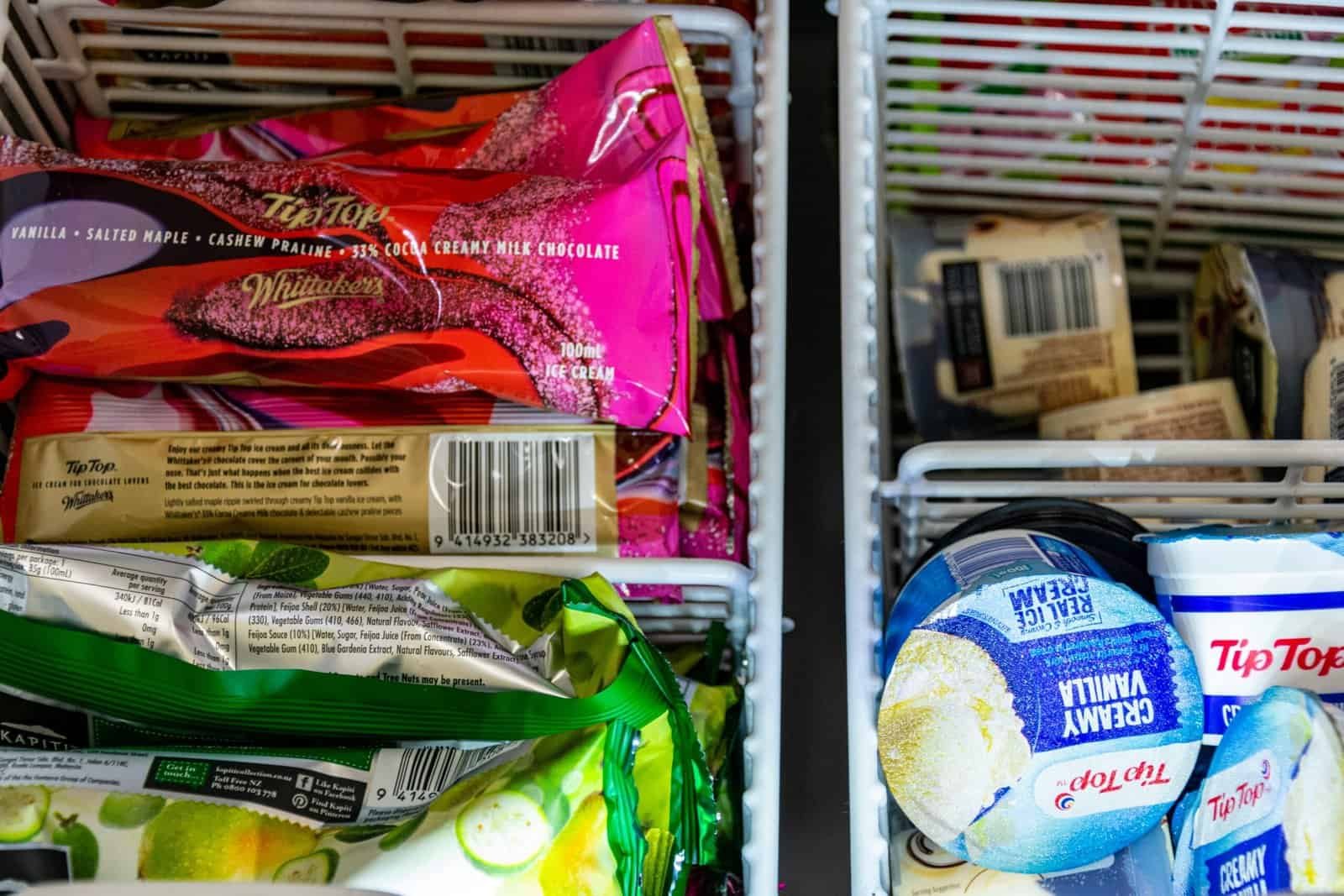
Freeze things flat, group them in bins by category rather than by date, and keep a written list on the door. How do you organize a freezer so it stays organized? By making every package the same shape and by tracking what is in there somewhere other than your memory.
A fridge rewards zoning by temperature. A freezer is uniformly cold, so it rewards something different, and our guide to organizing a fridge covers why the two appliances need different logic.
The zones below are about access and rotation rather than temperature.
| Zone | What belongs there | Why |
|---|---|---|
| Door bins, on an upright | Small items used weekly | Warmest spot, so nothing long-term |
| Eye-level shelf | This week’s meals | Whatever you grab without looking |
| Upper shelves | Flat-frozen bags, filed upright | Visible spines, like books |
| Lower shelves | Bulk meat and large packages | Heavy things belong low |
| A single bin for oddments | Half bags, loose items, mystery | Contains the mess in one place |
| Chest freezer baskets | Current rotation | The only layer you can reach easily |
| Chest freezer floor | Long-term bulk | Accept that you will dig for it |
| The door itself | The inventory list | Checked without opening anything |
Quick Answer
Freeze food flat in bags so packages file upright like books. Sort into labeled bins by category, not by date. Keep small frequently used items in the door. Write an inventory on the door and cross items off as you use them. Review it weekly.
Why a Freezer Resists Organization
Three things work against you, and none of them are about tidiness.
The first is that everything looks alike once frozen. Unlabeled packages become indistinguishable within weeks, and a freezer full of anonymous bundles gets avoided rather than used.
The second is that packages are all different shapes. Round containers, lumpy bags and rigid boxes cannot stack, so the space fills at maybe half its real capacity.
The third is that you cannot browse a freezer. Standing with the door open searching costs cold air, so the search gets abandoned and something else gets cooked.
Fix those three and the compartment works. Leave them and no amount of rearranging holds for long.
Flat Freezing Changes Everything
This single habit does more than any container purchase.
Put the food in a zip-top bag, press it flat until it is an even sheet, squeeze the air out, and lay it flat until solid. Once frozen it is a rigid tile.
Those tiles then stand upright in a bin like files in a drawer, with the label facing you. You can read the whole bin at a glance without lifting anything out.
Flat packages also thaw considerably faster than a block, because the distance from the surface to the center is small. That makes weeknight cooking from the freezer actually workable.
Soups, stock, sauces, ground meat, chopped vegetables and marinated portions all take to this well. Our roundup of food storage containers covers the rigid options for the things that cannot go flat.
Zones That Work in Practice
Bins, not shelves
Shelves let things migrate to the back and disappear. Bins move as a unit, so you pull one out, find what you need, and slide it back. Sort them by category: meat, vegetables, ready meals, baking, oddments.
The door is the warm spot
On an upright, the door bins swing through room air every time you open it. Put nuts, coffee, ice packs and things you use weekly there, and keep long-term storage on the interior shelves.
One bin for chaos
Half-used bags and loose items will exist no matter how disciplined you are. Giving them a designated bin stops them colonizing everything else.
Eye level earns its keep
Whatever sits at eye level is what gets cooked. Put this week’s intended meals there deliberately, and the freezer starts reducing food waste rather than storing it.
The Inventory Is the Real System
Bins and flat packages make a freezer navigable. A list makes it usable.
Keep a running inventory on the door with a wipe-clean board or a sheet in a sleeve. Add items as they go in, cross them off as they come out.
The reason this works is that it moves the search outside the appliance. You decide what to cook with the door shut, which costs nothing and prevents the frost problem that long door openings create.
Label every package with what it is and the date it went in, because the contents stop being obvious much sooner than you expect. Our roundup of label makers covers doing that legibly, though a permanent marker on the bag does the job.
Rotation then runs on the list rather than on digging. Our fridge and freezer storage chart covers how long each category holds its quality, which is what tells you when something has been on the list too long.
Chest, Upright, and the Compartment Above a Fridge
The designs fail in different directions, and the strategy differs accordingly.
An upright is easy to see into and easy to organize by shelf and bin. It loses more cold air on opening, and its door bins are genuinely warmer than the rest.
A chest holds temperature better and fits more in the same footprint. Its weakness is depth: anything below the top layer is effectively archived.
For a chest, hanging baskets plus a strict rule about what lives beneath them is the whole system. Treat the floor as long-term storage you consult from the list rather than by looking.
Stackable shopping totes work well in a chest where purpose-made baskets do not fit.
The compartment above a fridge is the most common setup and the most constrained. There is rarely height for bins, often a single shelf, and sometimes just a wire basket.
Flat freezing matters most here, because it is the only way to use the vertical space. Tiles standing upright turn a shallow shelf into something you can file into, and a pair of low-sided trays does the job that bins do elsewhere.
Skip the category system in a compartment that small. One tray for meals and one for ingredients, plus the door list, is as much structure as it can carry. Our guide to organizing a small kitchen covers the same constraint applied to cupboards, and our roundup of meal prep containers covers portioning that suits any of the three.
Keeping It That Way
- Empty it completely, once. You cannot organize around unknown contents.
- Discard anything unlabeled and unidentifiable. It was never going to get cooked.
- Decide your bin categories before reloading. Four or five, no more.
- Flat-freeze everything that can be flattened. This is the step that creates the space.
- Label as you load, not afterward. Afterward never happens.
- Start the door list the same day. A list begun later is always incomplete.
- Cook one freezer meal a week. Rotation is a habit, not a filing system.
Worth reading next: our roundup of refrigerator organizer bins covers bins that work in a freezer compartment too, and our guide to organizing your pantry covers the same rotation problem where the stakes are lower and the habits transfer directly.
Frequently Asked Questions
How do you organize a freezer?
Freeze food flat in bags so it files upright, sort those packages into labeled bins by category rather than by date, keep frequently used small items in the door, and maintain a written inventory on the outside of the door that you update as things go in and out.
Why bins instead of just using the shelves?
Because items on an open shelf migrate to the back and get forgotten. A bin pulls out as a unit, so you can see everything in that category at once and slide it back. Four or five category bins beat any amount of careful shelf stacking.
What is flat freezing?
Putting food in a zip-top bag, pressing it into an even sheet, forcing the air out, and freezing it lying flat. It becomes a rigid tile that stands upright like a file. Flat packages also thaw much faster than a block does.
Should I organize by date or by category?
By category, with dates written on each package. Sorting by date means rearranging the whole compartment every time you add something. Sorting by category stays stable, and the dated labels plus a door list handle rotation instead.
Is the freezer door really warmer?
On an upright, yes. Those bins swing out through room air every time the door opens, so they see the most temperature variation in the compartment. Keep things you use weekly there and long-term storage on the interior shelves.
How do I organize a chest freezer?
Hanging baskets for current rotation, and a deliberate decision about what lives underneath. Anything below the top layer is effectively archived, so it should be bulk items you consult from your inventory list rather than by digging around.
What about the small compartment above my fridge?
Flat freezing carries the whole job there, since filing tiles upright is the only way to use the height. Use one or two low-sided trays instead of bins, keep the category system to meals and ingredients, and rely on the door list more heavily than you would elsewhere.
Does a fuller freezer run better?
A well-filled freezer holds temperature more steadily, because the frozen mass itself buffers against warm air coming in. Packed so tightly that air cannot move past the vents is a different situation and causes uneven frost.
How often should I go through it?
A glance at the door list weekly, and a full look inside when you update that list. A complete empty-and-reset is worth doing when the list and the contents have drifted apart, which tends to happen once or twice a year.
