
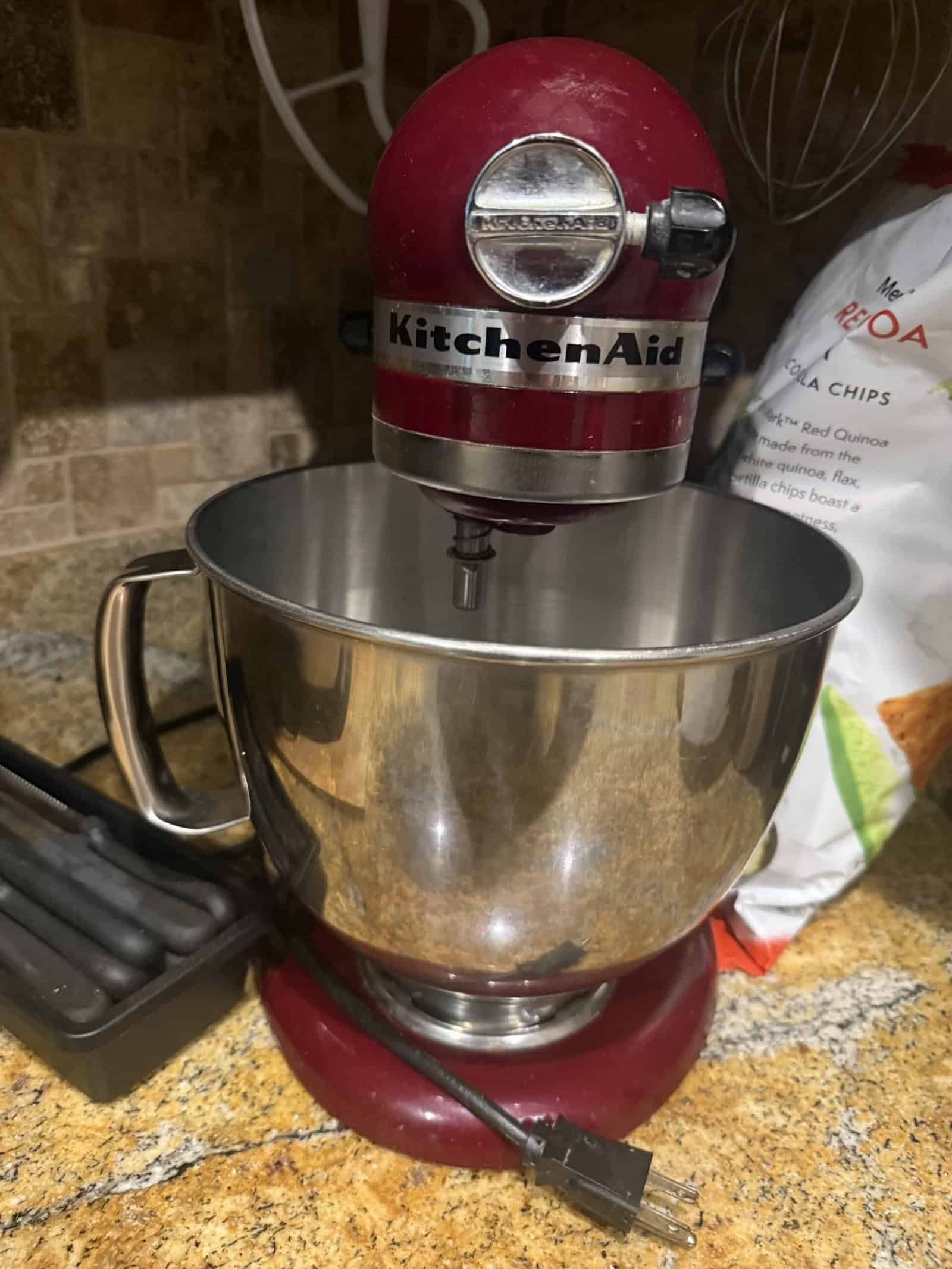
For dough, usually yes. Weight is what keeps a mixer still while it works, and a light machine walking across the counter under stiff dough is the problem heavier ones solve. The cost is that you cannot move it easily.
Mine is a heavier tilt-head model I have had a few years. It is genuinely heavy and hard to maneuver, and the heavy duty build is the part I like, so the trade has gone in my favor even though I notice the weight every time I shift it.
Quick Answer
Heavier mixers stay planted, handle stiff dough without straining, and last longer because the internals are built to match. Lighter ones are easier to store and move and struggle with bread dough. If you mostly make dough, buy heavy. If you mostly whip and batter, you do not need to.
What Weight Actually Buys
| Factor | Heavier mixer | Lighter mixer |
|---|---|---|
| Stability under dough | Stays put | Can walk or rock |
| Motor and gearing | Usually stronger | Adequate for batters |
| Stiff bread dough | Handles it | Strains or stalls |
| Moving and storing | Difficult | Easy |
| Lifespan | Typically longer | Shorter under heavy use |
| Price | Higher | Lower |
Weight itself is not the feature. It is a proxy for metal gearing, a cast housing, and a motor sized for resistance rather than for speed.
A mixer built from those things is heavy as a consequence, and the same construction is what lets it push through dough that stalls a lighter machine.
Why Stiff Dough Is the Test
Whipping cream and mixing cake batter ask very little of a motor. The load is light and consistent, and almost any mixer manages it.
Bread dough is different. It resists, and it resists unevenly as it develops, which means the motor faces a changing load rather than a steady one.
A lighter machine responds by rocking, since the dough hook is effectively pushing against the whole appliance. That is what makes a mixer travel across a counter.
It also heats the motor, and repeated heavy use on an undersized machine shortens its life considerably, covered in how to choose the right stand mixer.
Living With the Weight
Mine gets used quite a bit, mostly for doughs, with batters and whipping alongside. The heavy build is genuinely useful for that main job.
The cost is real though. It is hard to maneuver, and moving it is a two-handed operation I avoid where possible. It lives out on the counter partly for that reason.
There is an honest complication. My bread machine is newer and I have been reaching for it more than the mixer lately, and I like it more for dough.
That is not a criticism of the mixer. It is that a bread machine handles mixing, kneading, and rising without supervision, and the stand mixer only does the mixing part, covered in bread machine against stand mixer.
So the weight bought me capability I use less than I expected to, which is worth saying before someone spends on a heavy machine for the same reason I did.
When Lighter Is the Right Choice
Mostly batters and whipping
Cakes, cookies, meringue, and whipped cream do not need a heavy machine. A lighter one does those perfectly well for far less.
Limited storage
A mixer you cannot lift is a mixer that lives on the counter permanently, which is a space decision as much as a kitchen one.
Occasional use
Baking a few times a year does not justify a machine built for daily dough, and a hand mixer covers more than people assume, covered in stand mixer against hand mixer.
Small kitchens
Counter space is the binding constraint in a lot of homes, and a large heavy mixer takes a permanent share of it.
What to Check Besides Weight
Wattage is a poor guide on its own, since it measures power draw rather than usable torque. Two machines at the same wattage can perform very differently.
Gearing material matters more. Metal gears handle sustained resistance where nylon ones wear, though some manufacturers use a nylon gear deliberately as a sacrificial part that protects the motor.
Bowl capacity should match what you make. A large bowl handles small quantities badly, since the beater cannot reach a thin layer at the bottom.
Feet and suction matter for stability at any weight. Good grip on a smooth counter does some of what mass does, covered in stand mixers under two hundred.
How Much Dough Are You Actually Making
The case for a heavy mixer scales with batch size, and most home bakers overestimate what they need before they own one.
A single loaf is a small load. Most mid-range mixers handle one standard batch of bread dough without complaint, and the walking problem tends to appear at two batches rather than one.
Doubling changes it. Twice the dough is more than twice the resistance in practice, because the mass moves as one body and the hook has to displace all of it on every rotation.
Hydration matters as much as quantity. A wet high-hydration dough flows and is easier on the machine, and a stiff low-hydration one like bagel dough is where light mixers genuinely fail.
Frequency is the other axis. A machine handling one batch a month lasts a long time even if it strains, and the same machine handling several batches weekly wears out.
The practical version is to buy for your heaviest routine job rather than your heaviest imaginable one. People buy for the sourdough habit they intend to start and then make cakes.
Tilt-Head Against Bowl-Lift
Tilt-head models are lighter and more convenient, since the head pivots back and the bowl comes free easily.
Bowl-lift models are heavier and more stable, with the bowl raised into position by a lever. They generally handle larger and stiffer batches.
Height matters if the mixer lives under a cabinet, since a tilt-head needs clearance above to open and a bowl-lift does not.
For home dough in normal quantities, a heavy tilt-head is enough, and bowl-lift starts to matter at larger volumes.
The Honest Verdict
Buy heavy if bread dough is a regular part of what you make, since that is the one job where weight and build genuinely change the outcome.
Buy lighter for everything else. Batters, whipping, and occasional baking do not need it, and the storage and handling costs are real and daily.
And consider whether a bread machine does the job you are buying the heavy mixer for, because for routine loaves it handles more of the process with less supervision.
That is the thing I would tell someone in my position before they bought, covered in bread machines for sourdough.
Related Reading
- choosing a stand mixer
- bread machine against stand mixer
- stand against hand mixer
- stand mixers under two hundred
- hand mixers
- bread machine dough, oven bake
Frequently Asked Questions
Is a heavier stand mixer worth it?
For bread dough, yes. Weight keeps the machine still and usually indicates metal gearing and a motor sized for resistance. For batters and whipping it is unnecessary.
Why do light mixers walk across the counter?
Stiff dough pushes back against the hook, and without enough mass to resist it the whole machine rocks and travels. That is the clearest sign of an undersized mixer.
Does wattage tell me how powerful it is?
Not reliably. Wattage measures power draw rather than usable torque, and two machines with the same figure can behave very differently under dough.
Are metal gears always better than nylon?
Usually for durability, and some manufacturers use a nylon gear deliberately as a sacrificial part that fails before the motor does, which is cheaper to repair.
Tilt-head or bowl-lift?
Tilt-head is lighter and easier to use for home quantities. Bowl-lift is more stable for larger and stiffer batches, and it needs less clearance above.
What is the downside of a heavy mixer?
Moving it. A heavy machine ends up living permanently on the counter because lifting it in and out of a cupboard is genuinely awkward.
How much dough before weight matters?
Usually past a single batch. Most mid-range machines handle one loaf fine, and the walking problem appears at double batches or with stiff low-hydration dough.
Should I buy one if I have a bread machine?
Depends what else you make. A bread machine handles dough with less supervision, and a mixer covers batters, whipping, and everything a bread machine cannot.
Recommended Reading
See our note on setting up a home baking station.
