
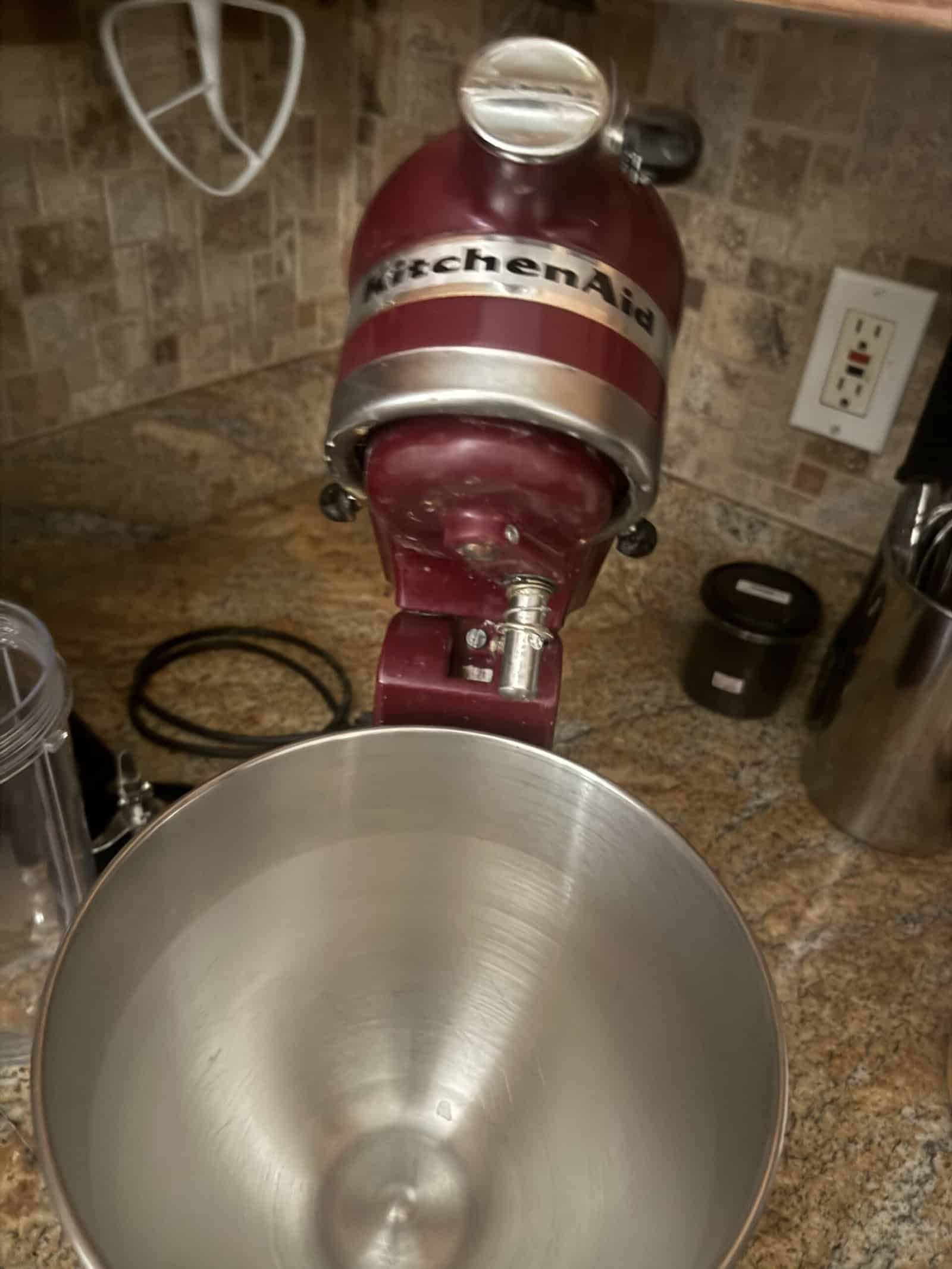
The two mechanisms solve the same problem differently. A tilt-head hinges backward to clear the bowl, and a bowl-lift raises the bowl to a fixed head on a lever.
Mine is a tilt-head, and the practical cost is overhead clearance. It sits under a wall cabinet and I have to pull it forward before the head will go back. Our note on choosing the right stand mixer covers the wider decision.
Quick Answer
Tilt-head suits most home kitchens on price and access. Bowl-lift suits larger batches and stiff dough, and needs less clearance above.
How They Compare
| Factor | Tilt head | Bowl lift |
|---|---|---|
| Overhead clearance | Needs room to tip back | Needs less above |
| Typical capacity | Around 4.5 to 5 quarts | 5 to 8 quarts |
| Stiff dough | Head can flex slightly | More rigid under load |
| Bowl access | Open, easy to scrape | Head sits over the bowl |
| Price | Generally lower | Generally higher |
| Footprint | Smaller | Taller and heavier |
The Clearance Problem Nobody Mentions
A tilt-head needs vertical space both behind and above it in order to hinge back, and product listings almost always quote the overall height with the head sitting down.
Under a wall cabinet that is the number that matters least of all. Mine has to come forward off its usual spot before the head will tip back at all, and that happens every single time.
That is not a fault in the machine at all, and it is a small daily friction that never appears anywhere in a specification table.
A bowl-lift avoids it entirely, because the head does not move. The bowl comes up to meet it instead. Our note on where to store a stand mixer covers placement.
Where Tilt Head Wins
Bowl access is genuinely better
With the head tipped back the bowl is fully open, which makes scraping and adding easier.
Lower price at the same brand
Tilt-head models sit below bowl-lift ones across most ranges.
Smaller and lighter
Easier to move, and less counter footprint.
Enough capacity for most homes
Mine is a 5-quart and it rarely if ever falls short. Our roundup of stand mixers under 200 covers the range.
Where Bowl Lift Wins
Rigidity is the main one. A fixed head does not hinge, so there is nothing to flex when the dough hook meets resistance.
Mine shifts minorly under heavy dough, which is normal for a hinged head rather than a defect, and it is exactly what a bowl-lift design avoids.
Capacity is the other. Bowl-lift models run larger, which matters for anyone doubling recipes routinely.
Lower overhead clearance follows from the head not moving, which suits a mixer that lives under cabinets permanently. Our note on whether a heavier mixer is worth it covers build.
The Locking Mechanism
Tilt-head mixers have a lever or latch that holds the head down, and it is the part that determines how the machine feels under load.
Locked properly, the head is held against the hinge and movement is limited to whatever play exists in the pivot itself.
Unlocked or partially engaged, the head can rise as the beater meets resistance, which is both noisy and worse for mixing since the clearance changes as it goes.
People frequently run a tilt-head without engaging the lock at all, since it works well enough for batter, and then blame the mixer when bread dough makes it bounce.
Checking the lock is engaged before anything stiff is a habit worth forming, and it costs nothing. Our roundup of bread machines covers the alternative for dough.
Capacity in Practice
Quart ratings describe total bowl volume rather than usable working volume, and no mixer can fill a bowl right to the rim and still actually mix what is in it.
Manufacturers publish flour and dough capacities separately, and those are the numbers that matter for bread.
A 5-quart handles standard batches of cookie dough, cake batter, and most single loaves comfortably.
Where it runs out is doubling bread recipes or making large quantities repeatedly, which is closer to small commercial use than home baking. Our note on bread machine versus stand mixer covers dough volume.
Head Flex Under Load
It is inherent to the hinge
Any hinged head has a pivot, and a pivot under load moves slightly.
Minor is normal
Mine shifts a little with dough and nothing more than that.
Excessive movement is not
A head that visibly lifts or knocks suggests the locking mechanism needs attention.
Stiff dough is the real test
Batter and cream never load the hinge the way bread does.
Counter Height and Working Position
Bowl-lift machines are taller, and that changes how you work at them in ways the spec sheet does not describe.
A taller mixer puts the bowl rim higher, which means reaching up to scrape rather than down into it.
On a standard counter that is fine for most people and becomes awkward for anyone shorter, since the bowl on a large bowl-lift can sit near chest height.
Tilt-head machines sit lower and the bowl is more accessible, which is part of why they suit smaller kitchens beyond just the footprint.
Anyone considering a bowl-lift is well served by seeing one in person on a counter rather than judging from dimensions, because the difference is more noticeable in use than on paper. Our roundup of mixing bowl sets covers what you reach into.
What Actually Decides It
For most home kitchens the honest answer is tilt-head, because the capacity is sufficient and the price is lower.
The case for bowl-lift is specific: routinely large batches, frequent stiff dough, or a permanent spot under cabinets where tipping back is impossible.
Wanting a mixer that simply feels more substantial on the counter is a real reason too, and it is worth naming honestly as a preference rather than dressing it up as a technical necessity.
Neither mechanism affects mixing quality for ordinary tasks in any meaningful way, which is precisely the thing people assume separates them and simply does not. Our roundup of stand mixer attachments covers what does the mixing.
Attachment Compatibility Differs
Tilt-head and bowl-lift mixers take differently sized attachments even within one brand, which catches people out when buying replacements.
Bowl sizes are not interchangeable between the two either, so a bowl from one will not fit the other.
Power hub accessories generally do cross over between the two, since the hub itself is a shared standard on the front of the machine.
Checking your model rather than the brand is the reliable approach, because the range spans several incompatible sizes. Our note on storing attachments covers what you end up with.
Common Mistakes to Avoid
Ignoring the clearance above
Listed height is with the head down, which is the least useful number under a cabinet.
Buying capacity you will not use
A 5-quart covers most home baking, and larger costs more and weighs more.
Expecting a bowl-lift to mix better
The mechanism affects rigidity and capacity rather than mixing quality.
Assuming attachments transfer
Sizes differ between the two designs from the same manufacturer.
Tilt Head Versus Bowl Lift FAQ
Which should I buy?
Tilt-head for most home kitchens. Bowl-lift if you routinely make large batches, work with stiff dough often, or have no clearance above.
What do you use?
A tilt-head. It sits under a wall cabinet and has to be pulled forward before the head will tip back, which is the daily cost of the design.
Does the head flex?
Mine shifts minorly under heavy dough. That is normal for a hinged head rather than a fault, and it is what a bowl-lift avoids.
Is 5 quarts enough?
For most home baking, yes. Mine rarely if ever falls short. Doubling bread recipes routinely is where it would.
Does bowl-lift mix better?
No. The mechanism changes rigidity and capacity, not mixing quality for ordinary tasks.
Can I swap attachments between them?
Not the beaters, hooks, or bowls. Those differ in size between designs. Power hub accessories generally do cross over.
Which is easier to use?
Tilt-head for bowl access, since the bowl is fully open with the head back. Bowl-lift for clearance, since nothing moves upward.
Why is bowl-lift more expensive?
Larger capacity, heavier construction, and more rigid frames. Those are the differences you are paying for rather than better mixing.
