
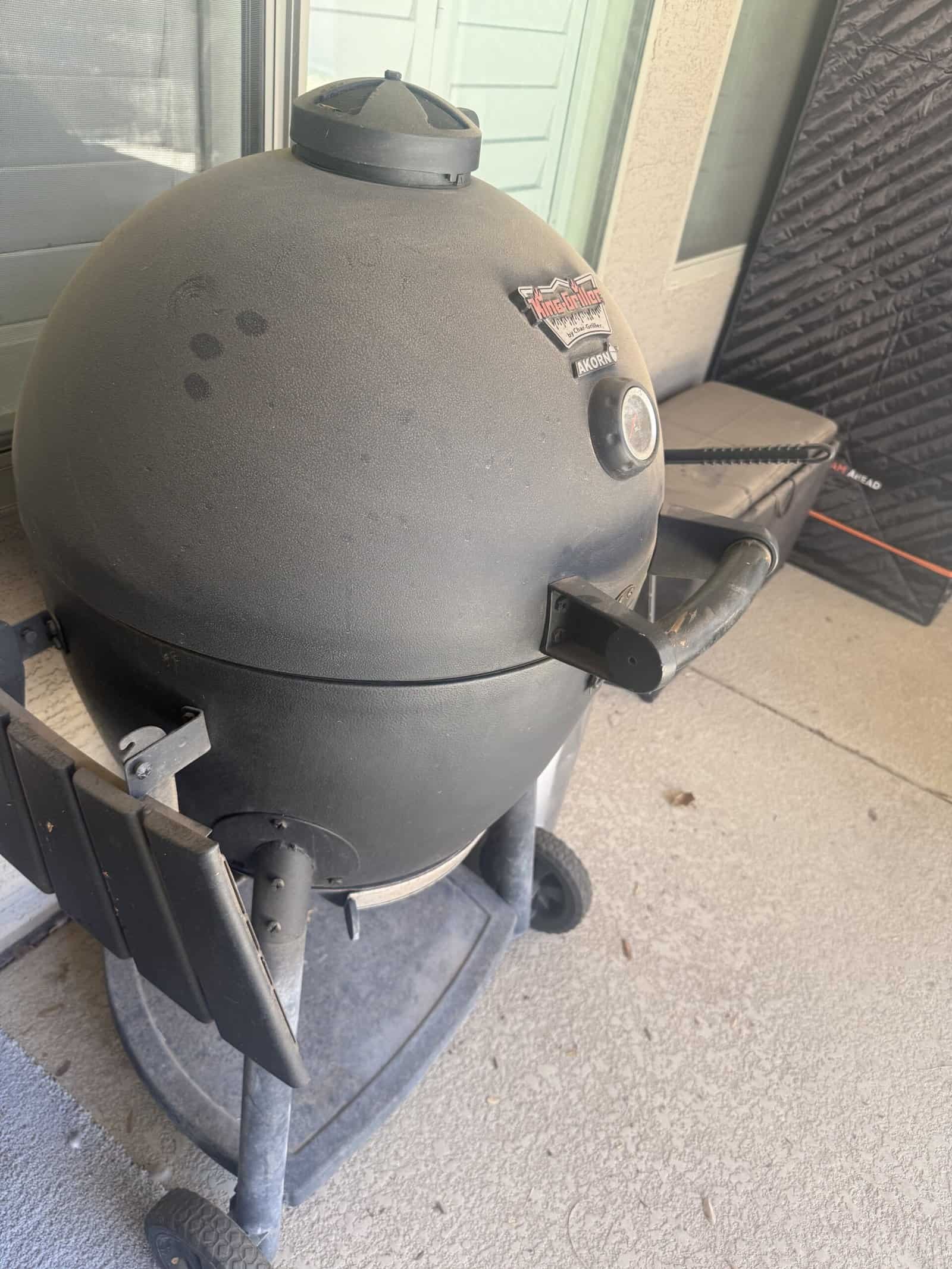
You need one for anything cooked longer than about half an hour, and you do not need one for steaks, burgers or vegetables over direct flame. Whether you need a heat deflector for a kamado grill comes down to a single question: is the food sitting above open fire, or does it need the cooker to behave like an oven?
Without a deflector a kamado is a very hot grill. With one it becomes a convection oven. Our guide to whether a kamado grill is worth it covers the range that switch creates.
Quick Answer
A heat deflector is a ceramic or steel plate that sits between the fire and the food, blocking radiant heat so the cooker circulates hot air instead. It is required for smoking, roasting, baking and anything low and slow. It is unnecessary and counterproductive for searing. Most kamados either include one or accept an aftermarket plate.
Key Takeaways
- A deflector converts radiant heat into circulating convection heat.
- Required for smoking, roasting, baking and long cooks.
- Unhelpful for searing, where you want the radiant heat.
- Also called a plate setter, conveggtor or diffuser plate depending on the brand.
- Steel and ceramic both work, with different warm-up behavior.
- Without one, long cooks burn the underside before the center is done.
| Cook | Deflector | Why |
|---|---|---|
| Steak, burgers, chops | No | Radiant heat is what makes the crust |
| Vegetables, skewers | No | Short cook, direct heat suits it |
| Whole chicken | Yes | Skin burns before the middle cooks |
| Ribs, pork shoulder, brisket | Yes | Hours at low temperature |
| Pizza, bread | Yes | Needs oven behavior, not flame |
| Reverse sear | Both | Deflector in, then out for the finish |
What a Heat Deflector Actually Does
Heat reaches food two ways in a closed cooker. Radiant heat travels in straight lines from the glowing charcoal, and convection heat moves as circulating hot air.
Radiant heat is intense and directional. It is what puts a crust on a steak, and it is also what burns the bottom of a chicken while the breast is still raw.
A deflector interrupts the straight line. The plate absorbs the radiant energy and re-emits it gently, so what reaches the food is moving air at a fairly even temperature.
That is the entire mechanism, and it is why the same cooker can sear at high heat and hold a low roasting temperature for hours.
When You Genuinely Need One
Anything over roughly thirty minutes
Long enough for the underside to take more radiant heat than the food can tolerate. Chicken, ribs, roasts and anything approaching an hour all qualify.
Low and slow smoking
A smoking temperature with direct fire underneath produces a burnt base and an undercooked interior. The plate is not optional here.
Baking
Pizza, bread and anything in a dish needs the cooker acting as an oven. Some setups use a deflector plus a separate baking stone above it.
Large cuts
The thicker the cut, the longer heat needs to travel inward, and the more the surface suffers under direct fire. Our guide to how long it takes to smoke chicken covers one of the cooks that depends on it.
When It Gets in the Way
Searing is the clear case. Radiant heat is the point, and blocking it means the surface browns slowly while the interior overcooks.
Quick grilling does not need it either. Burgers, chops, sausages and vegetables are finished before radiant heat becomes a problem.
There is also a practical cost. A ceramic plate takes time to come up to temperature, so putting it in for a fast cook adds waiting for no benefit.
And it has to come out hot if you change your mind mid-cook, which is awkward. Our roundup of oven mitts and pot holders covers handling that safely.
Names, and Why the Terminology Is Confusing
Different manufacturers use different names for the same component, which makes searching for one harder than it should be.
Plate setter, conveggtor, heat diffuser, deflector stone and indirect plate all describe a barrier between fire and food. Some are flat discs, some are legged so they hold the cooking grate above them.
Shape matters for fit rather than function. A legged plate replaces the need for a separate grate riser, while a flat disc sits on the existing grate supports.
Aftermarket plates exist for most sizes. The important dimensions are the firebox diameter and the gap between the plate and the grate above it.
Ceramic Against Steel
Ceramic plates are the traditional choice and they hold a lot of heat. Once up to temperature they are very stable, which is what a long cook wants.
The tradeoff is warm-up time and fragility. Ceramic takes a while to saturate with heat and it can crack if it is thermally shocked or dropped.
Steel plates come up faster and survive handling better. They are less thermally stable, so they respond more quickly to changes in the fire below.
Neither is wrong. Our guide to how long a kamado grill lasts covers the same steel and ceramic comparison at the level of the whole cooker.
Setting It Up
- Clear the ash first. Airflow from the bottom vent matters more once a plate is restricting the space above the fire.
- Light before the plate goes in. Getting a fire established around a plate is harder than dropping the plate onto a lit fire.
- Leave a gap above the fire. The plate should not sit on the charcoal, since it needs air moving around its edges.
- Allow warm-up time. A cold plate absorbs heat before it starts returning any, so the cooker stabilizes later than the gauge suggests.
- Add a drip tray if you want one. Fat landing on a hot plate smokes, and a tray above it keeps the plate cleaner.
- Expect a lower ceiling. With a deflector in, the maximum temperature at the grate is lower than the cooker can otherwise reach.
Our guide to controlling temperature on a charcoal smoker covers the vent work that goes alongside, and our roundup of meat thermometers covers reading the food rather than the dome gauge.
If Your Kamado Did Not Come With One
Check what is in the box before buying anything, since packages vary and the plate is sometimes bundled and sometimes sold separately.
People do improvise with a pizza stone, a cast iron pan or a stack of firebricks, and those work to a degree. The purpose-built plate fits better and leaves the airflow gap the design expects.
A foil-covered drip pan on the grate is the cheapest partial answer. It blocks some radiant heat, though not as evenly as a plate does.
Our roundup of grill mats covers a different accessory that is sometimes confused with this one, and our roundup of pellet grills covers cookers where indirect heat is the default rather than a setup step.
Recommended Reading
Frequently Asked Questions
Do you need a heat deflector for a kamado grill?
For anything cooked longer than roughly half an hour, yes. Smoking, roasting, baking and large cuts all need the cooker behaving like an oven rather than a grill. For steaks, burgers, chops and vegetables over direct flame, a deflector only gets in the way.
What happens if you smoke without one?
Radiant heat from the charcoal hits the underside of the food directly for hours. The result is a burnt or dried base with an undercooked interior, and temperature at the grate becomes much harder to hold steady.
Is a pizza stone the same thing?
Not quite. A pizza stone is designed to hold and transfer heat into dough, while a deflector is designed to block radiant heat and leave an airflow gap. A stone can stand in as a partial substitute, but the fit and clearance are usually wrong.
Ceramic or steel?
Ceramic holds more heat and is more stable once saturated, which suits long cooks. Steel warms up faster and survives handling better, and it responds more quickly to changes in the fire. Both do the job, with different warm-up behavior.
Do you leave it in for a reverse sear?
No, that is the one cook where it moves. The deflector goes in for the low-temperature stage that brings the interior up, then comes out so radiant heat can form the crust at the end. Handle it with proper heat protection.
Does a deflector lower your maximum temperature?
Yes, at the grate. The plate absorbs radiant energy that would otherwise reach the cooking surface, so the achievable temperature above it is lower than the cooker can reach with direct fire. That is the intended effect rather than a fault.
Can you use a drip pan instead?
A foil-covered drip pan blocks some radiant heat and is the cheapest partial answer. It is less even than a purpose-made plate and it does not hold heat, so temperature stability across a long cook is not as good.
How do you know which size to buy?
Measure the firebox diameter and the clearance between where the plate will sit and the cooking grate above it. Legged plates hold the grate themselves, while flat discs rely on existing supports, so the mounting style matters as much as the diameter.
