
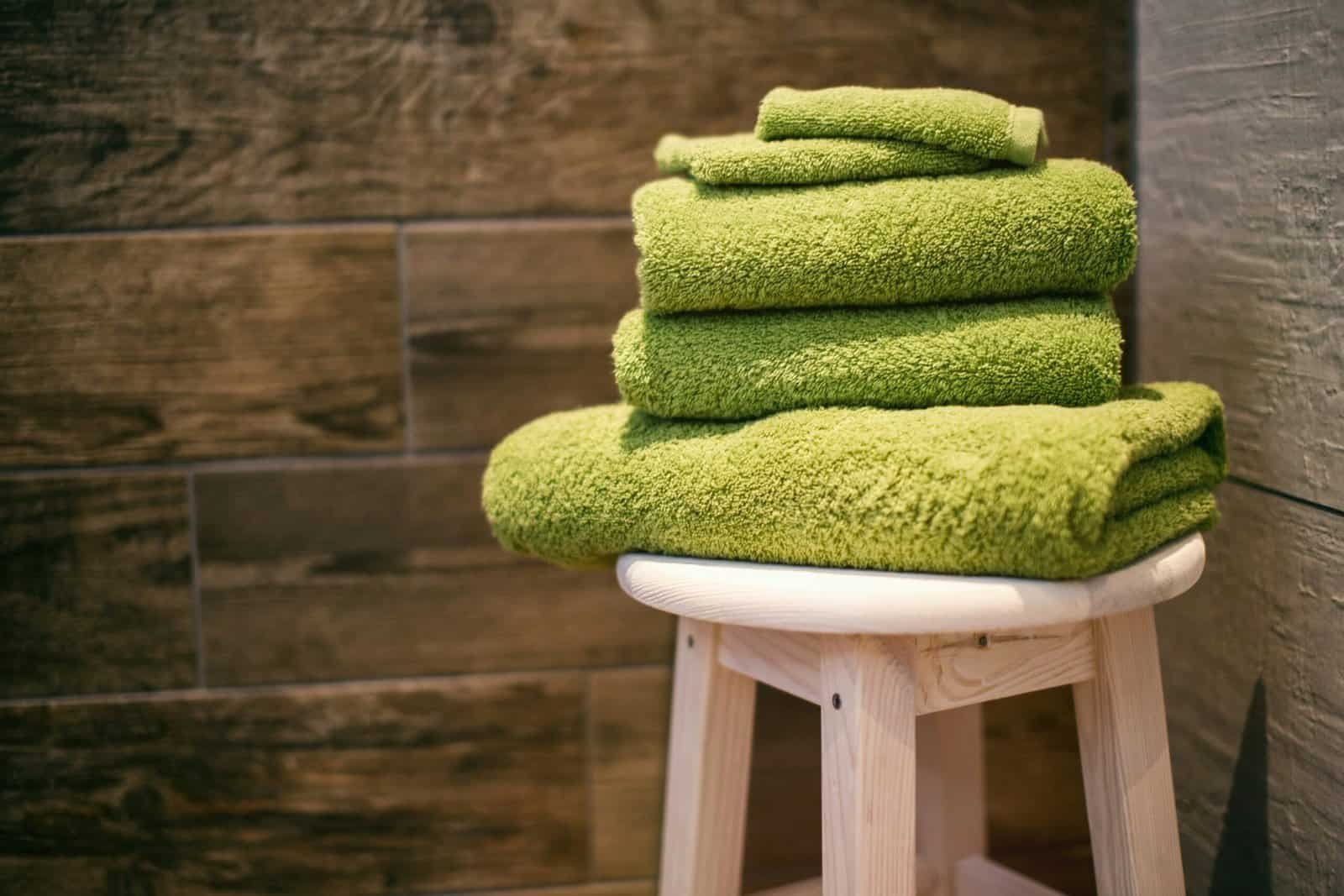
Fiber length is the specification that matters, so long-staple cotton is the answer for most bathrooms: it sheds less lint, holds its loops through repeated washing, and keeps absorbing for years. Among the best bath towels the differences after that are weave and weight, which trade plushness against how quickly a towel dries between uses. Nothing on a label matters more than those two variables.
Weight is usually quoted as grams per square meter, and it works in both directions. A heavier towel feels substantial and holds more water, which also means it stays damp longer in a closed bathroom.
Weave does the rest. A flat, low-pile or waffle structure exposes more surface to the air and dries fast, while a deep plush pile feels better and takes its time, the same tension that governs choosing a bath mat that dries quickly.
For most homes, a mid-weight long-staple cotton towel is the right buy, because it absorbs properly and still dries overnight on a bar. Choose Turkish cotton or waffle weave if your bathroom is small, humid or short on ventilation, since drying speed becomes the deciding factor. Reserve the heaviest plush towels for bathrooms with real airflow, and keep lightweight quick-dry towels for the gym bag rather than the rail.
Bath Towels at a Glance
| Type | Weight Feel | Drying Speed | Suits |
|---|---|---|---|
| Long-staple cotton | Mid to heavy | Moderate | Most bathrooms, as the default choice |
| Turkish cotton | Mid, flatter pile | Fast | Humid or poorly ventilated rooms |
| Egyptian cotton | Heavy, deep pile | Slow | Well-ventilated bathrooms, plush feel |
| Waffle weave | Light | Very fast | Small bathrooms and shared rails |
| Lightweight quick-dry | Thin | Very fast | Gym bags, travel, guest overflow |
| Organic cotton | Mid | Moderate | Lower-processing buyers |
Key Takeaways
- Long-staple cotton lasts longer and sheds less lint, which is why fiber length beats thread claims.
- Heavier towels absorb more and dry slower, so the right weight depends on your bathroom’s airflow.
- Fabric softener and dryer sheets coat the loops and destroy absorbency, permanently in bad cases.
- New towels carry a manufacturing finish and will not absorb properly until they have been washed.
- A towel that smells is a drying problem rather than a washing problem.
How We Picked These Towels
We organized this by fiber and weave, because those two things determine how a towel behaves and everything else on the packaging is secondary. Within each type we weighed durability through washing, absorbency and drying speed.
No comparative laundering trials were run here, so nothing is presented as a measured outcome from our own machine.
Drying speed was given more weight than usual. A towel that never fully dries becomes the problem described in our guide to towels that smell even after washing, and no fiber quality compensates for a rail with no air around it.
1. Long-Staple Cotton Towels, Best Overall
Why It Stands Out
Longer cotton fibers can be spun into yarn with fewer exposed ends, which is why these towels shed far less lint and keep their loops intact through years of washing.
Loop integrity is absorbency. A towel works by presenting a huge amount of fiber surface to water, and once the loops flatten or pull out, it stops drying you regardless of how thick it still feels.
Worth Knowing
Labels are unreliable here. Long-staple, extra-long-staple, Supima and Egyptian overlap and are used loosely, so a reputable seller matters more than the wording.
Mid-weight is the sweet spot for most people. The heaviest versions of these are genuinely luxurious and need a bathroom that can dry them.
This suits nearly every household as the main set. Skip it only if your bathroom has no ventilation at all, where a faster-drying weave is more practical. Best for: the everyday set in a typical bathroom, bought once and kept for years.
2. Turkish Cotton Towels, Best Fast-Drying
Why It Stands Out
Turkish cotton is typically woven with a flatter, shorter pile, which gives up some initial plushness in exchange for drying noticeably faster between uses.
They also soften with age rather than wearing out. Many people find these feel better after a dozen washes than they did new, which is unusual.
Worth Knowing
Out of the package they can feel thinner than expected. That is the trade for the drying speed, and it is a reasonable one in the right room.
Absorbency is slightly lower per towel because there is less fiber. For a small bathroom that rarely clears its humidity, that matters less than never having a damp towel, and it helps with the cause behind a musty-smelling bathroom.
Choose these for humid rooms, shared bathrooms and anywhere towels hang close together. Skip them if deep plushness is the main thing you want. Best for: bathrooms where drying between uses is the real constraint.
3. Egyptian Cotton Towels, Best Plush Feel
Why It Stands Out
Genuine Egyptian cotton has very long fibers, which allows a deep, dense pile that holds a lot of water and feels substantial in the hand.
This is the closest thing to a hotel towel for home use. The weight is the point, not a side effect.
Worth Knowing
The name is widely misused, and a great deal of towel labeled Egyptian cotton contains very little of it. Price and retailer reputation are the only practical guides.
Drying time is the real cost. A heavy plush towel in a small unventilated bathroom will still be damp the next morning, which no amount of quality prevents.
Buy these for a bathroom with a window or a working extractor fan. Skip them for a small interior bathroom or a busy shared one. Best for: plushness, in a room with enough airflow to dry them.
4. Waffle Weave Towels, Best for Humid Bathrooms
Why It Stands Out
The honeycomb structure creates a large amount of surface area with very little material, so these dry remarkably fast while still absorbing well for their weight.
They also pack flat and take up far less rail space, which is a practical advantage in a crowded bathroom.
Worth Knowing
The texture divides people. A waffle towel feels more like exfoliating than wrapping up, and some find it scratchy against the face.
The open weave can also snag on jewelry and rough nails, and a pulled thread shows more than it would on a terry pile. In a damp room the fast drying pays for that, much as a mildew-resistant shower curtain does.
This suits small bathrooms, humid climates and anyone whose towels never seem to dry. Skip it if you want to feel wrapped in something soft. Best for: rooms that hold humidity, where drying speed outranks feel.
5. Lightweight Quick-Dry Towels, Best for Gyms and Travel
Why It Stands Out
Thin, tightly woven towels dry in a fraction of the time and fold down small, which is exactly what a gym bag or a suitcase needs.
Because they dry so fast they resist developing a smell even when packed slightly damp, which is the usual failure of a full-weight towel in a bag.
Worth Knowing
They are not a substitute for a bathroom towel. There is simply less fiber, so one of these will be saturated before you are dry.
Many are part-synthetic, which drives the drying speed and changes the feel. A rack helps them even further, which is where a compact drying rack earns its keep.
Buy these for the gym, for travel and as guest overflow. Skip them as your main bathroom set. Best for: bags, travel and anywhere a towel has to dry fast and pack small.
6. Organic Cotton Towels, Best Low-Processing Option
Why It Stands Out
These are grown and finished with fewer chemical inputs, and they typically skip the optical brighteners and heavy softening finishes applied to conventional towels.
That has a practical upside. A towel without a softening finish absorbs properly from the first wash rather than needing several to strip the coating off.
Worth Knowing
Certification varies and the term is used loosely, so look for a named standard rather than the word alone on packaging.
Colors tend to be more muted, since the dye options are narrower. Undyed and natural shades are common for the same reason.
This suits buyers who care about how the cotton was grown and finished. Skip it if you want bright colors or the cheapest route to a full set. Best for: lower-processing buying, with absorbency that works immediately.
How to Choose Bath Towels
What weight should you buy
Match it to your bathroom’s airflow rather than to how it feels in the shop. A room with a window or a working fan can dry a heavy plush towel; a small interior bathroom cannot, and a mid or light weight will serve you better there.
Does thread count matter on towels
No, and it is largely a bedding metric borrowed for marketing. Fiber staple length and weave structure determine how a towel performs, so a stated thread count on a towel tells you almost nothing useful.
How many towels do you need
Enough that each one gets a full day to dry between uses, which usually means at least two per person in regular rotation. Rail space is the limiting factor more often than the number of towels, and a renter-friendly caddy frees up some of it.
Are bamboo and microfiber towels worth considering
Both dry quickly and feel different from cotton, with bamboo blends sitting closer to cotton and microfiber feeling synthetic against skin. They suit secondary uses well; for the main bathroom set, cotton remains the more durable and more pleasant choice.
Plush or Fast-Drying
When plush wins
Choose weight and depth when the bathroom can dry it, because a heavy long-staple towel absorbs more, lasts well and is simply nicer to use. This is the right call in a ventilated room with generous rail space.
When fast-drying wins
Choose a flatter weave whenever humidity lingers, towels hang touching each other, or more than one person shares a rail. A slightly thinner towel that is dry when you need it beats a luxurious one that is damp.
Common Towel Mistakes to Avoid
Using fabric softener
Softener works by coating fibers, and a coated loop cannot absorb water. This is the single most common reason a good towel stops drying you, and heavy build-up is difficult to reverse. Dryer sheets do the same thing.
Not washing new towels first
Towels leave the factory with a finish that makes them look and feel appealing on the shelf and actively repels water. Washing before first use removes it, and until you do, a new towel will seem to push water around instead of soaking it up.
Using too much detergent
Excess detergent does not rinse out of dense pile and leaves residue that stiffens the towel and blocks absorbency. Less detergent with a thorough rinse works better, and genuine marks are better handled with a targeted stain remover than with a heavier wash.
Bath Towel FAQ
What are the best bath towels for everyday use?
Mid-weight long-staple cotton suits most bathrooms, because it absorbs properly, sheds little lint and still dries overnight on a rail. Turkish cotton or waffle weave is the better pick for a small or humid room, and the heaviest Egyptian cotton towels need a bathroom with real ventilation.
Why are my new towels not absorbing water
Because of the finish applied at the factory, which makes towels look plump and uniform on a shelf while repelling water. Wash them before first use, without fabric softener, and absorbency improves immediately. A few washes fully settle it.
Does GSM matter when buying towels
It describes weight per unit area, so it tells you how substantial a towel is and, indirectly, how long it will take to dry. Higher is not better in itself: a heavy towel in a room with no airflow stays damp, which is worse than a lighter towel that dries.
Why do my towels smell even though I wash them
Almost always because they are not drying fully between uses, so the problem is airflow rather than detergent. Towels hung folded over on a crowded rail stay damp in the middle. Spreading them out and improving bathroom ventilation fixes more than changing products does.
How often should you replace bath towels
When the loops have flattened and the towel stops drying you, which is a function of washing and handling rather than a set age. Towels that have been through fabric softener fail sooner, and ones washed with less detergent and dried properly last considerably longer.
Is Turkish or Egyptian cotton better
They solve different problems. Egyptian cotton makes a plusher, heavier, more absorbent towel that dries slowly, while Turkish cotton makes a flatter towel that dries fast and softens with age. Your bathroom’s ventilation should decide between them, not the name.
Can you put bath towels in the dryer
Yes, and the main thing to avoid is overloading, since towels need room to tumble or they come out compacted and still damp inside. Skip dryer sheets entirely, because they coat the loops exactly as fabric softener does and reduce absorbency over time.
Worth reading next: our guides to organizing a bathroom and organizers for small bathrooms, plus the roundup of toilet paper holders and storage if rail and shelf space is the constraint.
