
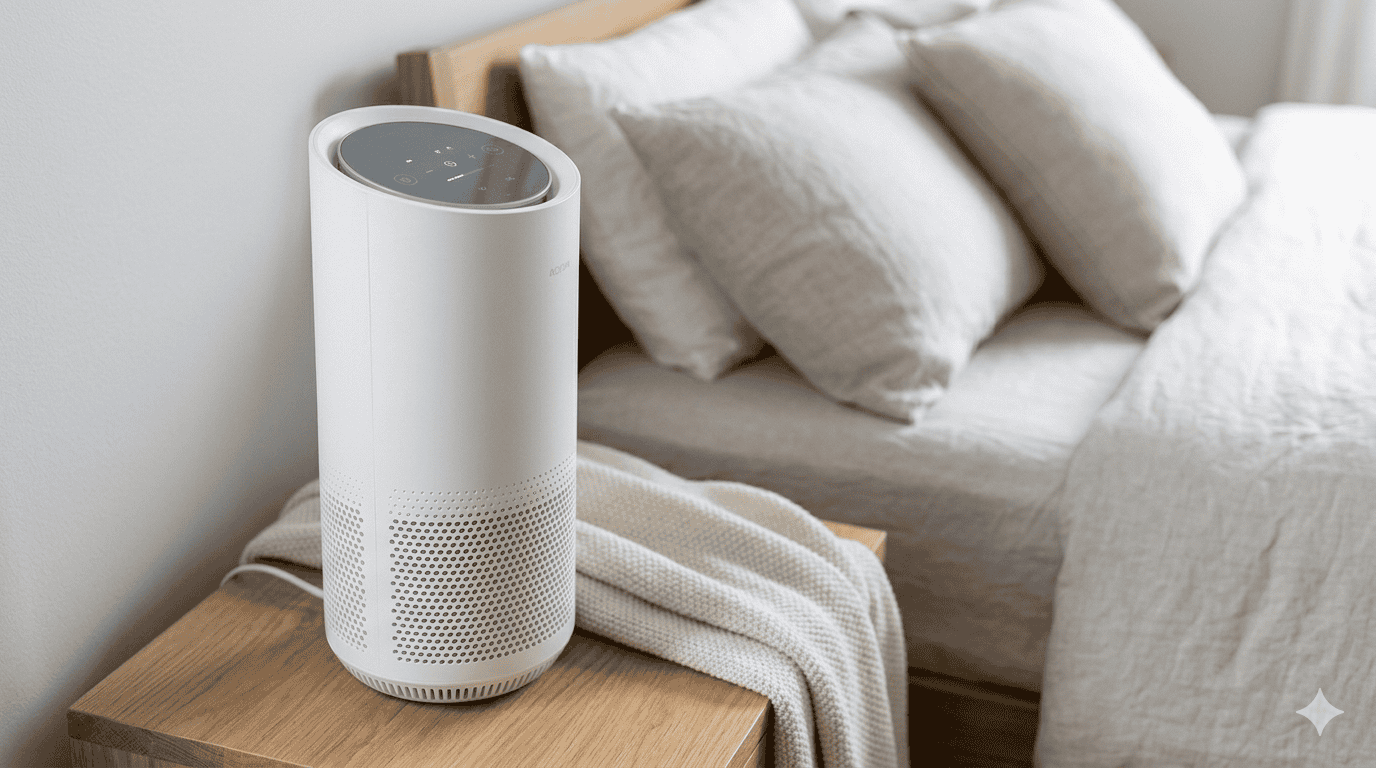
The best air purifiers for bedrooms fix a problem most people do not know they have, the air inside your bedroom is often significantly more polluted than the air outside it.
Dust mites, pet dander, mold spores, pollen, volatile organic compounds from furniture and paint, and fine particulate matter all accumulate in enclosed bedroom spaces where ventilation is limited, and surfaces collect particles continuously. For the 6 to 8 hours you spend in your bedroom each night, you breathe this air without interruption. The result shows up as congestion on waking, allergy symptoms that are worse indoors than outdoors, and disrupted sleep from airborne irritants that trigger respiratory responses during the night.
A quality bedroom air purifier running on its lowest fan setting overnight removes the majority of these particles continuously, producing measurably cleaner air without creating the noise that disrupts sleep. If you already use a white noise machine, our guide to the best white noise machines covers the best options for pairing with an air purifier to create a complete sleep environment.
What to Look for in a Bedroom Air Purifier
HEPA filtration is the non-negotiable minimum standard.
HEPA stands for High Efficiency Particulate Air. A true HEPA filter captures 99.97 percent of particles 0.3 microns and larger, which includes dust mite debris, pet dander, mold spores, pollen, and the majority of airborne bacteria. Filters marketed as HEPA-type or HEPA-like do not meet this standard and capture significantly fewer particles in the size ranges that matter most for allergy and respiratory health. Check specifically for TRUE HEPA certification before buying, not just the word HEPA in the product name.
CADR rating determines how quickly it actually cleans the air in your specific room.
CADR stands for Clean Air Delivery Rate, the volume of filtered air the purifier produces per minute at its highest fan setting, measured in cubic feet per minute. For a bedroom, take the room’s square footage and multiply by 0.75 to find the minimum CADR you need. A 200-square-foot bedroom needs a CADR of at least 150. A 300-square-foot bedroom needs at least 225. Buying a purifier with a CADR below your room’s requirement means the air cycles through filtration too slowly to produce measurably cleaner air.
Noise level at the sleep setting determines whether you actually keep it running at night.
A bedroom air purifier that runs at 50 decibels on its lowest setting is too loud to sleep next to comfortably, roughly the volume of a quiet conversation. The best bedroom air purifiers run at 25 to 35 decibels on their lowest fan setting, barely audible, comparable to a very quiet whisper. Check the decibel rating specifically at the lowest fan speed rather than the overall noise rating, which typically reflects the highest speed.
Filter replacement cost is the true long-term cost of ownership.
The purchase price of an air purifier is only part of what you spend. HEPA filters need replacement every 6 to 12 months, depending on air quality and runtime, replacement filters cost $20 to $60 per cycle. Over three years of operation, a purifier with a $50 annual filter replacement cost adds $150 to the total cost of ownership. Factor this into the purchase decision, a $70 purifier with $60 annual filter costs is more expensive long-term than a $120 purifier with $25 annual filter costs.
The 5 Best Air Purifiers for Bedroom in 2026
#1, Levoit Core 300S Air Purifier
Best Overall Bedroom Air Purifier | Price: ~$100
The Levoit Core 300S is the bedroom air purifier that hits every specification that matters for overnight operation in a single compact unit, and it does it at $100 without requiring you to compromise on any of the fundamentals.
Why the Core 300S Earns the Top Spot
The three-stage filtration system, pre-filter, true HEPA H13, and activated carbon, captures particles down to 0.1 microns while the activated carbon layer handles odors and volatile organic compounds that HEPA filters alone cannot address. At 141 CADR it handles rooms up to 219 square feet effectively, covering most standard bedrooms in a single unit.
The sleep mode runs the fan at its lowest speed at 24 decibels, genuinely quiet enough to sleep next to without noticing it. The auto mode uses an air quality sensor to adjust fan speed automatically when pollutant levels rise, which means it stays quiet when air quality is good and increases power automatically when it detects a problem. The 360-degree air intake design pulls particles from all directions simultaneously rather than from one side only.
App control via the Levoit VeSync app lets you schedule operation, set fan speed remotely, and monitor air quality data over time. The display dims automatically in sleep mode so the lights do not disturb sleep.
PROS:
- True HEPA H13 filtration captures particles down to 0.1 microns
- Runs at 24 decibels on sleep mode, genuinely quiet for overnight operation
- Auto mode adjusts fan speed based on real-time air quality sensor readings
- 360-degree air intake pulls particles from all directions
- App control with scheduling, remote operation, and air quality monitoring
- Display dims automatically in sleep mode
CONS:
- 141 CADR covers rooms up to 219 square feet, not sufficient for large master bedrooms
- Replacement filters cost approximately $25 every 6 to 8 months
- Cylindrical design requires clearance on all sides for optimal air intake
Best for: Anyone with a standard bedroom up to 220 square feet who wants a completely quiet overnight air purifier with smart features at an accessible price.
#2, Winix 5500-2 Air Purifier
Best Value Bedroom Air Purifier | Price: ~$170
The Winix 5500-2 covers larger bedrooms that the Levoit Core 300S cannot handle, at 243 CADR it cleans rooms up to 360 square feet effectively, making it the right choice for master bedrooms, open bedroom layouts, or anyone who runs their purifier in a connected living space during the day.
Coverage That Matches Larger Spaces
The four-stage filtration adds PlasmaWave technology to the standard HEPA and carbon combination, PlasmaWave creates hydroxyls that break down airborne pollutants at the molecular level, addressing VOCs and odors that carbon filters alone cannot fully handle. The washable pre-filter extends the life of the HEPA filter by capturing larger particles before they reach it, reducing the frequency and cost of HEPA filter replacements.
The auto mode uses a particle sensor and odor sensor simultaneously, the Levoit uses only a particle sensor. This dual-sensor approach detects both visible pollutants and odorless VOCs, triggering fan speed increases when either type of pollutant rises above the baseline. The sleep mode runs at 27.8 decibels, slightly louder than the Levoit but still quiet enough for most sleepers.
PROS:
- 243 CADR covers rooms up to 360 square feet, handles larger bedrooms
- Four-stage filtration, including PlasmaWave technology for VOC breakdown
- Washable pre-filter extends HEPA filter life and reduces replacement frequency
- Dual particle and odor sensor detects both visible and odorless pollutants
- Sleep mode at 27.8 decibels, quiet enough for most sleepers
- Strong reliability record across years of consistent production
CONS:
- Higher price at approximately $170
- Larger footprint than the Levoit Core 300S, takes more floor space
- PlasmaWave technology produces trace ozone, negligible at the levels produced, but worth knowing
Best for: Anyone with a larger bedroom over 220 square feet who needs a higher CADR and wants four-stage filtration, including VOC breakdown at a fair price.
#3, Coway AP-1512HH Mighty Air Purifier
Best Budget Bedroom Air Purifier | Price: ~$90
The Coway Mighty is one of the most consistently recommended budget air purifiers across every serious review publication, and the reason is simple. At $90, it delivers true HEPA filtration, an air quality indicator, and auto mode in a compact unit with a proven reliability record across hundreds of thousands of units sold.
At 246 CADR it covers rooms up to 360 square feet, a higher coverage rating than the Levoit Core 300S at $10 less. The air quality indicator uses a colored LED ring to show real-time air quality, green for good, yellow for moderate, red for poor, without requiring an app or a phone. The auto mode adjusts fan speed based on the particle sensor. The sleep mode runs the fan at its lowest speed with the display off.
The honest limitation compared to the Levoit and Winix is smart features, no app, no scheduling, no remote control. The controls are entirely physical. For buyers who prefer simple physical controls over app dependency, this is a feature rather than a limitation.
PROS:
- True HEPA filtration at $90, best filtration-to-price ratio on this list
- 246 CADR covers rooms up to 360 square feet
- Colored LED air quality indicator shows real-time status without an app
- Auto mode adjusts fan speed based on particle sensor readings
- Sleep mode with display off for overnight operation
- Proven reliability record across hundreds of thousands of units
CONS:
- No app control, scheduling, or remote operation
- Four-stage filtration does not include activated carbon in the base model
- Slightly louder sleep mode than the Levoit Core 300S
Best for: Buyers who want true HEPA filtration and auto mode at the lowest possible price, and anyone who prefers straightforward physical controls over app-connected smart features.
#4, Blueair Blue Pure 411i Max
Best Design-Forward Bedroom Air Purifier | Price: ~$130
The Blueair Blue Pure 411i Max is the bedroom air purifier for buyers who care about how the unit looks as much as how it performs, and unlike most design-forward products, it does not sacrifice performance to achieve its aesthetic.
The fabric pre-filter wraps around the outside of the unit in a range of colors, blue, dark shadow, white, and others, making the purifier look more like intentional decor than an appliance. The performance behind the design is genuine, the HEPASilent technology combines mechanical and electrostatic filtration to capture 99.97 percent of particles at lower fan speeds than standard HEPA-only designs, which means quieter operation at equivalent filtration efficiency.
At 190 CADR it handles rooms up to 260 square feet. The single-button control keeps operation simple. The app provides scheduling, air quality monitoring, and filter life tracking. At 17 decibels on the lowest fan setting, it is the quietest purifier on this list by a meaningful margin, genuinely inaudible in a quiet bedroom for most sleepers.
PROS:
- HEPASilent technology achieves equivalent filtration at lower fan speeds, quieter operation
- 17 decibels on the lowest setting, quietest option on this list
- Fabric pre-filter available in multiple colors, looks like intentional bedroom decor
- App control with scheduling and air quality monitoring
- One-button physical control for simple operation without the app
- Blueair’s brand reputation for consistent long-term performance
CONS:
- Higher price at approximately $130 for 190 CADR, lower coverage than alternatives at similar cost
- Fabric pre-filter requires hand washing monthly, additional maintenance step
- Replacement filters cost approximately $40 every 6 months
Best for: Buyers who want the quietest possible bedroom air purifier and care about how the unit looks on the bedroom floor, particularly those with smaller bedrooms up to 260 square feet.
#5, Honeywell HPA300 Air Purifier
Best High-Coverage Bedroom Air Purifier | Price: ~$180
The Honeywell HPA300 is built for large bedrooms and open-plan spaces where standard bedroom purifiers run out of coverage capacity. At 300 CADR it handles rooms up to 465 square feet, the highest room coverage on this list and the right choice for large master bedrooms, studio apartments where the bedroom and living space are combined, or anyone who runs a single purifier for multiple connected rooms.
The four-stage filtration includes true HEPA and activated carbon with Honeywell’s Turbo Clean setting, a high-power mode that rapidly cleans the air in a room that has experienced a sudden pollution event like cooking smoke, pet odor, or dusty activity before switching back to a quieter maintenance mode. The Turbo Clean cycle runs for two hours and then automatically drops to the previous fan speed setting.
At $180, it is the most expensive option on this list. The coverage justifies the price for buyers who actually need 465 square feet of effective filtration, paying $130 for a 260-square-foot purifier in a 400-square-foot space is a poor value regardless of the lower purchase price.
PROS:
- 300 CADR covers rooms up to 465 square feet, the highest coverage on this list
- True HEPA and activated carbon four-stage filtration
- Turbo Clean mode rapidly clears sudden pollution events, then returns to maintenance mode
- Honeywell brand reliability is backed by decades of air quality product manufacturing
- Auto mode adjusts fan speed based on air quality sensor readings
- Simple physical controls, no app required
CONS:
- Most expensive option on this list is approximately $180
- Largest footprint, requires significant floor space
- Sleep mode runs louder than the Levoit and Blueair alternatives
Best for: Anyone with a large bedroom or combined living and sleeping space over 300 square feet, where smaller purifiers cannot provide adequate air changes per hour.
Quick Comparison: Best Air Purifiers for Bedroom 2026
| Purifier | Price | CADR | Coverage | Sleep Noise | HEPA Grade | Score |
|---|---|---|---|---|---|---|
| Levoit Core 300S | ~$100 | 141 | 219 sq ft | 24dB | H13 | 9.3 |
| Winix 5500-2 | ~$170 | 243 | 360 sq ft | 27.8dB | True | 9.1 |
| Blueair 411i Max | ~$130 | 190 | 260 sq ft | 17dB | HEPASilent | 9.0 |
| Coway AP-1512HH | ~$90 | 246 | 360 sq ft | ~28dB | True | 8.9 |
| Honeywell HPA300 | ~$180 | 300 | 465 sq ft | ~32dB | True | 8.8 |
Our Verdict
For most standard bedrooms under 220 square feet, the Levoit Core 300S at $100 is the right call, true HEPA H13 filtration, 24-decibel sleep mode, and smart features in a compact unit at a fair price. For larger bedrooms, the Winix 5500-2 at $170 handles up to 360 square feet with four-stage filtration. If noise is your absolute priority, the Blueair at 17 decibels is the quietest option on this list by a clear margin.
Budget buyers who want the best filtration-to-price ratio should go with the Coway Mighty at $90, 246 CADR and true HEPA at the lowest price on this list. For large master bedrooms or combined spaces, the Honeywell HPA300 at $180 provides coverage that smaller units simply cannot match.
Frequently Asked Questions: Best Air Purifiers for Bedroom
What is the best air purifier for a bedroom in 2026? The Levoit Core 300S is the best overall bedroom air purifier for rooms up to 220 square feet, true HEPA H13 filtration, 24-decibel sleep mode, and auto mode with an air quality sensor at $100. For larger bedrooms, the Winix 5500-2 at $170 provides four-stage filtration and 360-square-foot coverage at a fair price.
Do bedroom air purifiers actually make a difference? Yes, measurably. Studies consistently show that HEPA air purifiers reduce airborne particulate matter, allergens, and pet dander in enclosed spaces by 50 to 80 percent within one hour of operation. For allergy sufferers, people with asthma, pet owners, and anyone who wakes up congested regularly, the improvement from running a quality air purifier overnight is noticeable from the first week of use.
More Questions About Bedroom Air Purifiers
Where should I place an air purifier in my bedroom? Place the air purifier near the head of your bed on the floor or a low nightstand, this puts the cleanest filtered air closest to where you breathe during sleep. Keep at least 12 to 18 inches of clearance around the unit on all sides for optimal air intake. Avoid placing it in a corner or against a wall, restricted air intake reduces filtration efficiency significantly, regardless of the unit’s rated CADR.
How long should I run a bedroom air purifier? Run it continuously, or at a minimum during the hours you spend in the bedroom. Air quality degrades within hours of turning a purifier off as particles accumulate again. The energy cost of running a bedroom air purifier continuously is minimal, most units consume 15 to 45 watts, comparable to a standard light bulb. Sleep mode on most quality purifiers automatically reduces power consumption and noise during sleeping hours without requiring manual adjustment.
Related Reading
Explore more: air fryer accessories, and smart air purifiers. Also explore: milk frothing pitchers, and water filter pitchers.
More Kitchen Guides
Recommended Reading
See also our guides to smart air purifiers.
