
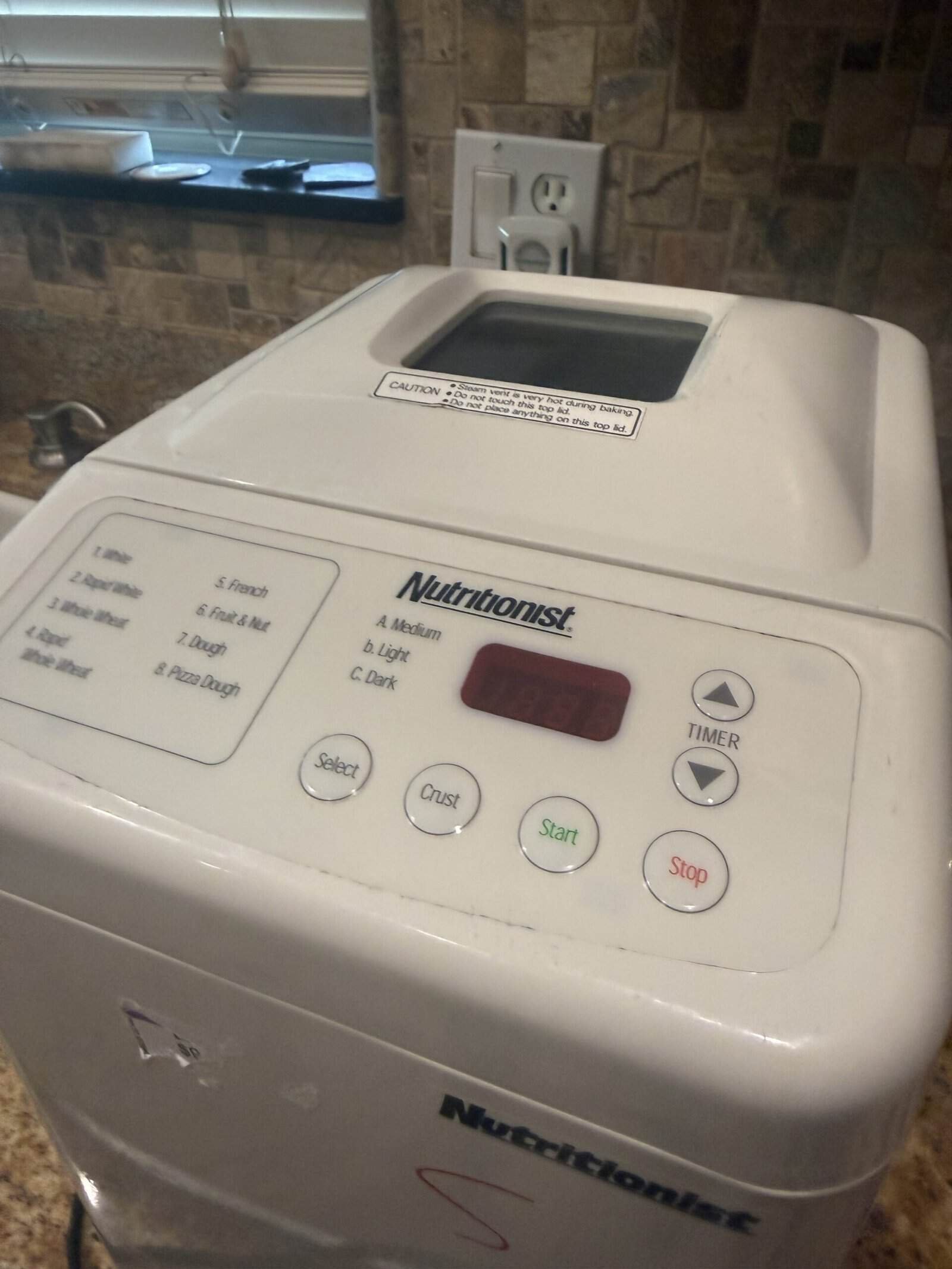
My bread machine is not on the counter right now. It is in a cabinet, because the honest answer to whether a bread machine is worth it, in my kitchen, comes down to a trade I make every time I want a loaf: the machine earns the counter for a day, and then it goes back into storage so the counter can be a counter again. If you have the room to leave one out, this question is easy. If you do not, it is a real decision, and that is the one nobody seems to write about. For more on this, see our guide to how often people actually use them.
Key Takeaways
- The real cost of a bread machine is not money, it is counter space.
- Mine lives in a cabinet and comes out only when I am baking.
- It heats evenly, which matters more than the feature list suggests.
- It is semi-loud and the paddle is a minor nuisance to remove.
- Worth it depends on whether you will actually use it, not the specs.
The Cost Is Counter Space, Not Money
A bread machine is a large single-purpose appliance, and that is the whole calculation.
Mine takes up a meaningful footprint, and in my kitchen counter space is the thing I do not have to spare. So it lives in a cabinet and comes out when I decide to bake, and goes back when I am done. That is not a complaint. It is the arrangement that makes owning one workable in a smaller space.
Which reframes the money question entirely. The purchase price is a one-time number and it is not the thing that decides whether the machine is worth it. What decides it is whether you are willing to give up the counter for a day at a time, repeatedly, or whether you have room to leave it out so that baking is a two-minute decision instead of a haul-it-out project.
If your kitchen has the space, skip ahead. If it does not, this is the honest center of the decision, and it is worth sitting with before you buy. Choosing a bread machine covers the models; this is about whether the thing fits your life.
What Getting It Out Actually Involves
Small friction, and it adds up in a way that decides how often you bake.
When the machine is stored, baking starts with retrieving it, finding a spot, and setting it up. None of that is hard. All of it is enough that baking becomes a thing I plan rather than a thing I do on a whim. That is the practical consequence of not having the counter space to leave it out.
The people who use a bread machine constantly are, I suspect, mostly the people who never put it away. When it is sitting there, ready, you use it because the cost of using it is nearly zero. When it lives in a cabinet, every loaf has a small tax on the front end.
That is not an argument against buying one. It is an argument for being honest about which of those two situations you are in, because it predicts how much use you will actually get.
It Heats Evenly, and That Matters
The thing that genuinely surprised me, and a point in the machine’s favor.
My loaves bake evenly. The crust comes out consistent around the loaf rather than scorched on one side and pale on the other, which is not something I took for granted going in. Even heating is one of those specifications that sounds boring on a product page and turns out to be most of what you actually want from the machine.
A bread machine that heats unevenly produces a loaf you have to apologize for, and no amount of good ingredients fixes it. Mine does not have that problem, and it is the single quality I would tell someone to prioritize over the length of the feature list. See also our guide to the delay start feature.
Features are easy to print. Even baking is the thing that shows up in the loaf, and it is worth weighting heavily when you compare machines.
The Honest Annoyances
Two of them, both minor, both worth knowing before you buy.
It is semi-loud. Not alarming, not something that fills the apartment, but it makes noise while it runs, and in a small space you hear it. If you are sensitive to appliance noise or you bake overnight, that is worth factoring in.
The paddle is a minor pain to get out of the loaf. Every bread machine bakes around a mixing paddle, and when the loaf comes out the paddle tends to come with it, lodged in the bottom. Working it free without tearing the loaf is a small skill you develop. It is not difficult and it is not a dealbreaker, but it is a real part of using one of these that the marketing never mentions.
Neither of these would stop me recommending a bread machine. They are the ordinary friction of the appliance, and I mention them because a worth-it article that only lists upsides is not being straight with you.
What You Actually Get For the Trade
The other side of the ledger, because the counter-space cost buys something real.
You get bread you made, on your schedule, from ingredients you chose. You get to make things a grocery run does not easily hand you. I have made basic white, sourdough, and a cheddar jalapeno loaf, and the last of those is the kind of thing that is genuinely better homemade and genuinely annoying to buy. The machine handles dough for things like cinnamon rolls too.
You also get a low-effort path to it. The machine does the mixing, the rising, and the baking, which is most of the labor of bread. That is the actual pitch: not that it is cheaper than store bread, but that it makes homemade bread a low-skill, mostly-hands-off thing instead of an afternoon project. The case is strongest for anyone buying gluten-free bread regularly, which our gluten-free machine picks cover.
Whether that is worth surrendering the counter for is the question, and it depends entirely on how much you value the output. Using a bread machine covers what the process actually looks like day to day.
Who Should Buy One, and Who Should Not
The decision, laid out honestly.
Buy one if you will actually use it, and be honest about what makes that likely. Counter space to leave it out makes constant use easy. A real appetite for homemade bread makes the storage tax worth paying. Wanting specific breads that are hard to buy, like a good cheddar jalapeno loaf, tips it further.
Think harder if your counter is already full and your interest is more idea than habit. A bread machine that lives in a cabinet and gets used twice is a large object you now store for no return. That is the most common way these end up as expensive clutter, and it is a space problem more than a money one.
For me it is worth it, with the storage trade fully acknowledged, because I use it and I value what comes out. That is the only version of worth it that means anything: not the specs, not the price, but whether the thing earns the space it costs you. Budget bread makers covers the lower end if you want to test the water before committing more.
Recommended Reading
See choosing a bread machine, using a bread machine, and bread machine vs stand mixer.
Are Bread Machines Worth It FAQ
Are bread machines worth it?
In my kitchen, yes, with one honest caveat: the real cost is counter space, not money. Mine lives in a cabinet and comes out only when I bake, because I do not have room to leave it out. If you will actually use it and you can accept that trade, it is worth it. If your counter is full and your interest is casual, it becomes an expensive object you store.
What is the real downside of a bread machine?
Space. It is a large single-purpose appliance, and if you cannot leave it on the counter, every loaf starts with hauling it out and setting it up. That small friction is what decides how often you actually bake, more than anything on the spec sheet.
Are bread machines loud?
Mine is semi-loud. Not alarming and not something that fills the whole space, but it makes noise while it runs, and you hear it in a small apartment. Worth considering if you are sensitive to appliance noise or plan to bake overnight.
Is the paddle hard to remove from the loaf?
It is a minor nuisance. The loaf bakes around the mixing paddle, so the paddle tends to come out lodged in the bottom of the bread, and working it free without tearing the loaf is a small skill you pick up. Not difficult, just a real part of using one that nobody warns you about.
Do bread machines bake evenly?
Mine does, and it was the thing that surprised me most. The crust comes out consistent around the loaf rather than scorched on one side. Even heating matters more than the length of the feature list, and I would prioritize it over extra settings when comparing machines.
Is homemade bread from a machine cheaper than store bread?
That is not the reason to buy one. The pitch is not cost, it is getting bread you made on your schedule from ingredients you chose, with the machine doing most of the labor. Some breads, like a good cheddar jalapeno loaf, are genuinely better homemade and annoying to buy, which is where the value shows up.
Who should not buy a bread machine?
Anyone whose counter is already full and whose interest is more idea than habit. A machine that lives in storage and gets used twice is a large object you now keep for no return. It ends up as clutter through a space problem, not a money one.
How do I know if I will actually use it?
Be honest about two things: whether you have room to leave it out, and how much you actually want homemade bread. Counter space makes constant use easy. Genuine appetite makes the storage tax worth paying. If neither is clearly true, wait.
More in this guide: how to set up a home baking station.
Recommended Reading
Related: bread machines for occasional bakers.
Related: basic bread machines without extra features.
Related: used bread machine worth buying.
