
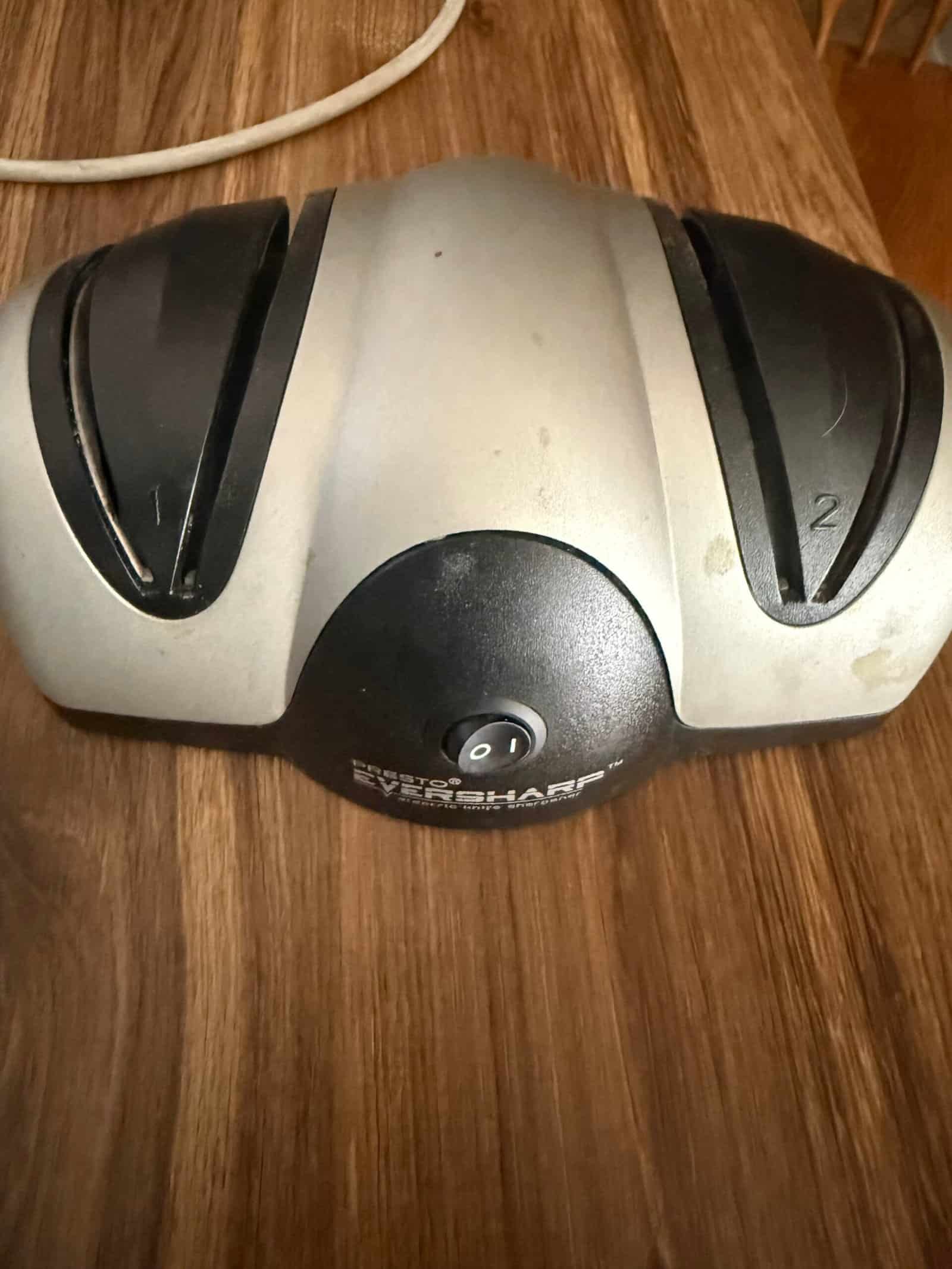
Electric knife sharpeners are solid, useful tools, but they come with real downsides you should know before buying one. I keep a countertop electric sharpener and run all my knives through it now and then, and my honest verdict is that it does the job well while not being perfect. It works better on some knives than others, it takes off a fair bit of metal, and it is loud. If those tradeoffs are acceptable to you, an electric sharpener is a genuinely convenient way to keep an edge.
Key Takeaways
- Electric sharpeners are convenient and effective, with real tradeoffs.
- They work better on some knives than others.
- They remove more metal than gentler methods.
- They are loud in use.
- Good for convenience; not the choice for precious or delicate knives.
My Experience With a Countertop Sharpener
I use a countertop electric sharpener for all my kitchen knives. I do not run them through constantly, just once in a while, and specifically whenever a knife starts feeling dull. That is the rhythm that works for me: rather than a fixed schedule, I sharpen when I notice an edge slipping, which keeps the knives cutting well without overdoing it.
The convenience is the real draw. Pulling a knife through a powered sharpener takes seconds and needs no skill or setup, unlike learning to hold an angle on a whetstone. For keeping a working set of kitchen knives usable with minimal effort, it delivers, which is why it earns its spot on my counter. Sharpening a knife covers the manual methods for comparison.
What Works Well
The main strength is speed and ease. An electric sharpener restores a dull edge quickly and reliably, and it does not ask you to master a technique. For someone who just wants sharp knives without a project, that is exactly the appeal. When a knife of mine starts feeling dull, a couple of passes brings it back to a working edge fast.
It also handles the everyday knives well. For a standard set of kitchen and steak knives that get used and dulled through regular cooking, an electric sharpener keeps the whole lot in usable shape without much thought. It is a practical tool for practical knives, and on that count it does what I want. Steak knives and other daily blades are where it shines.
The Real Downsides
The honesty part matters here, because electric sharpeners are not flawless, and I have run into their limits directly.
It works better on some knives than others. Not every knife comes out equally well. Some blades sharpen up beautifully, while others respond less well to the fixed slots and angles, so the results are not perfectly consistent across a mixed set. This is worth knowing if you expect uniform results on every knife you own.
It takes off some metal. An electric sharpener grinds, and grinding removes metal. More metal comes off than with gentle honing, which means the knife wears down faster over many sharpenings than it would with lighter methods. For everyday knives that is a fair trade, but it is a real cost over time.
It is loud. The motor and grinding make real noise. It is not a quiet tool, and if noise bothers you, that is a genuine consideration. None of these downsides ruin the tool, but you should go in knowing them. Why knives get dull covers what the sharpener is fixing.
Who Should Get One, and Who Should Not
An electric sharpener suits someone who wants sharp everyday knives with minimal effort and skill, and who is fine with the tradeoffs. If you have a set of working kitchen knives you use hard and just want them kept sharp without learning a technique, it is a strong, convenient choice. That describes how I use mine.
It is a worse fit for precious, expensive, or delicate knives, where the metal removal and the fixed angles are more of a concern, and where hand sharpening gives more control. If you own a prized chef knife you want to baby, a gentler method suits it better. Matching the tool to the knives you own is the whole decision. Choosing a kitchen knife covers the knives worth pairing with it.
How It Fits My Kitchen
The way I actually use the sharpener shapes how I feel about it. Because it removes metal, I do not run knives through it on a schedule. I sharpen only when a knife starts feeling dull, which for my everyday knives means occasionally rather than often. That restraint matters: sharpening only on need keeps the knives cutting well while slowing the metal loss that comes with every pass.
Living with one has taught me to match the knife to the tool. The everyday kitchen and steak knives that take the abuse go through the electric sharpener without a second thought, since convenience is what I want for those. The results vary a little from knife to knife, so I have learned which of mine come out best and which respond less well. Knowing that, I get the convenience where it counts and reach for a gentler method on anything I would rather not grind. That balance is what makes the tool genuinely useful in my kitchen rather than a frustrating compromise. Storing knives safely keeps the edge longer between sharpenings.
The Verdict
Are electric knife sharpeners good? Yes, with honest caveats. They are solid, convenient tools that keep everyday knives sharp fast and without skill, which is real value. The downsides are that they work better on some knives than others, remove more metal than gentle methods, and are loud. For a working set of kitchen knives, I find those tradeoffs easy to accept, and my countertop sharpener earns its place. For precious knives, I would reach for something gentler. Know the tradeoffs, match it to your knives, and it is a genuinely useful tool. Knife sharpeners cover the range of options.
Recommended Reading
Worth reading next: knife sharpeners, how to sharpen a knife, why knives get dull, and storing knives safely.
Are Electric Knife Sharpeners Good FAQ
Are electric knife sharpeners good?
Yes, with real caveats. They are convenient, effective tools that sharpen everyday knives fast and without skill. The downsides are that they work better on some knives than others, remove more metal than gentle methods, and are loud. For working kitchen knives, those tradeoffs are usually acceptable.
Do electric sharpeners damage knives?
They remove more metal than honing or light hand sharpening, so knives wear down faster over many sharpenings. That is a fair trade for everyday knives but a real cost for precious ones. Used sensibly rather than constantly, an electric sharpener is fine for standard kitchen knives.
How often should I use an electric sharpener?
Not constantly. Using one whenever a knife starts feeling dull, rather than on a fixed schedule, keeps edges working without removing metal needlessly. Because these sharpeners grind away metal, sharpening only when a knife actually needs it extends the life of the blade.
Do they work on all knives?
Not equally. Some knives sharpen up very well, while others respond less well to the fixed slots and angles, so results vary across a mixed set. Serrated knives in particular usually need a different approach. Expect good but not perfectly uniform results across every knife.
Are electric sharpeners loud?
Yes. The motor and grinding make real noise, so they are not quiet tools. It is brief, since sharpening takes only seconds, but if noise is a concern for you it is worth knowing before buying. This is one of the honest downsides of the convenience.
Should I use one on expensive knives?
Generally no. The metal removal and fixed angles make electric sharpeners a better fit for everyday working knives than for precious, expensive, or delicate ones. For a knife you want to protect, a gentler hand method gives more control. Match the tool to the knife’s value.
Are electric or manual sharpeners better?
It depends on what you want. Electric sharpeners win on speed and ease and suit everyday knives. Manual methods give more control and remove less metal, suiting precious knives and people who do not mind the technique. Many kitchens use an electric sharpener for convenience and accept its tradeoffs.
Sharpening sits inside a wider set of choices. choosing cookware and kitchen tools covers what else earns space.
