
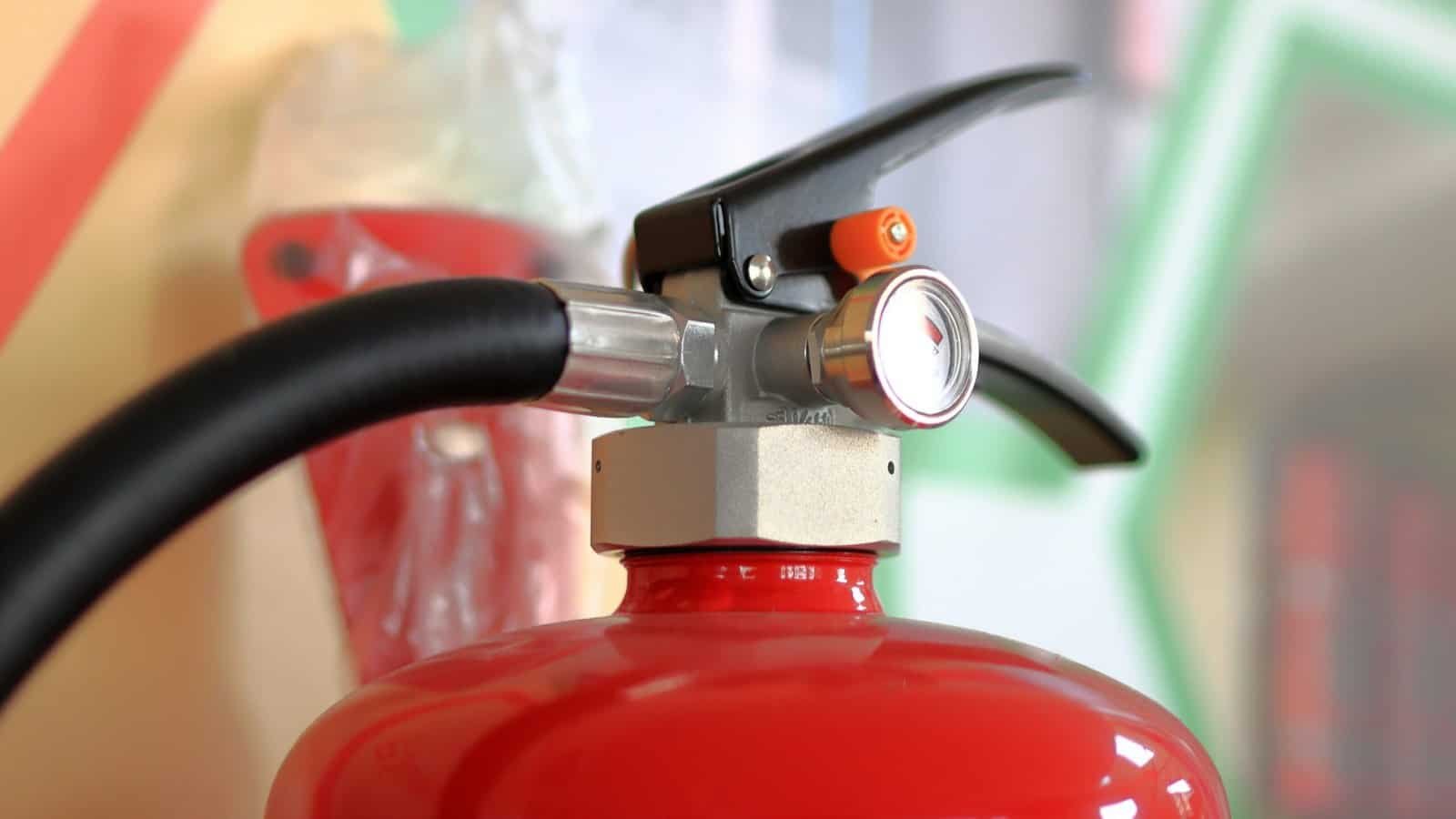
Most kitchen fires start in a pan, and the best fire extinguishers for the kitchen are the ones rated for that specific fire rather than the general-purpose unit in the garage. Cooking oil above its ignition point behaves differently from burning paper, and the wrong extinguisher can spread it across the room.
Where the unit hangs matters nearly as much as what is in it. An extinguisher stored behind the stove is unreachable in exactly the situation it exists for, which is a planning problem rather than a shopping one.
Quick Verdict
A compact ABC dry chemical unit covers the broadest range and belongs on the wall near the kitchen exit. Add a wet chemical Class K unit if you deep fry regularly. Keep a fire blanket within arm’s reach of the stove, because the fastest action on a small pan fire is smothering it rather than finding a canister.
Key Takeaways
- Letter ratings describe fire types: A for solids, B for flammable liquids, C for electrical, K for cooking oil.
- Never use water on a grease fire. It turns the oil into an airborne spray.
- Mount it between the stove and the exit, not beside the stove.
- Dry chemical leaves a corrosive powder that has to be cleaned up thoroughly.
- Disposable units have a service life and a gauge worth checking monthly.
- A fire blanket is faster than any extinguisher on a contained pan fire.
How We Picked
We sorted by fire class first, because that is the only specification that determines whether a unit works on the fire you are likely to have. Size, mounting hardware and refillability came second.
We favored units a person can actually lift and aim one-handed. A heavy canister rated for a warehouse is the wrong tool in a galley kitchen.
Cleanup was weighted too. The residue a unit leaves decides whether a small incident becomes a two-hour job or a two-day one.
1. Compact ABC Dry Chemical, Best Overall
Best all-purpose coverage | Score: 9.1/10 | Price: ~$25 to $45
Why It Stands Out
ABC covers burning solids, flammable liquids and live electrical equipment. That is nearly everything a kitchen produces short of a deep fryer.
The compact sizes weigh a few pounds, which is light enough to hold steady while aiming at the base of a flame. Heavier units are harder to control under pressure.
They also come with a wall bracket, which is the part that gets forgotten. An extinguisher in a cupboard is not where you will look for it.
Worth Knowing
Dry chemical powder is mildly corrosive and gets everywhere. On an electrical fire in an appliance, assume the appliance is finished.
Best for: the one extinguisher most kitchens should have, mounted near the exit.
2. Wet Chemical Class K, Best for Deep Frying
Best for cooking oil | Score: 9.0/10 | Price: ~$60 to $120
Why It Stands Out
Class K units discharge a fine mist that reacts with hot oil to form a soapy layer on the surface. That layer seals the fuel off from oxygen and holds it there.
The mist also cools the oil, which matters because oil above its ignition point reignites the moment the smothering layer breaks.
Dry chemical can knock a grease fire down and then let it come back. Class K is the format designed for the reignition problem.
Worth Knowing
These cost several times what an ABC unit does and only address oil fires. They make sense alongside an ABC unit, not instead of one.
Best for: households that deep fry, or anyone who keeps a large volume of oil hot.
3. Fire Blanket, Best for Speed
Best immediate response | Score: 8.8/10 | Price: ~$12 to $25
Why It Stands Out
A fire blanket is fiberglass cloth you drape over a burning pan. No pin to pull, no aiming, and no powder to clean up afterward.
On a contained pan fire it is quicker than any canister, because the action is one motion rather than four steps under stress.
It costs little enough to hang one inside a cupboard door right next to the stove, which is where speed comes from.
Worth Knowing
Blankets work on small contained fires only. Leave the pan covered and the heat off for a long while, because lifting it early lets oxygen back to oil that is still above ignition temperature.
Best for: the first thing you reach for on a stovetop fire, backing up an extinguisher rather than replacing it.
4. Aerosol Spray Extinguisher, Best for Small Kitchens
Best for tight spaces | Score: 8.3/10 | Price: ~$18 to $30
Why It Stands Out
Aerosol cans are the size of a large hairspray and fit in a drawer or on a narrow shelf. In an apartment kitchen with no free wall, that is the difference between owning one and not.
They operate like a spray can, which removes the pin and lever sequence people fumble.
Most leave a residue that wipes up with water rather than a corrosive powder, so a small discharge is a quick cleanup.
Worth Knowing
Capacity is much smaller than a canister and discharge time is short. Treat them as a first response on something small, not as full coverage.
Best for: galley kitchens, rentals and anywhere a bracket is not an option.
5. Rechargeable Metal-Valve Unit, Best Long Term
Best for serviceability | Score: 8.6/10 | Price: ~$50 to $90
Why It Stands Out
Cheap extinguishers use plastic valves and cannot be refilled, so a partial discharge means buying another one. Metal-valve units get recharged at a fire equipment shop.
That changes the economics if you ever use it, and it changes the habit too. People hesitate to discharge something disposable.
Build quality is generally better across the board, including the gauge, which is the part that tells you whether the unit still holds pressure.
Worth Knowing
Recharging costs money and requires finding a local service. In some areas that is easy and in others it is a drive.
Best for: homeowners planning to keep the same unit for years rather than replacing it.
6. Multi-Pack for Whole-Home Coverage, Best Value
Best coverage per dollar | Score: 8.4/10 | Price: ~$50 to $80 for a set
Why It Stands Out
One extinguisher in a house is one room’s worth of coverage. Guidance generally points at a unit per floor plus the kitchen and the garage.
Multi-packs drop the per-unit price substantially and arrive with matching brackets, which makes mounting them all in one afternoon realistic.
Having the same model everywhere also means one set of instructions, which matters when somebody else in the house has to use it.
Worth Knowing
Multi-packs are usually small disposable ABC units. They cover the common cases and none of them is a Class K unit.
Best for: going from one extinguisher to proper coverage in a single purchase.
Quick Comparison
| Type | Fire classes | Cleanup | Where it lives |
|---|---|---|---|
| Compact ABC | A, B, C | Corrosive powder | Wall, near the exit |
| Wet chemical K | K, often A | Soapy film | Wall, near the fryer |
| Fire blanket | Small contained | None | Cupboard door by the stove |
| Aerosol spray | Varies, often A, B, C | Wipes up with water | Drawer or shelf |
| Rechargeable | A, B, C | Corrosive powder | Wall, long term |
| Multi-pack | A, B, C | Corrosive powder | One per floor |
Why Water Makes a Grease Fire Worse
Burning oil sits well above the boiling point of water. A cup thrown into the pan flashes to steam instantly and expands hundreds of times in volume.
That expansion throws burning oil out of the pan and across the room. A contained fire becomes several uncontained ones in under a second.
Flour and sugar are the other instinctive reaches that make things dramatically worse, because fine organic powders ignite in air.
The correct order is heat off, lid or blanket on, and leave it covered. Baking soda works on something very small, and a great deal of it is needed.
Where to Mount It
Between the hazard and the door
You want to be able to reach it while moving away from the fire, not toward it. That single rule eliminates most bad mounting spots.
Visible, not tucked away
An extinguisher behind a door or under the sink behind the cleaning supplies will not be found quickly. Mounting it in plain sight is the trade worth making against tidiness.
At a height everyone can lift from
Around chest height suits most people. A heavy unit mounted high is awkward to get down, and step stools and kitchen ladders are not part of a fire plan.
Not above the stove
Reaching over a burning pan is how people get burned. The same logic applies to the cupboard directly above the hob.
The Rest of the Kitchen Fire Picture
Detection comes before suppression. An alarm that wakes you is worth more than any canister, and the options sit in smart smoke detectors.
Grease accumulation feeds fires, and the film on a range hood filter is fuel. Ventilation matters for the same reason, which exhaust fans covers from the moisture side.
Splatter control reduces how much grease ends up on surfaces in the first place, and splatter guards and screens handle that.
Handling hot pans safely is the other half, since most stovetop incidents start with a pan being moved. That is what oven mitts and pot holders and trivets exist for.
Our Verdict
Buy a compact ABC unit and mount it between the stove and the door. That covers the widest range of what a kitchen produces and it is the baseline.
Add a fire blanket inside a cupboard door next to the hob for under twenty dollars. On a pan fire it is the faster tool and it leaves nothing to clean.
Add Class K only if you deep fry. For everyone else the money goes further on a multi-pack that covers the rest of the house.
Recommended Reading
- Cast iron skillets for the pans that run hottest.
- Whether indoor grills are worth it if smoke indoors is already a concern.
- Air fryers for apartments with no vent hood for cooking without open oil.
- Organizing a kitchen if the mounting spot is the thing stopping you.
Frequently Asked Questions
What are the best fire extinguishers for the kitchen?
A compact ABC dry chemical unit mounted near the exit covers the broadest range for most households. Add a wet chemical Class K unit if you deep fry, and keep a fire blanket by the stove either way.
What does the ABC rating mean?
A covers ordinary solids like paper and wood, B covers flammable liquids, and C covers live electrical equipment. K is a separate class for cooking oils and fats.
Can I use an ABC extinguisher on a grease fire?
It can knock the flame down, but hot oil often reignites once the powder settles. Class K units are designed around that reignition problem.
How often should I check it?
Glance at the pressure gauge monthly and make sure the needle sits in the green band. Check the bracket is still tight at the same time.
Do extinguishers expire?
Disposable units carry a service life printed on the label, commonly around a decade. Rechargeable units get serviced instead of replaced.
Should I fight a kitchen fire at all?
Only something small and contained, with a clear path behind you to the door. Anything spreading, anything reaching a cupboard, or any doubt means getting everyone out and calling the fire service.
How many does a house need?
Common guidance is one per floor plus the kitchen and the garage. That is where multi-packs get cheaper than buying units one at a time.
