
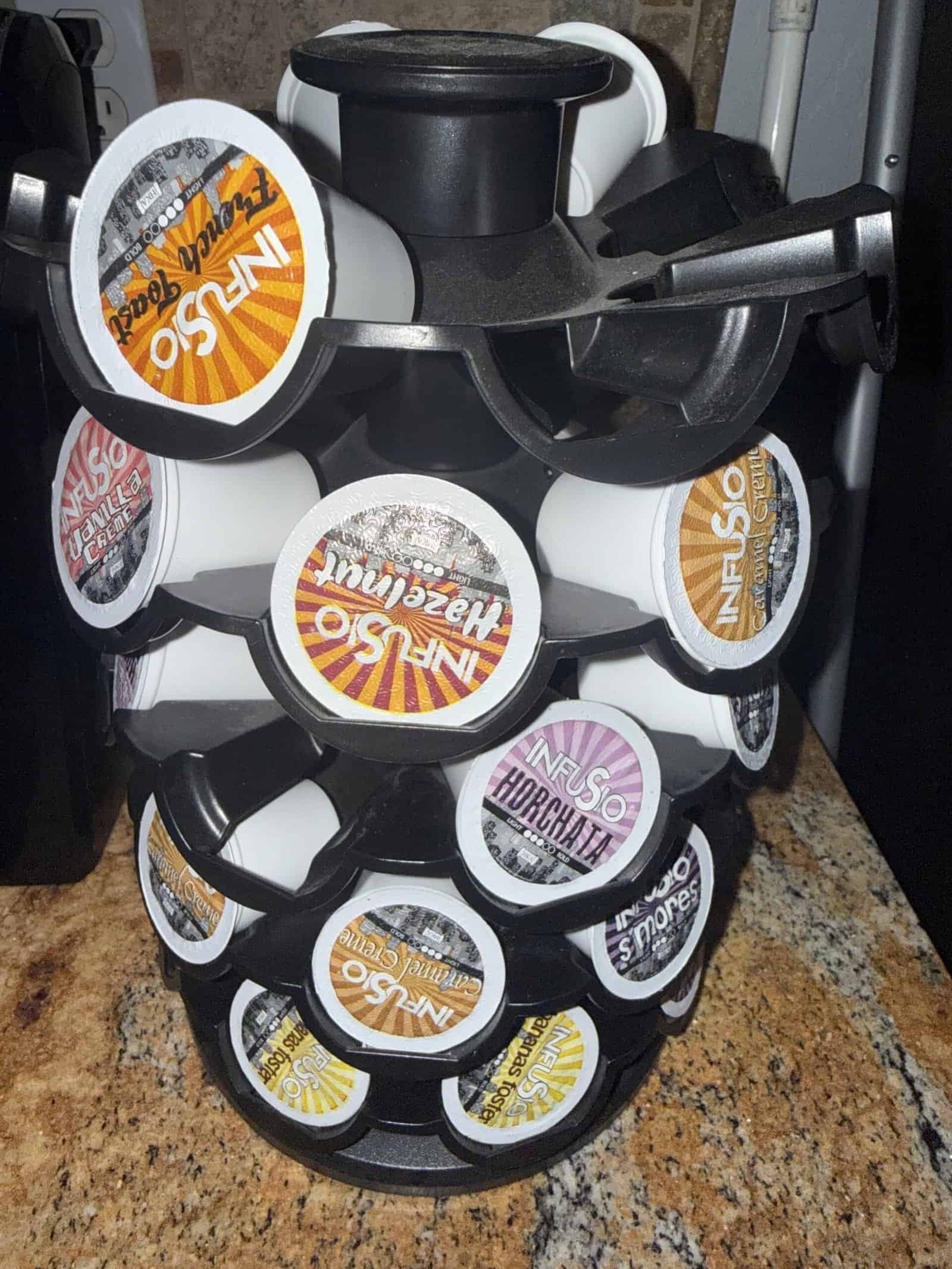
Every pod storage solution advertises a capacity, and almost nobody buys pods in that quantity. You buy a variety pack, or two boxes on offer, and now you have more pods than the carousel holds. What happens to the rest is the part these products do not address.
The practical answer for most households is a visible holder for what you drink regularly and a cabinet for the surplus. Sizing the visible one honestly matters more than buying the largest available. Our roundup of single-serve coffee makers covers the machines these feed.
Quick Verdict
A carousel suits a counter with space and works best when it holds your regular varieties rather than everything you own. Drawer inserts suit small counters, and under-machine drawers suit nobody with a cabinet directly above.
Key Takeaways
- Stated capacity rarely matches how people actually buy pods.
- Carousels are the most convenient and the most counter-hungry.
- Overflow storage is the half nobody plans for.
- Under-machine drawers need clearance above to load.
- Pods keep fine in their original boxes, so overflow needs no special container.
How We Picked
Organizers are grouped by where they put the pods rather than by capacity, since the constraint in most kitchens is space rather than volume. Access, footprint, and how they handle overflow carry the most weight.
Selections reflect construction and documented features. Descriptions come from product research except where personal use is stated directly.
1. A Rotating Carousel, Best Overall
Why It Stands Out
Spinning to find a variety is faster than sorting through a drawer, and having pods visible means you notice what is running low before it runs out.
Carousels also keep the machine and the pods together, which suits a coffee corner rather than storage scattered between a drawer and a cabinet.
Worth Knowing
They take a meaningful footprint on the counter, which in a small kitchen is the whole objection.
Capacity is usually stated generously, and pods stacked to the top can bind when the carousel turns. Our roundup of coffee storage canisters covers the ground-coffee equivalent.
This suits counters with room. Skip it if counter space is tight.
2. A Drawer Insert, Best for Small Counters
Why It Stands Out
A shallow tray that sits in an existing drawer uses space you already have and puts nothing on the counter at all.
Pods lie flat and stay sorted, which is considerably easier to scan than reaching into a box and turning each one to read the label.
Worth Knowing
This requires a drawer near the machine, and in a kitchen where drawer space is already the constraint that is a real cost.
Inserts also fit a specific drawer depth, so measuring first matters. Our roundup of kitchen drawer organizers covers the format.
This suits small counters. Skip it if drawers are already full.
3. An Under-Machine Drawer, Best Footprint
Why It Stands Out
A shallow drawer the machine sits on top of costs no additional counter space at all, which is the neatest solution where the counter is full.
It also raises the brewer slightly, which can help with mug clearance if you brew into anything taller than a standard cup.
Worth Knowing
Loading it means sliding the drawer out from under a machine, and if a cabinet sits directly above there may not be room to lift anything.
Raising the machine can also put the water reservoir lid into the cabinet above. Measure before buying.
This suits full counters with headroom. Skip it under a low cabinet.
4. A Wall or Cabinet-Mounted Rack, Best Space Saver
Why It Stands Out
Mounting pods on a wall or inside a cabinet door uses space that was doing nothing, and keeps the counter entirely clear.
Vertical racks also make it obvious at a glance what you are low on, which is harder to judge in a drawer where everything lies flat.
Worth Knowing
Adhesive mounts fail with weight over time, and a full pod rack is heavier than it looks.
Cabinet-door racks need clearance so the door still closes over the shelves inside. Our roundup of pantry storage containers covers that space.
This suits clear counters. Skip it if you cannot mount into a stud or use screws.
5. A Basket or Bin, Best Simple Option
Why It Stands Out
A basket in a cabinet holds far more than any purpose-made organizer and costs a fraction as much, which suits the overflow rather than the daily supply.
It also handles boxes and loose pods together without needing them sorted, which matters when a variety pack arrives and there is nowhere obvious to put it.
Worth Knowing
Finding a specific variety means digging, so this suits bulk rather than selection.
Deep bins bury what is at the bottom, and pods have a long shelf life so that matters less than with food.
This suits overflow storage. Skip it as your only solution.
6. A Countertop Tower, Best Capacity
Why It Stands Out
Vertical towers hold more than carousels in a smaller footprint, since they stack rather than spread.
Slotted designs also let you see the whole inventory at once, so nothing gets buried the way it does in a bin.
Worth Knowing
Taking a pod from the middle of a stack is awkward on some designs, and gravity-fed towers dispense in order rather than by choice.
Tall towers are also top-heavy when full, which matters on a counter where things get knocked. Our note on organizing a small kitchen covers footprint decisions.
This suits high-volume households. Skip it if you want to pick varieties freely.
Storage Types at a Glance
| Type | Counter space | Access | Best for |
|---|---|---|---|
| Carousel | Significant | Best | Daily varieties |
| Drawer insert | None | Good | Small counters |
| Under-machine drawer | None | Fiddly to load | Full counters |
| Wall or cabinet rack | None | Good | Clear counters |
| Basket in a cabinet | None | Digging | Overflow |
| Countertop tower | Moderate | Varies | High volume |
How I Store Mine
I use a carousel, and whatever does not fit stays in the box in a cabinet. That is the whole system, and it works because it separates the two jobs rather than trying to solve both with one product.
The carousel holds what I am actually drinking, so it is quick to grab one without thinking. The overflow sits in its original packaging out of the way until the carousel needs refilling.
What I would say about this is that no carousel is big enough for how pods get bought. A variety pack or two boxes on offer immediately exceeds what fits, and the answer is not a bigger carousel, it is accepting that some of them live elsewhere.
Pods keep well in their boxes, so the overflow needs nothing special. A cabinet shelf does the job and the sealed cups are not deteriorating while they wait.
What I cannot compare is drawer inserts, under-machine drawers, or wall racks, since I have not used any of them. Those sections come from research rather than from things on my counter.
Sizing It Honestly
Work out how many pods you get through in a week and how you buy them. Someone drinking two a day who buys a forty-count box monthly needs different storage from someone buying variety packs on offer.
Then size the visible storage to roughly a week or two of drinking rather than to the whole supply. That keeps the counter footprint reasonable and means the organizer is doing the job it is good at, which is selection rather than bulk.
The overflow question answers itself once you accept there will be overflow. A cabinet shelf, a basket, or the original boxes all work, and none of them need to look like anything. Our note on organizing your kitchen covers where it goes.
What to Look For
How many do you actually keep out?
Size the visible storage to your regular rotation rather than your total stock. The rest can live anywhere.
What space can you spare?
Counter, drawer, cabinet, or wall. This decides the category before capacity does.
Is there clearance to load it?
Under-machine drawers and cabinet racks both need room to operate. Measure the gap above before buying either.
Do you need to see the varieties?
If you choose by mood, visible storage matters. If you drink the same thing daily, a bin is fine.
Common Mistakes to Avoid
Buying for total stock
An organizer sized for every pod you own will dominate the counter. Size it for the rotation and store the rest.
Ignoring clearance
Raising the machine on a drawer can push the reservoir lid into the cabinet above, which makes refilling awkward.
Trusting adhesive mounts
A full rack is heavy and adhesive fails gradually. Screws into a stud or a cabinet door are more reliable.
Decanting pods unnecessarily
Sealed pods keep well in their boxes, so overflow does not need a special container. Our note on storing coffee beans covers where freshness genuinely matters.
Recommended Reading
See our comparison of Keurig and Nespresso machines, our note on descaling a coffee maker, our roundup of coffee mugs, and a guide to choosing a coffee maker, and what K-cups cost per cup, and reusable and disposable pods.
K-Cup Storage FAQ
How many pods should I keep on the counter?
Enough to cover your regular rotation rather than your whole stock. Most people buy in larger quantities than any organizer holds, and sizing for the total is what makes these dominate a counter.
Do K-cups go stale?
They are sealed and nitrogen-flushed, so they keep considerably longer than ground coffee. Best-by dates are usually far out, and storing overflow in the original box is entirely adequate.
Which organizer holds the most?
Countertop towers and large carousels hold the most in a purpose-made form, and a basket in a cabinet beats both for sheer volume at a fraction of the price. The trade is that you have to dig for a specific one.
Are under-machine drawers worth it?
They save counter space, which is their whole appeal, and loading one means sliding it out from under the machine. Check the clearance above first, since raising the brewer can put the reservoir lid into a cabinet.
Do carousels jam?
They can when filled past their comfortable capacity, since pods stacked to the top bind against each other as it turns. Stated capacities tend to be generous, so treating them as a maximum rather than a target helps.
Can I mount a rack on a cabinet door?
Often, and you need to check that the door still closes over the shelves inside the cabinet. That clearance is the thing people discover after mounting rather than before.
Should I take pods out of the box?
Only for the ones you want visible and accessible. Sealed pods keep perfectly well in packaging, so decanting the overflow adds work without adding anything.
What is the cheapest solution?
A basket or bin in a cabinet, which costs a fraction of any purpose-made organizer and holds more. It works less well for choosing between varieties, which is what the visible options are actually for.
