
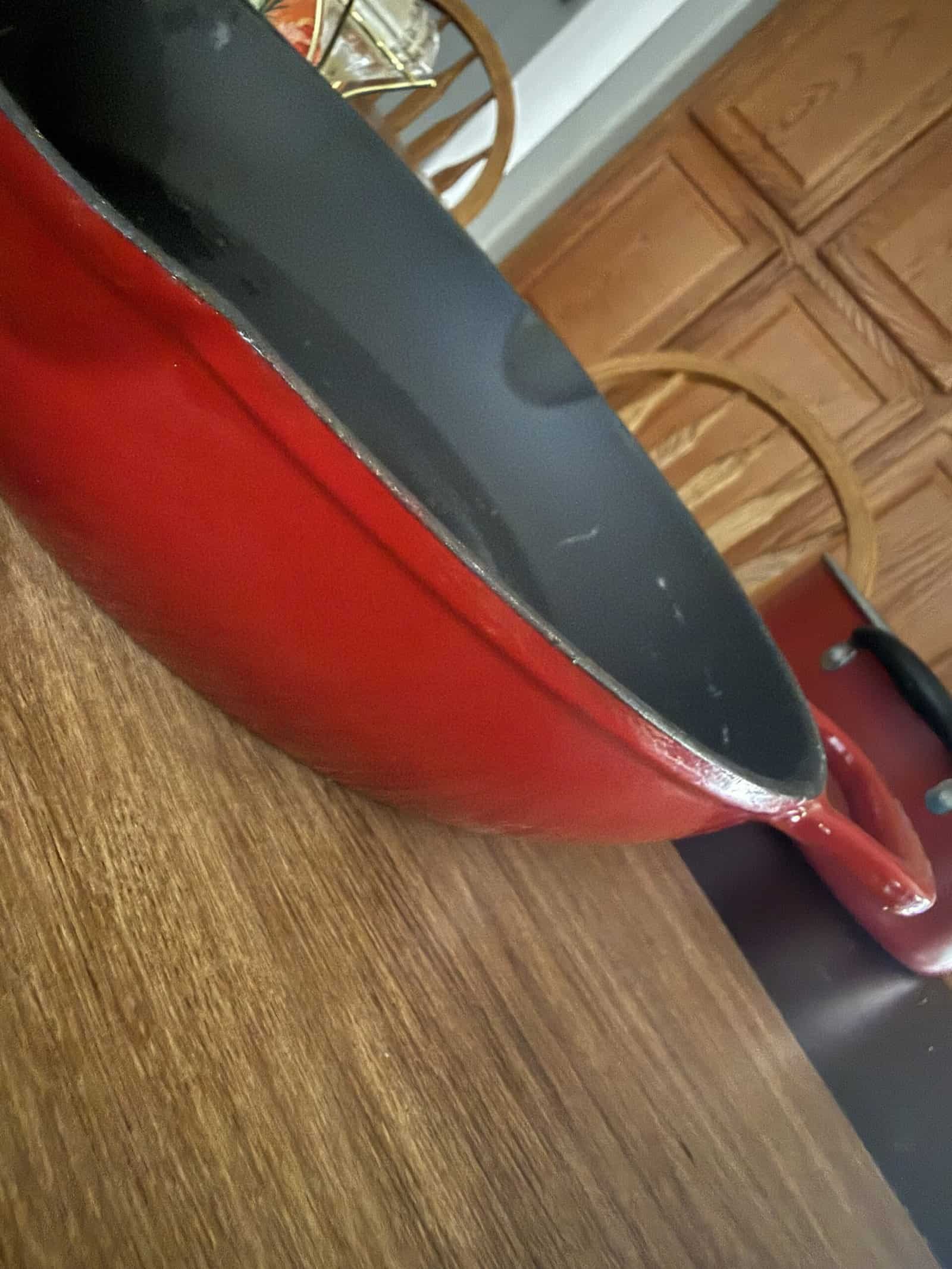
A braiser is best for anything that needs a lot of food touching the pan at once, which means searing, one-pan family meals, and shallow braises where the liquid comes partway up the meat. Knowing what to cook in a braiser starts with its shape, since the wide flat bottom and low sides are the whole point. If you are still deciding between shapes, our roundup of braisers covers the options.
Mine is enameled cast iron with a wide flat bottom, big enough to cook a whole family meal in one dish, and it has earned a spot in the regular rotation. Most of what I do in it happens on the stovetop rather than in the oven, which is not the classic use but is how it actually gets used.
Why the Shape Decides the Dish
A braiser trades depth for surface area. Compared with a Dutch oven of the same capacity, it gives you far more pan floor and much lower walls.
That matters because browning needs contact. Meat crowded into a deep pot steams in its own moisture, while the same amount spread across a braiser floor actually sears.
Low sides also mean liquid reduces rather than pooling. A shallow braise concentrates as it cooks, which is why a braiser produces a sauce and a stockpot produces broth.
The heavy lid does the other half. It traps enough moisture to keep meat tender without turning the dish into soup.
Quick Answer
Cook anything that wants a wide surface: browned ground meat, seared chicken thighs, pork chops, sausages, one-pan rice dishes, shallow braises, and baked pasta. Skip anything that needs depth, such as deep stews, stock, or a tall loaf of bread. If the recipe says brown in batches, a braiser probably lets you do it in one.
What I Actually Cook in Mine
Meat is most of it, and a lot of different meats. Hamburger, taco meat, diced chicken and sausage for grinders all get browned in there.
The routine is simple. A light oil, medium heat, meat spread across the bottom in a single layer, then liquid goes in if the dish needs it.
The single layer is the part the braiser makes easy. In a smaller or deeper pan I would be doing two batches, and the second batch always comes out worse than the first.
The honest friction is that it sticks occasionally. Not often, and not badly, but enameled cast iron is not a non-stick surface and anyone expecting one will be disappointed. Enough oil and enough patience before the first turn handles it most of the time.
Cleanup is genuinely one of its best everyday traits. Enameled cast iron needs no seasoning, so it wipes or washes clean and goes back on the shelf.
The boundary worth stating: mine stays mostly on the stovetop. The long oven braises and the deep-fry uses below come from research rather than from things I have made in it.
Best Dishes for a Braiser
| Dish type | Why the braiser suits it |
|---|---|
| Browned ground meat | Whole batch in one layer, no steaming |
| Seared chicken thighs | Skin crisps, then braises in the same pan |
| Pork chops and sausages | Enough floor for four to six pieces |
| Shallow braises | Liquid reduces into a sauce, not a broth |
| One-pan rice dishes | Wide base cooks rice evenly, crust forms |
| Baked pasta | More surface means more browned top |
| Roasted vegetables | Single layer, real caramelization |
| Shallow frying | Low sides, stable heat, easy turning |
Shallow Braises Are the Namesake Dish
A braise means browning first, then cooking gently in liquid that comes partway up the food rather than covering it. The exposed top stays firm while the submerged part goes tender.
Chicken thighs are the classic. Sear them skin down until the skin releases, turn, add stock or wine to roughly halfway, cover, and let them go.
Short ribs, pork shoulder pieces, lamb shanks and chicken legs all work the same way. So do vegetables, since braised fennel, cabbage wedges and leeks are excellent and take under an hour.
This is where the braiser and the Dutch oven genuinely differ, and our comparison of Dutch oven versus cast iron skillet covers the neighboring question.
One-Pan Meals and Rice Dishes
Anything built by browning a protein, adding aromatics, then adding a starch and liquid belongs in a braiser. The wide base means the rice or pasta cooks in an even layer instead of a deep mass.
Paella-style rice, jambalaya, arroz con pollo, risotto and one-pan orzo dishes all benefit. So does the crisp layer that forms on the bottom, which needs contact area to develop.
Baked pasta is the other easy win. A shallow wide dish gives more browned surface per serving than a deep casserole does.
What Not to Cook in a Braiser
Deep stews and soups are the obvious miss. Low sides mean less capacity than the diameter suggests, and a full pot will slosh.
Stock is the same problem. You want depth and a long simmer, which is a stockpot job, as our comparison of Dutch oven versus stockpot explains.
Bread does not work either. A boule needs tall walls and a trapped steam environment, which is exactly what a braiser lacks.
Deep frying is possible but unwise. Shallow oil in a wide pan is more likely to spill, and a Dutch oven contains it better.
Getting Better Results From It
Preheat before the oil goes in, and give it longer than feels necessary. Enameled cast iron heats slowly and unevenly at first, then holds temperature superbly once it gets there.
Use medium rather than high. High heat on enamel risks damage and does not brown any faster, since the mass of the pan is doing the work.
Leave meat alone until it releases. Protein sticks while it is searing and lets go when a crust forms, so early poking is what turns a sear into a mess.
For cleaning, warm water and a soft scrubber handle almost everything. Our guide on cleaning a Dutch oven applies directly, since the enamel is identical.
Related Reading
- Enameled cast iron cookware
- What to cook in a Dutch oven
- Dutch ovens
- Cast iron skillets
- How to choose cast iron cookware
Cooking in a Braiser FAQ
What is a braiser best for?
Dishes that need a lot of food touching the pan at once. Searing meat in a single layer, one-pan rice dishes, shallow braises and baked pasta all suit it. The wide flat bottom and low sides are what separate it from a Dutch oven.
Can you use a braiser on the stovetop?
Yes, and plenty of people use one mainly that way, as I do. Enameled cast iron works on gas, electric and induction, and the flat bottom sits stably on any burner. Just heat it gradually rather than starting on high.
Does food stick in an enameled braiser?
Sometimes. Enamel is not a non-stick coating, so it will grab if the pan is underheated, the oil is too thin, or you move the meat before a crust forms. Mine sticks occasionally and it is rarely difficult to clean off.
Do you need to season a braiser?
No. Enameled cast iron has a glass surface fused to the iron, so there is no seasoning to build or maintain. That is a real advantage over bare cast iron for anyone who does not want the upkeep.
Can you bake bread in a braiser?
Not well. Bread wants tall walls and a sealed steam environment, and a braiser gives you neither. A Dutch oven is the right pan for a boule, and our guide on what size Dutch oven you need covers sizing for it.
Braiser or Dutch oven if I can only buy one?
Buy the Dutch oven first if you make soups, stews and bread, since depth is harder to work around than width. Buy the braiser first if most of your cooking is browning meat and one-pan dinners, which is where the extra surface pays off every single time.
What size braiser should I get?
Three and a half to four quarts suits most households and holds a family meal. Larger sizes get heavy quickly, and the weight matters more here than on a deep pot because you lift a braiser by two short handles.
Can a braiser go in the oven?
Yes, and the classic long braise is exactly that. Check the lid knob rating, since some are limited to a lower temperature than the pan itself, and a metal replacement knob is a cheap upgrade if yours is.
