
Choose an air fryer by picking basket or oven style first, then sizing it to how you actually cook, and treat the feature list as the last consideration. Knowing how to choose the right air fryer is mostly one decision, since basket and oven models suit genuinely different kitchens, and everything after that is detail. If you already know you want the compact version, the sub-$100 options are where most people land.
Quick Answer
Pick basket style for speed, crispiness, and a small footprint. Pick oven or combo style if you want capacity and one appliance that also bakes and toasts. Size to your household, not the box claim. Cleaning ease matters more than any feature, because it decides how often you actually use it.
Key Takeaways
- Basket versus oven is the real decision. Everything else is secondary.
- Quart ratings are optimistic. Usable capacity is smaller than the number suggests.
- A combo oven replaces several appliances but takes real counter space.
- Cleaning frequency is the hidden cost, and it is higher than most buyers expect.
- Most features are noise. Preheat, capacity, and cleanability are not.
Basket or Oven: The Only Big Decision
| Basket | Oven or combo | |
|---|---|---|
| Best at | Fast, crisp, small batches | Capacity, versatility, whole meals |
| Footprint | Compact, storable | Large, lives on the counter |
| Also does | Air frying, mostly | Bake, toast, roast, often pizza |
| Cleaning | One basket, often dishwasher safe | More surfaces, racks, and a door |
| Suits | One or two people, sides, reheating | Families, batch cooking, small kitchens replacing an oven |
A basket model circulates air in a tight space, which is why it crisps fast and preheats quickly. An oven style trades some of that speed for room and range. This is the fork that decides whether you are happy, and it is worth more thought than the brand.
Size It to How You Actually Cook
Quart ratings measure the basket, not the food that fits in a single layer, and the single layer is what determines whether food crisps. A four quart basket suits one or two people. Six quarts and up starts handling a family, provided you accept cooking in batches.
The honest test is whether you can spread food without overlapping. Crowding is the most common reason air fryer food comes out soft instead of crisp, and it is the mistake almost everyone makes first. An oven style buys you rack space rather than depth, which is a different kind of capacity.
What I Use and What It Costs Me
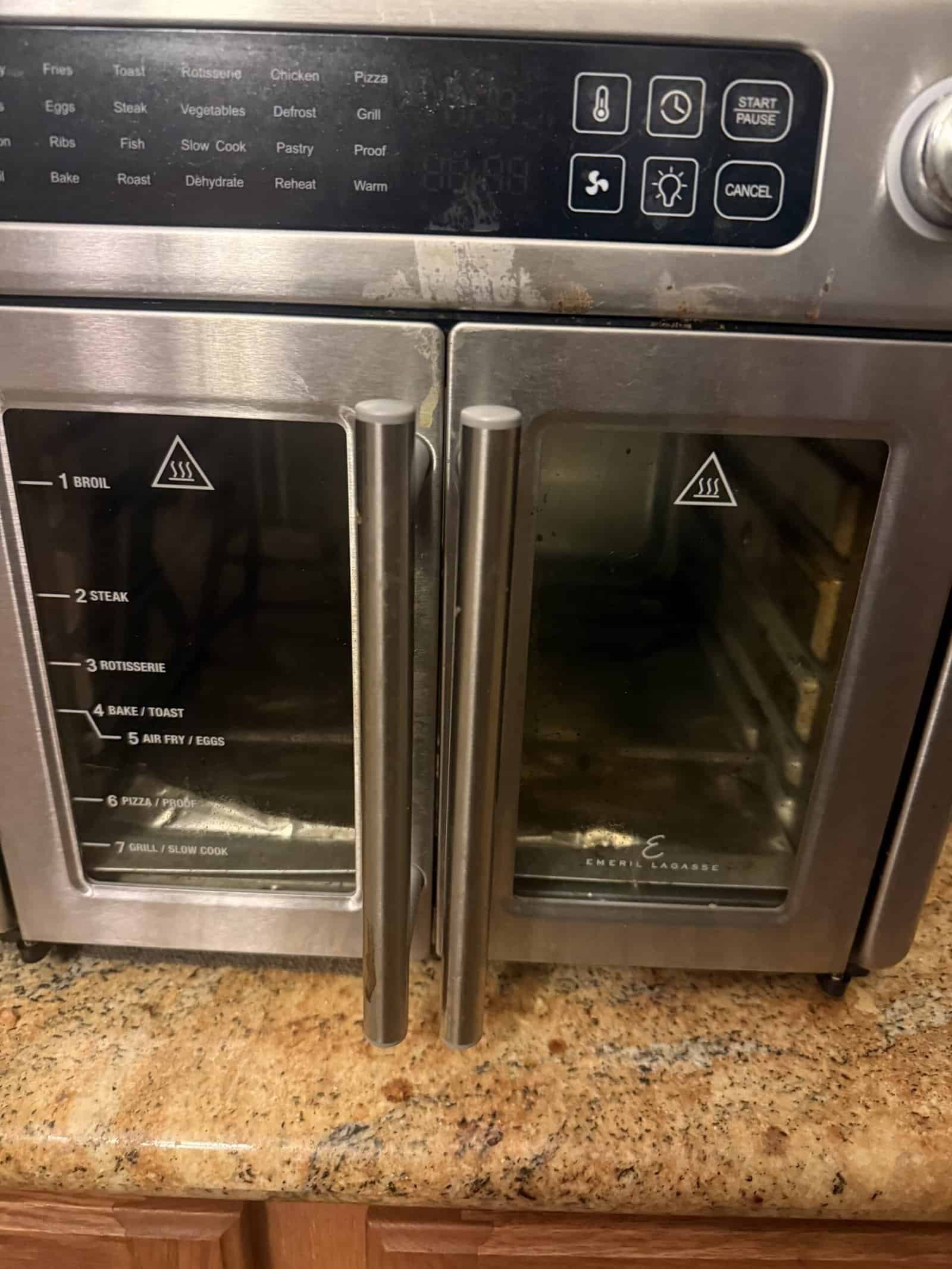
I cook on an Emeril Lagasse French Door oven, and I have had it a couple of years. It is the one I actually own, and chicken and fries are what I make most on it.
Being able to air fry, bake, and make pizza in one appliance means most of a meal comes from one machine, which is most of why I would recommend a combo to anyone short on space or appliances. In my experience it does a high-quality job on everything I have used it for, and results come out consistently.
The friction is real and worth knowing before you buy one. It is sometimes hard to manipulate, which is the cost of a larger oven-style body. The doors get a little greasy and I have to clean them often, and the crumbs are a lot to clean.
That is the tradeoff nobody mentions in the specs. A combo oven gives you range and takes maintenance back in return, and if you will not keep up with the cleaning, a basket you can drop in the dishwasher may genuinely serve you better. My experience covers one combo oven over a couple of years, not the basket models, and not long-term reliability across brands.
Features Worth Paying For, and Ones That Are Not
Preheat matters, because a preheated cavity is what makes the first batch behave like the third. Whether you need a dedicated preheat function is a fair question, since some models handle it invisibly.
A removable, dishwasher-safe basket or tray matters more than any preset. Presets are shortcuts for temperature and time, and they are the first thing you stop using. Digital versus dial is preference, not performance.
Accessories are where marketing lives. A few earn their keep and the rest sit in a drawer, which is why the accessory question is worth answering deliberately rather than by buying a bundle.
Cleaning Is the Feature Nobody Lists
Cleaning decides how often the appliance actually gets used, which makes it the most practical spec in the category. Grease reaches every surface that hot circulating air touches, so more cavity means more to wipe.
Basket models concentrate the mess into one removable part. Oven and combo styles spread it across racks, a tray, and a door, and the door is the part people underestimate. Keeping one clean is a routine rather than an event, and going in knowing that is better than discovering it.
Does It Replace Anything You Own?
A combo oven can genuinely replace a toaster oven, and often a countertop oven too, which is the space argument in its favor. The toaster oven comparison is the one worth reading before you buy both.
It does not replace a full range, and it is not faster than a big oven for large batches. Against a conventional oven it wins on preheat and small loads, and loses on volume. Against other countertop cookers, a pressure cooker does a different job entirely, and an indoor grill is about sear rather than circulation.
Recommended Reading
For picks across both styles, see our air fryer roundup, or narrow to combo ovens and French door models like the one I cook on. Once you have one, what to actually cook in it and how to keep it clean are the two guides that matter, and air fryer combo cooker vs separate appliances, and air fryers for one or two people, and air fryers for small kitchens, and quiet air fryers, and you bake bread in an air fryer, and you use foil in an air fryer, and how much counter space does an air fryer need, and using an air fryer combo cooker, and the grill function on an air fryer worth using, and where to put an air fryer in a small kitchen.
How to Choose the Right Air Fryer FAQ
What size air fryer do I need for a family of 4?
Six quarts or larger for a basket model, or an oven style if you want to cook a full meal at once. The limiting factor is single-layer space rather than volume, since crowded food steams instead of crisping. Families often end up cooking in batches with a basket, which is the main argument for going oven style.
Is a basket or an oven style air fryer better?
Neither, they suit different kitchens. Baskets crisp faster, take less space, and clean more easily. Oven and combo styles hold more, bake and toast as well, and replace other appliances. Choose basket if you cook for one or two, oven if you want one machine doing most of the work.
Do I need a preheating function on my air fryer?
A dedicated button is not essential, but preheating itself helps. A hot cavity means the first batch cooks like the ones after it, which is why results often improve partway through a session. Some models preheat automatically, others expect you to run them empty for a few minutes first.
Are air fryer combo ovens hard to clean?
Harder than a basket, yes. More cavity means more surfaces that hot grease reaches, including racks, a tray, and the door. In my own use the doors get greasy and need cleaning often, and crumbs accumulate. It is manageable as a routine, but it is a real cost worth weighing before you buy one.
What foods should I not cook in an air fryer?
Wet batters, which drip before they set, and very light loose greens, which the fan blows around. Anything needing a lot of liquid belongs elsewhere. Cheese without a coating tends to melt through the basket. Beyond that, the limits are mostly about capacity rather than the food itself.
How long should an air fryer last?
Several years with regular use is a reasonable expectation, and mine has lasted a couple of years so far. Lifespan tracks maintenance closely, since built-up grease strains the fan and heating element. The parts that fail first are usually the basket coating or the fan, not the electronics.
Is an air fryer worth it if I already have an oven?
Usually, for small loads. An air fryer preheats in a fraction of the time and crisps better than most conventional ovens, which makes it the appliance you reach for on a weeknight. It does not replace an oven for volume, so the honest case is convenience and speed rather than capability.
Do air fryers use a lot of electricity?
Less than heating a full oven for the same job, because the cavity is small and preheat is short. For a single tray of food, it is meaningfully more efficient. For a large batch that fills a real oven anyway, the advantage disappears, since you will be running the air fryer several times.
For the full rundown, see the comprehensive choosing a stand mixer guide.
