
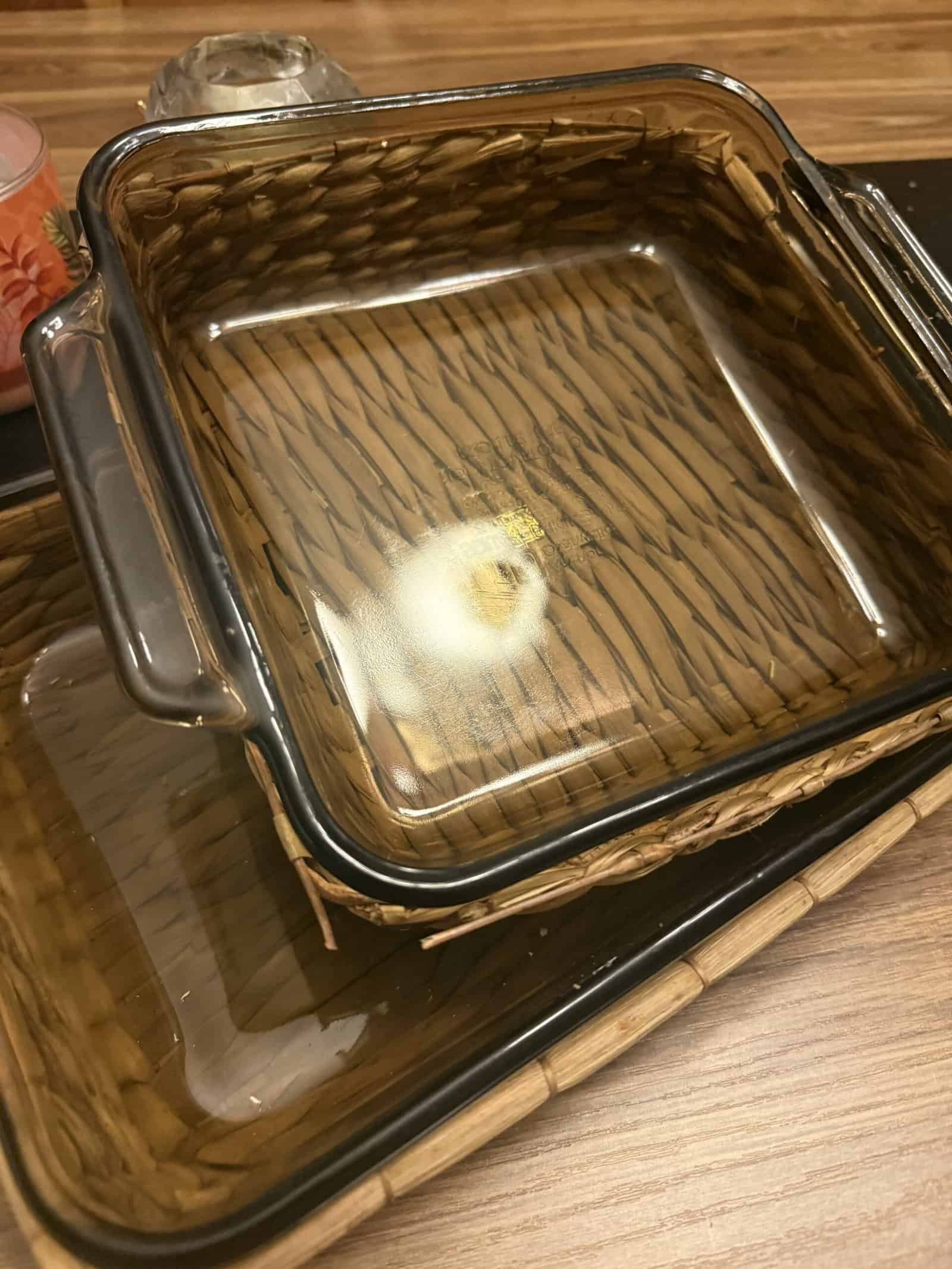
I put almost everything in the dishwasher. Glass cookware, bakeware, pizza pans, oven dishes, and knives I have been told repeatedly not to. I rinse them first and then in they go, and across years of doing this nothing has been wrecked. That is not a claim that the dishwasher is harmless. It is a claim that if you buy the right things, it stops mattering.
Quick Verdict
Glass and stainless survive indefinitely. Silicone does not care. Enamelled cast iron and nonstick do not belong in there whatever the box says. Rinse first, and the rest of the argument mostly evaporates.
Key Takeaways
- Glass is the champion. Nothing you can do to it in a dishwasher matters.
- Rinsing first is the highest-value habit. It removes acid and salt before the cycle.
- “Dishwasher safe” on nonstick means “will survive, will get worse”.
- Cast iron and wood are the genuine no-go list.
- Buying dishwasher-safe is cheaper than buying nice and hand washing forever.
1. Glass Bakeware, Best Overall
The undisputed winner and most of what I own.
Glass does not react, does not corrode, does not have a coating to lose, and does not have a handle to loosen. Detergent that would pit steel and strip nonstick does nothing to it. Heat that would warp a thin pan is irrelevant to something designed to go in an oven at 400 degrees.
My glass cookware and bakeware goes in the dishwasher every time and it comes out the same as it went in, which is the whole point. The only real failure mode is thermal shock, and that is a cooking mistake rather than a washing one.
Bakeware sets covers the range, and glass vs metal gets into the cooking differences, which are real and separate from this.
Best for: anyone who does not want to think about it again.
Skip if: you need the browning that metal gives, which is a cooking argument, not a washing one.
2. Glass Food Storage, Best Everyday
Same material, same indifference, applied to the containers you use more than any pan.
Plastic containers stain, warp, hold onto smells, and eventually go cloudy from repeated cycles. Glass does none of that. It goes from fridge to microwave to dishwasher on a loop for years and looks the same at the end.
The lids are the weak point, and they always are. Plastic lids warp on the heated dry and stop sealing, which is how a container becomes a bowl. Top rack for lids, or skip the heated dry, and they last considerably longer.
Food storage containers covers the field, and pantry storage for the dry goods version.
Best for: leftovers, meal prep, anyone tired of stained plastic.
Skip if: weight matters, since glass is heavy and breaks when dropped.
3. Pizza Pans, Best Proof of Concept
Mine go in and nothing has ever come of it.
A metal pizza pan is a simple thing: no coating to strip, no handle to loosen, no wood, no seasoning to protect. That is exactly the profile that survives a dishwasher indefinitely.
Perforated pans are the ones worth checking, because the holes trap water and can spot if left sitting wet. Taking them out at the end of the cycle rather than leaving them in a humid box for hours solves that entirely.
The distinction that matters: a pizza pan is fine, a pizza stone absolutely is not. Stone is porous, it will drink detergent, and it will give it back to your next pizza. Personal pizza pans covers the sizes.
Best for: anyone who makes pizza and does not want to scrub.
Skip if: you meant a stone. Never the stone.
4. Stainless Cookware, Best Pans
The only pan material that genuinely does not mind.
Stainless has no coating to degrade, resists the detergent that corrodes carbon steel, and has no wood or adhesive in the handle if you buy the all-metal version. It is the pan you can be careless with.
What you get in exchange is a pan that sticks more than nonstick and browns better than nonstick, which is a trade some people want and some do not. It is not the pan for eggs.
The riveted handles are worth a look before buying: all-stainless with riveted joints survives anything, while anything with a bonded plastic or wooden grip is a different proposition. Choosing cookware covers the material question properly.
Best for: browning, deglazing, being careless.
Skip if: you want eggs to release, which is a nonstick job.
5. Silicone Tools, Best Utensils
Silicone is chemically inert and heat-resistant well past anything a dishwasher does, which makes it the most genuinely dishwasher-proof thing in the kitchen.
Spatulas, mats, brushes: all of it goes in, none of it cares. One-piece silicone is the version to buy, because a spatula with a separate head and handle traps food in the joint and that is where things go wrong.
Baking mats are the underrated case. They replace parchment, they go in the dishwasher, and they last years. Silicone spatulas covers utensils, baking mats the sheet-pan liner, and basting brushes, which beat natural bristle for exactly this reason.
Best for: everything. Silicone is the free win.
Skip if: you need the stiffness of metal, which silicone will never have.
6. Stainless Mixing Bowls, Best Prep Gear
Light, unbreakable, indifferent to detergent, nest for storage. There is not much to say and that is the appeal.
Glass bowls do the same job and let you see through them and microwave in them, at the cost of weight and breakability. Both survive the dishwasher without complaint, so this is a preference rather than a durability question.
What to avoid is anything with a silicone base bonded on for grip. That joint traps water and food and it is the one part of a mixing bowl that can fail. Mixing bowl sets covers both materials, and measuring cups follow the same logic: metal or glass, nothing bonded.
Best for: prep, storage, drawers you do not have room in.
Skip if: you want to microwave in the bowl, which is a glass job.
What Survives and What Does Not
| Material | Dishwasher | Why |
|---|---|---|
| Glass | Yes, forever | Nothing to corrode, coat, or loosen |
| Stainless | Yes | Resists detergent, no coating |
| Silicone | Yes | Inert, heat proof |
| Metal pizza pans | Yes | Simple, nothing to lose |
| Nonstick | Technically | Survives, degrades faster |
| Enamelled cast iron | No | Enamel dulls, exposed rims rust |
| Bare cast iron | Never | Strips seasoning, rusts |
| Wood | Never | Cracks, warps, splits |
| Pizza stone | Never | Porous, absorbs detergent |
Rinsing First Is the Whole Trick
This is the habit that makes the rest of it work, and it costs about four seconds.
What damages things in a dishwasher is not really the water, it is the detergent plus time plus whatever was left on the item. A pan that goes in with tomato acid or salt on it sits in that for ninety minutes at temperature. A rinsed pan sits in clean hot water with detergent, which is a much milder proposition.
I rinse everything before it goes in. Not scrub, rinse. And I think that is a large part of why nothing has been wrecked despite doing things the internet disapproves of, including putting knives in there.
The other free habit: take things out at the end rather than leaving them in a warm humid box for hours. That is where spotting and corrosion happen on anything with a hole or a seam.
Loading matters more than people think too. Things that nest together trap water between them and come out wet and spotted, and things that touch each other move during the cycle and scratch. Neither ruins anything on its own, both are avoidable by not cramming the machine, and cramming the machine is exactly what everyone does.
The Nonstick Asterisk
Nonstick pans say dishwasher safe on the box and they are lying by omission.
The pan will survive. It will not fail, crack, or fall apart. What happens is that the coating degrades faster than it would with hand washing, so a pan that would give you five years gives you three. That is not damage in the sense of a broken thing, it is damage in the sense of a shorter life, which is harder to notice and easier to accept.
Given a nonstick pan is a consumable anyway, that might be a trade you want. It is your call and it should be an informed one. Choosing a nonstick pan covers the lifespan question, and cleaning one the gentler route.
The Real No List
Cast iron, and this one is not negotiable. Bare cast iron loses its seasoning to detergent and rusts in a wet cycle, which undoes years of work in ninety minutes. Enamelled is better and still not good: the enamel dulls and the exposed rim rusts. Cleaning cast iron takes about a minute and is the price of owning it.
Wood, for the same reason it always is. Boards crack and warp, handles loosen. My wooden board gets scraped and wiped and never goes near the machine.
And pizza stones, which drink detergent and hand it back to your next pizza.
The pattern across all three is the same: anything porous, coated, or made of two materials bonded together is at risk, and anything solid and inert is not. That is a more useful rule than memorising a list, because it tells you what to do with the thing you just bought that is not on anyone’s list.
Recommended Reading
See choosing cookware, knives in the dishwasher, and food storage.
Dishwasher Safe Cookware FAQ
What cookware is genuinely dishwasher safe?
Glass, stainless, silicone, and simple metal pans with no coating. Those four survive indefinitely because there is nothing on them for detergent to attack. Everything else is a spectrum from “will get worse” to “do not”.
Is glass bakeware really fine in the dishwasher?
Yes, and it is the best answer in the category. It does not react, corrode, or have a coating to lose. Mine goes in every time and comes out identical. The only real risk with glass is thermal shock while cooking, which has nothing to do with washing.
Does rinsing first actually matter?
More than anything else you can do. Detergent plus time plus leftover acid and salt is what does damage. A rinsed item sits in clean hot water instead of marinating in its own residue for ninety minutes. It takes four seconds and I think it is most of why nothing of mine has been wrecked.
Can nonstick pans go in the dishwasher?
They will survive and they will not last as long. The box says dishwasher safe, which is true and incomplete: the coating degrades faster, so a five year pan becomes a three year pan. Nonstick is a consumable anyway, so that may be a trade you accept.
Why can’t cast iron go in?
Detergent strips the seasoning and a long wet cycle rusts it, which undoes years of work in one wash. Enamelled cast iron is less catastrophic and still bad, since the enamel dulls and the unprotected rim rusts. Hand washing cast iron takes a minute.
What about pizza pans and stones?
Pans yes, stones never. A metal pizza pan has no coating and nothing to lose, and mine go through without issue. A stone is porous, absorbs detergent, and gives it back to the next thing you cook on it.
Do lids survive?
Plastic lids are the weak point in any glass storage set. The heated dry warps them until they stop sealing, and a container that will not seal is a bowl. Top rack, or skip the heated dry, and they last much longer.
Is it cheaper to buy dishwasher-safe or buy nice and hand wash?
Dishwasher safe, if you are honest about yourself. Buying cookware that requires a ritual you will not perform is how people end up with expensive damaged pans and a grievance. I buy things that tolerate how I actually behave, which is glass, stainless, and silicone.
Recommended Reading
Loading habits matter as much as what goes in. Rinsing against scraping covers which one is worth doing.
