
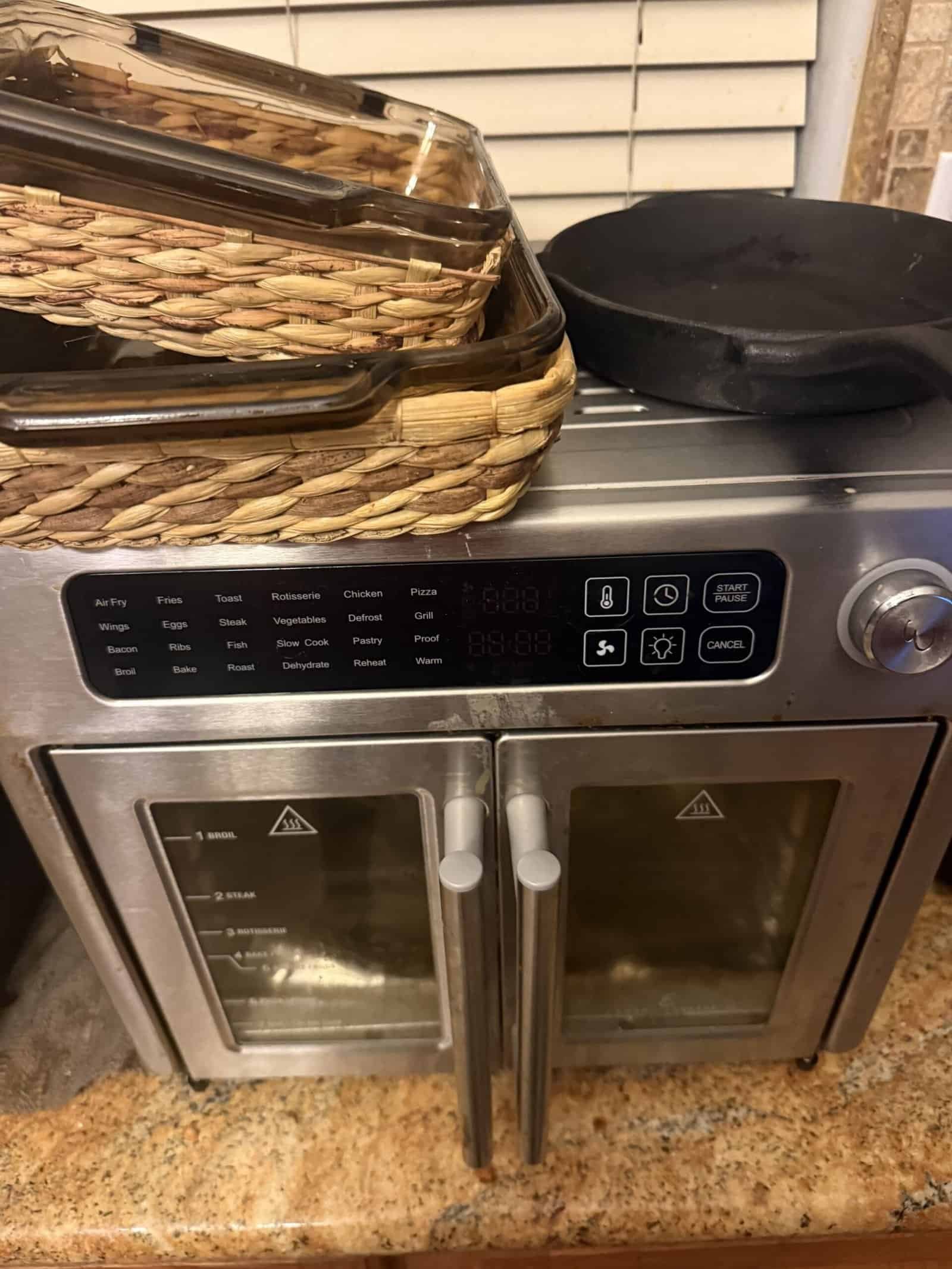
Every apartment kitchen article assumes everything is small. Mine is not. I have decent counter space, a closet, and a pantry, which is more storage than most people writing this stuff would credit. What I do not have is drawer space, and that single fact has shaped what I own more than square footage ever did. I keep few pots and pans, and I refuse duplicate tools, because the drawer decides.
Quick Verdict
Buy things that do more than one job. One good skillet beats a set. One good knife beats a block. The constraint in most apartment kitchens is not floor space, it is the drawer, and the way you win is by owning less rather than organizing more.
Key Takeaways
- Work out your actual constraint. Counter, cabinet, and drawer are different problems.
- Multi-taskers beat specialists. Every specialist costs drawer space forever.
- One skillet, one knife, one board covers most cooking.
- Wall space is free real estate and nobody uses it.
- Owning less is easier than organizing more.
1. A Cast Iron Skillet, Best Multi-Tasker
If drawer space is the constraint, the answer is things that do several jobs, and this does more than anything else I own.
Sear, fry, bake, roast, stovetop to oven without a second thought. It replaces a frying pan, a roasting dish, and most of a grill pan, and it takes one cabinet slot to do it. That is the maths that matters when you are deciding what earns space.
I cook steak in mine, among most other things. It is the reason I do not need many pots and pans, because one heavy thing that does everything beats five light things that each do one job. Cast iron skillets covers the range, what to cook in one shows the range, and choosing cast iron if you are starting out.
Best for: anyone whose kitchen is deciding what they own.
Skip if: weight is a problem, in which case stainless does most of it lighter.
2. A Magnetic Knife Strip, Best Space Win
The purchase that taught me the principle.
A knife block sits on the counter taking space permanently. Knives loose in a drawer take drawer space, which is the thing I do not have, and dull each other besides. A magnetic strip goes on the wall and takes neither.
I will be honest that I chose mine for convenience and because it looks good rather than out of some spatial strategy. The space benefit came free, and it is the clearest example of the wall being the only surface in an apartment kitchen nobody competes for.
Knife storage covers the options, blocks if you would rather, and choosing a knife for what goes on it.
Best for: anyone short on drawers or counter, which is most apartments.
Skip if: your lease forbids wall fixings, though most tolerate a strip.
3. One Chef’s Knife, Best Anti-Set Purchase
A twelve-piece knife set is three knives you use and nine that occupy space you do not have.
This is where the drawer constraint becomes a buying philosophy rather than a storage problem. If you cannot store nine knives, you are forced to confront that you never needed nine knives, and that turns out to be a gift.
A chef’s knife does most of the cutting in any kitchen. Add a bread knife because a serrated edge does something no straight blade can, and a paring knife because it is cheap and small. That is a complete kitchen and it fits on a strip.
Chef’s knives is where to spend, sets if you genuinely have nothing, and bread knives for the one thing your chef’s knife cannot do.
Best for: everyone. Buy one good one instead of nine mediocre ones.
Skip if: you are starting from zero and a set is the cheapest floor.
4. A Big Wooden Cutting Board, Best Counter Use
The one place I spend space rather than save it, deliberately.
A big board is better than a small one, and it is not close. Enough room to actually work means less pushing things around, fewer awkward angles, and less mess. Mine is large and it earns the space it takes.
The reason it works in an apartment is that counter space is my one abundance, so the board lives out and the drawer stays free. That is the trade you make once you know which constraint you are actually under: spend the resource you have, protect the one you do not.
Wood also happens to be kind to knives in a way glass and stone are not, which matters when you are down to one good knife. Cutting boards covers the choice.
Best for: anyone with counter space and not much else.
Skip if: counter is your constraint, in which case a thin board that stores upright wins.
5. Glass Food Storage, Best Pantry Partner
Storage containers are where a pantry becomes useful rather than a place things go to be forgotten.
Glass stacks, does not stain, does not hold smells, goes fridge to microwave to dishwasher forever. Plastic does all of that worse and then goes cloudy. If you have pantry and closet space, containers are how you turn it into capacity rather than shelving.
Mine goes in the dishwasher with everything else and comes out fine, which is the whole reason it survives daily use. Food storage containers covers the fridge side, pantry containers the dry side, and dishwasher safe cookware for why glass keeps winning.
Best for: anyone with pantry space and no system.
Skip if: weight matters or you have small children around glass.
6. An Indoor Grill, Best Appliance Bet
The one countertop appliance I would defend in a space-constrained kitchen.
Appliances are where apartment kitchens go wrong, because each one is a permanent claim on a finite surface. Most are single-purpose and most sit unused between the two weeks a year you remember them.
An indoor grill earns it by doing something the oven does slowly and the skillet does smokily. I use mine for steak alternating with cast iron, and it gets used enough to justify the footprint, which is the only test that matters.
The test I would apply to any appliance: is this weekly? If it is monthly, it is a guest in a house with no spare room. Indoor grills covers the field and choosing one the specifics.
Best for: people who will use it weekly. Nobody else.
Skip if: you already have a skillet and a working stove, honestly.
Apartment Kitchen Priorities
| Item | Jobs it does | Space cost |
|---|---|---|
| Cast iron skillet | Sear, fry, bake, roast | One cabinet slot |
| Magnetic strip | Knife storage | Wall. Free. |
| Chef’s knife | Most cutting | On the strip |
| Big wooden board | All prep | Counter, deliberately |
| Glass storage | Leftovers, pantry | Pantry |
| Indoor grill | Weeknight cooking | Counter. Earn it. |
| Knife set | Three knives, nine fillers | Too much |
| Duplicate tools | Nothing | The drawer |
Find Out What Your Constraint Actually Is
This is the step everyone skips, and it is why generic small-kitchen advice fails.
“Apartment kitchen” gets treated as one problem and it is at least four. Counter space, cabinet space, drawer space, and pantry space are separate resources and almost nobody is short of all of them. Being short of counter means one thing. Being short of drawers means something else entirely.
Mine has generous counter, a closet, and a pantry. On paper that is a good kitchen. But the drawer is small, and drawers are where tools live, so tools are what I ration. I do not buy a second spatula. I do not buy a gadget that does one job a knife already does. Not because I am disciplined, but because there is nowhere for it to go.
Work out which of the four you are short of before you buy a single organizer. Half of what gets sold as small-kitchen solutions is solving the wrong resource.
Owning Less Beats Organizing More
The organizer industry would like you to believe the problem is arrangement. Usually the problem is volume.
A drawer organizer makes a full drawer slightly more navigable. Owning four fewer tools makes it empty. One of those is a purchase and the other is a decision, and only one of them works permanently.
The practical version: before buying anything, ask what it replaces. If nothing, it is a specialist and it costs drawer space forever, so it had better be earning that. Most do not. The garlic press, the avocado tool, the strawberry huller, all real products, all doing something a knife already does.
Where organization genuinely helps is the pantry, because dry goods in bags are a mess and dry goods in containers are inventory. Organizing a kitchen covers the whole picture, and the honest version of it always starts with getting rid of things.
What I Do Not Own
Worth listing, because a list of absences is more useful than another list of purchases.
Not many pots and pans. No duplicate tools. No twelve-piece knife set, no matching cookware set where half sits in a cupboard, no single-purpose gadgets. Not on principle, on space.
What I have found is that the constraint made better decisions than I would have made freely. Given unlimited drawers I would own a drawer full of things I use twice a year. The apartment kitchen is not really a compromise. It is a filter.
Recommended Reading
See organizing your kitchen, choosing cookware, and knife storage.
Apartment Kitchen FAQ
What do I actually need in an apartment kitchen?
One good skillet, one good knife, a board, storage, and at most one appliance you use weekly. The trick is buying multi-taskers, because every specialist costs storage permanently. Cast iron alone replaces a frying pan, a roasting dish, and most of a grill pan.
Is counter space the main problem?
Not necessarily, and this is the part generic advice gets wrong. Counter, cabinet, drawer, and pantry are four separate resources and almost nobody lacks all four. Mine has good counter, a closet, and a pantry, but small drawers, so tools are what I ration. Work out which one you are short of first.
Should I buy a knife set for a small kitchen?
No, unless you have nothing at all. A twelve-piece set is three knives you use and nine occupying space you do not have. A chef’s knife, a bread knife, and a paring knife is a complete kitchen and it fits on a wall strip.
Where should knives go if drawers are tight?
The wall. A magnetic strip takes no counter and no drawer, which makes it free space in a kitchen short of both. A block works but claims counter permanently. Loose in a drawer is the worst option and it also dulls them.
Are drawer organizers worth it?
Less than owning fewer things. An organizer makes a full drawer slightly more navigable. Getting rid of four tools makes it empty. One is a purchase, the other is a decision, and only one of them holds. Organizers earn their keep in the pantry, not the drawer.
Which appliance is worth the counter space?
One you use weekly, and that is the whole test. Most countertop appliances are single-purpose and sit idle between the two weeks a year you remember them. I keep an indoor grill because it gets used, not because it is clever.
How do I stop buying kitchen gadgets?
Ask what it replaces. If the answer is nothing, it is a specialist and it costs storage forever. Garlic presses, avocado tools, strawberry hullers: all real, all doing something a knife already does. A tight drawer answers this question for you, which is a hidden advantage.
Is a big cutting board a mistake in a small kitchen?
Depends which resource you are short of. Mine is big and lives out, because counter is what I have and drawer is what I lack. If counter is your bottleneck, a thin board that stores upright is the better answer. Same question, opposite conclusion.
More in this guide: our picks for kitchen scoops.
Recommended Reading
