
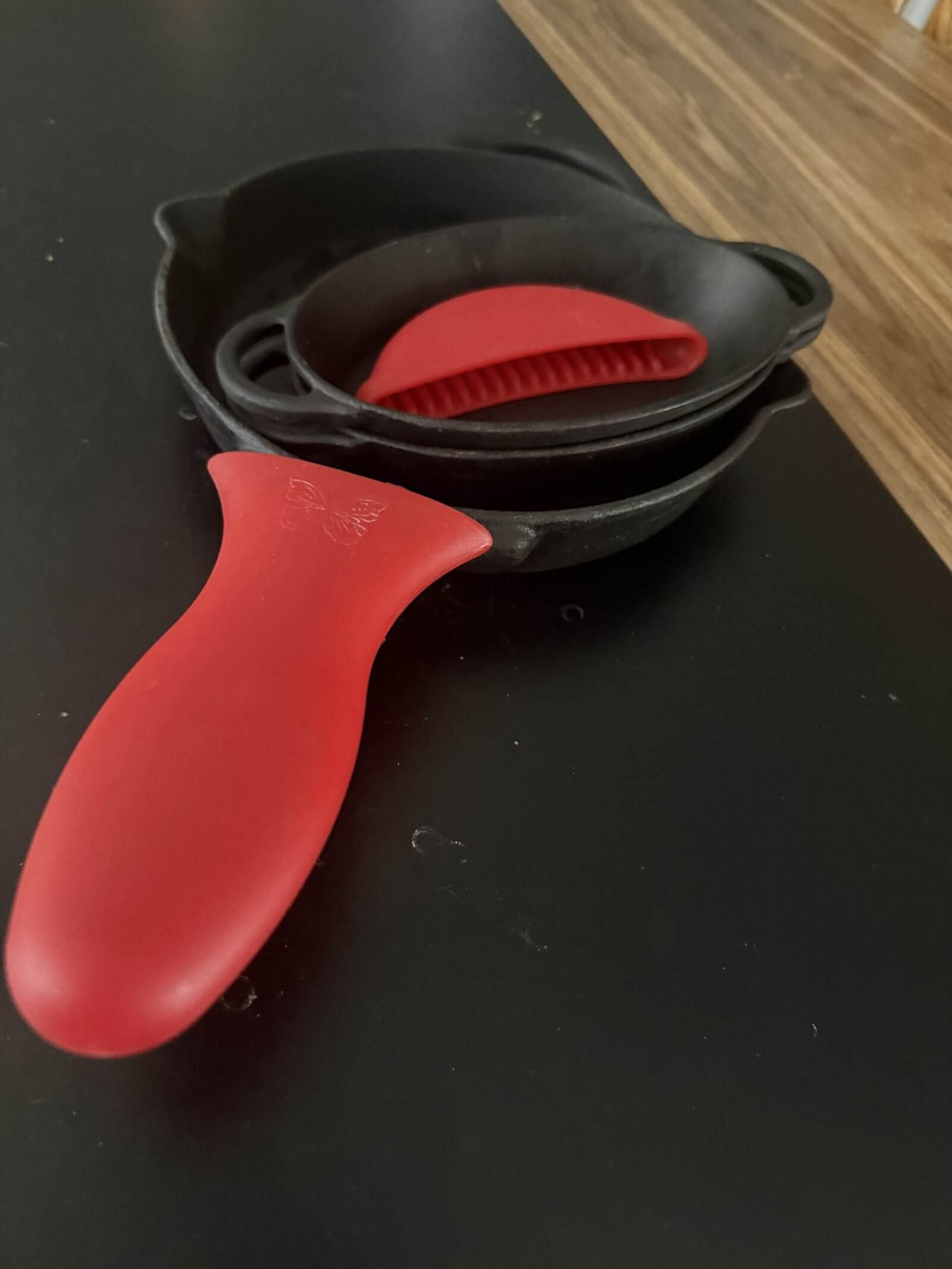
Cast iron attracts accessories the way no other pan does, and most of them exist because people are anxious about doing it wrong. I own a few. Two of them get used constantly and both are for cleaning. One of them, a lid, hardly comes out at all, because it turns out not to be needed for what I cook in there. That ratio is roughly what you should expect from this category.
Quick Verdict
A metal scrubber and a pan scraper are the two worth owning, and they cost very little between them. Everything else depends entirely on what you cook, and most of it is solving a problem you do not have.
Key Takeaways
- The cleaning accessories are the ones that earn their place.
- A metal scrubber plus a scraper handles essentially everything.
- A lid is only useful if you cook things that need one. Mine mostly does not.
- A handle cover solves a real burn problem, and a towel also does.
- Most cast iron accessories are anxiety management, not equipment.
1. A Metal Scrubber, Best Overall
The one I would buy first and the one that gets used every time.
It comes in two forms. Chainmail is a square sheet of linked stainless rings. A knitted scrubber is bunched loops of stainless wire. Both work for the same reason: harder than stuck-on food, softer than seasoning, so they take off what is welded to the surface without stripping the polymerized layer underneath. That is the exact trick every other cleaning method gets wrong in one direction or the other.
A sponge is too soft and gives up. Steel wool is too aggressive and takes your seasoning with it. A metal scrubber sits in between, and it is the only thing in this category that solves a problem that genuinely exists. Between the two forms, chainmail is the gentler one and the safer default on a young or patchy pan.
Mine is the knitted stainless type, used for cleaning constantly for several years on the same skillet. It has not rusted and the seasoning has held, which is more than the usual warnings about abrasive tools would predict. It also does not wear out in any meaningful way, being metal. Cleaning cast iron covers the process, and fixing sticky seasoning if yours has gone tacky rather than dirty.
Best for: every cast iron owner, immediately.
Skip if: nothing. This is the one.
2. A Pan Scraper, Best Companion
The other one I actually use, and it does the job a scrubber is clumsy at.
It is a piece of stiff plastic with shaped edges, and it takes off the flat stuck-on stuff in one pass. Where a scrubber is good at working over texture, a scraper is good at lifting a sheet of whatever fused to the bottom. They are a pair rather than alternatives.
The shaped corners matter more than they look like they should, because a skillet has a curved wall and a square scraper cannot reach into it. The rounded edge does.
They cost almost nothing and they are the difference between cleaning a skillet in thirty seconds and standing there resenting it. Both of mine get used for cleaning and that is the whole extent of my accessory collection that earns its keep.
Best for: stuck-on flat residue, curved pan walls, being quick.
Skip if: you have a scrubber and infinite patience, which nobody does.
3. A Handle Cover, Best Safety Buy
Solves a real problem, and the problem is that the handle is exactly as hot as the pan.
That is the price of cast iron being one piece of metal. There is no cool grip, no insulation, no warning. A skillet that has been in a 400 degree oven has a 400 degree handle and it looks identical to a cold one, which is how people get burned.
A silicone or leather cover slides on and removes that hazard. Silicone is cheap and has a temperature ceiling worth checking. Leather is better at high heat and costs more. Covers vary more than they look, and our roundup of silicone handle covers goes into fit and temperature ratings.
The honest note: a folded towel does this for free and you already own one. The cover is better because it is always on the handle, and the towel is better because it is free. Both work, and the failure mode is not having either while reaching for a hot pan. Cast iron skillets covers which pans come with what.
Best for: anyone using the oven with cast iron, which is most of the point of it.
Skip if: you are disciplined with a towel. Genuinely.
4. A Lid, Best Depends Entirely on You
I own one. It hardly gets used, and being honest about why is more useful than pretending otherwise.
It is not needed for what I cook in there. My cast iron does steak and things that want a hard sear, and a lid is the opposite of that: it traps steam, which softens a crust, which is the one thing I bought the pan for.
Where a lid earns its place is anything braised, anything shallow-simmered, anything that wants to cook through after browning. Those are real uses and if that is your cooking, a lid turns the skillet into something closer to a braiser.
So this is not a bad accessory. It is an accessory whose value is entirely determined by what you cook, and mine sits in a cupboard because my cooking does not ask for it. Work out which of those you are before buying. What to cook in cast iron is the honest way to decide, and Dutch oven vs skillet if you find yourself wanting a lid often.
Best for: braising, simmering, cooking through after a sear.
Skip if: your cast iron is a searing pan. Mine is, and mine sits unused.
5. A Press, Best Narrow Specialist
A heavy disc that sits on food and holds it flat against the pan.
The use case is genuinely narrow and genuinely real: bacon that curls, smashburgers, a grilled sandwich, anything where full contact with the surface is the point and the food would rather not cooperate.
Outside those, it does nothing. It is not a general cast iron accessory, it is a bacon and burger tool that happens to be made of cast iron, and it will sit in a cupboard if that is not what you cook.
If smashburgers are the appeal, that is a specific tool rather than this one. Burger smashers covers that job properly.
Best for: bacon, smashburgers, pressed sandwiches.
Skip if: you do not cook those. It is a single-purpose weight.
6. Seasoning Oil, Best Maintenance Item
The one that is technically optional and mildly useful.
Seasoning is oil polymerized onto iron, and maintaining it means a thin wipe of oil onto a warm dry pan occasionally. Purpose-made seasoning oils are blended for a high smoke point and they work.
They also cost more than the vegetable oil in your cupboard, which does the same thing adequately. The one real advantage is that a spray or a dedicated bottle makes you more likely to actually do it, and the maintenance you perform beats the maintenance you optimize.
The mistake to avoid is too much oil, which is what makes a pan sticky rather than seasoned. Thin to the point of looking dry. Seasoning cast iron covers the method, and fixing sticky seasoning covers the result of ignoring that advice.
Best for: people who want it decided for them.
Skip if: you have cooking oil. You do.
What Earns Its Place
| Accessory | Job | Verdict |
|---|---|---|
| Metal scrubber | Scrubbing without stripping | Buy it |
| Pan scraper | Lifting flat stuck-on residue | Buy it |
| Handle cover | The handle is as hot as the pan | Or use a towel |
| Lid | Braising, simmering | Only if you cook that way |
| Press | Bacon, smashburgers | Narrow |
| Seasoning oil | Maintenance | Optional |
| Cleaning brush kits | What a scrubber does | No |
| Storage sleeves | Nothing | No |
The Cleaning Ones Are the Real Ones
There is a pattern in what I actually reach for, and it is not subtle.
Both accessories that get used are for cleaning. That is because cleaning is the only part of cast iron ownership that is genuinely a bit awkward, and it is the part people get wrong in ways that cost them. Everything else about the pan is just cooking.
A scrubber and a scraper between them handle it. Hot water, scrub, scrape what will not come off, dry it properly, done in under a minute. That is the whole ritual, and the reason it matters is that a cleaning process you resent is a pan you stop using.
Which is the real argument for spending on these two rather than anything else here. They are not making the pan better, they are making you keep using it. Cleaning cast iron covers the routine, and restoring a rusty one for when the routine slipped.
Most of This Category Is Anxiety
Worth saying plainly on a page listing things to buy.
Cast iron has a reputation for being demanding, and that reputation sells accessories. Brushes, kits, sprays, sleeves, conditioners, all promising to protect you from ruining a pan that is a lump of iron and extremely difficult to ruin.
The reality is that it wants cleaning, drying, and occasional oil. That is two cheap tools and a habit. The rest of the category exists because people are nervous, and nervousness is a good market.
My own collection makes the point. Two things I use constantly, and a lid in a cupboard that I bought because it seemed like the kind of thing you should have. It is not a bad lid. It is just not for the way I cook, and I did not work that out until after. Choosing cast iron covers the pan itself, which matters far more than any of this.
Recommended Reading
See cleaning cast iron, seasoning it, and cast iron skillets.
Cast Iron Accessories FAQ
What cast iron accessories do I actually need?
A metal scrubber and a pan scraper. That is it, and both are cheap. They are the two I use constantly and both are for cleaning, which is the only genuinely awkward part of owning cast iron. Everything else depends on what you cook.
Is a metal scrubber worth it?
Yes, and it is the first thing to buy. It is harder than stuck-on food and softer than seasoning, which is the exact balance a sponge misses in one direction and steel wool misses in the other. It also does not wear out, being metal.
Do I need a lid for my cast iron skillet?
Only if you cook things that need one. I own one and it hardly gets used, because my skillet does steak and things that want a hard sear, and a lid traps steam which softens crust. If you braise or simmer, a lid turns the pan into something closer to a braiser and earns its place.
Is a handle cover necessary?
It solves a real problem, since the handle is exactly as hot as the pan and looks identical cold. A folded towel does the same job for free. The cover is better because it lives on the handle; the towel is better because you already own it. Having neither is the actual mistake.
Do I need special seasoning oil?
No. Purpose-made oils are blended for a high smoke point and they work, and so does the vegetable oil in your cupboard. The one advantage is that a dedicated bottle makes you more likely to do it. Use it thin, to the point of looking dry, since too much is what makes a pan sticky.
What about a cast iron press?
Narrow but real. Bacon that curls, smashburgers, pressed sandwiches. Outside those it does nothing and sits in a cupboard. It is a bacon and burger tool made of cast iron rather than a general accessory.
Why are there so many cast iron accessories?
Because cast iron has a reputation for being demanding and that reputation sells things. The pan is a lump of iron and it is hard to ruin. It wants cleaning, drying, and occasional oil, which is two cheap tools and a habit. The rest of the category is nervousness being monetised.
What is the fastest way to clean cast iron?
Hot water, scrubber for the stuck-on texture, scraper for whatever is welded flat to the bottom, then dry it properly. Under a minute. The reason it is worth getting this quick is that a cleaning process you resent is a pan you quietly stop using.
This guide is part of the full guide to choosing the right cookware for your kitchen.
