
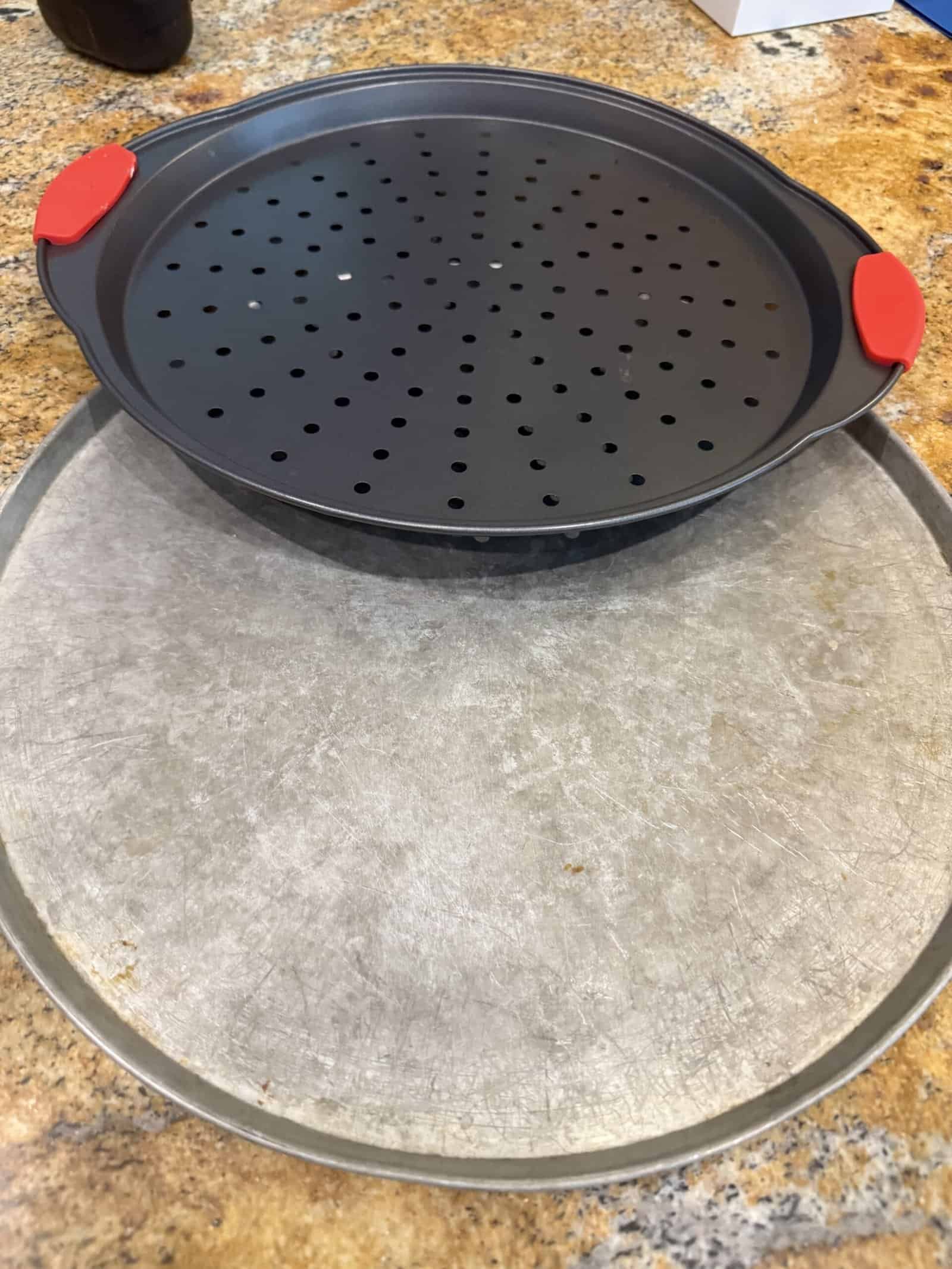
A soggy base is a steam problem rather than a heat problem. Moisture leaves the dough during baking, and on a solid pan it has nowhere to go, so it condenses underneath and softens the crust you were trying to crisp. Perforated pans and crisper trays exist to give that steam an exit. Everything else in this category is a variation on that idea. Our roundup of pizza stones covers the other approach.
Quick Verdict
A perforated aluminum pan handles most home baking and costs very little. Crisper trays with raised mesh go further for frozen pizza and reheating. Solid pans suit deep dish and anything with a wet topping that would drip through.
Key Takeaways
- Perforation lets steam escape, which is what crisps the base.
- Dark pans absorb more heat and brown faster than shiny ones.
- Non-stick coatings limit maximum oven temperature.
- Solid pans suit deep dish and very wet toppings.
- Warping is the usual failure on thin aluminum.
How We Picked
Pans are grouped by how they handle moisture and heat, since those are the two variables that decide whether a base crisps. Material and finish are weighted alongside perforation, because a dark pan and a shiny one behave differently at the same oven setting.
Selections reflect materials and construction. Descriptions come from product research except where personal use is stated directly.
1. A Perforated Aluminum Pizza Pan, Best Overall
Why It Stands Out
Holes across the base let steam escape and hot air reach the dough directly, which is the difference between a crisp base and a pale soft one.
Aluminum also heats quickly and evenly, and these cost little enough to own two.
Worth Knowing
Very wet dough can sag through larger perforations before it sets, which is a technique issue rather than a pan fault.
Thin aluminum warps with repeated high heat, and a warped pan never sits flat again. Our note on cast iron pizza pans covers the heavier alternative.
This suits most home pizza baking. Skip it for deep dish or very loose dough.
2. A Crisper Tray, Best for Frozen Pizza
Why It Stands Out
Raised mesh lifts the base off the surface entirely, so air circulates underneath rather than around a flat sheet. For frozen pizza, which arrives with moisture built in, that is the biggest single improvement available.
They also work for reheating leftover slices, where a solid surface produces a limp result.
Worth Knowing
Mesh is harder to clean than a flat pan, since cheese that escapes bonds around the wires.
Coated mesh has a temperature ceiling, so check it against the pizza box instructions. Our roundup of personal pizza pans covers smaller versions.
This suits frozen pizza and reheating. Skip it for fresh dough that might sag through.
3. A Dark Steel Pizza Pan, Best Browning
Why It Stands Out
Dark surfaces absorb more radiant heat than shiny ones, which browns the base faster at the same oven temperature.
Steel is also more rigid than thin aluminum, so it resists the warping that ends cheap pans.
Worth Knowing
Faster browning means less margin, and a pizza that would have been fine on aluminum can overshoot on dark steel.
Recipes assume a mid-tone pan unless they say otherwise, so treat stated times as a starting point.
This suits anyone whose bases come out pale. Skip it if you already burn the bottom.
4. A Solid Pizza Pan, Best for Deep Dish
Why It Stands Out
Deep dish and pan-style pizza need sides and a solid base to hold oil and a thick layer of topping, which perforation cannot do.
Solid pans also suit very wet toppings that would drip through holes onto the oven floor.
Worth Knowing
The base will be softer than on a perforated pan, which for deep dish is generally the intended texture rather than a failure.
Oiling the pan generously is part of the technique for pan pizza. Our roundup of bakeware sets covers similar pieces.
This suits deep dish and pan pizza. Skip it if a crisp thin base is the goal.
5. A Pizza Screen, Best for Very Wet Dough
Why It Stands Out
An open mesh screen supports dough while leaving nearly the whole base exposed to hot air, which crisps more aggressively than a perforated pan.
Screens are also flat, thin, and stack, which suits a cupboard already full of pans.
Worth Knowing
Dough sticks to a new screen until it develops a seasoned surface, so the first few uses need oil or a light dusting.
Screens also leave a visible grid pattern on the base, which is cosmetic.
This suits crisp thin-crust baking. Skip it if you want a clean smooth base.
6. A Non-Stick Coated Pan, Best Easy Release
Why It Stands Out
Coated pans release a finished pizza without a struggle, which matters for pan-style bases that would otherwise stick around the edges.
They also clean easily, since cheese that escapes lifts rather than bonding.
Worth Knowing
Non-stick coatings carry maximum temperature ratings, often below the very high settings that thin-crust pizza benefits from. Check yours against how hot you actually bake.
Metal cutters also scratch the coating, so cut on a board rather than in the pan. Our roundup of pizza cutters covers that step.
This suits pan pizza and easy cleanup. Skip it for very high heat baking.
Pan Types at a Glance
| Type | Base crispness | Heat ceiling | Best for |
|---|---|---|---|
| Perforated aluminum | Very good | High | Most home baking |
| Crisper tray | Best | Check coating | Frozen pizza, reheating |
| Dark steel | Very good, browns fast | High | Pale bases |
| Solid pan | Soft by design | High | Deep dish |
| Pizza screen | Best for thin crust | High | Wet dough |
| Non-stick coated | Good | Limited | Easy release |
How I Clean Mine
My pizza pans get rinsed and then go in the dishwasher, and nothing has been wrecked doing that. The same applies to my glass cookware and bakeware, which all get the same treatment.
That is worth saying because a lot of bakeware advice assumes hand washing, and in my experience the pans have held up fine. What I would add is that this is a habit rather than a considered recommendation: my pans happen to tolerate it, and I have not compared them against pans that were only ever hand washed.
The caution worth passing on is about coatings specifically. Non-stick pans and coated mesh often carry manufacturer guidance against the dishwasher, since detergent and heat degrade coatings over repeated cycles. Uncoated aluminum and steel are a different case, and aluminum in particular can discolor in a dishwasher without being damaged.
What I cannot compare is screens, crisper trays, or dark steel pans, since I have not used them. Those sections come from research rather than from pans I have baked on. Metal pans need their own care, and our note on why a pizza pan rusts covers what causes it.
What to Look For
Is it perforated?
This is the main decision. Holes let steam out, and steam trapped under dough is what produces a soggy base.
How dark is the surface?
Dark absorbs more heat and browns faster. If your bases come out pale, this helps. If they come out burnt, it does not.
What temperature do you bake at?
Coated pans have ceilings, often lower than thin-crust recipes want. Uncoated metal has no such limit.
Will it warp?
Thin aluminum buckles under repeated high heat and never sits flat again. Thicker gauge or steel resists it.
Pan or Stone?
A pan
Cheap, light, quick to heat, easy to store, and easy to get in and out of the oven. Perforated versions crisp well enough for most home baking.
A stone
More thermal mass, so it holds temperature when cold dough lands on it, which is what produces the strongest oven spring. The trade is a long preheat, weight, and fragility. Our roundup of baking sheets covers that route.
Common Mistakes to Avoid
Using a solid pan for thin crust
Steam has nowhere to go, and the base softens as it bakes. Perforation is the fix rather than more heat.
Exceeding a coating’s temperature limit
Non-stick pans have ceilings, and thin-crust pizza often wants more heat than the pan is rated for.
Cutting in the pan
Metal cutters scratch coatings and score aluminum. Move the pizza to a board first.
Ignoring warping
A buckled pan bakes unevenly because parts of it no longer contact the heat the same way. Once warped, replacement is the only fix. Our note on cleaning cast iron covers care for the heavier option.
Recommended Reading
See our roundup of cooling racks, our guide to oven thermometers, our note on cleaning a cutting board, and a roundup of silicone baking mats, and choosing the right cookware.
Pizza Pan FAQ
Do perforated pizza pans really work?
Yes, and the mechanism is steam rather than heat. Moisture leaving the dough has nowhere to go on a solid pan, so it condenses underneath and softens the base. Holes give it an exit, which is what allows the bottom to crisp.
What is the difference between a screen and a perforated pan?
A screen is open mesh with almost the entire base exposed, so it crisps more aggressively. A perforated pan is solid metal with holes, which supports wet dough better and leaves a cleaner-looking base.
Can I put pizza pans in the dishwasher?
Uncoated aluminum and steel generally tolerate it, though aluminum can discolor. Non-stick pans and coated mesh are commonly advised against by manufacturers, since detergent and heat degrade coatings over repeated cycles. Check the manual for anything coated.
Why does my pizza base come out soggy?
Usually trapped steam, particularly on a solid pan with a wet topping. A perforated pan or crisper tray addresses it directly. Overloading with sauce or wet vegetables adds moisture the base then has to fight.
Dark pan or shiny pan?
Dark absorbs more radiant heat and browns the base faster at the same oven setting. That helps pale bases and hurts if you already burn the bottom. Recipes generally assume a mid-tone pan unless stated.
Is a crisper tray worth it for frozen pizza?
It is where these show the biggest improvement, since frozen pizza arrives with moisture built in and raised mesh lets air circulate underneath. It also revives leftover slices better than a flat surface does.
Why did my pan warp?
Thin aluminum buckles under repeated high heat, and sudden temperature changes make it worse. A warped pan bakes unevenly and does not recover, so thicker gauge or steel is the answer if you bake hot regularly.
What size pan do I need?
Match it to your oven rather than to an ambition. A pan needs clearance around the edges for air to circulate, and one that fills the shelf entirely blocks the airflow that browns the top.
