
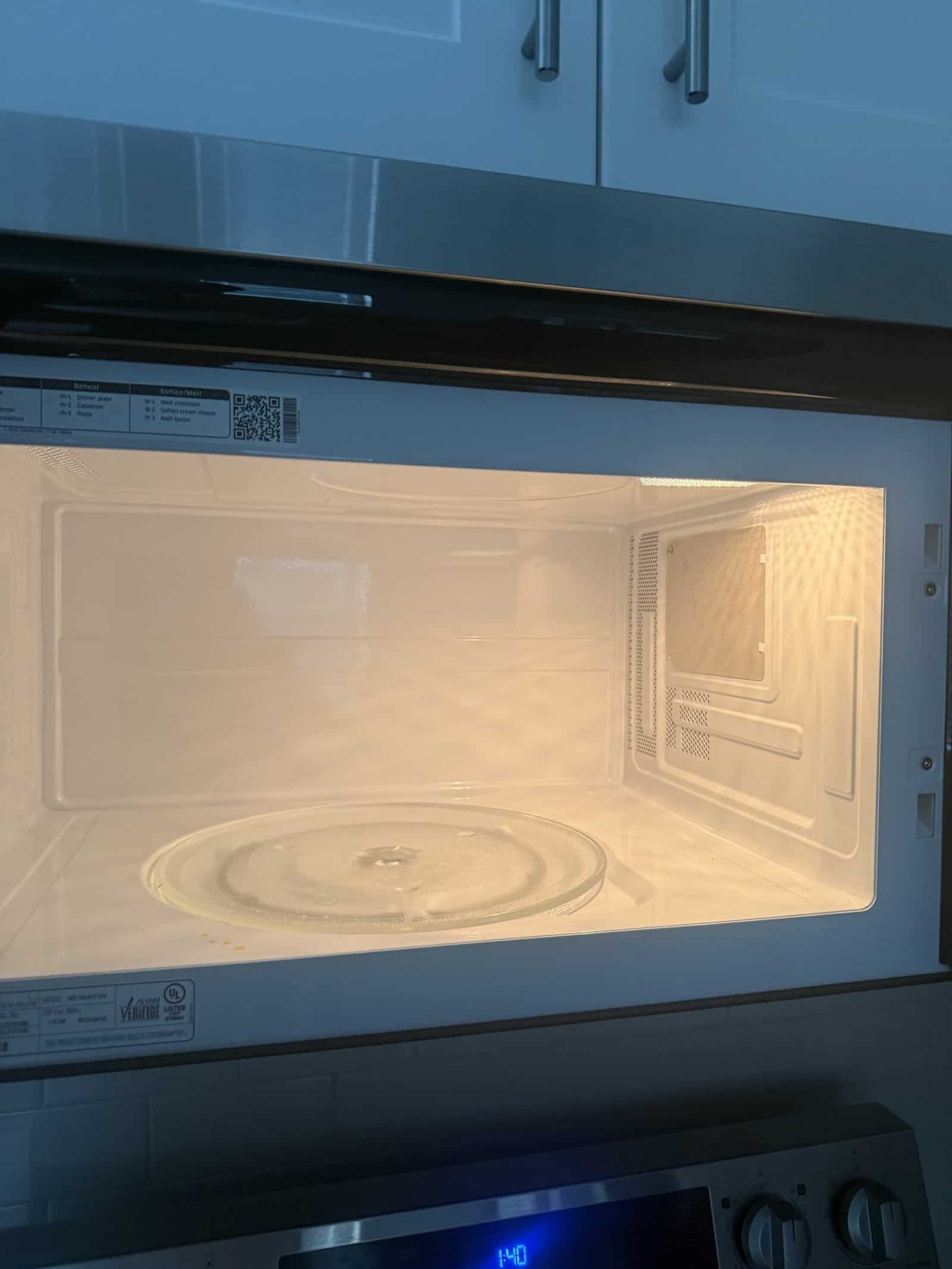
Steam it with water for a few minutes, wipe the softened residue out, then clean the turntable separately and rinse anything food touches. Learning how to clean a microwave is mostly about letting steam do the scrubbing, because heat and moisture lift baked-on splatter that a dry cloth just smears.
Mine is an over-the-range unit, and I use it mostly for popcorn, about once a month, which is not often at all. Leftovers go in my air fryer combo oven instead of the microwave.
Low use changes the interior and not the filters. An over-the-range unit vents the cooktop below it, so its grease filter loads up on cooking rather than on microwave use.
Quick Answer
Microwave a bowl of water for several minutes, leave the door shut a few more, then wipe the loosened residue with a damp cloth. Wash the turntable and its support ring in the sink. On over-the-range units, wash the grease filter monthly and replace the charcoal filter about twice a year.
Key Takeaways
- Steam does the work; scrubbing does not.
- Wash the turntable in the sink, not inside the cavity.
- Rinse any surface food touches with plain water afterward.
- Over-the-range units have two filters handled oppositely.
- The grease filter is washed; the charcoal filter is replaced.
- Skip abrasives, which scratch the interior coating.
- Never wet the vents or the waveguide cover.
| Part | How to clean it | How often |
|---|---|---|
| Interior walls and ceiling | Steam, then damp cloth | When splatter is visible |
| Turntable and support ring | Sink, warm soapy water | With the interior |
| Door and seal | Damp cloth, no soaking | With the interior |
| Control panel | Barely damp cloth only | As needed |
| Grease filter, underside | Mild soap and water, often dishwasher safe | Monthly |
| Charcoal filter, top vent | Replace, cannot be washed | About every six months |
| Waveguide cover | Wipe gently, keep dry | Carefully, rarely |
Step by Step
- Put a microwave-safe bowl of water inside. A couple of cups is plenty. A slice of lemon helps with smell and does nothing for grease.
- Run it until the water boils and steams. Several minutes on high, watching that it does not boil dry.
- Leave the door closed a few minutes longer. This is the part people skip, and it is where the residue actually softens.
- Take the bowl out carefully. It will be hotter than you expect and may boil over when moved.
- Wipe the ceiling first, then walls, then floor. Gravity is on your side in that order.
- Remove the turntable and support ring. Wash both in the sink rather than trying to clean around them.
- Wipe the door and the seal. Damp cloth, and keep water out of the vents and the latch.
- Rinse the food-contact surfaces with plain water. The turntable especially, then let it air dry.
- Do the control panel last. Barely damp, never sprayed, since liquid behind a membrane panel kills buttons.
- Check the filters if it is over the range. Different job, different schedule, covered below.
My Actual Routine, and Where It Falls Short
I wipe it out with paper towels and Clorox wipes. Popcorn is nearly the only thing that goes in there.
That combination is worth separating out, because popcorn does not splatter the way a bowl of sauce does. Bagged popcorn leaves a fine oily film rather than baked-on spots, and film comes off with a wipe.
The gap in that method is the rinse. The Clorox Disinfecting Wipes label states that for surfaces that may come in contact with food, a potable water rinse is required, and that the product is not intended for use on dishes, glassware or eating utensils.
Clorox draws the line at direct contact: a countertop needs no rinse, while a hard nonporous surface food actually touches should be rinsed with potable water and allowed to air dry. In a microwave that means the turntable, because food sits on it.
Why Steam Beats Scrubbing
What baked-on splatter is
Microwaved food spits, and the droplets cook onto hot interior surfaces. That is a dried, cooked film rather than loose dirt.
What steam does to it
Moisture and heat rehydrate that film and break its grip on the surface. The residue then lifts rather than needing to be abraded off.
Why abrasives are the wrong answer
Scouring pads and powders scratch the painted or enamel interior. Scratches hold future residue and can expose metal underneath.
What to use instead
A soft cloth and patience, with a second steam cycle if the first did not finish it. Our guide to cleaning burnt pots and pans covers the same soak-first principle.
The Two Filters Almost Nobody Touches
An over-the-range microwave replaces the range hood, which means it is filtering cooking air from the cooktop below it. Those filters load up on cooking, not on microwave use.
The grease filter sits in the underside and slides out. It is washed with mild soap and water, and most of them can go in the dishwasher, on a monthly schedule or when the filter indicator prompts.
The charcoal filter is a different part behind the vent grille at the top front. It cannot be cleaned and gets replaced about every six months, and reaching it means removing two screws and tilting the grille forward.
Mixing those two up is the common error. Washing a charcoal filter ruins it, and replacing a grease filter wastes money. Our guide to why your kitchen smells like fried food covers what a loaded charcoal filter stops doing.
Smells, and What Actually Removes Them
A lingering smell usually means residue you have not found rather than air that needs freshening. Under the turntable and along the door seal are the two usual hiding places.
Steam and a wipe remove the source. Lemon in the water makes the steam smell pleasant and has no effect on what caused the problem.
A bowl of baking soda left inside with the door shut overnight absorbs what is left. That works after cleaning, not instead of it.
Burnt popcorn is the one smell that outlasts everything, because the smoke compounds settle into every surface. Our roundup of popcorn makers covers the appliances that keep that out of the microwave entirely, and our guide to cleaning a popcorn maker covers the oily film side of it.
The Parts to Leave Alone
The waveguide cover is the small rectangular panel on an interior wall, usually a thin composite material. It protects the opening that microwaves enter through.
Wipe it gently and keep it dry, because it absorbs water and degrades. A damaged or missing waveguide cover causes arcing and needs replacing rather than cleaning.
Never spray anything into the vents. Liquid in there reaches electronics and the magnetron area.
Do not remove interior panels or the outer case. There is nothing user-serviceable behind them and a microwave’s high-voltage capacitor holds a charge with the unit unplugged.
Keeping It From Getting Bad
- Cover food with a vented lid. Most splatter never reaches the walls if something is over the plate.
- Wipe spills while the cavity is still warm. Residue has not cooked on yet at that point.
- Use lower power for sauces and soups. Violent boiling is what throws food at the ceiling.
- Pull the turntable out occasionally. Whatever ran off the edge is under it.
- Keep the seal clean. Debris on a door seal is a closure problem, not just a dirt problem.
- Set a filter reminder if it is over the range. Nothing prompts you until performance drops.
Our roundup of food storage containers covers the vented lids worth owning, our guide to deep cleaning a kitchen covers where this fits in a bigger pass, and our roundup of paper towel holders covers keeping the supplies to hand.
Related Reading
Frequently Asked Questions
How do you clean a microwave?
Microwave a bowl of water for several minutes, then leave the door shut a few minutes longer so the steam softens the residue. Wipe ceiling, walls and floor in that order with a soft damp cloth, wash the turntable in the sink, and rinse surfaces food touches.
What is the fastest way to loosen baked-on splatter?
Steam. Splatter is cooked-on food film rather than loose dirt, so moisture and heat rehydrate it and break its grip. A second steam cycle beats scrubbing, and abrasive pads or powders scratch the interior coating.
Can you use disinfecting wipes inside a microwave?
The Clorox Disinfecting Wipes label requires a potable water rinse for surfaces that may come in contact with food, and says the product is not intended for dishes, glassware or utensils. In practice that means rinsing the turntable with plain water afterward and letting it air dry.
Do over-the-range microwaves need filter maintenance?
Yes, and they have two different filters. The grease filter underneath is washed with mild soap and water, often in the dishwasher, about monthly. The charcoal filter behind the top vent grille cannot be cleaned and is replaced roughly every six months.
How do you get a smell out of a microwave?
Find the residue first, since a lingering smell usually means food you have not located, commonly under the turntable or along the door seal. Steam and wipe, then leave a bowl of baking soda inside overnight. Lemon only makes the steam smell nicer.
What should you not clean in a microwave?
Keep the waveguide cover dry and wipe it only gently, since it absorbs water and degrades. Never spray into the vents, and do not remove interior panels or the outer case, because the high-voltage capacitor holds a charge even when the unit is unplugged.
How often should you clean a microwave?
It depends entirely on what goes in it. A unit used for covered leftovers needs a wipe when splatter appears, while one used for sauces and soups needs it far more often. Wiping spills while the cavity is still warm prevents most of the work.
Does covering food really help?
It is the single biggest difference. Most splatter never reaches the walls when something vented sits over the plate, and using lower power for sauces and soups stops the violent boiling that throws food at the ceiling in the first place.
