
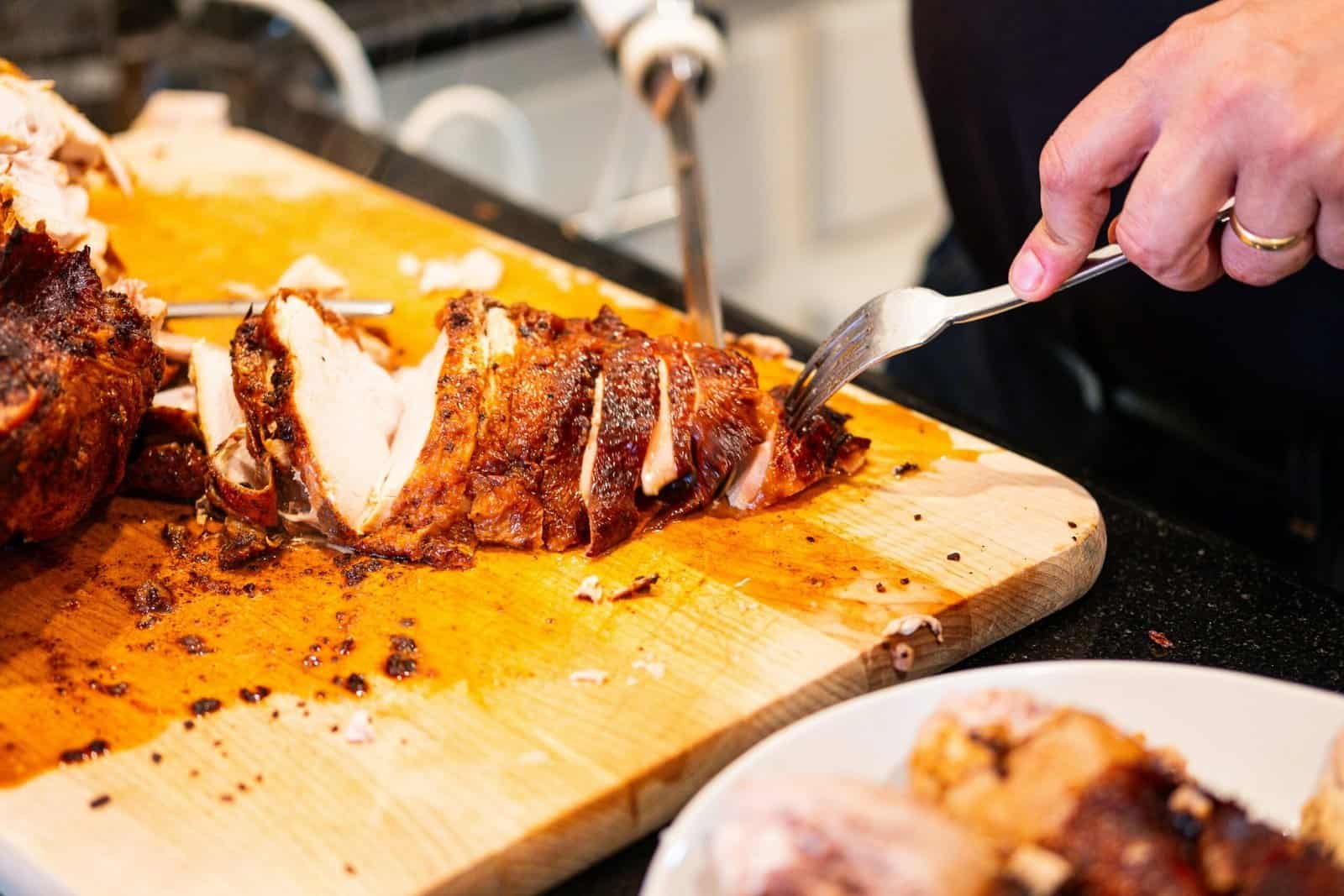
A chef’s knife is the wrong tool for a roast, and the best carving knives and forks are long Granton-edge slicers, because the oval hollows along the blade break the suction that makes meat cling and tear. Length is what lets you cross the whole joint in one stroke.
Sawing is what ruins slices. One continuous pass is what keeps them even and intact.
That is why this is a separate knife rather than a nice-to-have. Our knife sets under 100 roundup covers the block sets, and this covers the one blade most of them skimp on.
Carving Tool Types at a Glance
| Type | Blade | Best Cut | Effort | Best Use |
|---|---|---|---|---|
| Granton edge slicer | Long, hollowed sides | Clean release | Low | Most roasts |
| Carving knife and fork set | Medium to long | General carving | Low | Matched pair, gifts |
| Brisket and ham slicer | Longest, straight | Full-width slices | Low | Large cuts |
| Flexible slicer | Thin, bends | Very thin slices | Low, needs control | Ham, fish, poultry |
| Electric carving knife | Twin reciprocating | Even, effortless | Least | Hands or holidays |
| Carving fork or meat claws | Not a blade | Holds the joint | Low | Stability and safety |
How We Picked the Best Carving Knives and Forks
We compared blade types rather than named products, because knife lines change often while the geometry that makes a slicer work has not changed in decades.
Each section covers one type, the cut it suits and where it falls short. We weighted four things: how cleanly the blade releases meat, whether the length suits a home joint, how much control the handle gives, and how it is sharpened and stored.
We have not published blade lengths in inches or steel hardness figures. Those differ by product, and a figure quoted as a category rule would not help anyone choose.
1. Granton Edge Slicing Knives, Best Overall
Why It Stands Out
A long straight blade with a row of oval scallops ground into both sides. The hollows hold tiny pockets of air between the steel and the meat.
That breaks the suction which otherwise drags a slice as you pull the knife through. Slices release instead of folding over.
The blade is also narrow from edge to spine, which keeps the cutting path thin and reduces how much the knife pushes meat aside.
Worth Knowing
Granton edges still need sharpening like any blade, and the scallops do not make the edge last longer. They affect release, not retention.
Long blades also need a drawer or a strip that fits them, and most knife blocks have no slot this long.
Best for roasts, turkey and anything you want in even slices. Our magnetic knife strips picks solve the storage problem.
2. Classic Carving Knife and Fork Sets, Best Matched Pair
Why It Stands Out
A slicing knife and a two-tine fork sold together, usually with matching handles and often a storage case.
Buying them together guarantees the fork suits the knife’s scale, which matters because a fork too small does not hold a large joint steady.
These also make the obvious gift in this category, which is why the presentation cases exist.
Worth Knowing
Set pricing usually means the knife is a step below what the same money buys on its own. You are paying for the pair and the case.
Many sets also use a shorter blade than a dedicated slicer, which limits them on bigger cuts.
Best for a complete starting point and for gifting. See our serving platters picks for where the slices land.
3. Long Brisket and Ham Slicers, Best for Large Roasts
Why It Stands Out
The longest blades in the category, straight-edged and designed to cross a brisket or a bone-in ham in a single pass.
Crossing the whole width in one stroke is the only way to get a slice with no step in it. A shorter knife forces a second pass that always shows.
The extra length also keeps your knuckles clear of a large hot joint.
Worth Knowing
These are unwieldy on anything small, and a long blade on a chicken is harder to control than a shorter one.
Storage is the other issue, since a slicer this long fits very few blocks and needs a guard or a strip.
Best for smoked brisket, whole hams and large bone-in cuts. Our electric smokers roundup covers what produces them.
4. Flexible Slicing Knives, Best for Thin Slices
Why It Stands Out
A thinner blade with deliberate flex, which lets the edge follow a curve or ride along a bone rather than cutting straight through it.
Flex is what makes very thin slices possible. The blade bends with the contour instead of fighting it.
That also makes these the better choice around poultry joints and the curve of a ham, where a rigid blade has to be lifted and repositioned.
Worth Knowing
Flex costs control. A flexible blade wanders if you push, so these reward a light hand and a slow pull.
They are also less suited to dense cuts, where the blade deflects rather than tracking.
Best for ham, poultry and fish, and for anyone who wants deli-thin slices. Our boning knives picks cover working around bone before carving starts.
5. Electric Carving Knives, Best Effortless Cutting
Why It Stands Out
Two serrated blades reciprocate against each other, so the knife cuts with almost no force from you.
For anyone with reduced grip or hand pain, that changes carving from difficult to manageable. It is a genuine accessibility tool rather than a gadget.
They also produce remarkably even slices without technique, which is why they persist as a holiday fixture.
Worth Knowing
The cut face is slightly rougher than a sharp manual blade leaves, because serrated teeth tear rather than slice.
They also need storing, charging or plugging in, and the blades are not sharpenable in the usual way. Replacement blades are the maintenance path.
Best for reduced hand strength and for large holiday joints. Our tools for cooking steak roundup covers the smaller-scale alternative.
6. Carving Forks and Meat Claws, Best Holding Tools
Why It Stands Out
A long two-tine fork pins the joint while you slice, keeping your other hand well away from the blade.
A roast that rocks as you cut is the main cause of uneven slices and of cut fingers. Holding it still is half the job.
Meat claws do the same work differently, gripping from above with several short prongs, which suits pulling and shredding as well as holding.
Worth Knowing
Fork tines leave puncture holes and release juice, so many cooks pin at one end rather than through the middle of the slice line.
Claws grip well but offer less precision than a fork for holding a joint against a stroke.
Best bought alongside any carving knife, because the knife alone is the less safe half. Our cutting boards for home cooks picks cover the surface, ideally one with a juice groove.
How to Choose a Carving Knife
Pick length from your largest joint
The blade should cross the widest cut you cook in one pass. Measure a typical roast rather than guessing.
Granton edge for release, flex for contour
Those are the two geometries that matter. Hollows stop sticking, flex follows curves, and you can have one or the other.
Check the handle with a wet hand
Carving happens with greasy fingers over a hot joint. A handle that is secure only when dry is the wrong handle.
Confirm how you will store it
Most blocks will not take a long slicer. Plan on a magnetic strip, an in-drawer tray or a blade guard before you buy.
Match it to a sharpening method you own
A long thin blade needs the same care as any knife. Our honing rods and sharpening steels picks cover keeping it straight between sharpenings.
A Carving Knife or a Chef’s Knife?
What a carving knife does better
It is longer, narrower and often hollowed, so it crosses a joint in one stroke and releases the slice. A chef’s knife is too short and too wide for that, and the belly curve makes a straight pass awkward.
What a chef’s knife does better
Everything else. It is the one knife worth owning first, and our chef knives roundup covers it. A carving knife is the specialist you add once roasts are a regular event.
Common Carving Mistakes to Avoid
Carving straight out of the oven
Meat needs to rest or the juices run out and the slices fall apart. The knife gets blamed for a timing problem.
Sawing instead of pulling
A sharp slicer wants one long draw. Short back-and-forth strokes shred the surface and show on every slice.
Cutting with the grain
Slicing across the grain is what makes meat tender to eat. Find the direction of the fibers before the first cut.
Using a board with no groove
A flat board sends juice across the counter. A groove catches it and keeps the board from becoming slippery mid-carve.
Pinning through the middle of the slice line
Fork holes in the center of each slice release juice and look untidy. Pin at the end you are working away from.
Worth reading next: our guides to meat thermometers, roasting pans, and knife sharpeners.
Best Carving Knives and Forks FAQ
What are the best carving knives and forks?
Long Granton-edge slicers suit most roasts, because the hollowed sides release the slice instead of letting it cling and tear. Flexible slicers are better for ham and poultry where the blade needs to follow a curve, and an electric knife is the answer for reduced hand strength.
What is a Granton edge and does it help?
It is a row of oval hollows ground into both sides of the blade, which trap air between the steel and the meat and break the suction that makes a slice stick. It genuinely improves release. It does nothing for how long the edge stays sharp.
How long should a carving knife be?
Long enough to cross your largest joint in a single stroke, since a second pass always leaves a visible step. Measure a typical roast rather than buying by a number. Very long slicers are excellent on brisket and clumsy on a chicken.
Can I just use my chef’s knife to carve?
You can, and it will be harder work with worse results. A chef’s knife is shorter, wider and curved, so it cannot cross a large joint cleanly and tends to push meat rather than release it. For an occasional roast it is adequate.
Are electric carving knives any good?
They produce impressively even slices with no effort and no technique, which makes them genuinely useful for anyone with grip or hand pain. The cut surface is slightly rougher than a sharp manual blade leaves. Blades are replaced rather than sharpened.
Do I need a carving fork?
It is the cheaper half and arguably the more important one for safety, since a joint that rocks while you cut is how people slip. A fork holds it steady and keeps your other hand away from the blade. Meat claws do a similar job with a different grip.
How do you keep a carving knife sharp?
Hone it on a rod before each use to realign the edge, and sharpen properly when honing stops helping. Store it on a magnetic strip, in a blade guard or in an in-drawer tray so the edge never touches other utensils.
Should you slice with or against the grain?
Against the grain, which cuts the muscle fibers short and makes each slice more tender to chew. Look at the direction the fibers run on the surface of the rested joint, then set your knife across them before the first cut.
