
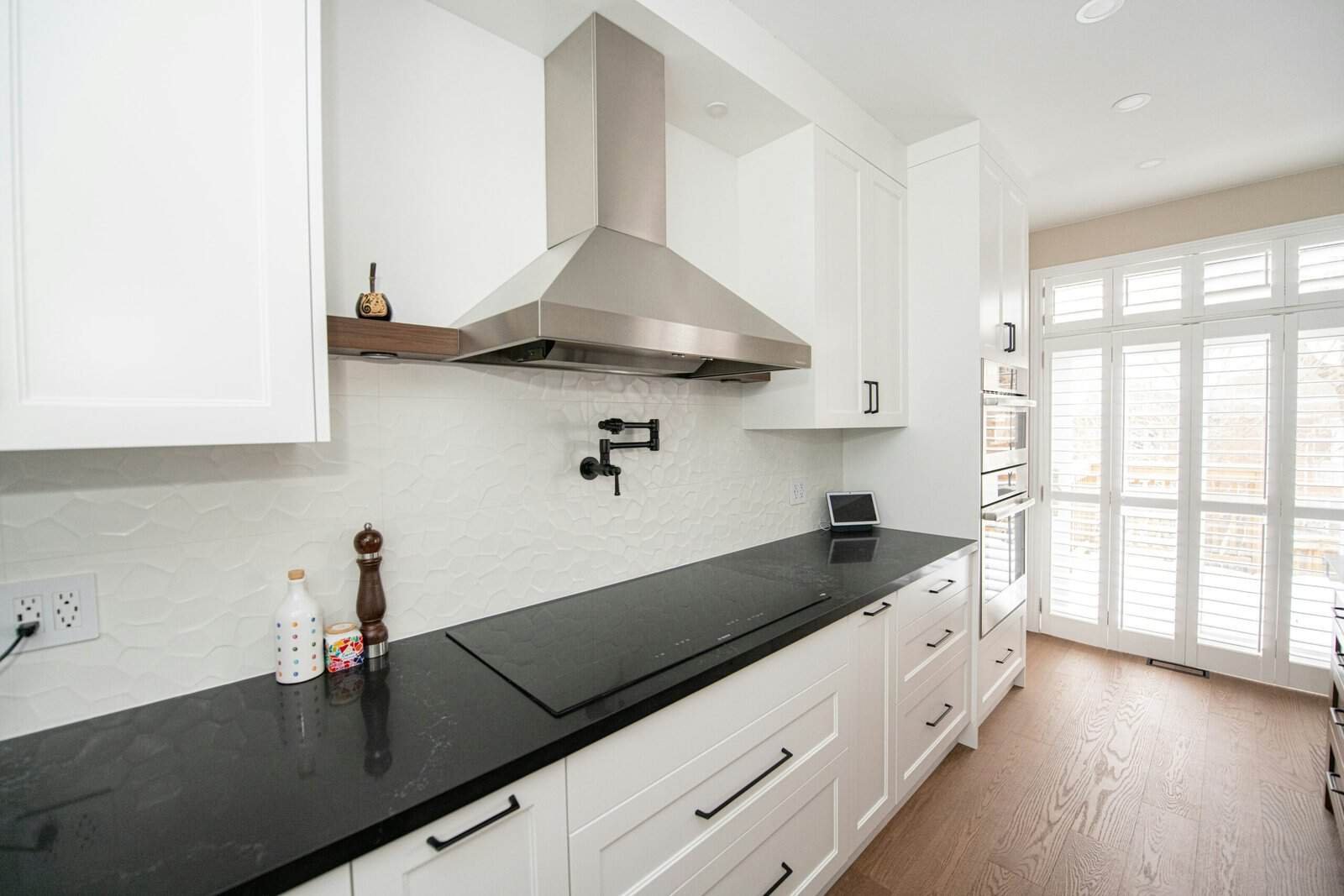
A range hood works by catching cooking plume before it spreads, so the size and position of the canopy matter more than the fan number on the box. Range hoods are chosen on CFM far too often, when a wider hood mounted at the right height moves less air and removes more grease, steam, and odor. Ducted hoods send that air outside, recirculating hoods filter it and return it to the room, and the gap between those two is the largest single decision in the category. Anyone cooking without any hood at all should read our roundup of air fryers for apartments with no vent hood.
Range Hoods at a Glance
| Type | Mounting | Ducted? | Best suited to |
|---|---|---|---|
| Under cabinet | Beneath a wall cabinet | Either | Standard kitchen runs |
| Wall chimney | Wall, no cabinet above | Usually ducted | Open wall ranges |
| Island | Ceiling suspended | Ducted | Island cooktops |
| Insert or liner | Inside custom joinery | Ducted | Built-in cabinetry |
| Ductless recirculating | Any | No | Apartments and interior walls |
| Downdraft | Behind or beside the hob | Ducted | Island with low ceiling |
Key Points
- Capture area matters more than CFM, and a hood should be as wide as the cooktop or wider
- Every duct elbow and every foot of run cuts the airflow the fan actually delivers
- Recirculating hoods handle grease and odor but return heat and moisture to the room
- Sones measure noise, and anything above about six sones discourages daily use
- Baffle filters outperform mesh on heavy cooking and clean up in a dishwasher
- Very high CFM hoods can require makeup air, which is a building code question
How We Picked
Capture came first. A hood narrower than the cooktop leaves plume escaping at the edges regardless of fan speed, so width and canopy depth ranked ahead of airflow figures.
Duct compatibility came second. Most kitchens have a fixed route, and a hood that wants an eight inch round duct in a house plumbed for six will underperform badly. Models offering multiple duct configurations ranked higher.
Noise came third, because a loud hood gets switched off. Published sone ratings at working speed carried more weight than the maximum boost figure.
Filter maintenance came fourth. Dishwasher-safe baffles get cleaned, and awkward mesh screens do not. Ease of removal decided this.
1. The Under-Cabinet Range Hood
Why It Stands Out
It mounts beneath an existing wall cabinet, so it fits the most common kitchen layout with no joinery changes. Duct routing can go up through the cabinet, out the back wall, or recirculate. Prices sit lowest in the category for equivalent airflow.
Worth Knowing
Canopy depth is usually shallow, which limits how much plume it holds before spilling. Mounting height is fixed by the cabinet, and cabinets are frequently higher than ideal. Check the required clearance above your specific cooktop type.
Right for standard kitchen runs with cabinets above the range. Skip it where the wall above is open.
2. The Wall-Mount Chimney Hood
Why It Stands Out
A deep canopy and a tall chimney cover let this style hold a much larger volume of plume before it escapes. That deeper capture is why chimney hoods outperform under-cabinet models at the same CFM. They also become the focal point of the wall rather than hiding.
Worth Knowing
They need open wall space with no cabinet above, which sometimes means giving up storage. Chimney covers come in fixed heights, so unusual ceilings need an extension piece. Ducting almost always runs vertically through the ceiling.
Right for open wall ranges and heavier cooking. Skip it if you cannot lose the cabinet above.
3. The Island Range Hood
Why It Stands Out
Suspended from the ceiling, it handles a cooktop with no wall behind it. Canopies are usually wider and deeper than wall models, because plume on an island can drift in any direction. Controls and lighting are built for viewing from all sides.
Worth Knowing
Island hoods work harder for the same result, since there is no wall to help contain the plume. Room air currents from doors, windows, and ceiling fans disrupt capture noticeably. Our roundup of smart ceiling fans covers the conflict between the two.
Right for island cooktops with ceiling duct access. Skip it if the ceiling cannot be routed.
4. The Insert or Liner
Why It Stands Out
An insert is the working part alone, built to sit inside custom joinery or a plaster canopy. That lets the visible hood match the kitchen exactly while the blower, filters, and lights come from a specialist. Blower power at this tier is often the highest available.
Worth Knowing
You are buying half a product, and the surround has to be built or bought separately. Sizing has to be right before the joinery is made, which removes the option of changing your mind. Access for filter cleaning depends entirely on how the surround was built.
Right for custom cabinetry and renovation projects. Skip it as a straight replacement for an existing hood.
5. The Ductless Recirculating Hood
Why It Stands Out
Charcoal filters strip grease and odor, then the fan returns the air to the room. No duct means it installs on an interior wall, in an apartment, or anywhere a landlord will not allow a hole. Installation is often a two-hour job rather than a trade visit.
Worth Knowing
Heat and moisture stay in the kitchen, so a recirculating hood does nothing for a steamy room. Charcoal filters need replacing every few months and are a recurring cost. Our roundup of smart air quality monitors covers measuring what the room actually holds.
Right for rentals, interior walls, and light cooking. Skip it if you cook with high heat or a lot of steam.
6. The Downdraft Vent
Why It Stands Out
A downdraft rises from behind or beside the cooktop and pulls air sideways, then ducts it down through the floor or cabinet. It keeps sight lines completely clear across an island. When retracted it disappears entirely.
Worth Knowing
Pulling plume downward works against how heat behaves, so downdrafts lose ground on tall pots and rolling boils. They also consume cabinet space beneath for the duct run. Our roundup of portable induction cooktops covers a low-plume cooking route that suits them better.
Right for islands with a low ceiling or a view to preserve. Skip it if you sear and boil heavily.
What to Look For in a Range Hood
Is the hood at least as wide as the cooktop?
Plume spreads as it rises, so a hood narrower than the burners loses the edges immediately. Matching the cooktop width is the minimum, and three inches wider on each side is noticeably better. This single dimension outweighs a large CFM difference.
What does the duct run actually look like?
Airflow drops with every foot of duct and every bend, and flexible ducting costs more than rigid. A short straight run out a nearby wall delivers far more than a long route with three elbows. Plan the path before choosing the fan.
How loud is it at the speed you will use?
Sone ratings describe perceived loudness, and manufacturers usually quote the quietest setting. Ask for the figure at the speed you would run while cooking. Anything much above six sones tends to get switched off, which makes the hood useless.
Which filters does it use?
Baffle filters separate grease by forcing air through sharp turns, handle heavy cooking well, and go in the dishwasher. Mesh filters clog faster and are harder to clean properly. Recirculating models add charcoal filters, which are consumable rather than washable.
Ducted vs Ductless
Where ducted wins
It removes heat, moisture, grease, and combustion byproducts from the building entirely, which no filter can do. That matters most with gas cooking and with anything that produces steam. Our roundup of cookware for gas stoves covers the heat side of the same setup.
Where ductless wins
Installation freedom and cost. It goes anywhere with power, needs no hole through the structure, and suits rentals where alterations are not allowed. For light cooking on an interior wall it is a reasonable compromise rather than a failure.
Common Misconceptions
That more CFM is always better
A high CFM fan on a narrow, shallow hood still misses plume at the edges. Very powerful hoods can also depressurize a tightly sealed house, which introduces makeup air requirements under building codes. Capture geometry does the work.
That mounting height is flexible
Too high and plume disperses before reaching the canopy. Too low and it becomes a hazard over an open flame. Manufacturers publish a clearance range for a reason, and gas cooktops usually require more than electric.
That filters can wait
Grease-loaded filters restrict airflow sharply and become a fire risk over a burner. Monthly cleaning on a dishwasher cycle is enough for most households. Our roundup of splatter guards and screens covers cutting the grease load at the source.
That a hood replaces ventilation
A hood handles the cooktop, not the room. Steam from a dishwasher, a kettle, or a long simmer spreads well beyond the canopy. Our guide on cooking steak on the stove covers the highest-smoke case a home kitchen produces.
Worth reading next: our roundup of smart air purifiers covers the rest of the room, our roundup of cookware for glass top stoves and our roundup of cookware for induction stoves cover matching pans to the surface underneath the hood.
Frequently Asked Questions
How many CFM does a range hood need?
A common rule is about one hundred CFM per linear foot of cooktop for electric, and more for high-output gas burners. Treat that as a starting point rather than a target, since hood width, canopy depth, mounting height, and duct length all change what reaches the room. A wider hood at a modest CFM usually beats a narrow one at a high figure.
Is a ductless range hood worth having?
For light cooking on an interior wall, yes. Charcoal filters capture grease and a good deal of odor, which is meaningfully better than nothing. They return heat and moisture to the room, so they are a poor match for heavy searing or frequent boiling.
How high should a range hood be mounted?
Most manufacturers specify somewhere between twenty four and thirty six inches above the cooking surface, with gas usually requiring more clearance than electric. Follow the specific model instruction rather than a general rule. Too high loses capture and too low creates a hazard.
What is the difference between baffle and mesh filters?
Baffles force air through tight turns so grease condenses and drains into a channel, and they clean up in a dishwasher. Mesh screens trap grease in layered wire, clog faster, and are harder to get properly clean. Baffles suit heavy cooking better.
How often should filters be cleaned?
Monthly for most households, and more often with frequent frying. A clogged filter restricts airflow badly and becomes a fire risk above an open burner. Charcoal filters in recirculating hoods cannot be washed and typically need replacing every few months.
Does duct size matter?
Considerably. Reducing an eight inch outlet to a six inch duct throttles the fan and raises noise at the same time. Keep the duct at the size the hood specifies, use rigid duct where possible, and minimize elbows.
Can I install a range hood myself?
Replacing a like-for-like hood on existing ducting is within reach for most people. Cutting a new duct path through an exterior wall or roof, or altering electrical supply, is trade work in most jurisdictions. Very high output hoods may also trigger makeup air requirements that need checking locally.
Why does my hood seem to do nothing?
The usual causes are a hood narrower than the cooktop, a long or kinked duct run, loaded filters, or a mounting height outside the specified range. Check those four before assuming the fan is at fault. A damper stuck shut at the wall outlet is another common and invisible culprit.
