
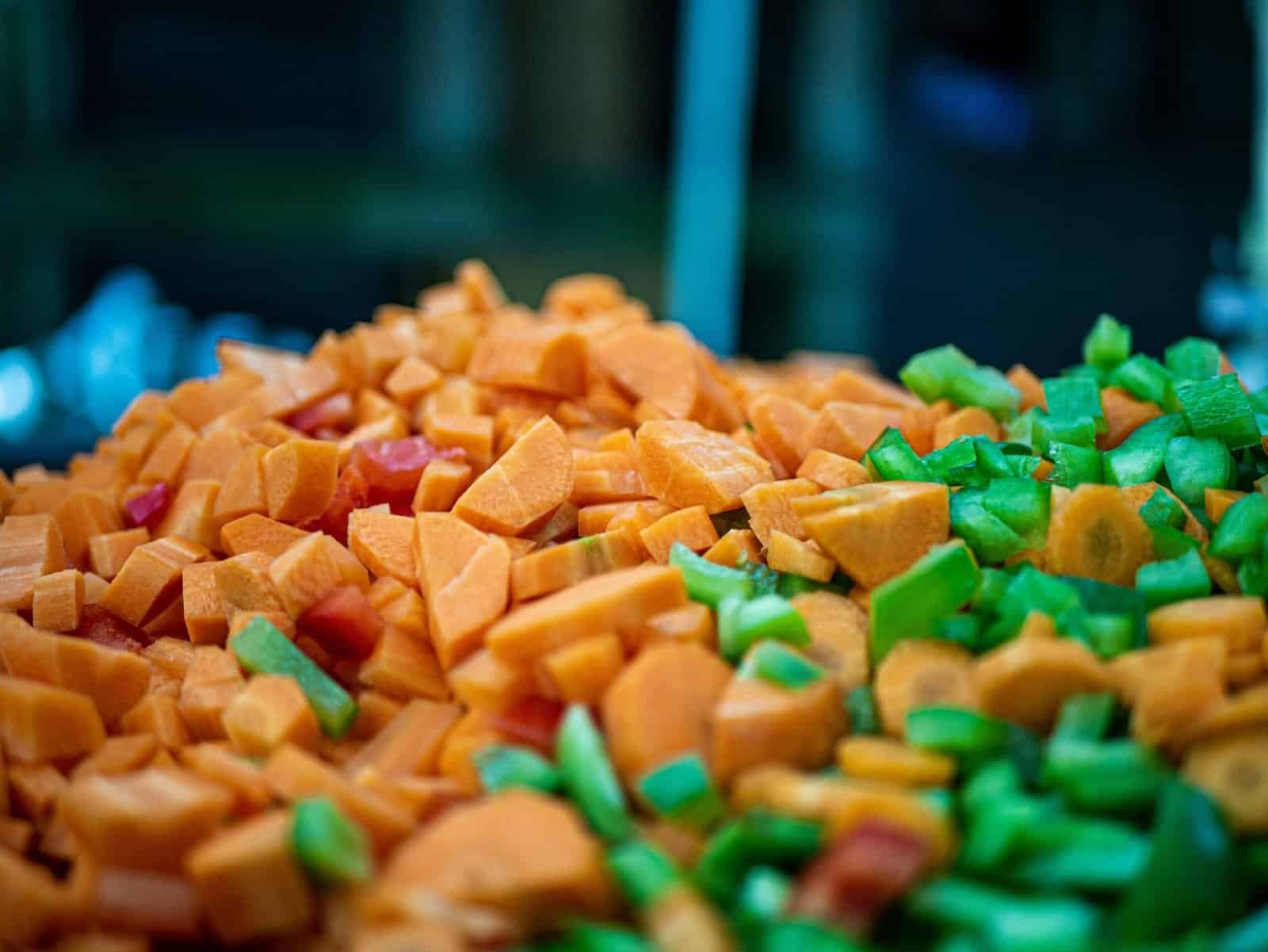
A vegetable chopper trades knife skill for a grid of blades, and whether that saves you time depends entirely on how many pieces you have to wash afterward. The best vegetable choppers and dicers split into six types, and the deciding factor is the volume you prep at once against the cleanup you will tolerate. A push chopper beats a knife on onions and loses to it on almost everything soft.
Uniform pieces are the real benefit, not raw speed. Vegetables cut to the same size cook at the same rate, which is why restaurant prep looks the way it does.
Onions are where most people start, and for good reason. Our piece on why onions make you cry covers why cutting fewer of them by hand appeals.
Quick Answer
Push-down grid choppers handle onions, peppers, and firm vegetables faster than a knife and are the sensible default. Mandoline-style slicers with dicing inserts add thickness control, pull-string choppers suit soft herbs and garlic, and rocking blades handle a board full at once. Spiralizers make noodles rather than dice, and food processors chop but rarely dice cleanly.
Key Takeaways
- Grid choppers dice firm vegetables well and turn soft ones to mush.
- Blade sharpness decides the result more than the mechanism does.
- Cleanup is the reason most choppers end up in a cupboard, so count the parts.
- A chopper that catches into a base container saves a separate bowl.
- Pull-string choppers are for small amounts of herbs, garlic, and nuts.
- No chopper beats a sharp knife on tomatoes or anything ripe and soft.
How We Picked
We compared chopper types rather than individual units, because lineups turn over while the cutting mechanisms stay the same. Each section covers one type and the prep it suits.
We ranked types on four things: how cleanly they cut firm and soft produce, how much force they need, how many parts need washing, and whether they store without taking over a drawer.
We excluded anything sold on piece count alone, and we have not stated dice dimensions, since grid sizes differ between makers.
1. Push-Down Grid Choppers
Why It Stands Out
A hinged lid presses produce through a blade grid and drops the dice into a container below. On onions, peppers, and carrots it is genuinely faster than a knife.
Catching the dice in the base is the underrated part. No board to scrape, no bowl to find.
Worth Knowing
Force is the limit. Hard carrots and raw sweet potato need real weight behind the lid, and some units flex under it.
The grid needs clearing with the included pick after every few pushes. A good cutting board still earns its place for the trimming beforehand.
Best for: Onions, peppers, celery, and weekly meal prep. Skip it for tomatoes and anything very ripe.
2. Mandoline-Style Slicers with Dicing Inserts
Why It Stands Out
A mandoline with interchangeable blades slices, juliennes, and dices from one frame. Thickness control is what sets it apart, since a grid chopper offers one size only.
Even slices matter for gratins, chips, and anything layered. Nothing else gets there as consistently.
Worth Knowing
These are the sharpest tools in this category and the ones that cause the injuries. Use the hand guard every time, including the last piece.
Blade changes add parts to wash and to store safely. Our guide to mandoline slicers covers the full range and the safety side.
Best for: Thin even slices and variable thickness. Skip it if you want one-handed speed with no setup.
3. Pull-String and Hand-Crank Choppers
Why It Stands Out
A cord or crank spins blades inside a small bowl, chopping garlic, herbs, nuts, and onion in seconds. It needs no power and washes in a sink.
The small bowl is the point. Small amounts get lost in a food processor and work perfectly here.
Worth Knowing
Texture control is limited, and one pull too many turns herbs into paste. Short pulls and checking between them is the technique.
Pull cords are the part that fails, so gentler cranked versions last longer. For garlic specifically, a garlic press is often quicker still.
Best for: Garlic, herbs, nuts, and small quantities. Skip it for anything you want in even cubes.
4. Rocking Blades and Mezzaluna Choppers
Why It Stands Out
A curved double-handled blade rocks across a board and chops a whole pile at once. For herbs, greens, and rough chopping it is fast and oddly satisfying.
There is almost nothing to clean, which is why these stay in rotation while gadget choppers do not.
Worth Knowing
It chops rather than dices, so pieces come out uneven. That suits soups and sauces and not a stir fry.
A deep board or a purpose-made bowl keeps things contained. Herb work often goes faster with herb scissors instead.
Best for: Herbs, greens, and rough chopping with minimal cleanup. Skip it if uniform cubes are the goal.
5. Spiralizers and Julienne Cutters
Why It Stands Out
Spiralizers turn firm vegetables into long strands, and julienne cutters produce matchsticks. Neither dices, and both solve a problem a chopper cannot touch.
Zucchini noodles and carrot ribbons are the obvious uses, and slaw is the underrated one.
Worth Knowing
Only firm dense vegetables work. Soft produce shreds rather than spiralizing, and short vegetables waste a lot as an end core.
Countertop models take real space for one job. Handheld versions store easily and take more effort, which is the usual trade with single-purpose gadgets.
Best for: Vegetable noodles, ribbons, and slaw. Skip it if you want dice or cubes.
6. Electric Choppers and Mini Food Processors
Why It Stands Out
A small motorized bowl handles onions, garlic, and herbs with a button instead of force. For anyone with wrist or grip problems, that matters more than speed.
Mini processors also emulsify dressings and make small batches of pesto, which widens the use case considerably.
Worth Knowing
Blades chop rather than dice, and the result is uneven with some pieces turning to liquid. Pulse rather than run it continuously.
It is another appliance on the counter with a motor to store. Our comparison of blender versus food processor covers where each one earns the space.
Best for: Hands-free chopping and small sauces. Skip it if you want clean even cubes.
Vegetable Choppers and Dicers at a Glance
| Type | Cut produced | Handles soft produce | Parts to wash | Best situation |
|---|---|---|---|---|
| Push-down grid | Even dice | Poorly | Several | Onions and meal prep |
| Mandoline with inserts | Slices, julienne, dice | Reasonably | Several | Even thickness work |
| Pull-string chopper | Rough chop | Yes | Few | Garlic and herbs |
| Rocking blade | Uneven chop | Yes | One | Herbs and greens |
| Spiralizer | Strands and ribbons | No | Few | Noodles and slaw |
| Electric mini chopper | Uneven chop | Yes | Few | Hands-free prep |
What to Look For in a Vegetable Chopper
What are you chopping most?
Onions, peppers, and carrots suit a grid chopper. Herbs and garlic suit a small pull chopper, and tomatoes suit a sharp knife and nothing else.
Buy for the thing you prep weekly rather than the widest range. Range is what fills drawers.
How many parts come apart?
Every chopper is a cleanup question first. Lid, grid, container, and pick means four items after a two-minute job.
Dishwasher-safe parts change the calculation, provided the blades survive it. Check that claim before relying on it.
How much force does it need?
Grid choppers need body weight for hard root vegetables, and a flimsy hinge flexes rather than cutting. Press the lid before buying if you can.
Anyone with grip or wrist limitations should look at electric or cranked designs instead. Force is the usual reason a chopper gets abandoned.
Where will it live?
Bulky choppers in a low cupboard do not get used. A drawer or a reachable shelf keeps a tool in rotation.
Storage is the quiet decider across most kitchen gadgets, and our guide to organizing a small kitchen covers the trade honestly.
How consistent does the dice need to be?
Stir fries and roasted vegetables want even pieces, because uneven ones burn at the edges while the middles stay raw. That is the case for a grid.
Soups, stews, and sauces forgive almost anything, since everything softens and breaks down anyway. A rough chop is fine there.
Match the tool to the dish rather than to the vegetable. The same onion wants different treatment in a salsa and a stock.
Can you sharpen or replace the blades?
Chopper blades dull like any others, and a dull grid needs far more force to push through. Most people mistake that for a design flaw.
Replacement grids and inserts exist for better units and not for cheap ones. That availability is what separates a three-year tool from a one-season one.
Mandoline blades are usually replaceable and worth replacing rather than sharpening. Grid blades generally are not sharpenable at home.
Chopper vs Sharp Knife
Where a chopper wins
Uniform dice, repeated volume, and onions without tears. On a weekly meal prep session the time saved is real.
It also produces consistent results regardless of skill, which a knife does not.
Where a knife wins
Soft produce, small amounts, odd shapes, and anything where you want to see what you are doing. There is one thing to wash and no grid to unclog.
A sharp knife is also faster than any chopper once you count setup and cleanup. Our guide to sharpening a knife covers keeping that advantage.
Common Vegetable Chopper Mistakes to Avoid
Chopping soft tomatoes in a grid
Ripe tomatoes collapse through a grid and come out as pulp. Firm plum tomatoes manage it, and anything softer needs a knife.
Overfilling the chamber
Too much produce at once jams the grid and needs far more force. Half loads cut cleaner and faster overall.
Leaving it to soak with the blades in
Soaking dulls edges and hides a sharp grid underwater. Rinse immediately and dry it instead.
Buying one to avoid knife skills
A chopper helps with volume, and it does not replace a sharp knife for everyday cooking. Our piece on looking after your knives covers the tool that still does most of the work.
Recommended Reading
- Chopping jalapenos without burning your hands covers the one vegetable where a chopper really helps.
- Box graters cover the shredding side of the same prep.
- Vegetable peelers cover the step before the chop.
Frequently Asked Questions
What are the best vegetable choppers and dicers?
Push-down grid choppers suit most kitchens, because they dice onions, peppers, and firm vegetables quickly and catch the result in a container. A mandoline with dicing inserts is the better pick when you need control over thickness, while a small pull chopper handles garlic and herbs.
Do vegetable choppers actually save time?
On volume, yes, and on a single onion the cleanup cancels most of the gain. The stronger argument is uniformity, since evenly cut pieces cook at the same rate.
Can you chop tomatoes in a vegetable chopper?
Firm plum tomatoes go through a grid reasonably well, and ripe ones turn to pulp. For anything soft, a sharp serrated knife gives a far better result.
Are vegetable choppers dishwasher safe?
Many are, though repeated dishwasher cycles dull blades faster than hand washing. Rinsing immediately after use is what keeps the grid clear and the edges keen.
What is the difference between a chopper and a food processor?
A chopper pushes produce through fixed blades and gives even dice, while a food processor spins a blade and gives an uneven chop. Processors handle far more volume and never produce true cubes.
Why is my chopper so hard to press?
Dull blades, an overfilled chamber, and dense root vegetables are the three causes. Halving the load usually fixes it, and if it does not, the blades have gone dull.
Do you need a spiralizer and a chopper?
They do different jobs entirely, since one makes strands and the other makes cubes. Only buy the spiralizer if vegetable noodles or slaw are something you will actually make.
Which chopper is best for weak grip or wrist pain?
Electric mini choppers and hand-cranked models need far less force than a push-down grid. Cranked designs also avoid the sudden pressure that a push chopper requires.
