
Four habits cover almost all of it: cut on a surface softer than the blade, store them so nothing touches the edge, sharpen before they feel dull, and dry them rather than letting water sit. A knife treated that way lasts decades.
Most damage comes from things that have nothing to do with cutting. Scraping a board with the edge, loose drawer storage, the dishwasher, and water left to dry on the steel all take more off a knife than ordinary use does.
Quick Answer
Use a wooden or plastic board, never glass or stone. Store on a strip, in a block, or in a guard rather than loose. Sharpen when the edge stops biting, and hone between times. Wash by hand and dry immediately, since standing water is what spots and pits steel.
Key Points
- Cutting surface matters more than any other single factor
- Scraping with the edge dulls knives without cutting anything
- Loose drawer storage chips edges over time
- Dishwashers shorten knife life more than use does
- Honing realigns an edge, sharpening removes steel
- Water left on steel causes spotting even on stainless
The Four Habits
| Habit | What it prevents | Effort |
|---|---|---|
| Soft cutting surface | Edge wear from every contact | One purchase |
| Protected storage | Chips and nicks between uses | One purchase |
| Hone and sharpen | Dullness and forced pressure | Minutes, occasionally |
| Hand wash and dry | Spotting, pitting, loose handles | Seconds per knife |
The Cutting Surface Decides Most of It
Every time a blade meets something harder than its own steel, the edge gives way rather than the surface. Glass, stone, ceramic, and metal all fall into that category and all of them dull a knife with each stroke.
Wood and plastic are softer than the blade, so the board takes the mark instead. That is the whole reason those two materials dominate, and board comparisons sit in cutting boards for home cooks.
Board weight matters for a different reason. A light board that slides makes control harder and encourages pressing down, and the fixes sit in stopping a board sliding.
The habit worth checking is how you clear the board. Dragging the sharpened edge sideways rolls the steel at its tip, and turning the knife over solves it, covered in scraping a board with your knife.
My Setup and Its Compromises
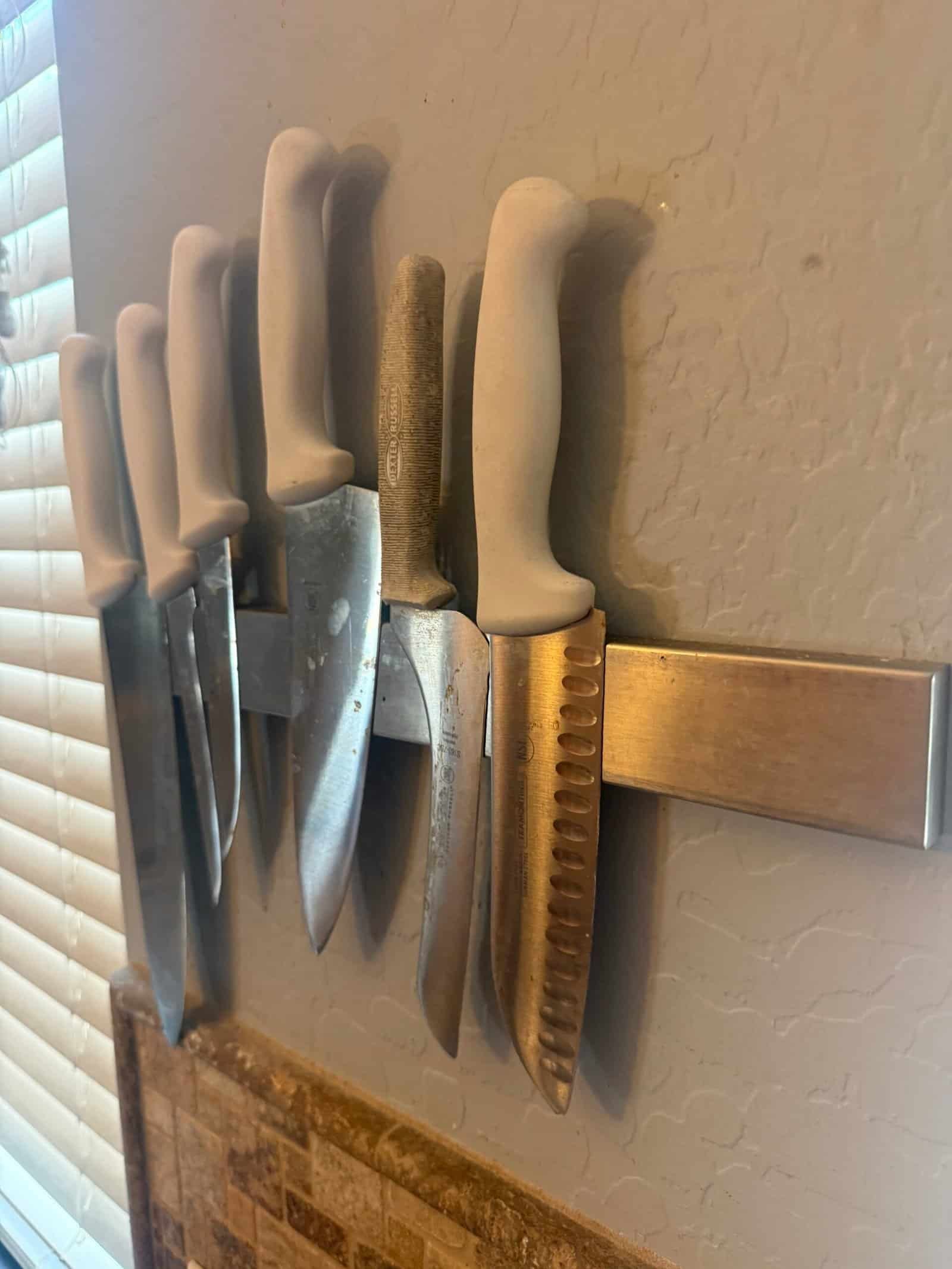
My cooking knives live on a magnetic strip on the wall next to the sink. My steak knives are stored somewhere else entirely, which works fine and is worth saying because a strip does not have to hold everything.
I used a block before that. The switch was about counter space and I have not wanted to go back, though the strip does throw glare from the blades next to the sink, which nobody mentions before you mount one.
I sharpen less than once a month, with an electric sharpener and nothing else. No honing steel, which I know is the gap in my routine rather than a considered choice.
The bigger compromise is the dishwasher. I rinse everything under running water and then it goes in, knives included, and they have spotted a bit as a result. That is the cost of the habit and I have accepted it rather than pretending it does not happen.
I hand dry them a bit and then let them air dry the rest of the way. Given the spotting, drying them fully by hand would probably be the better call.
My experience covers stainless knives on a wall strip in an apartment kitchen. It does not cover carbon steel, which needs far more attention to moisture, or Japanese knives with harder steel and thinner edges, where the tolerances are tighter.
Storage Protects the Edge
Loose in a drawer is the worst arrangement. Blades knock against each other and everything else, and each contact takes a small piece off the edge.
A magnetic strip keeps knives visible, accepts any blade, and costs no counter space, at the price of needing wall access and a drill. A block encloses the blades and consumes counter, and that comparison sits in strip against block.
Where neither works, in-drawer trays and blade guards keep edges separated. The full range sits in storing knives safely, with strip options in magnetic knife strips and blocks in knife blocks and storage.
Honing Against Sharpening
These are different operations and the distinction is the most useful thing to understand about knife care.
Honing realigns an edge that has bent to one side. It removes almost no steel, takes seconds, and restores sharpness immediately when bending is the problem. Method sits in using a sharpening steel.
Sharpening removes material to form a new edge. It is needed when the steel has genuinely worn rather than bent, and it should be occasional rather than routine. The process sits in sharpening a knife.
Honing frequently means sharpening rarely, which is why a steel is the tool most home kitchens are missing. Whether an electric sharpener is the right choice for the sharpening side sits in electric knife sharpeners, with options in knife sharpeners.
Knowing When to Sharpen
A sharp knife bites into a tomato skin under its own weight. One that slides across the surface needs attention.
Paper is the other common check. A sharp edge slices cleanly through a held sheet, and a dull one tears or catches. Both tests sit in telling if a knife is sharp.
The interval matters more than any schedule. A knife needing sharpening more often than it used to is telling you something about the steel, the angle you are sharpening at, or what it is meeting, covered in why knives get dull.
Washing and Drying
Hand washing is the recommendation and the reasons are specific. Dishwasher heat loosens handle joints, harsh detergent affects the finish, and blades knock against other items during the cycle.
Drying matters more than washing. Water left standing on steel causes spotting and eventually pitting, and stainless resists rust rather than being immune to it. The mechanism sits in why knives rust.
Plenty of people put knives in the dishwasher anyway, accepting the tradeoff. The full case sits in knives in the dishwasher, and rinsing habits are covered in whether to rinse before loading.
Steel Type Changes the Care
Stainless resists corrosion and holds an edge less long than harder steels. It suits people who want low maintenance and accept sharpening more often.
Carbon steel takes a finer edge and holds it longer, and it rusts readily and needs drying immediately every time. The comparison sits in stainless against carbon steel.
German and Japanese knives differ in hardness and edge angle, which changes both sharpening technique and how much abuse they tolerate. That sits in German against Japanese knives.
When Care Stops Being Enough
A knife that sharpens fine and dulls within days has soft steel, and no routine changes that. That is a replacement rather than a maintenance question.
Structural damage is the other case. A cracked or loose handle, a bent blade, a chip deep enough to need reshaping, or corrosion pitted into the steel all end a knife’s usable life. The thresholds sit in how often to replace kitchen knives.
Dullness is never on that list. A knife dull for years is almost always recoverable, and choosing a replacement when one is genuinely needed sits in choosing a kitchen knife.
Related Reading
- sharpening technique
- storage that protects edges
- what causes dullness
- when a knife is finished
- the knife you use most
- knives that live elsewhere
Frequently Asked Questions
How often should I sharpen my knives?
When the edge stops biting rather than on a schedule. For most home kitchens that works out to a few times a year with regular honing, and more often without it.
What is the difference between honing and sharpening?
Honing realigns an edge that has bent to one side and removes almost no steel. Sharpening removes material to form a new edge. Honing often means sharpening rarely.
Can I put knives in the dishwasher?
Most guidance says no, since heat, detergent, and contact with other items dull edges and loosen handles. Plenty of people do it anyway, and spotting on the blades is the usual visible cost.
What cutting board is best for knives?
Wood or plastic, since both are softer than the blade. Glass, stone, and ceramic are harder than knife steel and take a small amount off the edge with every stroke.
Why do my stainless knives spot?
Stainless resists corrosion rather than being immune to it, and water left standing on the steel causes spotting and eventually pitting. Drying immediately after washing prevents it.
Is a magnetic strip or a block better?
A strip saves counter space and accepts any blade, and it needs wall access. A block encloses blades and suits renters and homes with children, at the cost of counter space.
When should I replace a knife instead of maintaining it?
When the handle is cracked or loose, the blade is bent, a chip needs reshaping, or corrosion has pitted the steel. Dullness alone is almost never a reason to replace.
Knife care sits alongside every other kitchen decision. arranging a kitchen covers storage and layout.
