
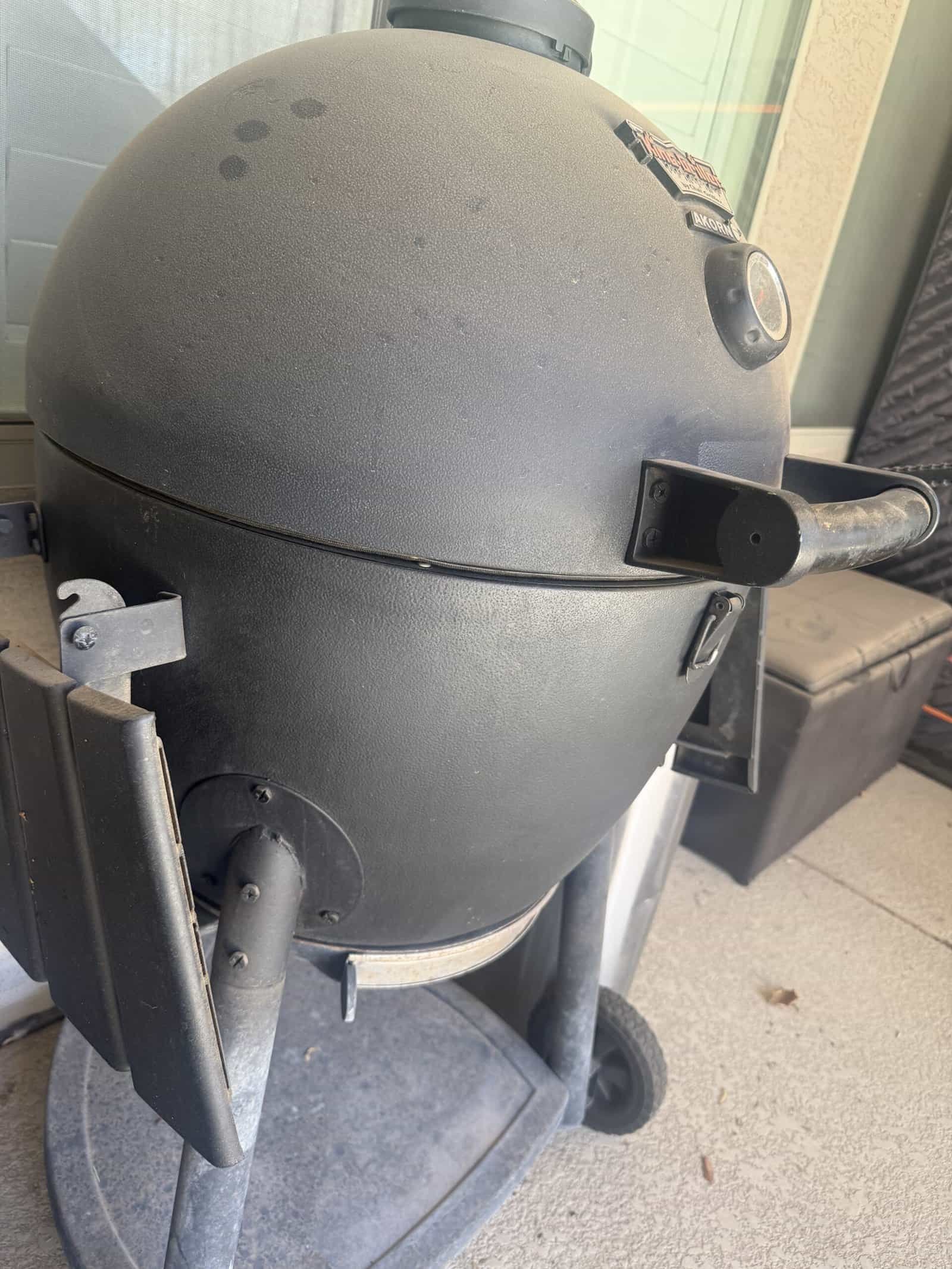
Close the top and bottom vents completely and leave the lid down, and the fire goes out on its own once the trapped oxygen is used up. That is the whole of how you shut down a kamado grill, and the reason it works is that a kamado seals well enough to starve its own fire.
Nothing gets poured on the coals and nothing gets removed while hot. Our guide to controlling temperature on a charcoal smoker covers the same vents doing the opposite job.
Quick Answer
Shut the bottom vent first, then the top, then leave the lid closed. The fire dies within minutes and the cooker stays hot for hours afterward. Do not use water, do not open the lid to check, and do not empty the ash until everything is cold. Unburned charcoal that is left in the firebox can be lit again next time.
Key Takeaways
- Closing both vents cuts the air supply and the fire goes out by itself.
- Bottom vent first, then top, then lid down and walk away.
- Water inside a kamado is the one thing to never do.
- The body holds heat for hours after the fire is out.
- Leftover charcoal is reusable, so there is no reason to burn it off.
- Ash and grate work waits until the cooker is fully cold.
| Step | What to do | Why |
|---|---|---|
| 1 | Close the bottom vent | Stops incoming air at the source |
| 2 | Close the top vent | Stops the draw that pulls air through |
| 3 | Leave the lid shut | Any opening restarts the fire |
| 4 | Walk away | The fire dies on its own in minutes |
| 5 | Wait until cold | Ash, grates and hardware all wait |
Why Closing the Vents Is Enough
A charcoal fire needs three things and a kamado lets you remove exactly one of them. Fuel and heat are already there, so air is the lever.
The bottom vent is where combustion air enters and the top vent is what pulls it up through the charcoal. Shut both and the draw stops.
What remains inside is a small volume of air that the coals consume quickly. After that there is nothing left to burn with, and the fire goes out whether you watch it or not.
This is also why a kamado uses so much less fuel than an open grill. The same seal that lets you extinguish it on purpose is what stops it wasting charcoal during a cook.
The Order That Matters
Bottom vent first
Closing the intake before the exhaust means the fire has nothing new coming in while the remaining air clears out. Doing it the other way round traps a hot pocket with air still available.
Top vent second
With the bottom shut, closing the top removes the chimney effect. Both closed is what actually ends it.
Lid stays down
Opening the lid to look is the most common way people restart a fire they were trying to put out. A lungful of fresh air on hot coals is all it takes.
Nothing else happens yet
Grates, ash and any accessories stay where they are. Our guide to cleaning a kamado grill covers what to do once it is cold.
Three Years of Shutting Mine Down
Mine is a Char-Griller Akorn I have had for over three years, and it burns charcoal. I close both vents and leave it.
The leftover charcoal gets reused sometimes. It depends.
What has changed over three years is the hardware. The grates and everything else have become noticeably harder to open, gradually enough that I only notice it by comparison.
Anything harder to open is something you handle less willingly, and cleanup is already the part I like least. If I were doing it again I would treat the hinges, latches and vent hardware as maintenance items from the first year rather than waiting for them to stiffen.
What to Do About the Leftover Charcoal
Unburned charcoal is not waste. Closing the vents while there is fuel left is the normal way a kamado cook ends, and that fuel lights again next time.
Leave it in the firebox. Moving hot charcoal into a bucket is a fire risk and there is no benefit to it.
Next cook, add fresh charcoal on top of what is already there and light through the new layer. Old charcoal on the bottom still burns.
The one thing worth doing before relighting is clearing ash from underneath, since ash blocks the airflow the fire depends on. That is the same reason ash matters for temperature control in the first place.
How Long It Stays Hot
The fire going out and the grill being cool are two different events separated by a long gap. A kamado is built to hold heat, so it does.
Insulated steel and ceramic both stay warm for hours after the coals die. The thicker the body, the longer it takes.
That has a practical consequence: the lid, hinge and vent hardware are hot long after the fire is dead. Our roundup of oven mitts and pot holders covers the heat protection worth having within reach.
It also means you cannot rush the ash. Trying to empty a warm firebox puts hot ash into a container that is not built for it.
Mistakes That Cost You Fuel or Hardware
- Pouring water on the coals. Thermal shock cracks ceramic and warps steel, and it turns ash into a paste that sets hard.
- Opening the lid to check. Fresh air on hot charcoal restarts what you just stopped.
- Leaving a vent slightly open. A partly open vent lets the fire smolder on and burn through fuel you wanted to keep.
- Removing the charcoal while hot. There is no reason to, and it is the riskiest thing you can do at the end of a cook.
- Scraping grates cold. Burning the grates clean at the end of a cook is easier than scrubbing them later.
- Forgetting the hardware. Hinges and vent threads live through every heat cycle, and they seize if nothing is ever done about them.
Our roundup of wire cleaning brushes covers the grate side, and our guide to how long a kamado grill lasts covers what the heat cycles do to everything else over the years.
If You Are Weighing a Kamado Against Something Else
Shutdown is one of the genuine advantages here. A pellet grill runs a cooldown cycle on electricity and a gas grill simply turns off, but neither saves you unused fuel the way a sealed charcoal cooker does.
It also means walking away is allowed. There is no shutdown sequence to babysit and nothing to unplug.
Our guide to whether a kamado grill is worth it weighs that against the learning curve, and our roundup of pellet grills covers the set-and-forget alternative.
Recommended Reading
Frequently Asked Questions
How do you shut down a kamado grill?
Close the bottom vent, then the top vent, then leave the lid down. The fire runs out of oxygen within a few minutes and goes out by itself. Nothing else is needed, and the cooker will stay hot to the touch for hours afterward.
Can you put water on a kamado grill to put it out?
No. Water inside a kamado is the one thing to avoid completely. It thermally shocks the body, which cracks ceramic and warps steel, and it turns loose ash into a hard paste that is far worse to remove than dry ash.
How long does it take for the fire to go out?
The flame is out within minutes of both vents closing, because the sealed body holds only a small volume of usable air. The cooker itself is a different matter and stays warm for several hours depending on how thick the walls are.
Can you reuse the charcoal left in a kamado?
Yes, and that is the normal way to do it. Unburned charcoal relights without any problem. Add fresh fuel on top and light through the new layer, and clear the ash out from underneath first so airflow is not blocked.
Should you leave the vents slightly open?
No. A vent left cracked open keeps a slow fire alive, which burns through charcoal you meant to save and leaves the cooker hot much longer. Both vents fully closed is the point of the method.
Do you need to clean it before shutting down?
Burning the grates off at the end of a cook is worth doing while the fire is still up, since heat does most of the work. Everything else, including ash and any scraping, waits until the grill is completely cold.
Is it safe to leave a kamado unattended after closing the vents?
Once both vents are shut and the lid is down, the fire has no air supply and dies on its own. Keep it clear of anything flammable while it cools, as the exterior stays warm for hours even after the coals are dead.
What if the fire will not go out?
Check that both vents are fully seated rather than nearly closed, since a warped or ash-blocked vent can leave a gap. A worn gasket also lets air in around the lid, which is one of the first parts to degrade with age.
