
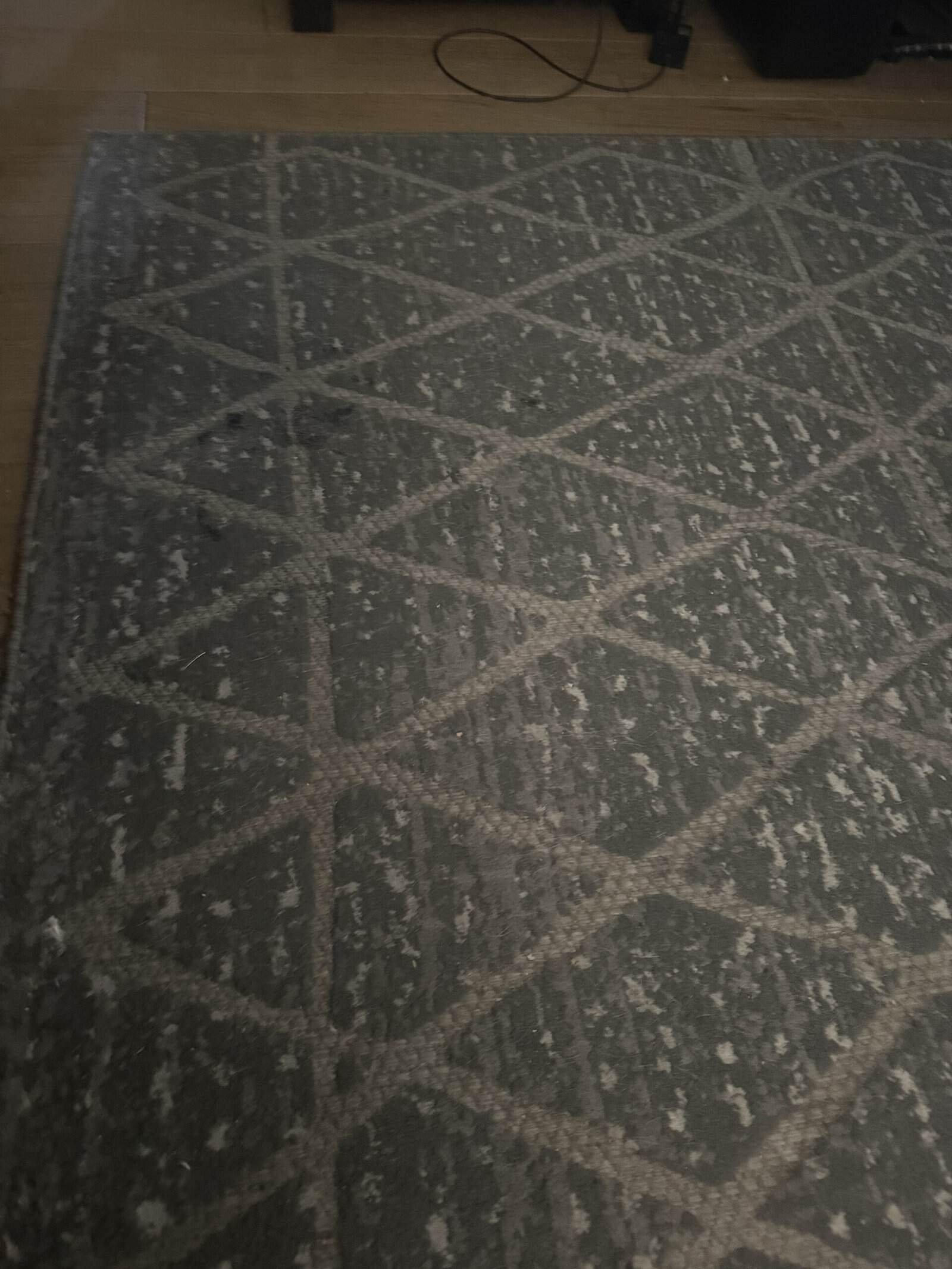
Most living room rugs are too small. The instinct is to buy something that sits in the middle of the seating area like a mat, and the result reads as undersized no matter how good the rug is.
Mine is very big and covers most of the room easily, with the coffee table sitting on it and hardwood underneath. Going large is the version that works, and it is the one people talk themselves out of. Our roundup of couch covers covers the furniture side.
Quick Answer
Pick the largest size that leaves a consistent border of bare floor around the edges. Front legs of seating on the rug at minimum, all legs if the room allows. Once the size is settled, our roundup of area rugs for living rooms covers the materials and pile heights that suit the room.
To check your own room against the standard rug sizes, the calculator below works from your measurements.
Three Approaches
| Layout | What it looks like | Best for |
|---|---|---|
| All legs on | Rug extends under every piece | Large rooms, most cohesive |
| Front legs on | Seating anchored at the front edge | Medium rooms, most common |
| All legs off | Rug floats between furniture | Small rooms only, reads as a mat |
| Near wall-to-wall | Border of floor all around | What I have, works well |
| Layered | Small rug over a large neutral | Adding pattern without commitment |
| Under the table only | Coffee table island | Rarely looks intentional |
Why Too Small Is the Default Mistake
Rug prices climb steeply with size, and the jump between a medium and a large is enough to make people reconsider at the exact moment they should not.
A rug that only reaches the coffee table divides the room visually rather than tying it together, because the seating is standing on bare floor around an island of textile.
Larger rugs make a room look bigger for the same reason a large mirror does. The eye reads the uninterrupted surface as more space rather than less.
Mine covers most of the room with a border of hardwood showing around it, and that is the arrangement that reads as intentional rather than as a rug that did not quite fit.
Buying up a size is the advice almost every furnishing guide gives, and it is the one people ignore most consistently. Our roundup of console tables covers the surrounding pieces.
The Furniture Leg Rules
All legs on
Every piece sits fully on the rug. The most cohesive look and the largest rug.
Front legs on
Front legs of seating on the rug, back legs on the floor.
All legs off
Only the coffee table on the rug. Works in small rooms and rarely elsewhere.
Mixing them looks wrong
Pick one and apply it to every piece in the group.
Leaving a Border of Floor
A rug should not run wall to wall, because at that point you have carpet rather than an area rug and the effect changes entirely.
Leaving a consistent border of bare floor around the edges is what defines the rug as a deliberate element, and consistency matters more than the exact measurement.
Uneven borders are what make a room look off without anyone identifying why, since one side showing considerably more floor than the other reads as misplaced.
Mine leaves hardwood visible around the edges, which is the arrangement I would recommend to anyone with a room that allows it.
In a very small room the border shrinks and the principle holds, since even a narrow strip of floor does the job. Our roundup of cordless vacuums covers cleaning both surfaces.
Standard Sizes and What They Suit
Area rugs come in a fairly narrow set of standard dimensions, and knowing which ones suit which rooms saves a lot of measuring.
Smaller rectangular sizes work in apartments and reading corners, and they are the sizes people buy for living rooms where they should be going larger.
Mid-size rectangles suit most standard living rooms on the front-legs-on arrangement, which is the most common layout in practice.
Large rectangles are what an all-legs-on layout requires, and they are the sizes that make a room feel finished.
Runners and rounds have their own uses and rarely serve as the main living room rug. Our roundup of entryway mats covers smaller formats.
Measure With Tape on the Floor
Rug dimensions on a listing mean very little until you see them in the actual room, and the difference between two adjacent sizes is easy to underestimate on a screen.
Painter’s tape on the floor marking the outline costs nothing and takes five minutes, and it shows immediately whether the furniture arrangement works.
Doing that with the furniture in place rather than pushed aside is the version that tells you something useful.
Walking the room afterward matters too, since a rug edge in a traffic path is a trip hazard and an area that wears faster.
That test also catches door clearance problems, which are considerably easier to find before the rug arrives than after.
Shape and Room Proportion
Rectangular rugs suit rectangular rooms, which covers most living rooms, and orienting the long dimension along the long wall is the default.
Square rugs suit square rooms and look awkward in long narrow ones.
Round rugs work under round tables and in corners rather than as the main anchor of a seating arrangement.
Open plan spaces frequently want the rug to define the seating zone rather than fill the room, which is a different job from what a rug does in an enclosed room.
In that case the rug boundary becomes the room boundary, and sizing it to the furniture group matters more than sizing it to the walls. Our roundup of robot vacuums covers navigating open layouts.
Pile Height and Practicality
Pile height is how long the fibers are, and it affects everything about living with a rug rather than how it looks from across the room.
Low pile means short fibers and a thinner rug, which vacuums easily, lets doors clear, and does not shift under furniture.
High pile is softer underfoot and considerably harder to clean, and furniture legs sink into it and leave marks that take time to recover.
Mine is not thick, which is why the coffee table sits on it without any of the instability that a plush rug causes.
For a room with furniture on the rug, lower pile is the practical answer regardless of how a thicker one feels. Our roundup of robot vacuum and mop combos covers hard floors and rugs together.
A rug is one of the larger decisions in a room and it interacts with everything else you put down. Our note on organizing an entryway covers the adjoining space where flooring transitions matter.
What to Check Before Buying
Which leg rule you are using
That decides the size more than the room does.
The border on all four sides
Consistent matters more than wide.
Door clearance
Easier to check before the rug arrives.
Pile height against your furniture
Furniture on a thick rug sits unevenly.
Common Mistakes to Avoid
Buying a size down to save money
The undersized rug is the most common living room mistake by a distance.
Uneven borders
One side showing much more floor than the other reads as misplaced.
Mixing leg rules within a seating group
Pick all legs on or front legs on and apply it to everything.
High pile under furniture
Legs sink in, the piece sits unevenly, and the marks take time to recover.
Recommended Reading
See our note on whether furniture should sit on an area rug, our note on keeping a rug from sliding, our roundup of entryway lighting, and a roundup of shoe racks.
Living Room Rug Size FAQ
What size rug for a living room?
The largest that leaves a consistent border of bare floor around the edges. Front legs of seating on the rug at minimum, all legs if the room allows.
What do you have?
A very big one that covers most of the room easily, with the coffee table on it and hardwood showing around the edges.
Should the couch sit on the rug?
Front legs at minimum. All legs looks the most cohesive and needs a larger rug. Only the coffee table on it reads as undersized in most rooms.
How much floor should show?
Enough to define the rug as a deliberate element, and consistent on all four sides. Uneven borders are what make a room look off.
Can a rug be too big?
Wall to wall stops being an area rug and becomes carpet. Short of that, larger is almost always the better call.
Does pile height matter?
For a room with furniture on the rug, yes. Low pile vacuums easily, lets doors clear, and holds furniture level. High pile lets legs sink in. For a room with a real traffic path, our roundup of low pile rugs for high traffic covers density and fiber choice.
How do I check a size before buying?
Painter’s tape on the floor marking the outline, with the furniture in place. It takes five minutes and catches door clearance problems too.
What shape should I get?
Rectangular for rectangular rooms, oriented with the long dimension along the long wall. That covers most living rooms.
