
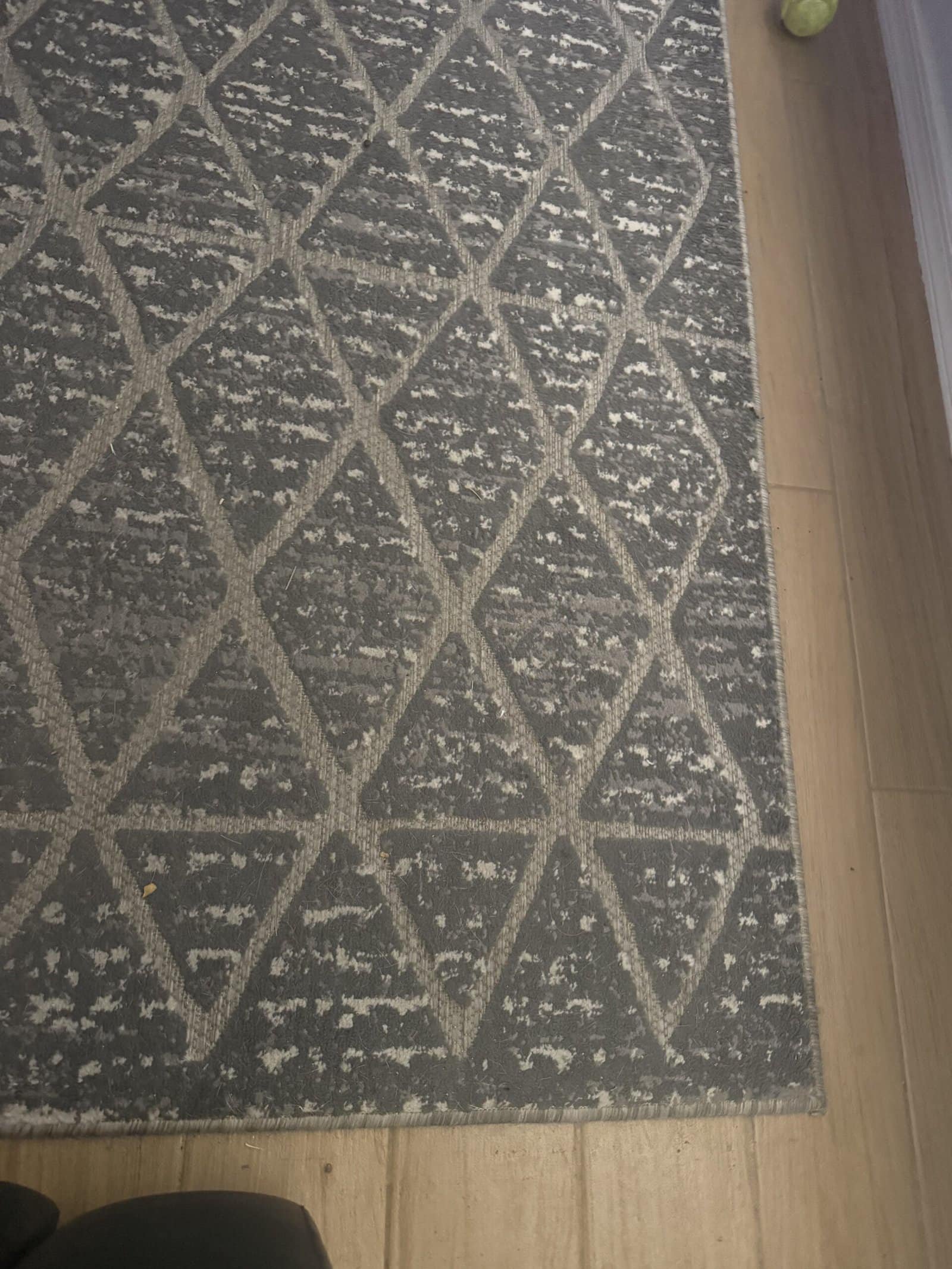
High traffic destroys rugs in one very specific way. Fibers crush flat along the exact path people walk, and once they have crushed they rarely come back up, which is why a traffic lane becomes clearly visible long before anything on the rug actually looks dirty.
Low pile resists that better than anything else available, simply because there is a great deal less fiber there to crush in the first place. Mine is not thick at all, sits over hardwood with the coffee table on top of it, and holds up without any visible tracking so far. Our note on rug sizing covers the other half of the decision. Pile height is what decides whether a robot copes, as our guide to robots on carpet explains.
Types at a Glance
| Type | Best for | Limitation |
|---|---|---|
| Low pile synthetic | General traffic, easy cleaning | Less soft underfoot |
| Flatweave | Thinnest, reversible | No cushioning at all |
| Low pile wool | Recovers from crushing | Cost |
| Indoor-outdoor | Entryways, spills, pets | Rougher texture |
| Washable low pile | Households with accidents | Thin, needs a pad |
| Patterned low pile | Hiding wear and marks | Harder to match a room |
How We Picked
Selections are grouped by construction and fiber, since those determine how a rug handles sustained foot traffic rather than how it looks when new.
Descriptions come from documented product characteristics alongside my own use of a low-pile rug in a room with furniture on it.
1. Dense Low-Pile Synthetic, Best Overall
Why It Stands Out
Density matters more than material for traffic resistance, and a tightly constructed synthetic holds up remarkably well for the price.
Vacuums in one pass, holds furniture level, and lets doors clear without any thought.
Worth Knowing
Quality varies enormously within this category, and cheap versions crush quickly.
The test is whether you can part the fibers to see the backing. Our note on furniture on rugs covers stability.
This suits most living rooms. Skip it if underfoot softness matters more.
2. Flatweave, Best for Thin Clearance
Why It Stands Out
Almost no height at all, which solves door clearance problems no other rug type can.
Reversible on many designs, so a worn side can simply be flipped.
Worth Knowing
Zero cushioning, so it feels exactly like the floor underneath.
Slides freely without a pad or furniture. Our note on keeping a rug from sliding covers that.
This suits tight doorways. Skip it where comfort matters.
3. Low-Pile Wool, Best for Recovery
Why It Stands Out
Wool fibers have natural crimp that springs back after compression, which means traffic paths recover rather than becoming permanent.
Naturally stain resistant because of how the fiber is structured.
Worth Knowing
Considerably more expensive, and it sheds noticeably for the first few months.
Professional cleaning is generally advised. Our guide on what size area rug a living room needs covers choosing one.
This suits a long-term rug. Skip it on a budget.
4. Indoor-Outdoor, Best for Abuse
Why It Stands Out
Built for weather, which means it shrugs off spills, mud, and sun in a way indoor rugs do not.
Hoses clean, dries quickly, and resists fading.
Worth Knowing
Rougher underfoot than an indoor rug, since the fibers are chosen for durability.
Limited style range. Our roundup of entryway mats covers the same territory in smaller sizes.
This suits entryways and pets. Skip it in a formal room.
5. Washable Low Pile, Best for Households With Accidents
Why It Stands Out
Goes in a household machine, which changes the calculation entirely in a home with pets or young children.
Frequently sold as a thin rug over a separate grip pad.
Worth Knowing
Thin by design, since it has to fit a washer drum.
Check your machine capacity before buying large. Our roundup of vacuum and mop combos covers between-wash upkeep.
This suits messy households. Skip it if you want substance.
6. Patterned Low Pile, Best for Hiding Wear
Why It Stands Out
Pattern disguises both crushing and soiling, which is why commercial spaces use it almost exclusively.
A busy design hides a traffic path that would be obvious on a plain rug.
Worth Knowing
Harder to match to existing furniture than a solid.
Strong patterns date faster. Our roundup of console tables covers coordinating pieces.
This suits busy households. Skip it in a minimal room.
Density Beats Pile Height
Low pile is the headline specification and density is what actually determines how long a rug survives traffic.
Density means how much fiber actually sits per square inch of rug, and a dense low-pile rug will outlast a sparse one of exactly the same height by years.
The test itself takes about a second. Part the fibers with your fingers and look at how easily the backing shows through underneath. Backing that becomes visible under light pressure means sparse construction.
Weight is a reasonable proxy to go on when buying online, since a denser rug of exactly the same dimensions will weigh noticeably more than a sparse one.
That is also why two rugs described identically can perform completely differently, and why cheap low-pile rugs develop visible paths within a year. Our note on organizing an entryway covers reducing what reaches the rug.
Why Low Pile Suits Furniture
Legs stay level
Nothing sinks, so tables do not rock.
Dents recover faster
Less fiber to crush means less to bounce back.
Doors clear properly
Thickness is the thing that stops a door opening.
Vacuums in one pass
Deep pile bogs down beater bars and robot vacuums alike.
Where the Traffic Actually Goes
Every room has a path, and knowing where yours runs changes which rug makes sense before you look at any specification.
The route between a doorway and the seating is the heaviest lane in most living rooms, and it takes several times the footfall the rest of the rug sees.
A rug positioned so that path crosses one edge wears unevenly and looks worn while most of the rug is untouched.
Positioning it so the path crosses the middle spreads that wear across more area, which is counterintuitive and produces a rug that ages evenly.
Rooms with two doorways have two paths that intersect somewhere, and that intersection is where wear concentrates fastest regardless of what you put down. Our note on entryway lighting covers arranging around it.
Fiber Choice for Traffic
Polypropylene is the most common synthetic in low-pile rugs and it resists staining and moisture well while feeling less pleasant than alternatives.
Nylon is more resilient and springs back from compression better, which makes it the better synthetic for heavy traffic despite costing more.
Polyester feels softer and crushes more readily, which makes it a poor choice for a path people walk daily.
Wool outperforms all of them on recovery and costs accordingly.
For a room with real traffic, nylon or wool are the fibers that hold up, and polypropylene is the value compromise. Our roundup of cordless vacuums covers maintenance.
Maintenance That Extends Life
Vacuuming regularly does more for a rug’s lifespan than anything else you can do, because grit trapped down in the base of the fibers cuts at them from below every time somebody walks across.
Rotating the rug periodically moves the traffic path onto a different section, which spreads wear rather than concentrating it.
A pad underneath absorbs compression that would otherwise grind fibers against a hard floor.
Entry mats cut down how much grit arrives on the rug in the first place, and that is easily the cheapest intervention available to you.
Addressing spills quickly matters more on synthetic than wool, since wool has natural resistance that buys you time. Our roundup of rug pads covers the layer underneath.
Backing and How It Fails
The backing is the part nobody inspects and the part that decides whether a rug survives to its second decade.
Tufted rugs have fibers punched through a foundation and held with adhesive, and that adhesive eventually breaks down, which is what causes shedding that never stops.
Woven rugs have the fibers integrated into the structure rather than glued in, so there is no adhesive layer to fail in the first place.
Latex backings stiffen and crack with age, and a rug that has gone crunchy underfoot is telling you the backing has failed even though the surface looks fine.
Checking the underside before buying is worth doing where you can, since a visible grid of adhesive-held tufts is a different product from a woven structure at the same price. Our roundup of coat racks and hooks for entryways covers protecting whatever backing you end up with.
What to Look For
Density over pile height alone
Part the fibers and see how easily the backing shows.
Nylon or wool for real traffic
Both recover from compression better than polyester.
Pattern if the path is obvious
It hides crushing and soiling considerably better than a solid.
Washable if accidents happen
The category changes what is practical in a pet household.
Common Mistakes to Avoid
Buying low pile without checking density
A sparse low-pile rug develops a visible path within a year.
Polyester in a traffic path
It feels softer in the store and crushes faster in use.
Pale solids in a busy room
Every mark shows, and the traffic lane becomes obvious quickly.
Never rotating it
Wear concentrates in one strip that could have been spread across the whole rug.
Recommended Reading
See our roundup of robot vacuums, our roundup of shoe racks, our roundup of couch covers, and a roundup of entryway storage.
Low Pile Rug FAQ
What is low pile?
Short fibers, which means a thinner rug. It vacuums easily, holds furniture level, and lets doors clear without adjustment.
What do you have?
A large low-pile rug over hardwood with the coffee table on it. The table sits level and the rug has never slid.
Does low pile last longer in traffic?
Generally yes, because there is less fiber to crush. Density matters more than height though, and a sparse low-pile rug wears fast.
How do I judge density?
Part the fibers with your fingers. If the backing shows through easily, construction is sparse. Weight is a reasonable proxy when buying online.
Which fiber holds up best?
Wool for recovery, nylon as the best synthetic, polypropylene as the value option. Polyester feels softer and crushes faster.
Does pattern help?
Considerably. It disguises crushing and soiling, which is why commercial spaces use patterned carpet almost exclusively.
Do I still need a pad?
For grip on hard floors unless furniture holds the rug, and for cushioning that stops fibers grinding against the floor.
What extends the life most?
Regular vacuuming, since grit at the base of the fibers cuts them from below. Rotating the rug spreads wear rather than concentrating it.
