
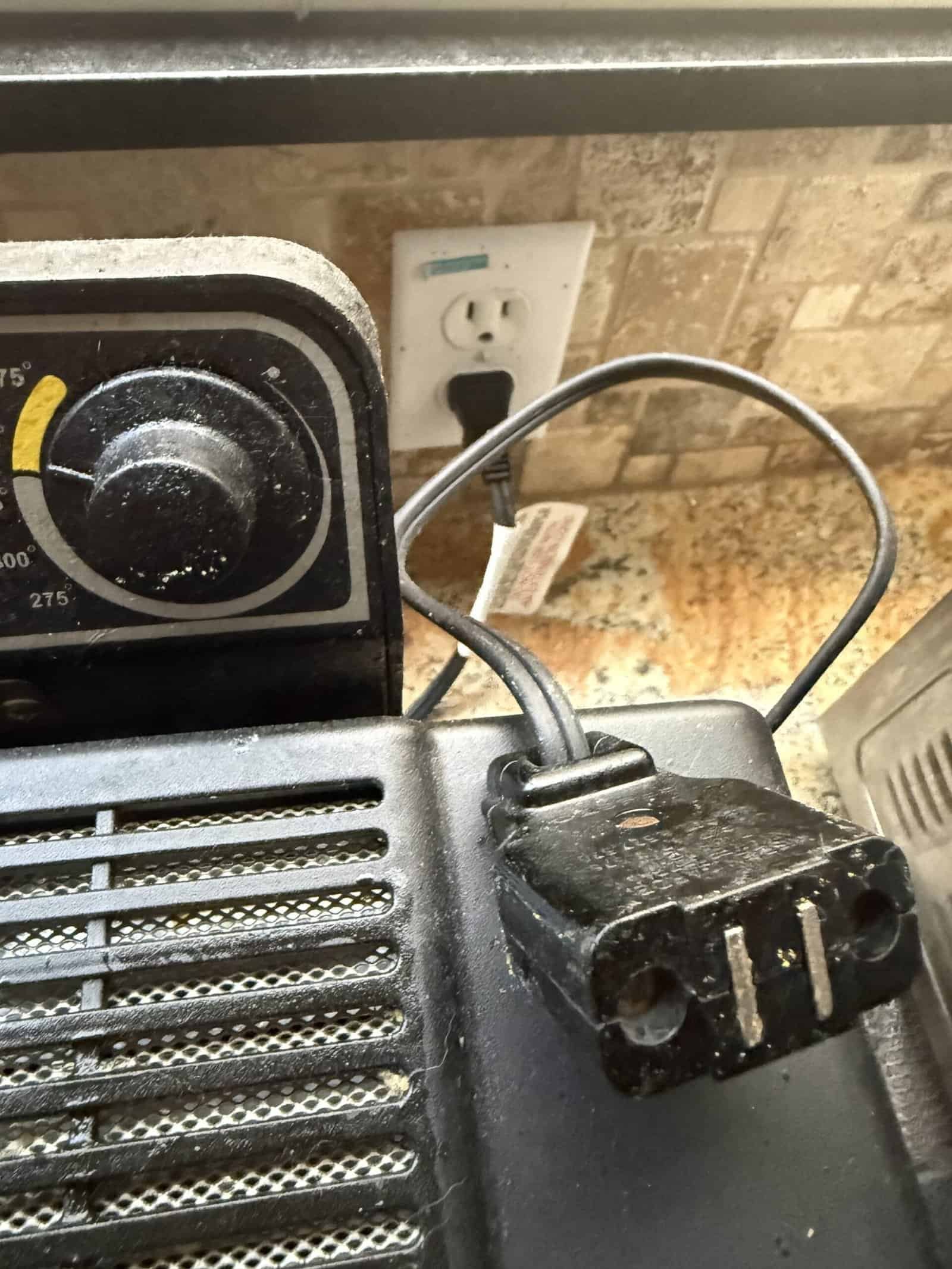
A deep fryer is one of the highest-draw appliances in a kitchen, because heating oil to frying temperature and holding it there takes sustained power. Put a second heating appliance on the same circuit and the breaker does exactly what it is designed to do.
Mine trips if anything else goes into the same outlet. I am careful now to never plug anything in alongside it, and that has been the whole fix. Our roundup of deep fryers covers the machines. Our note on the reset button on a deep fryer covers that in more detail.
A Safety Note
A breaker tripping is a protective system working correctly. Repeated tripping, an outlet that gets warm, scorch marks, a burning smell, or a receptacle that needs replacing are different, and those are signs to stop using the outlet and have an electrician inspect it. Do not run a high-draw appliance on an extension cord or a power strip.
Quick Answer
Deep fryers draw heavily and sustain that draw. Two heating appliances on one circuit exceeds what it can supply, and the breaker cuts power before the wiring overheats.
What Draws What
| Appliance | Draw | Shares a circuit well |
|---|---|---|
| Deep fryer | Very high, sustained | No |
| Air fryer | High | No |
| Kettle or toaster | High, brief | Not with a fryer |
| Microwave | High | No |
| Slow cooker | Low | Usually fine |
| Lighting, phone chargers | Negligible | Fine |
Why Heating Appliances Are Different
Anything that produces heat from electricity converts nearly all the power it draws into heat, which is why heating elements dominate a household’s peak demand.
A fryer also holds temperature rather than reaching it and stopping, so it cycles back on repeatedly through a cooking session.
That sustained draw is what separates it from a blender or a mixer, which pull hard briefly and then stop.
Two such appliances together will exceed a standard kitchen circuit, and the breaker interrupting that is the correct outcome rather than a fault. Our note on cleaning a deep fryer covers the machine itself.
What Happens With Mine
It trips when a second thing is plugged into the same outlet, which is a straightforward overload rather than anything unusual about the fryer.
What was not straightforward is that the outlet itself has needed replacing, twice.
A breaker tripping is normal and protective. An outlet degrading to the point of replacement is not, and it points at heat or a poor connection at the receptacle rather than at the appliance.
My approach since has been to keep that outlet for the fryer alone, and anyone in the same position should treat repeated receptacle failure as a reason to get the circuit looked at rather than a quirk to work around. Our note on countertop appliances worth the space covers what else is competing for outlets.
Why It Trips Partway Through Cooking
The timing of a trip tells you something, and mid-session is the most common pattern.
A fryer draws hardest while bringing oil up to temperature, then settles into cycling on and off to hold it there.
Adding cold food drops the oil temperature sharply, which sends the element back to full draw at exactly the moment you are least expecting it.
If something else on the circuit happens to cycle on at the same time, that overlap is where the total crosses the limit.
That is why a setup can work fine for twenty minutes and then trip, and why people conclude the fault is intermittent when the load pattern simply changed. Our note on reusing frying oil covers the cooking side.
Circuit Versus Outlet
A circuit serves several outlets
Kitchen outlets are frequently grouped, so two sockets on opposite walls can be the same circuit and moving the plug changes nothing.
The breaker protects the wiring
It trips based on total current through the circuit, not on what any one appliance is doing.
A duplex outlet is one point
Both halves of a standard wall socket feed from the same connection, so using the second half does not spread the load.
Dedicated circuits exist for this
Some kitchens have circuits serving one outlet only, which is where a high-draw appliance belongs. Our note on cleaning up after deep frying covers the rest of the process.
Why Extension Cords Make It Worse
An extension cord adds resistance, and resistance in a high-current circuit produces heat along the cord rather than at the appliance.
Power strips are worse still, because they invite exactly the thing that causes the problem, which is plugging a second appliance in alongside.
Many strips are not rated for sustained high-current loads, and the internal connections are the weak point rather than the cable.
Manufacturers say to plug high-draw appliances directly into a wall outlet, and that instruction is about fire rather than performance.
Finding Out What Shares the Circuit
Guessing which outlets are connected wastes time, and finding out takes one session with the breaker panel.
Switch off one breaker and walk the kitchen checking which outlets are dead, noting them as you go.
Plugging a lamp or a phone charger into each outlet makes this quick, since you can see at a glance which are out.
Label the panel while you are there, because the information is only useful if it survives until the next time you need it.
Most kitchens have fewer circuits than people assume, and discovering that two outlets on opposite walls are the same one explains a lot of apparently random tripping. Our note on dispose of cooking oil covers what competes for them.
When It Is the Appliance
A fryer that trips a breaker instantly on being switched on, with nothing else running, suggests a fault in the appliance rather than an overload.
A ground fault outlet that trips rather than the breaker points at moisture or a leak to ground, which in a frying appliance is worth taking seriously.
Visible damage to the cord or plug is a straightforward replacement rather than a diagnosis.
A burning smell from the appliance itself means stopping and not using it again, which is different from the outlet warming under a heavy load. Our roundup of deep fryers under 100 covers replacements.
Any of those points at the appliance rather than the circuit, and the distinction matters because one is a workaround and the other is a repair or a replacement.
Working Around It Sensibly
Running the fryer alone on its outlet is the simplest answer and the one I use.
Knowing which outlets share a circuit takes one experiment with the breaker panel and saves guessing afterward.
Sequencing rather than overlapping helps, so the kettle boils before the fryer heats rather than during.
And where a kitchen genuinely cannot support the appliances in it, that is an electrical question rather than a cooking one, and worth a conversation with an electrician rather than a workaround.
Deep Fryer Breaker FAQ
Why does my deep fryer trip the breaker?
It draws heavily and sustains that draw. Combined with another heating appliance on the same circuit, the total exceeds what the wiring supplies and the breaker cuts power.
Is tripping dangerous?
The trip itself is the protection working. What is worth attention is repeated tripping, a warm outlet, scorch marks, or a receptacle needing replacement.
Can I use a different outlet?
Only if it is on a different circuit. Kitchen outlets are frequently grouped, so moving a few feet along the wall may change nothing at all.
Will an extension cord help?
No, and it adds risk. Extra resistance means heat along the cord, and power strips invite the second appliance that caused the problem.
What if my outlet keeps failing?
Mine has needed replacing twice, and that is not normal. It points at heat or a poor connection at the receptacle and is worth an electrician rather than another replacement.
How do I know if it is the fryer?
If it trips instantly with nothing else running, or a ground fault outlet trips rather than the breaker, the appliance is the likely cause rather than the load.
Can I run a fryer and an air fryer together?
Not on one circuit. Both are heating appliances with high sustained draw, which is the combination most likely to trip a breaker.
What is the simplest fix?
Give the fryer an outlet to itself and plug nothing else in alongside it. That is what I do, and it has held since.
For the wider picture, see our guide to air fryer vs oven.
