
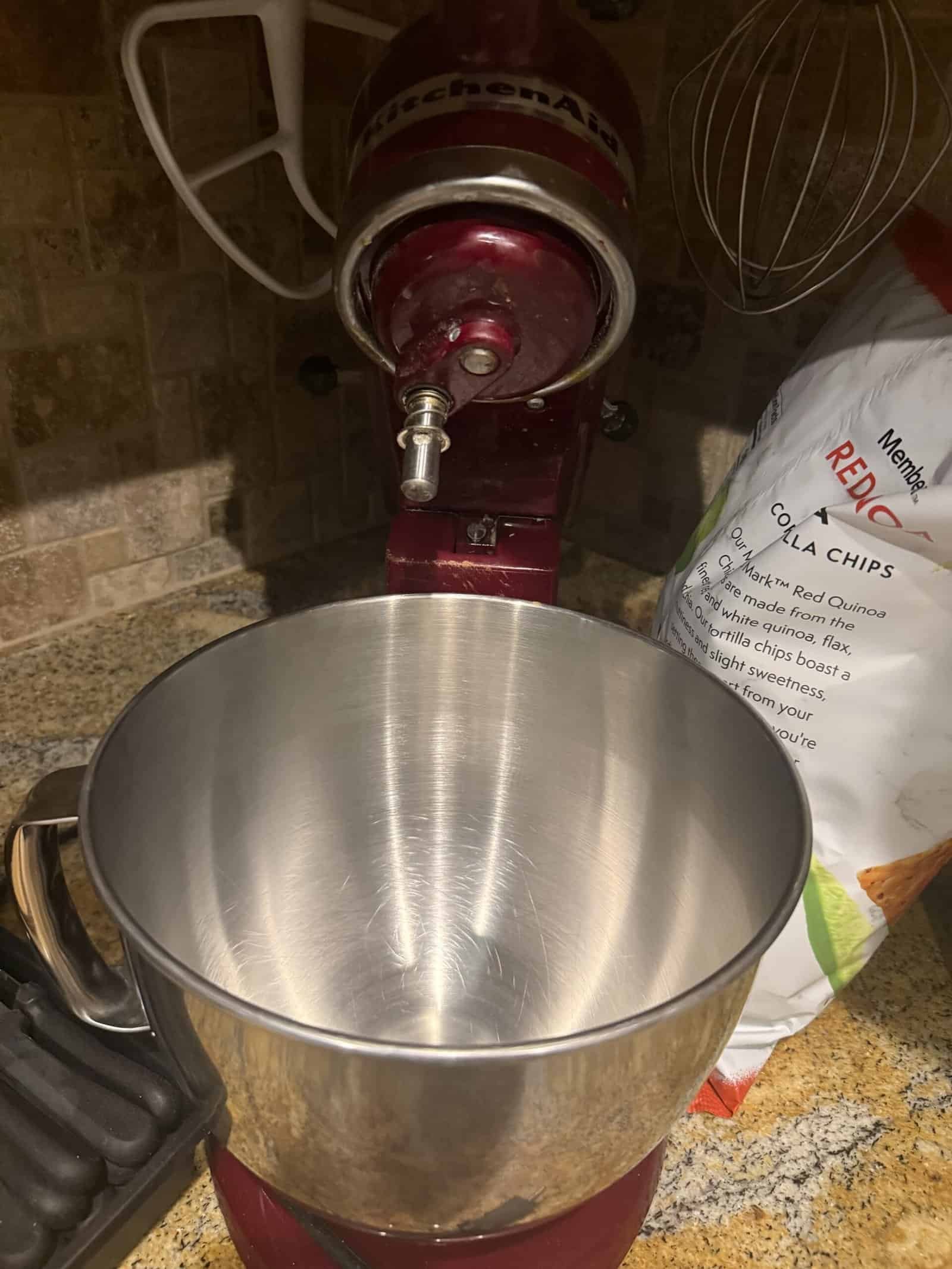
The bowl and attachments are the easy part. What makes a stand mixer awkward is the machine itself, since it cannot go near water and the places that collect flour and batter are exactly the places you cannot reach easily.
Mine is awkward to wash, and after a few years of regular use I would call that the main daily annoyance of owning one. It is not difficult so much as fiddly in a way the bowl is not.
Quick Answer
Wash the bowl and attachments by hand or check whether they are dishwasher safe, since many are not. Wipe the machine body with a damp cloth immediately after use, and clean the beater shaft and the underside of the head, which is where residue accumulates unnoticed. Which attachment did the work also decides how much cleaning follows, and our guide to matching attachment to task covers that.
What Goes Where
| Part | Method | Notes |
|---|---|---|
| Bowl | Hand wash or dishwasher | Check the model, some discolor |
| Beater and whisk | Usually hand wash | Coated beaters chip in dishwashers |
| Dough hook | Hand wash | Dough sets hard, soak first |
| Machine body | Damp cloth only | Never submerge or rinse |
| Beater shaft | Damp cloth, immediately | The spot people miss |
| Underside of head | Damp cloth | Splatter collects here |
Do It Immediately
Everything about this is easier within a few minutes of finishing. Batter wipes off wet and chips off dry, and dough that has set on a hook takes real effort.
Filling the bowl with warm soapy water and leaving it while you deal with the rest handles most of what would otherwise need scrubbing.
The machine body is the one that benefits most from immediacy, since flour and splatter dry into a film that resists a damp cloth once it has set.
That is the single habit that changes how annoying this appliance is to own, and general selection sits in how to choose the right stand mixer.
The Parts People Miss
The beater shaft
The post the attachments mount onto collects batter that runs up during mixing. It is easy to overlook because attachments cover it, and it hardens into a ring.
The underside of the head
Everything thrown outward by the beater lands here. On a tilt-head model you only see it when the head is back, which is not when you are cleaning.
Around the speed lever
Flour works into the gap around the control and stays there. A dry brush moves it where a cloth pushes it further in.
The bowl locking points
The tabs or slots the bowl seats into trap dried dough, which eventually stops the bowl locking properly, covered in stand mixers under two hundred.
Why Mine Is Awkward
The machine is heavy, which is useful in every other respect and unhelpful here. Tipping it to reach underneath is not a casual movement.
It lives on the counter, so cleaning happens where it stands rather than at a sink. That means a damp cloth and patience rather than running anything under a tap.
The bowl and attachments are straightforward. It is the body, the shaft, and the head underside that make it a job rather than a wipe.
None of this is a fault with the machine, and it is the reality of an appliance that cannot get wet and has moving parts above an open bowl.
What I would say is that the annoyance is proportional to how long you leave it, which makes it a habit problem more than an equipment problem.
Attachments and the Dishwasher
Check the manual before assuming anything. Bowls are frequently dishwasher safe and coated beaters frequently are not, and the two often ship together.
Aluminum bowls and attachments discolor and can pit in a dishwasher, since detergent is alkaline and aluminum reacts to it.
Coated beaters chip, and once the coating breaks the exposed metal underneath is a food contact problem rather than a cosmetic one.
Stainless steel bowls generally handle a dishwasher fine, which is worth knowing when choosing between bowl materials, covered in mixing bowl sets.
Cleaning the Bowl Properly
Bowls look like the simple part and they have their own quirks worth knowing.
Greasy residue is the enemy of whipped egg whites. Any trace of fat prevents them reaching full volume, which is why meringue fails in a bowl that looked clean. Wiping the interior with vinegar or lemon juice before whipping removes what soap missed.
Stainless steel bowls develop a dull film over time from detergent and hard water. That is cosmetic and it comes off with a paste of bicarbonate of soda.
Glass bowls show everything, which is genuinely useful for spotting residue and means they look worse than steel for the same level of clean.
Ceramic and coated bowls chip at the rim if they knock against a tap, and a chip in the interior surface is a reason to stop using it for food.
Dry bowls before storing them nested. Water trapped between nested bowls leaves marks and, on some materials, causes staining that does not lift.
Dealing With Dried Dough
Soak rather than scrape. Dough on a hook softens in warm water within fifteen minutes and comes away without tools.
For the machine body where you cannot soak, a damp cloth left resting on the spot for a few minutes does the same job.
Avoid anything abrasive on painted or coated surfaces, since scratches give future residue somewhere to hold.
A soft brush handles crevices better than a cloth, and an old toothbrush is the tool most people end up using.
The Once-a-Year Jobs
Two things need attention on a schedule rather than after each use, and both get skipped for years.
The beater to bowl clearance drifts over time. If the beater scrapes the bottom or leaves an unmixed layer, most tilt-head models have an adjustment screw in the hinge that sets the height. The standard check is whether a coin placed in the bowl gets nudged by the beater as it passes.
The other is the grease inside the gearbox on models that use it. That is a service job rather than a cleaning one, and the sign is a change in noise or a smell during heavy use.
Neither is urgent and both extend the life of a machine considerably. A mixer running for a decade is normal, and one running for two decades usually belongs to someone who did these.
Keeping It Cleaner in the First Place
Use a splash guard
The pouring shield that came with the machine catches most of what would otherwise reach the head underside. Many people leave it in a drawer.
Start slow
Most splatter happens in the first seconds at too high a speed. Starting at the lowest setting and increasing prevents the majority of it.
Do not overfill
A bowl filled past its working capacity throws contents outward and strains the motor at the same time.
Cover it when stored
A machine on the counter collects kitchen grease and dust, which is harder to remove than fresh batter, covered in storing small kitchen appliances.
Related Reading
- choosing a stand mixer
- stand mixers under two hundred
- stand against hand mixer
- mixing bowl sets
- bread machine against stand mixer
- hand mixers
Frequently Asked Questions
How do you clean a stand mixer?
Wash the bowl and attachments by hand, wipe the body with a damp cloth immediately after use, and clean the beater shaft and the underside of the head where residue collects.
Can a stand mixer go in the dishwasher?
The body never. Bowls often can and coated beaters often cannot, and the manual is the only reliable guide since it varies by model.
Where does residue build up unnoticed?
The beater shaft, the underside of the head, around the speed lever, and the bowl locking points. All are hidden during normal use.
How do I remove dried dough?
Soak rather than scrape. Warm water softens it within about fifteen minutes, and a damp cloth left resting on the spot does the same on the body.
Why do aluminum attachments discolor in a dishwasher?
Dishwasher detergent is alkaline and aluminum reacts to it, which causes discoloration and can pit the surface over repeated cycles.
How do I reduce splatter?
Use the pouring shield, start at the lowest speed and increase gradually, and avoid filling the bowl past its working capacity.
Should I cover it on the counter?
Worth doing. A machine left out collects kitchen grease and dust, which is considerably harder to remove than fresh batter.
Recommended Reading
See our note on setting up a home baking station.
