
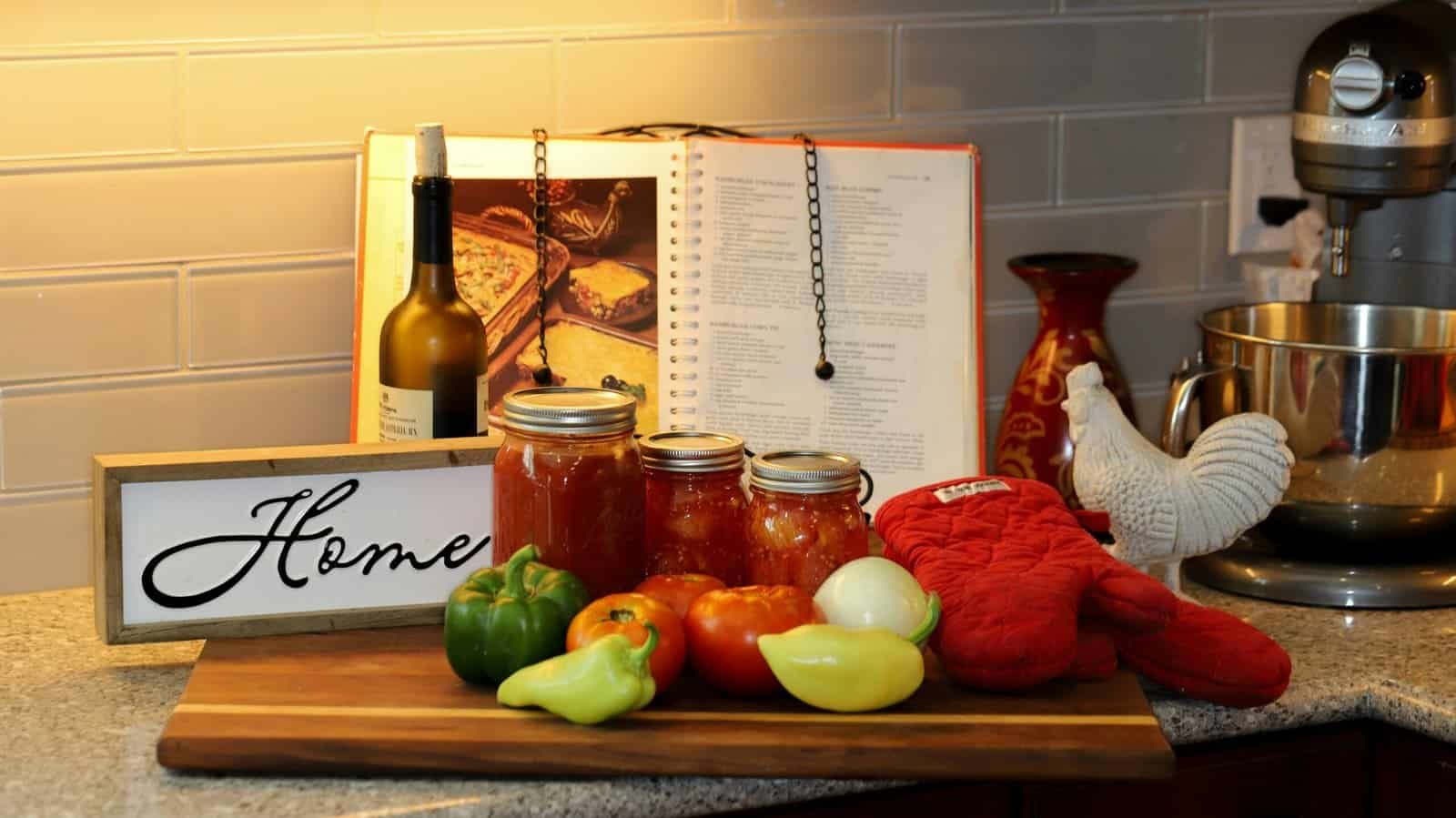
Canning equipment exists to solve two problems: moving hot jars safely and getting a reliable seal. Jars and lids do the preserving, and everything else on the list is there so you can handle boiling water and glass without burning yourself or cracking a jar. The method you choose matters more than the brand of anything, because high-acid foods and low-acid foods need different equipment entirely. Our roundup of mason jars covers what goes inside.
Quick Verdict
A water bath canner covers high-acid foods and is where most people start. A pressure canner is required for low-acid foods and is not optional there. A jar lifter and a wide funnel are the two small tools that make the difference between a manageable afternoon and a burnt hand.
Key Takeaways
- High-acid foods go in a water bath; low-acid foods need pressure.
- A jar lifter is the tool you cannot improvise safely.
- Fresh lids each time; bands and jars are reusable.
- Headspace and air bubbles both affect whether a jar seals.
- Follow an approved recipe from a reliable source rather than adapting one.
How We Picked
Equipment is grouped by the job it does in the sequence: heating, moving, filling, sealing, and storing. The two canner types are separated because they are not interchangeable, and choosing the wrong one is the most consequential decision in this category.
Selection reflects how each piece of equipment functions in a home canning workflow. Descriptions are written from product research rather than from batches put up in a particular canner.
1. A Water Bath Canner, Best Overall for Beginners
Why It Stands Out
A tall stockpot with a rack handles jams, jellies, pickles, chutneys, and most fruit, which is the majority of what home cooks put up. Water covers the jars, boils for a set time, and the seal forms as the jars cool.
The rack is the part that matters. Jars sitting directly on the base of a pot are exposed to direct heat and can crack, and the rack keeps water circulating underneath.
Worth Knowing
Depth is the specification to check. The pot needs to hold enough water to cover the jars with clearance above, and a pot that is nearly deep enough is not deep enough.
Water bath canning is only safe for high-acid foods. Vegetables, meats, and anything low-acid require pressure, and no amount of longer boiling substitutes. Our roundup of stockpots covers the general-purpose version of the same shape.
This suits jams, pickles, and fruit. Skip it if you are canning vegetables or meat.
2. A Pressure Canner, Best for Low-Acid Foods
Why It Stands Out
Pressure canners reach temperatures above boiling, which is what low-acid foods require. Green beans, carrots, soups, stocks, and meats all fall here, and a pressure canner is the only home equipment that handles them safely.
Most also work as water bath canners, so one purchase can cover both methods if the pot is deep enough.
Worth Knowing
A pressure canner is not the same as a pressure cooker, and the smaller electric multi-cookers are generally not suitable for canning. Buy something specifically described as a pressure canner.
Dial gauges need checking for accuracy periodically, and weighted gauges avoid that but need the correct weight for your altitude. Read the manual before the first batch rather than during it.
This suits vegetables, meat, and stock. Skip it if you only make jam.
3. A Jar Lifter, Best Essential Tool
Why It Stands Out
A jar lifter grips a hot jar around its neck and lifts it straight out of boiling water. Nothing else does this safely, and it is the single tool most worth owning before you start.
The rubberized jaws also hold a wet jar securely, which ordinary tongs cannot manage on smooth glass.
Worth Knowing
Cheap lifters flex under a full quart jar, which is exactly when you need them not to. Look for a solid hinge and enough spring tension to hold without you squeezing hard.
Lift jars straight up and keep them upright. Tilting a hot jar can disturb the headspace and affect the seal. Our roundup of oven mitts and pot holders covers the rest of the heat protection.
This suits every canning setup. Skip it only if you are not canning.
4. A Wide-Mouth Funnel and Headspace Tool, Best for Filling
Why It Stands Out
A canning funnel sits in the jar mouth and keeps the rim clean, which matters because anything on the rim can prevent a seal. It also stops hot liquid running down the outside of the jar and onto your hand.
Many funnels have headspace markings, so you fill to the right level without measuring separately.
Worth Knowing
Headspace is not a suggestion. Too little and the contents force out during processing, breaking the seal; too much and air remains in the jar. Follow what the recipe specifies.
The flat end of the tool also releases trapped air bubbles by running it around the inside of the jar, which is a step people skip. Our guide to kitchen scales covers the other measuring that matters in preserving.
This suits every batch. Skip it if you enjoy wiping rims.
5. Replacement Lids and Bands, Best Consumable
Why It Stands Out
Flat lids are single use, because the sealing compound is designed to soften once and form a seal as the jar cools. Buying them in quantity is cheaper than in small packs and means you never stop mid-batch.
Bands are reusable and only need replacing when they rust or bend, so most people accumulate plenty over time.
Worth Knowing
Reusing flat lids is the most common cause of failed seals. It feels wasteful and it is the rule that keeps the food safe.
Wide mouth and regular mouth lids are not interchangeable, so check which your jars take before ordering a case. Our roundup of jar openers covers getting them off again later.
This suits anyone canning more than once. Skip it only if a starter kit already included enough.
6. A Canning Starter Kit, Best for Getting Everything at Once
Why It Stands Out
Kits bundle the jar lifter, funnel, headspace tool, bubble remover, and lid wand, which is the exact set of small tools you discover you need halfway through a first batch.
Buying together also costs less than the pieces separately and removes the guesswork about what is actually required.
Worth Knowing
Kit quality is generally adequate rather than good, and the jar lifter is usually the piece worth upgrading first since it carries the most weight and the most risk.
Most kits do not include a canner, so check what you are actually getting before assuming it is a complete setup. Our roundup of pantry storage containers covers where the finished jars go.
This suits a first canning setup. Skip it if you already own the small tools.
Canning Equipment at a Glance
| Item | Job | Required for | Reusable |
|---|---|---|---|
| Water bath canner | Processing high-acid foods | Jams, pickles, fruit | Yes |
| Pressure canner | Processing low-acid foods | Vegetables, meat, stock | Yes |
| Jar lifter | Moving hot jars | Every method | Yes |
| Funnel and headspace tool | Clean rims, correct fill | Every batch | Yes |
| Flat lids | Forming the seal | Every jar | No, single use |
| Bands | Holding lids during processing | Every jar | Yes |
What to Look For in Canning Equipment
What are you actually canning?
This decides the canner and nothing else does. High-acid foods use a water bath; low-acid foods require pressure. Getting this wrong is the one mistake in canning with real consequences.
Is the pot deep enough?
Jars need to sit on a rack with water covering them and room to boil above. Measure your tallest jars against the pot depth rather than assuming a large pot is tall enough.
Does it suit your stove?
Flat-bottomed canners are needed for glass and induction hobs, and a heavy full canner is a significant load on a glass surface. Check the manufacturer’s guidance for your stove type.
How much are you making at a time?
Canner capacity sets your batch size, and processing in two runs doubles the afternoon. Match it to how much produce you handle at once rather than to the biggest pot available.
Water Bath or Pressure?
When a water bath is enough
High-acid foods, which covers jams, jellies, pickles, chutneys, most fruits, and anything acidified with vinegar to an approved recipe. Boiling water reaches the temperature these need.
When pressure is required
Low-acid foods including vegetables, meats, poultry, and stocks. These need temperatures above boiling, which only a pressure canner reaches at home. There is no water bath workaround, and longer processing does not substitute. Our roundup of food storage containers covers the alternative for anything you would rather refrigerate or freeze.
Common Canning Mistakes to Avoid
Reusing flat lids
The sealing compound works once. A reused lid may appear to seal and fail later, which is the worst version of the outcome because you do not notice.
Adapting a recipe
Changing ratios, reducing vinegar, or scaling ingredients alters the acidity that makes the method safe. Follow approved recipes from reliable sources rather than adjusting to taste.
Ignoring headspace
Too little forces contents past the lid during processing and breaks the seal. Too much leaves air in the jar. The figure in the recipe is part of the method.
Skipping the rim wipe
A trace of jam on the rim is enough to prevent a seal. Wipe every rim with a clean damp cloth before the lid goes on, every time. Our note on organizing a kitchen covers setting up a workspace where that is easy.
Recommended Reading
See our roundup of sourdough starter jars, notes on mixing bowl sets, our colander and strainer picks, and a guide to fine mesh strainers.
Canning Supplies FAQ
What do I actually need to start canning?
A canner suited to what you are preserving, jars with fresh flat lids and bands, a jar lifter, and a funnel. Everything else is convenience. The jar lifter is the one item you cannot safely improvise, since ordinary tongs will not grip wet glass reliably.
Can I use a regular stockpot as a water bath canner?
If it is deep enough to cover the jars with water and boil above them, and you add a rack so jars are not sitting on the base. Without a rack, direct heat on the glass can crack jars. Depth is the more common limitation.
What is the difference between a pressure canner and a pressure cooker?
A pressure canner is built and rated for processing jars at the temperatures low-acid foods require, and it holds jars at that temperature reliably. Standard pressure cookers and most electric multi-cookers are not suitable for canning, whatever the marketing suggests.
Can I reuse canning lids?
No. The sealing compound on a flat lid is designed to soften and seal once. A reused lid can appear to seal and then fail during storage. Bands and jars are reusable; the flat lids are consumable every time.
Why did my jars not seal?
Most often a rim that was not wiped clean, incorrect headspace, a reused lid, or a chip on the jar rim. Check each of those before blaming the equipment. An unsealed jar can be refrigerated and used rather than discarded.
Do I need to sterilize jars first?
It depends on the processing time in the recipe. Shorter processing times generally require pre-sterilized jars, while longer ones sterilize the jars during processing. The recipe you are following will state it, and that instruction is part of the method.
Can I can vegetables in a water bath?
Not safely. Vegetables are low-acid and require the higher temperatures only a pressure canner reaches. Pickled vegetables are different, because the vinegar makes them high-acid, and those follow a water bath recipe.
How should I store finished jars?
Bands off, somewhere cool and dark. Removing the bands means a failed seal becomes obvious rather than being held in place, and darkness preserves color and quality. Label everything with the contents and the date.
