
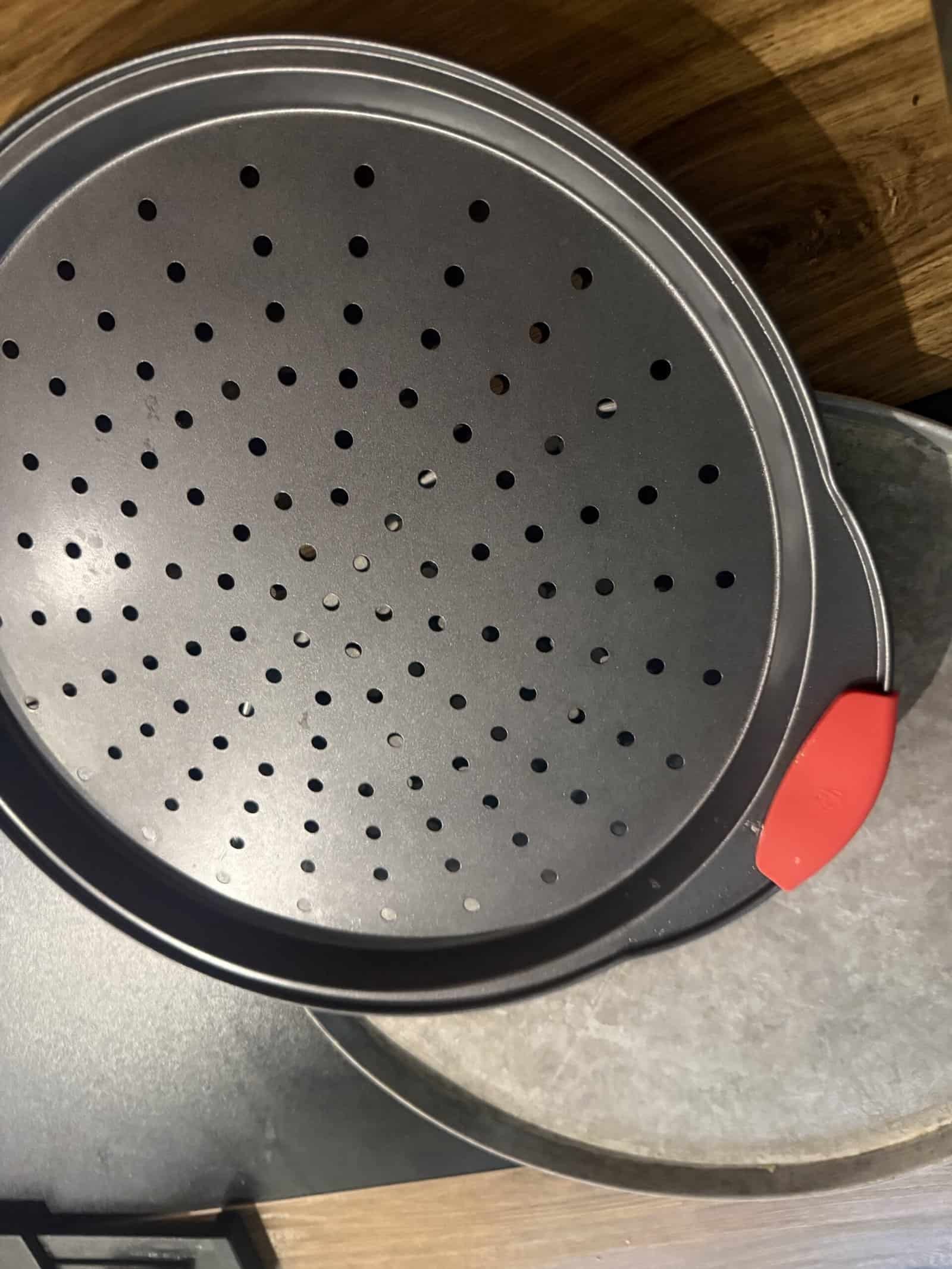
Before anything else, the material decides whether rust is even possible. Rust is iron oxide, so it only forms on iron and steel. An aluminum pan cannot rust no matter how it is treated.
Mine are aluminum and a gray non-stick, and they go through the dishwasher every time without anything going wrong. Our roundup of pizza pans and crisper trays covers the materials.
Quick Answer
Aluminum does not rust; it oxidizes and can dull or darken. Steel rusts where a coating has failed. Carbon steel and cast iron rust readily without seasoning.
What Each Material Does
| Material | Can it rust | What happens instead |
|---|---|---|
| Aluminum | No | Oxidizes, can darken or dull |
| Anodized aluminum | No | Coating can wear over time |
| Coated steel | Yes, at chips | Rust spreads under the coating |
| Carbon steel | Yes, readily | Needs seasoning like cast iron |
| Cast iron | Yes, readily | Needs seasoning and oil |
| Stainless steel | Rarely | Can pit from salt or long soaking |
Why Aluminum Cannot Rust
Rust is specifically the oxidation of iron, and aluminum contains none.
Aluminum does oxidize, and the result is different. It forms a thin, hard, transparent oxide layer almost immediately on exposure to air, and that layer protects the metal underneath rather than flaking away the way rust does.
What people see and call rust on an aluminum pan is usually darkening, a dull gray film, or pitting from something acidic.
None of that is structural in the way rust is, and a discolored aluminum pan is generally still a working pan. Our note on cleaning a nonstick pan covers surface care.
The Dishwasher Question
Standard advice is to keep aluminum out of the dishwasher, and the reason is real. Dishwasher detergents are alkaline, and alkaline solutions attack the protective oxide layer, which can leave aluminum darkened or chalky.
How much that happens depends on the detergent, the water, the cycle temperature, and whether the aluminum is anodized or bare.
Mine go through every time. They are aluminum and a gray non-stick, and nothing has been wrecked by it.
That is one household with one detergent and one machine rather than a general rule, and it is worth saying plainly because the advice against it is usually stated as though the bad outcome were certain rather than likely. Our note on putting knives in the dishwasher covers a similar disputed case.
Where Coated Steel Actually Rusts
At chips and scratches
The coating is the only thing between the steel and moisture, and a break anywhere exposes it.
Around the rim edge
Coatings are thinnest at edges, and rims take the most contact.
Under the coating
Once water gets in at a chip, rust spreads sideways beneath the surface where you cannot see it.
At perforations
Crisper trays have many cut edges, and each one is a place the coating may not fully cover.
Why Perforated Pans Are More Vulnerable
A crisper tray or perforated pizza pan has dozens or hundreds of holes, and every hole has a cut edge.
Coatings applied after punching cover those edges less reliably than a flat surface, and holes also hold water after washing.
The combination of an imperfect coating and standing moisture is exactly what corrosion needs on a steel pan.
On an aluminum crisper the same holes hold water and there is no rust to follow, which is one practical argument for aluminum in that shape. Our roundup of baking sheets and cookie sheets covers construction.
Why Coated Steel Is Used at All
If aluminum cannot rust, the obvious question is why anyone makes bakeware from coated steel.
Steel is stiffer, so a steel pan resists warping in a hot oven better than an aluminum one of the same thickness.
It is also cheaper at a given rigidity, which matters for large flat shapes like pizza pans and sheet trays.
Dark coatings absorb heat and brown a crust faster, which is a genuine cooking difference rather than a cosmetic choice, and it is part of why dark non-stick pizza pans exist.
The rust vulnerability is the price of those properties, and it only becomes a problem once the coating is broken. An intact coating on steel behaves much like aluminum for most of a pan’s life. Our roundup of bakeware sets covers the material mix.
What Looks Like Rust and Is Not
Dark gray or black marks on aluminum are oxidation rather than rust, and they wipe or scrub back in many cases.
Baked-on oil polymerizes into a hard brown or black layer that resembles corrosion and is actually the same process that seasons cast iron.
Hard water leaves behind a white or chalky deposit that is mineral rather than metal.
Orange or red staining from tomato-based sauces can sit on a surface and look alarming at a glance without anything at all corroding underneath it.
Drying Matters More Than Washing
Corrosion needs moisture and time, so a steel pan that is dried immediately is far less exposed than one left to air dry.
Dishwasher heated-dry cycles help on that count, which is a point in their favor for steel that people rarely make.
Stacking pans while still slightly damp traps moisture between them, which is worse than leaving them out.
Storing in a humid cupboard extends the exposure indefinitely, and that is where most slow rust actually happens. Our note on organizing your kitchen covers storage.
Salt and Acid Accelerate Everything
Two things in ordinary cooking speed corrosion considerably, and both come up more with pizza than with most food.
Salt in solution conducts, which speeds the electrochemical reaction corrosion depends on. Salty dough residue left on a damp pan is worse than plain water.
Acid attacks differently, and tomato is the relevant one here. Acidic food sitting on bare aluminum pits the oxide layer and leaves marks that do not scrub out easily.
Neither matters much during cooking, since the exposure is short and the pan is hot and dry afterward.
What matters is residue left sitting, which is the argument for rinsing soon after use rather than for any particular washing method. Our note on cleaning a cutting board covers a related residue problem.
Dealing With Rust That Has Started
Light surface rust on steel scrubs off with a non-metallic pad and does not require anything aggressive.
Rust spreading under a non-stick coating cannot be fixed, since removing it means removing the coating.
Carbon steel and cast iron are the exceptions where rust is genuinely repairable, because those surfaces are meant to be stripped and re-seasoned.
A coated pan with rust through the cooking surface is worth replacing rather than treating, and coated bakeware is inexpensive enough that this is not a hard call.
Common Mistakes to Avoid
Assuming any discoloration is rust
Aluminum cannot rust. Dark marks on it are oxidation or baked-on oil.
Using metal tools on coated pans
Every scratch is a place rust can start on the steel underneath.
Long soaking
Time in water is what corrosion needs, more than the water itself.
Stacking damp
Traps moisture between surfaces for hours, which is worse than open air.
Pizza Pan Rust FAQ
Why does my pizza pan rust?
Only if it contains iron. Coated steel rusts where the coating has chipped, and carbon steel rusts readily without seasoning.
Can aluminum pans rust?
No. Rust is iron oxide and aluminum contains no iron. It oxidizes instead, forming a protective layer, and can darken or dull.
Do you dishwasher yours?
Yes, every time. Mine are aluminum and a gray non-stick, and nothing has been wrecked by it.
Is the dishwasher bad for aluminum?
Detergents are alkaline and can attack the oxide layer, leaving darkening or a chalky look. How much depends on detergent, water, and the pan.
Why are crisper trays worse?
Every perforation is a cut edge where coating coverage is less reliable, and the holes hold water after washing.
What is the dark film on my aluminum pan?
Oxidation, baked-on polymerized oil, or hard water minerals. None of them is rust and none is structural.
Can I fix a rusted pan?
Light surface rust on bare steel scrubs off. Rust under a non-stick coating cannot be fixed without destroying the coating.
Does drying matter?
More than washing. Corrosion needs moisture and time, so drying immediately and not stacking damp does most of the work.
