
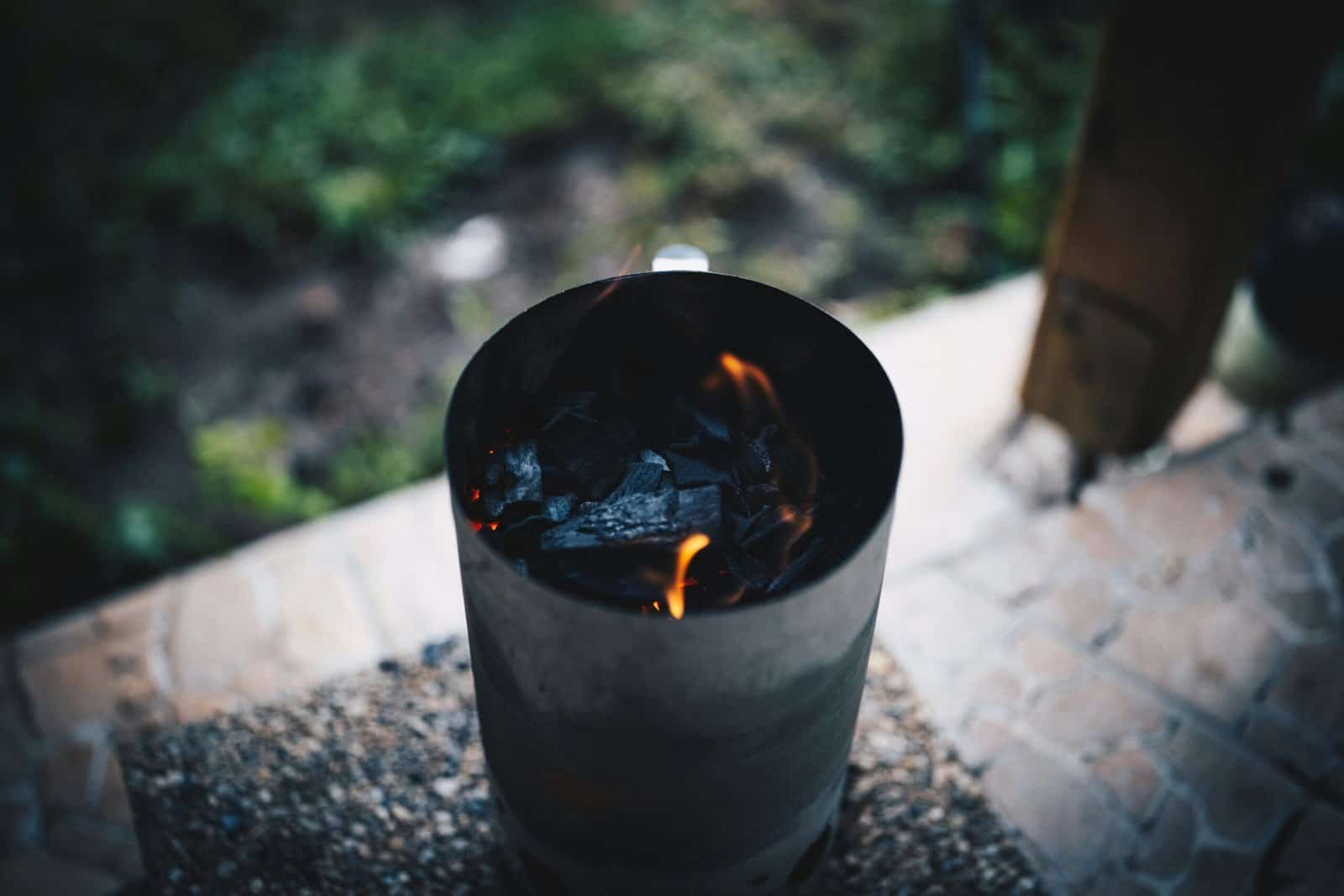
Lighter fluid leaves a taste on the first thing you cook, and the best charcoal chimney starters remove the need for it entirely by using a chimney effect to light coals from a sheet of newspaper underneath. A standard steel chimney does this well enough that the expensive versions have little left to improve.
The physics is the product. Hot air rising through a packed column drags flame upward through the coals.
That is why a cylinder with a grate beats a pile of coals on the grill floor every time. It is also why capacity and handle design are the only specifications that really matter.
Quick Verdict
A standard steel chimney suits most grills and costs the least, so start there. Large chimneys matter if you fill a kettle or a barrel grill, compact ones suit portable grills, a hinged pour spout makes emptying safer, and twin handles help with a full load. Buy fire starter cubes alongside whichever you choose, because newspaper is getting harder to come by.
Key Takeaways
- A chimney lights charcoal with paper or a starter cube and needs no lighter fluid at all.
- Capacity should match your grill, since a chimney too small means lighting two loads.
- Coals are ready when the top layer is ashed over rather than when flames appear.
- The whole body gets extremely hot, so handle design is a safety feature rather than a convenience.
- A second handle or a hinged spout makes pouring a full load far more controlled.
- Set it on a noncombustible surface and never carry a lit chimney indoors.
How We Picked the Best Charcoal Chimney Starters
We compared chimney types rather than named models, because the design is simple and long-settled while specific products come and go.
Each section covers one type, the grill it suits and where it falls short. We weighted four things: how much charcoal it holds, how securely it can be poured when full and hot, how well the handle insulates, and how the steel holds up over seasons.
We have not published capacities in pounds or light times. Those depend on the charcoal, the weather and how tightly the column is packed, and a figure here would not describe your grill.
1. Standard Steel Chimney Starters, Best Overall
Why It Stands Out
A galvanized or aluminized steel cylinder with a grate partway up, a heat shield and a single insulated handle. This is the design almost everyone means by a chimney starter.
Capacity on a standard unit suits a typical kettle grill in one load, which is the whole point. One fill, one light, one pour.
They are also cheap enough that replacing one after several seasons is unremarkable, and there is nothing on them to break.
Worth Knowing
Thin steel warps and eventually burns through near the grate. Heavier gauge costs a little more and lasts noticeably longer.
The single handle means pouring a full load is a one-handed lift at an awkward angle, which is where most spills happen.
Best for kettle grills and anyone starting out with charcoal. Our wire cleaning brushes picks cover the step after cooking.
2. Large Capacity Chimneys, Best for Big Grills
Why It Stands Out
Wider and taller cylinders that hold enough charcoal to fill a barrel grill or a large kettle in a single load.
Lighting two consecutive loads is the thing that makes charcoal feel slow. One large fill removes that entirely.
A bigger column also draws harder, so a large chimney often lights slightly faster per coal than a small one.
Worth Knowing
Full and lit, these are heavy, and that weight is all in a hot steel tube. A second handle is close to essential at this size.
They also take more storage space, and the width can be awkward on a narrow grill when you pour.
Best for barrel grills, large kettles and cooking for a crowd. Our pellet grills roundup covers the no-lighting alternative if this sounds like work.
3. Compact Chimneys for Small and Portable Grills, Best for Travel
Why It Stands Out
Short narrow cylinders sized for a portable or tabletop grill, light enough to pack and small enough to store in a cupboard.
A standard chimney overfills a small grill, and the excess coals have nowhere useful to go. Matching the volume avoids waste.
Some collapse or nest for transport, which makes them practical for camping and tailgating.
Worth Knowing
Small capacity means a long cook needs a second load, so these suit short high-heat sessions rather than low and slow.
Light construction also warps sooner, since there is less steel to absorb the heat.
Best for tabletop grills and travel. Our fire pits picks cover the other outdoor use for a chimney.
4. Chimneys With a Hinged Pour Spout, Best Controlled Pour
Why It Stands Out
A hinged section or a shaped lip that lets coals leave in a directed stream rather than all at once from an open cylinder.
Pouring is the dangerous moment in this whole process, and a spout gives you aim. You can bank coals to one side rather than dumping them in a heap.
Banking matters for two-zone cooking, where you want a hot side and a cooler side, and a controlled pour is what makes that tidy.
Worth Knowing
Hinges and latches are extra parts in a place that gets very hot, and they are the part most likely to seize or fail.
These also cost more than a plain cylinder for a benefit you only feel during the few seconds of pouring.
Best for two-zone setups and for anyone who finds the pour nerve-wracking. See our grill mats picks for protecting whatever is under the grill.
5. Chimney Starters With Twin Handles, Best Safe Handling
Why It Stands Out
A main insulated handle plus a secondary grip on the opposite side, so a full load is lifted and tipped with two hands.
Two points of contact is what turns an awkward one-armed tip into a controlled movement. It is the single most worthwhile feature here.
The secondary handle also sits where it helps you angle the cylinder rather than just support it.
Worth Knowing
The second handle needs its own heat shield or it becomes useless when hot. Check that it is insulated rather than bare steel.
Twin handle models also take more space to hang or store, which matters in a packed garage.
Best for large loads and for anyone with limited grip strength. Our oven mitts and pot holders picks cover the gloves you should be wearing regardless.
6. Fire Starter Cubes and Tumbleweeds, Best Lighting Aid
Why It Stands Out
Paraffin-soaked cubes or wax-dipped wood wool that light from a match and burn long enough to catch the coals above them.
Newspaper is scarcer than it used to be, and it also leaves a lot of ash. A cube is cleaner and more reliable in wind.
They are tasteless and odorless in use, which is the advantage over fluid, and they store indefinitely in a tub.
Worth Knowing
These are a consumable, so there is a small ongoing cost. One or two cubes per light is typical.
Not all are odorless, and the cheapest can smell while burning. Paraffin and wood wool types are the dependable ones.
Best bought with any chimney, since the starter is the half people forget. Our tools for cooking steak roundup covers what happens once the coals are ready.
Chimney Starter Types at a Glance
| Type | Capacity | Handles | Pour Control | Best Use |
|---|---|---|---|---|
| Standard steel | One kettle load | Single | Open cylinder | Most grills |
| Large capacity | Barrel grill load | Single or twin | Open cylinder | Big cooks |
| Compact | Tabletop load | Single | Open cylinder | Portable grills |
| Hinged pour spout | Standard | Single | Directed stream | Two-zone banking |
| Twin handle | Standard or large | Two | Better by control | Heavy loads |
| Starter cubes | Consumable | Not applicable | Not applicable | Lighting the chimney |
How to Choose a Charcoal Chimney Starter
Match capacity to your grill
A chimney that fills your grill in one load is the right size. Too small means two lights, too large means wasted coals.
Look at the steel gauge
Thin steel warps and burns through around the grate. Heavier steel costs slightly more and survives several more seasons.
Insist on a real heat shield
The shield between the body and the handle is what keeps the handle usable. A chimney without one gets uncomfortable fast.
Prefer two handles for a big one
A full large chimney is heavy and hot, and pouring it one-handed is the riskiest moment in charcoal grilling.
Check the grate position
The internal grate needs enough space beneath it for paper or a cube to burn with air around it. A grate set too low chokes the light.
Chimney Starter or Electric Looper?
What a chimney does
It needs no power, costs very little, lights a full load at once and produces evenly ashed coals. For most people it is the whole answer.
What an electric starter does
An electric loop or a hot air wand lights coals in place with no paper at all, which suits a balcony or anywhere open flame is awkward. It needs an outlet and an extension lead, and it lights a smaller area at a time. Our electric grills under 100 roundup covers skipping charcoal altogether.
Common Chimney Starter Mistakes to Avoid
Pouring before the coals have ashed over
Flames are not the signal. Wait until the top layer is gray with ash, or the bottom coals will still be cold when you cook.
Packing the column too tightly
A chimney works on airflow. Charcoal crammed in blocks the draw and the light stalls partway up.
Setting it on a wooden or vinyl surface
The base radiates serious heat downward. Light it on the grill grate, on concrete or on something noncombustible, never on a deck board or a plastic table.
Reaching for lighter fluid anyway
The whole point is that it is unnecessary, and fluid in a chimney flares badly. A cube or paper underneath is all it needs.
Handling it without gloves
Even with a heat shield, a full lit chimney is radiating heat at your hand and forearm. Grill gloves are not optional at the pour.
Recommended Reading
Best Charcoal Chimney Starters FAQ
What are the best charcoal chimney starters?
A standard heavy-gauge steel chimney suits most grills and costs the least, which makes it the sensible default. Large versions are worth it if you fill a barrel grill, and a twin-handle model is the upgrade that matters most, because pouring a full hot load one-handed is the riskiest part of the process.
How do you use a charcoal chimney starter?
Put crumpled paper or a starter cube in the space below the internal grate, fill the cylinder above it with charcoal, set it on the grill grate or another noncombustible surface, and light the paper from underneath. Wait until the top coals are ashed over, then pour them into the grill wearing gloves.
How long does a chimney starter take?
Long enough for the flame to climb the whole column and ash over the top layer, which varies with the charcoal type, the pack density and the weather. Judge it by the gray ash on top rather than by a clock. Briquettes and lump charcoal behave differently.
Do you need lighter fluid with a chimney starter?
No, and that is the main reason to own one. Paper or a paraffin starter cube underneath is enough, and neither leaves a taste on the food. Fluid in a chimney also flares unpredictably because of the confined draw.
What size chimney starter do I need?
One that fills your grill in a single load. A standard chimney suits a typical kettle, a large one suits a barrel grill or a big kettle, and a compact one suits a tabletop grill. Lighting two loads back to back is the symptom of buying too small.
Can you use a chimney starter on a balcony?
Check your building rules first, since many prohibit charcoal on balconies outright. Where it is allowed, the chimney must sit on something noncombustible with clearance above and around it. An electric starter or an electric grill avoids the question.
How long does a chimney starter last?
Several seasons for a heavy-gauge unit, less for thin steel, and the failure is usually warping or burn-through near the internal grate. Storing it dry and out of the weather extends it, since rust on thin steel accelerates the problem.
Can you light wood chunks in a chimney?
Small chunks will light, though wood burns less predictably in a confined column than charcoal does and can throw sparks. Most people light charcoal in the chimney and add wood chunks to the grill afterward for smoke. That also gives better control over how much smoke you get.
