
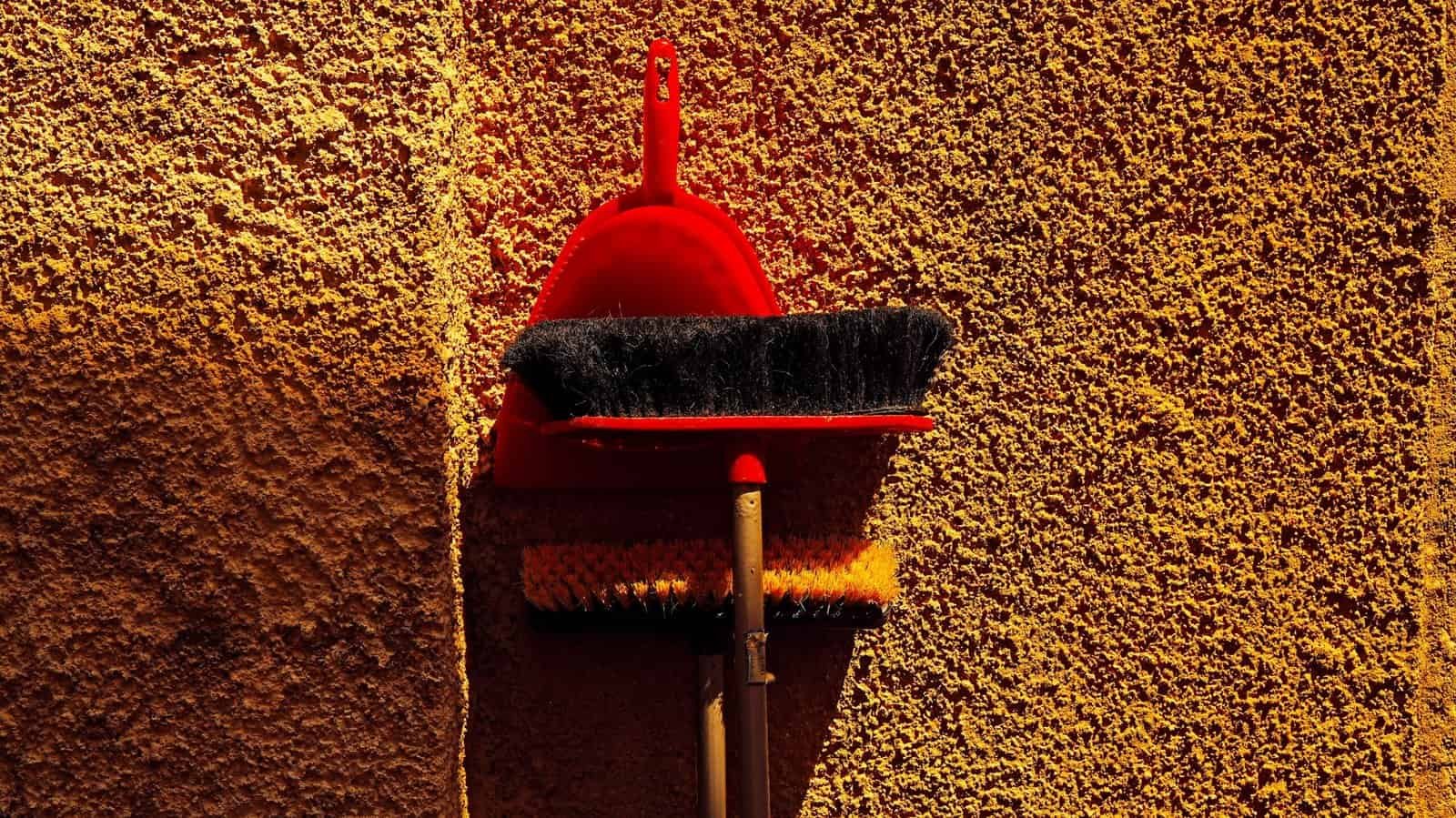
Bristle type decides everything, so choose by floor first: fine split-tip synthetic for hard floors and fine dust, stiff flagged bristle for rough outdoor surfaces, and rubber for carpet and pet hair. The best brooms and dustpans are the ones matched to the surface rather than the ones with the most features. Dustpan performance comes down to a single detail, which is whether the lip sits flat on the floor.
Most sweeping frustration is a mismatch. A stiff outdoor broom skips fine dust across a wood floor, and a soft indoor broom collapses against a concrete patio.
The dustpan half gets ignored, though it causes more irritation. A lip with any gap under it leaves a line of grit behind on every pass, no matter how good the broom is, and the only fix is a pan whose edge actually meets the floor.
Quick Verdict
A split-tip synthetic angle broom with a lipped standing dustpan handles the great majority of homes, because it catches fine dust and reaches into corners. Rubber brooms win on carpet and pet hair. Corn brooms remain the best thing for rough outdoor surfaces, and they shed.
Key Takeaways
- Split or flagged bristle tips trap fine dust; blunt-cut bristles push it around.
- An angled head reaches baseboards and corners that a straight head cannot.
- A dustpan is only as good as its lip, and a worn or warped edge leaves a line every time.
- Rubber bristles pull hair out of carpet by static and grip, which synthetic bristle will not do.
- Indoor and outdoor brooms are different tools, and using one for both ruins the indoor one.
How We Picked These Brooms
The list is organized by surface, because that is how the choice is actually made. Within each type we weighed bristle construction, head shape, handle length and how the tool stores.
We did not conduct sweeping comparisons, so nothing here is presented as a measured result from our own floors.
Storage mattered more than expected. A broom that will not hang ends up leaning in a corner with its bristles bent, and bent bristles stop meeting the floor evenly.
1. Split-Tip Synthetic Angle Brooms, Best Overall
Why It Stands Out
The fine ends on these bristles are split deliberately, which multiplies the number of contact points and lets the broom pick up dust rather than drive it ahead of itself.
The angled head is the other half of it. Cutting the bristle face on a diagonal lets the broom reach into a corner and run along a baseboard, where a square head leaves a stripe of dust behind.
Worth Knowing
Synthetic bristle takes a set. Leaning the broom on its head rather than hanging it bends the tips permanently, and from then on it only touches the floor in patches.
These also struggle on rough concrete. The fine tips that make them good indoors fold over on an abrasive surface, which is why outdoor sweeping wants something else.
This suits almost every indoor floor, from hardwood to tile to low pile rugs. Skip it as your only broom if you have a patio or garage to sweep. Best for: indoor hard floors and fine dust, as the one broom most homes need.
2. Rubber Bristle Brooms, Best for Carpet and Pet Hair
Why It Stands Out
Rubber grips hair instead of sliding past it. On carpet and rugs the bristles rake fibers and lift hair that a synthetic broom skates straight over.
Static does part of the work. Fine hair clings to the rubber rather than drifting away, which is the difference that makes these worth owning in a house with animals.
Worth Knowing
They are slower on fine grit. Rubber does not have the fine tips that catch dust, so for a floury or sandy floor a split-tip broom finishes sooner.
The bristles also collect what they lift and need pulling clean by hand. That is a small job done often rather than a large one done rarely.
Buy this if hair on rugs is the recurring problem, which it usually is with pets. Skip it if your floors are entirely hard and mostly dusty. Best for: carpet, rugs and pet hair, alongside a conventional broom rather than instead of one.
3. Corn and Natural Fiber Brooms, Best for Rough Outdoor Surfaces
Why It Stands Out
Natural corn fiber is stiff enough to move leaves, gravel and caked dirt off concrete without folding over. It also has enough body to sweep a textured surface where synthetic tips just skim the high points.
The traditional flat shape helps on a large area. A wide face pushes a lot of debris in one pass, which matters on a driveway.
Worth Knowing
Corn brooms shed, and they shed indoors as well as out. Stray fibers on a clean kitchen floor are a genuine nuisance, which is most of the case for keeping this one outside.
They also hold water and rot. Left out in rain the fiber softens and the broom loses its stiffness permanently.
This is for patios, garages, driveways and workshop floors. Skip it indoors entirely. Best for: rough outdoor surfaces and bulky debris, stored under cover.
4. Push Brooms, Best for Large Floor Areas
Why It Stands Out
A wide head on a braced handle covers ground that a hand broom cannot. For a garage or a basement the time difference is substantial.
Pushing also uses your weight rather than your wrist. Over a large area that is less tiring and the stroke stays consistent.
Worth Knowing
A push broom cannot work a corner. The head is too wide and the bracket gets in the way, so it always needs a smaller broom to finish the edges.
Bristle choice still applies. A coarse push broom moves debris and leaves dust, while a fine-bristled one does the reverse, so the surface decides which you want.
Choose this for garages, workshops and anywhere with real floor area. Skip it in an apartment, where it is unwieldy and has nowhere to live. Best for: large open floors, paired with an angle broom for edges.
5. Standing Dustpans With Long Handles, Best for Not Bending Over
Why It Stands Out
A dustpan on its own handle lets you sweep and collect without crouching, and it clips to the broom so the two store as one object.
The better versions have a hinged pan that holds its angle. That keeps the lip on the floor while you sweep into it rather than tipping as you press.
Worth Knowing
The clip mechanism is what breaks. A pan that no longer grips the broom handle becomes two awkward items instead of one convenient one.
A teeth-lined back edge is worth looking for, because it combs the broom bristles clean as you pull the broom out. Without it, hair and dust stay in the broom and end up back on the floor.
This suits anyone who sweeps often or dislikes crouching. Skip it if storage space is genuinely tight, since it takes a broom-sized footprint. Best for: frequent sweeping, especially in homes with an entryway that collects grit.
6. Rubber-Lipped Hand Dustpans, Best Flush Edge
Why It Stands Out
A soft rubber or vinyl lip deforms to the floor and closes the gap that leaves a grit line behind. That one feature solves the most common dustpan complaint outright.
Low profile helps too. A pan with a shallow entry angle takes debris in rather than letting the broom push it over the top.
Worth Knowing
The lip wears and eventually hardens, at which point the gap returns. It is a replaceable item rather than a permanent one.
Hand pans also mean crouching, which is the trade for the better seal. A deep pan holds more and is harder to empty neatly.
Buy this if a line of dust left behind is what drove you to look. Skip it if bending down is the problem rather than the seal. Best for: getting everything up in one pass, particularly on hard floors near rug edges.
Brooms and Dustpans at a Glance
| Type | Bristle or Lip | Best Surface | Suits |
|---|---|---|---|
| Split-tip angle broom | Fine split synthetic | Indoor hard floors | Nearly every home, as the main broom |
| Rubber bristle broom | Molded rubber | Carpet and rugs | Households with pets |
| Corn fiber broom | Stiff natural fiber | Concrete and paving | Patios, garages, driveways |
| Push broom | Coarse or fine, wide head | Large open floors | Garages and workshops |
| Standing dustpan | Hard lip, hinged pan | Any | Frequent sweeping without crouching |
| Rubber-lipped hand pan | Soft flexible lip | Hard floors | Picking up everything in one pass |
What to Look For in a Broom
Which bristle suits your floors
Fine split tips for indoor hard floors, stiff natural fiber for rough outdoor surfaces, and rubber for carpet and hair. Choosing by surface rather than by price settles most of the decision immediately.
Angled head or straight
An angled face reaches corners and runs along baseboards, which is where indoor dust accumulates. A straight head is only preferable on a wide push broom, where coverage matters more than edges.
Does the dustpan lip sit flat
Press the lip against a hard floor and look for daylight under it. Any gap becomes a line of grit on every sweep, and a soft rubber lip is the reliable fix.
Can you hang it up
A hanging hole or a flat-top handle keeps bristles off the ground and keeps them straight. A broom stored on its head bends permanently and stops touching the floor evenly, so storage is a durability question, not a tidiness one.
Broom or Vacuum
When the broom wins
Sweeping is faster for a small spill, quieter at night, and needs no power or emptying. It also handles larger debris that would jam a vacuum, and it reaches under furniture a machine cannot get beneath.
When the vacuum wins
A vacuum removes fine dust from carpet and from between floorboards instead of relocating it, and it does not raise dust into the air. For whole-house cleaning a robot vacuum and mop covers the routine work and leaves the broom for spills and edges.
Common Sweeping Mistakes to Avoid
Using one broom everywhere
Taking an indoor broom onto a concrete patio folds the fine tips over, and they do not recover. After that it pushes dust around indoors instead of collecting it.
Sweeping fast
Quick strokes throw fine dust into the air, where it settles again behind you. Short, slow pulls keep the dust in the pile, which is the whole point.
Standing the broom on its bristles
This is the most common way a good broom is ruined, and it happens over weeks without being noticed. Hang it, or store it bristles-up, and it keeps its shape for years. The same neglect shortens the life of a steam mop pad left compressed in a cupboard.
Recommended Reading
- Rug pads that keep floors protected
- Stopping a rug from sliding
- Entryway storage that stops dirt spreading
Broom and Dustpan FAQ
What are the best brooms and dustpans for a typical home?
A split-tip synthetic angle broom paired with a dustpan that has a soft rubber lip covers most homes, because that combination catches fine dust and picks it all up in one pass. Add a rubber broom if you have pets and carpet, and keep a corn broom outside for patios and garages.
Why does my dustpan leave a line of dust behind
Because the lip is not meeting the floor. Either the plastic edge is too thick, or it has warped or worn so a gap has opened underneath. A pan with a soft flexible lip deforms to the surface and closes that gap, which is the only reliable fix.
Are rubber brooms better than regular brooms
On carpet, rugs and pet hair, clearly yes, because rubber grips and lifts hair that synthetic bristles slide over. On fine grit and dust on hard floors they are slower than a split-tip broom. Most homes with animals end up owning both rather than choosing.
How do you clean a broom
Pull hair and lint out of the bristles by hand or with a dustpan’s comb edge, then rinse synthetic bristles in warm water and let the broom dry hanging up. Natural fiber brooms should not be soaked, since the fiber softens and loses stiffness permanently once it has been wet through.
Should you sweep or vacuum hard floors
Sweeping is quicker for spills, quieter and handles larger debris, while vacuuming removes fine dust rather than moving it and stirs less into the air. Many people sweep the kitchen daily and vacuum the whole floor weekly, which uses each tool where it is better.
What is an angle broom for
The diagonal bristle face lets the broom reach into corners and run flat along a baseboard, which is exactly where indoor dust collects. A square-faced broom leaves a line of dust at every wall, so for interior floors the angled head is the more useful shape.
How long should a broom last
A synthetic broom lasts for years if it hangs rather than resting on its bristles, since bent tips are what end its useful life rather than wear. Corn brooms have shorter lives because they shed fiber continuously, and getting one wet shortens that further.
