
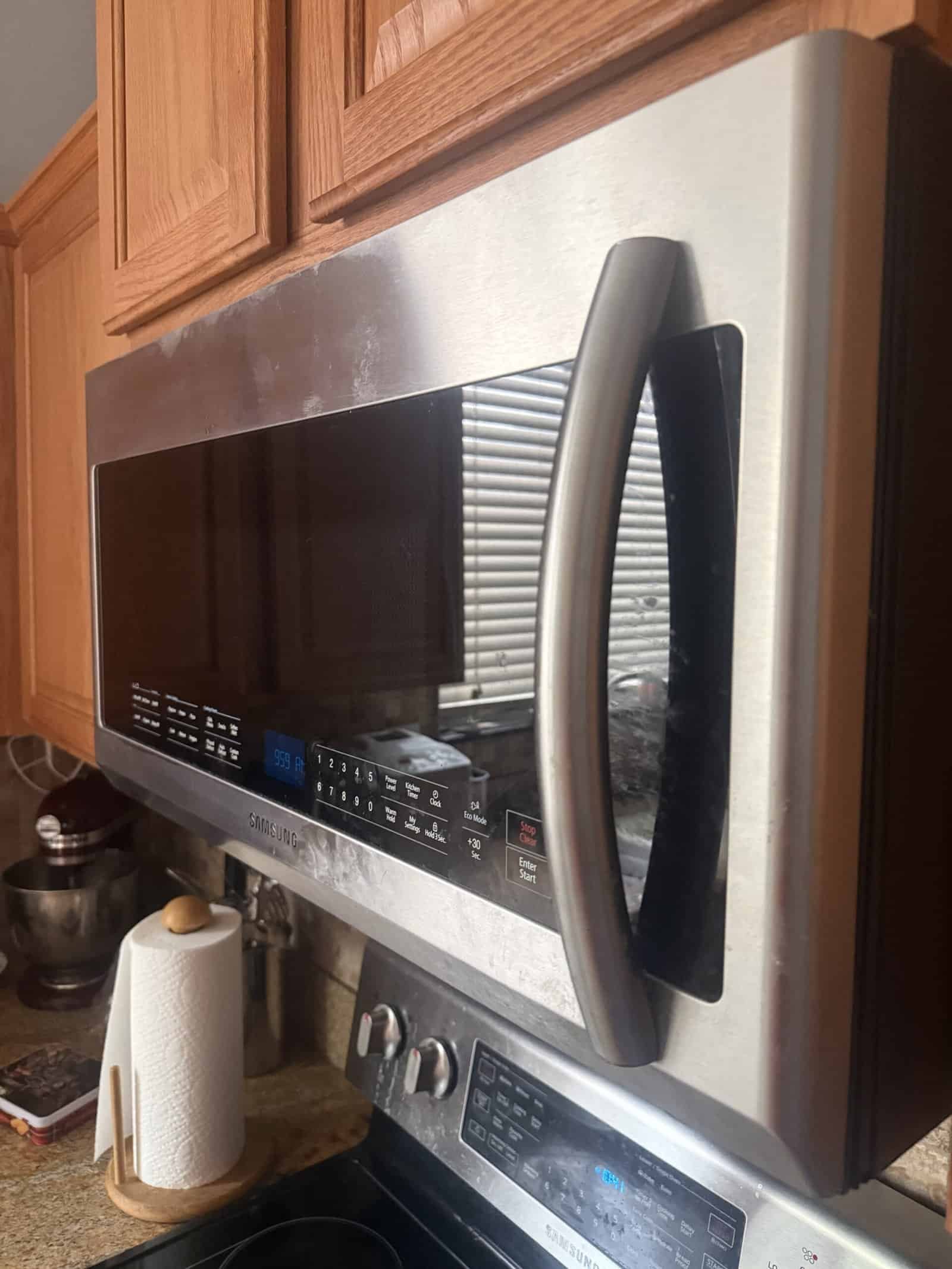
Pick an over-the-range microwave if your kitchen already has the cabinet opening and a vent run, and pick a countertop unit if you want it at a comfortable height, cheap to replace, and movable. The over-the-range vs countertop microwave decision is really a question about installation and ventilation, not about cooking. Both heat food the same way.
The split matters because one of these is a renovation and the other is a purchase. If you want model-by-model options rather than the format argument, our microwave ovens roundup covers those.
Quick Verdict
Over-the-range wins when counter space is scarce and the opening and ducting already exist. Countertop wins on price, on reach, on repair, and on the freedom to put it somewhere sensible. Renters and anyone replacing a dead unit on short notice should take the countertop.
Key Takeaways
- Over-the-range buys counter space and costs installation.
- Countertop costs counter space and buys flexibility.
- The over-the-range fan is usually recirculating, not vented outside.
- Reaching into a hot dish above shoulder height is the real ergonomic cost.
- Replacement is a swap on one and a job on the other.
How We Compared
We compared on the things that differ between the two formats rather than on wattage and turntable size, which vary by model in both camps. That means installation, ventilation, ergonomics, counter cost and replacement.
Cooking performance is deliberately absent. A countertop unit and an over-the-range unit at the same wattage heat food the same way, so judging the formats on heating would be judging them on nothing.
Over-the-Range and Countertop at a Glance
| Factor | Over-the-range | Countertop |
|---|---|---|
| Counter footprint | None | Significant |
| Install | Mounted to cabinets, wall bracket, dedicated outlet | Plug it in |
| Typical price | Higher, plus install | Lower |
| Ventilation | Built-in fan, usually recirculating | None |
| Door height | Above the cooktop | At counter level |
| Replacement | Removal and remount | Unplug and carry |
| Suits renters | No | Yes |
| Doubles as | Range hood and cooktop light | Nothing |
Over-the-Range Microwaves, Pros and Cons
- Frees the counter completely, which is the whole reason the format exists.
- Adds a fan and a cooktop light in the same unit.
- Looks built in and lines up with the cabinet run.
- Needs a cabinet opening, a mounting plate and an outlet above.
- Puts the door and a hot dish above the cooktop.
- Costs more up front and more again to replace.
This suits owners with the opening already there, small kitchens where the counter is the scarce resource, and anyone who wants the cooktop lit and vented without a separate hood. Skip it if you rent, if you are short, or if a dead microwave needs replacing this week.
Countertop Microwaves, Pros and Cons
- Cheapest route into the category by a wide margin.
- No installation, no tools, no landlord conversation.
- Door sits at counter height, which is safer with a full dish.
- Moves with you and can be relocated to a cart or a shelf.
- Eats the counter space you were going to use for prep.
- Does nothing for cooktop ventilation or lighting.
This suits renters, tight budgets, households where somebody short uses it daily, and anyone who would rather solve ventilation with a proper hood. Skip it if the counter is already full and you have nowhere else to put it.
Which costs less to get working?
Countertop wins, and not narrowly. A countertop unit costs less at the shelf and nothing to install, while an over-the-range unit carries a higher sticker price plus mounting hardware and usually an installer.
The gap closes only in one case: when the cabinet opening, bracket and outlet already exist from a previous unit. Then an over-the-range swap is closer to a straightforward purchase, though it is still a two-person lift with a template to line up.
If the opening does not exist, you are paying for cabinet modification and electrical work on top of the appliance. That is a renovation, and it should be priced as one.
Which is easier to live with day to day?
Countertop wins again, mostly on height. Pulling a full bowl of soup out at chest or eye level is the one genuine safety complaint about the over-the-range format, and it does not improve with familiarity.
Over-the-range wins on the counter, which is the trade people accept it for. In a kitchen where the working stretch between the sink and the stove is the scarce thing, taking a large appliance off the counter is worth a lot.
Cleaning splits oddly. An over-the-range unit collects cooking grease on its underside and its filter, which is a job a countertop unit never creates. Our guide to cleaning a microwave covers the inside of either one.
Which actually handles ventilation?
Over-the-range wins by default, because the countertop format offers nothing here. The caveat is large enough to matter, though.
Most over-the-range installations recirculate rather than duct outside. Air passes through a charcoal filter and returns to the kitchen, which handles smell and does little for steam and grease.
If ventilation is the actual problem you are solving, a range hood ducted outside outperforms any microwave fan. Choosing over-the-range for its fan and then discovering it recirculates is the most common disappointment with the format.
Which is easier to replace when it dies?
Countertop wins, decisively. You unplug the old one, carry it out, and put the new one down, which is a same-day fix.
An over-the-range failure is a different event. The unit comes off a wall bracket at head height, the new one has to match the opening width and the mounting pattern, and the kitchen loses its fan and cooktop light until the swap happens. Our note on how long microwaves last is worth reading before committing to the format.
Which Fits Your Situation
| If this is you | Better choice |
|---|---|
| You rent | Countertop |
| The cabinet opening and outlet already exist | Over-the-range |
| Counter space is your binding constraint | Over-the-range |
| Somebody short uses it every day | Countertop |
| You need a working microwave this week | Countertop |
| You cook on the stove often and want real venting | Range hood, plus a countertop unit |
| You use a microwave rarely | Countertop, the smallest one that fits your plates |
| You are remodeling the kitchen anyway | Over-the-range |
What Mine Is, and How Little I Use It
Mine is an over-the-range unit, mounted to the cabinets. I did not buy it and I do not know how old it is, and nothing has ever gone wrong with it.
I use it mostly for popcorn, about once a month, which is not often at all. Leftovers go in my air fryer combo oven instead of the microwave, which is where almost all of the reheating happens.
For cleaning, I wipe it out with paper towels and Clorox wipes. At that usage level, the format’s downsides have never cost me anything, and neither have its upsides.
Here is the honest boundary. The over-the-range half of this comparison comes from living with one, and the countertop column comes from documented product characteristics rather than from my own use. What it does show is that a light microwave user gets very little from the expensive format.
How to Choose Between Them
Start with whether the opening exists. If it does not, the over-the-range option is a renovation decision that happens to involve a microwave, and it should wait for the renovation.
Then be honest about how much you use one. Heavy daily users benefit from reach and easy replacement, which points to the counter. Light users are paying installation for an appliance they open occasionally.
Last, check whether a different appliance is the real answer. Plenty of people reaching for a bigger microwave actually want an air fryer that replaces a microwave, and plenty of people short on counter want somewhere to put the appliances they already own.
The Verdict
Over-the-range wins on counter space and on having a fan and light built in. Countertop wins on price, reach, replacement and flexibility, which is three of the five factors that actually separate the formats.
Owners with an existing opening who are short on counter should take the over-the-range. Everyone else, and renters without exception, should take the countertop and spend the difference on a countertop appliance that earns its footprint.
Recommended Reading
- Under-cabinet lighting, if the cooktop light is what you are really after
- Why a microwave heats unevenly, which affects both equally
- Microwaving plastic containers and putting metal in a microwave
- Popcorn makers, if that is most of what yours does
Common Misconceptions
That over-the-range means vented outside
Most are set up to recirculate through a filter. Check whether your cabinet run has a duct before buying one for its fan.
That over-the-range units cook better
They do not. At the same wattage, both formats heat food identically, and the built-in look is doing the persuading.
That installation is a weekend job
Mounting one involves a wall bracket, a cabinet template, a two-person lift and an outlet in the cabinet above. A fresh install without those is a cabinet and electrical project.
That a bigger microwave solves a reheating problem
If the complaint is that leftovers come out soft, capacity will not fix it. That is a moisture problem, and hot moving air is what addresses it.
Over-the-Range vs Countertop Microwave FAQ
Is an over-the-range or countertop microwave better
Over-the-range is better when the opening exists and counter space is tight. Countertop is better on price, height, replacement and flexibility. Neither cooks better than the other at the same wattage.
Can I put a countertop microwave where an over-the-range one was
Not in the opening itself, since countertop units need clearance on the sides and back for airflow and are not built to mount. The usual fix is a shelf or cart elsewhere, plus a range hood or an open cabinet where the old unit sat.
Do over-the-range microwaves work as a range hood
Partially. The fan handles smells reasonably well and struggles with steam and grease, especially in recirculating setups. For serious stovetop cooking, a ducted hood does a job the microwave fan cannot.
Is an over-the-range microwave dangerous to reach into
It is the format’s main ergonomic weakness. Lifting a full hot dish from above shoulder height over a cooktop is awkward, and it is a genuine reason to choose a countertop unit for shorter households.
Which lasts longer
Lifespan tracks build quality and usage rather than format. The practical difference is what happens at the end: a countertop unit is replaced the same day, while an over-the-range unit needs removal, a size match and a remount.
Can renters install an over-the-range microwave
Generally not without permission, because it means mounting to cabinets and often cabinet modification. If the apartment came with one, replacing it is a landlord matter rather than a tenant purchase.
Does an over-the-range microwave add value to a kitchen
It reads as built in, which helps a kitchen look finished. The counter it frees is the more concrete benefit, and in a small kitchen that stretch of counter is worth more day to day than the appearance is.
